
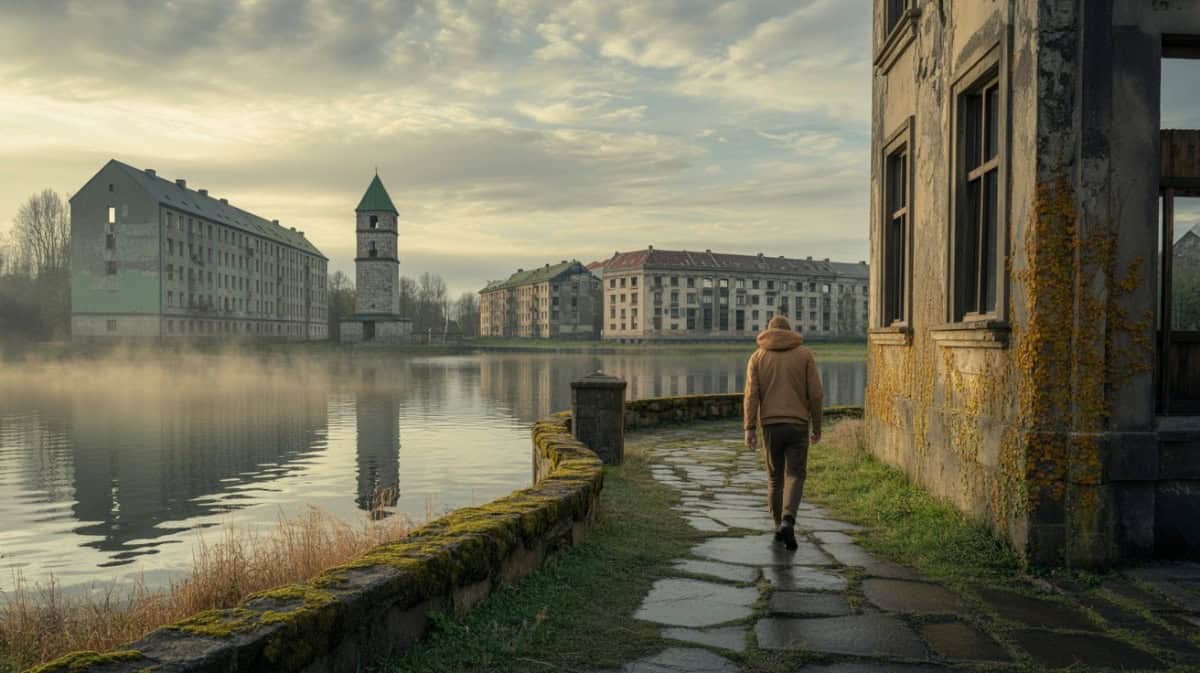
Image generated with Ai
Pripyat is becoming a leading example in Europe’s new phenomenon of phantom tourism, where people discover lost cities to experience extraordinary travel adventures that are not typical of other destinations. In addition, these forgotten cities are now becoming extraordinary journeys where history, mystery, and human elements meet each other. Phantom tourism is becoming a new phenomenon, which proves that the abandoned cities can be transformed into attractions while keeping the history intact. The transformation of Pripyat exemplifies how Europe is discovering its fascination for lost cities, where travelers find extraordinary travel adventures shaped by the elements of resilience, tragedy, and heritage.
The appeal of phantom itineraries comes from their ability to connect travellers with places where ordinary life suddenly stopped. These destinations allow visitors to see abandoned apartment blocks, empty streets, forgotten buildings and landscapes transformed by history.
Advertisement
The strongest examples are not simply old ruins. They are places where human life once existed in a visible way. A city evacuated after a disaster, a village hidden beneath water, or a wartime settlement preserved as evidence creates a strong emotional connection for visitors.
Research shows that Europe’s abandoned destinations are becoming increasingly managed tourism experiences. Governments and cultural institutions are investing in preservation, visitor control and digital interpretation rather than rebuilding these locations into modern settlements.
Advertisement
Advertisement
These destinations offer travellers something different. They provide a journey into lost worlds where history, memory and imagination meet.
Pripyat in Ukraine remains one of Europe’s most recognised examples of an abandoned urban destination. Built as a Soviet city connected with the Chornobyl nuclear complex, it was evacuated after the 1986 nuclear disaster.
Before the full-scale war, Ukraine worked to develop controlled tourism around the Chornobyl exclusion zone. Government plans focused on improving visitor routes, checkpoints, electronic systems and international promotion of the area.
However, Pripyat is not an ordinary tourist attraction. It remains part of a specially regulated radioactive zone. As of August 2026, official confirmation of normal public tourism access could not be verified. The city’s current visitor status remains unspecified.
The city continues to attract global attention because it represents a frozen moment in time. Empty schools, abandoned homes and silent streets tell a powerful story about technology, disaster and human resilience.
In Norway’s Svalbard region, Pyramiden presents another unique example of phantom tourism. The former Soviet mining settlement was abandoned as a mining community in 1998 but remains remarkably preserved.
Unlike many abandoned locations, Pyramiden still contains buildings, public spaces and signs of its former Soviet identity. Travellers visit to experience its unusual Arctic atmosphere and explore a settlement where time appears to have stopped.
However, tourism around Pyramiden has become influenced by international politics. Visit Svalbard removed ordinary tourism products connected with Russian state-owned companies following Russia’s invasion of Ukraine. The move affected official tourism promotion but did not create a general legal ban on visiting the settlement.
The destination shows how abandoned places can become connected with wider geopolitical changes. Heritage tourism is no longer only about history. It can also reflect modern international relationships.
Not every phantom destination is created by abandonment alone. Some are preserved because they carry important historical memories.
Oradour-sur-Glane in France is one of Europe’s strongest examples. The village was destroyed by Waffen-SS forces on 10 June 1944, and its ruins were preserved as a national memorial site. The French state protects the remains as historical evidence rather than restoring the village into a functioning community.
The site receives nearly 300,000 visitors annually and requires continuous maintenance to prevent the ruins from disappearing. The preservation approach shows that abandoned places need active protection, even when the goal is to maintain their damaged appearance.
In Spain, Belchite Viejo represents another model. The old town was destroyed during the Spanish Civil War and later protected as a historic site. Visitors can only explore through controlled tours, while rules limit drones and professional filming.
Both destinations show that phantom tourism is not simply about curiosity. It is also about education, remembrance and responsible travel.
Some of Europe’s most unusual phantom destinations are places that disappeared beneath water.
At Lake Resia in Italy, the old village of Curon vanished after the creation of a reservoir in 1950. Today, only the famous church tower remains above the water, creating one of Europe’s most recognisable travel images. South Tyrol’s tourism system promotes the lake, landscape and history of the lost settlement.
Portugal’s Vilarinho da Furna offers another extraordinary experience. The village has remained underwater since 1971 after reservoir construction. However, during low water periods, old roads, walls and houses appear again. The municipality promotes the site as part of its cultural heritage and memory tourism.
These destinations demonstrate how tourism can transform disappearance itself into an experience. The absence of a village becomes the reason travellers arrive.
The future of phantom tourism is not limited to physical travel. Digital technology is creating new ways to experience places that are damaged, inaccessible or completely changed.
The Warsaw Rising Museum’s “City of Ruins” digitally reconstructs Warsaw after the destruction of the Second World War. The project allows visitors to experience a vanished city through a three-dimensional journey and has reached nearly two million viewers since its launch.
European cultural institutions are also using three-dimensional models to protect heritage. Digital reconstruction can provide access to restricted areas, record fragile structures and help future conservation work.
This creates a new type of travel experience. Visitors may soon combine physical visits with digital journeys, exploring both the present remains and the lost versions of historic places.
Phantom itineraries being more numerous than ever before prove that tourists want to see more locations with more history now. But for the authorities, the task still remains rather difficult since the fame that keeps some of the ruins standing can, on occasion, damage them.
Limited access seems to be the dominant tendency in Europe. The ruins are protected with the help of guided tours, fences, security measures, and virtual tours.
Therefore, forgotten cities of Europe are not only a unique sightseeing destination but also a lesson about memories, destruction, survival, and fragile relationship between humans and their past environment.
Advertisement
Advertisement
Advertisement













Friday, September 4, 2026

Friday, September 4, 2026

Friday, September 4, 2026

Friday, September 4, 2026

Thursday, September 3, 2026

Wednesday, September 2, 2026

Friday, September 4, 2026

Friday, September 4, 2026


