
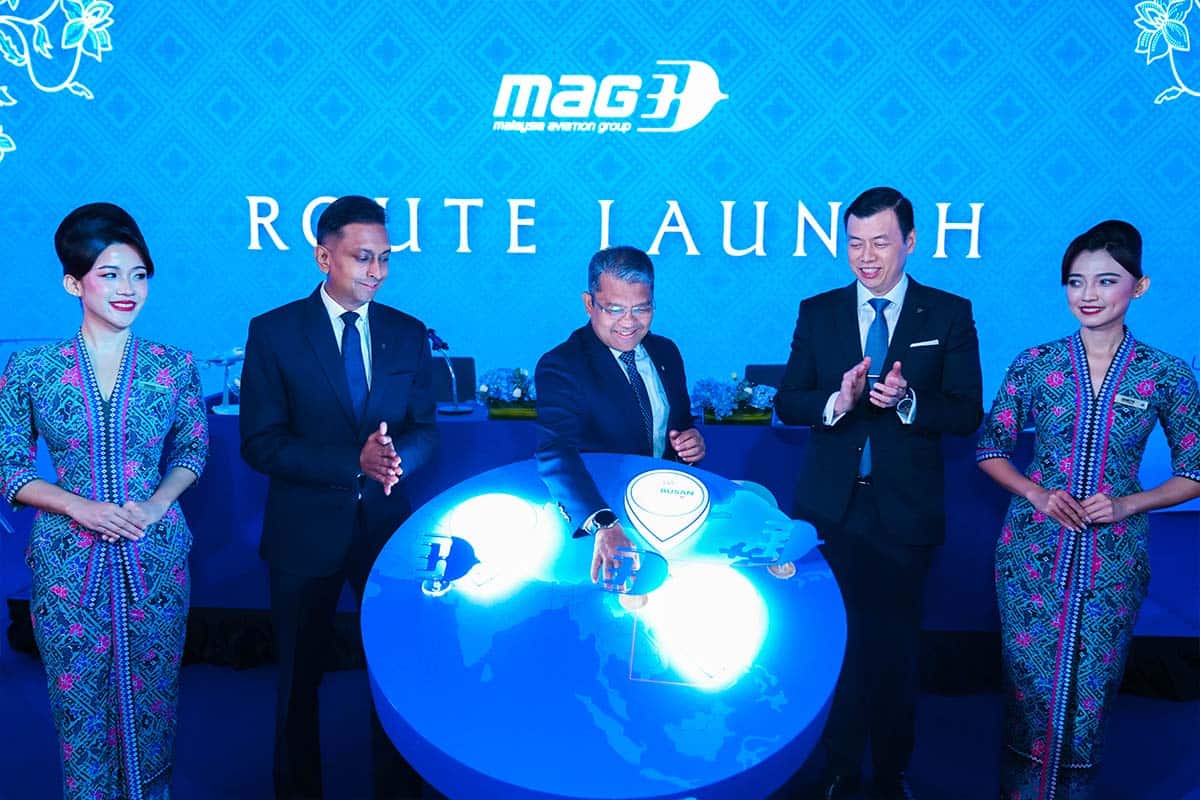
Image generated with Ai
Malaysia Airlines is making a significant regional push, bringing back Busan flights while increasing services to Brisbane, Fukuoka and Surabaya. At the same time, Firefly is preparing to enter China with direct Kunming services. The moves give travellers more choice and reinforce Kuala Lumpur’s role as a regional aviation hub.
But the expansion is not limited to flight schedules. Malaysia Aviation Group is also investing in a new in-flight catering facility near KLIA. The project is designed to nearly double meal-handling capacity and support future airline growth. Together, these developments show how MAG is combining network expansion with investment in the passenger experience.
Advertisement
Malaysia Aviation Group (MAG) is expanding its regional aviation footprint with a combination of new routes, returning services, additional frequencies and a major investment in in-flight catering infrastructure.
The developments form part of MAG’s Long-Term Business Plan 3.0 (LTBP3.0), with the group taking a measured approach to growth while responding to demand across important Asian and regional markets.
Advertisement
Advertisement
A major highlight is Malaysia Airlines’ return to Busan, South Korea, from 2 December 2026.
The airline will operate four weekly Kuala Lumpur-Busan services using Boeing 737-8 aircraft. The route will operate on Tuesdays, Wednesdays, Saturdays and Sundays.
Malaysia Airlines last served Busan between 1996 and 1998. Its return will complement the carrier’s existing Kuala Lumpur-Seoul connectivity and provide another direct option for travellers heading to South Korea.
The airline is expected to be the only carrier providing non-stop Kuala Lumpur-Busan connectivity when the service resumes.
Malaysia Airlines is also exploring another destination in South Asia, indicating that further network development could follow as demand evolves.
Firefly is also widening MAG’s international network by preparing to launch direct services to Kunming in southwest China.
The carrier will operate the route with Boeing 737-800 aircraft. Further details, including the launch date and ticket-sale information, are expected to be announced later.
Kunming, known as China’s “Spring City”, offers access to Yunnan’s landscapes, cultural attractions and food traditions. The new service could therefore provide an additional gateway between Malaysia and southwest China.
MAG is simultaneously adding capacity on established routes.
Malaysia Airlines will increase Kuala Lumpur-Brisbane services from six flights per week to daily operations from 25 October 2026. The airline plans to deploy its new-generation Airbus A330neo on the route.
Fukuoka services will rise from five weekly flights to daily from 1 December 2026. The route resumed on 2 September 2026, and Malaysia Airlines remains the only carrier operating non-stop Kuala Lumpur-Fukuoka flights.
Surabaya will also receive additional capacity. From 1 November 2026, Malaysia Airlines will increase flights from 14 to 16 per week, strengthening access between Kuala Lumpur and East Java.
The combined changes give MAG greater capacity across destinations where demand is already established rather than relying solely on entirely new markets.
Behind the network expansion, MAG is also investing in the infrastructure needed to support its airlines.
MAG Culinary Solutions (MAGCS) is developing its own in-flight catering facility near KLIA. Groundworks began in July 2026, with completion targeted for the fourth quarter of 2028 and operations expected to start in the second quarter of 2029.
The facility is expected to produce about 50,000 meals a day, almost twice MAGCS’ current handling capacity. It is intended to serve Malaysia Airlines and potentially third-party carriers while creating employment and new commercial opportunities.
The investment follows the insourcing of Malaysia Airlines’ catering operations in 2023 and the creation of MAGCS in September 2025.
MAG said customer satisfaction with in-flight dining has increased from 72% to 78%, while catering on-time performance has reached 99.9%.
MAGCS has also secured the required Civil Aviation Authority of Malaysia (CAAM) Ground Handling Licence and Technical Approval Certificate, alongside an interim Manufacturing Licence from the Malaysian Investment Development Authority (MIDA).
Malaysia Airlines is also progressively introducing new products for younger passengers. From 1 September 2026, children can receive products including the Malaysian Safari Activity Pack, Kids Headphones and Baby Blankets, with offerings designed around different ages and flight durations.
The wider strategy is clear: expand connectivity while improving the experience on board.
The network changes also support Malaysia’s Visit Malaysia 2026 campaign and MAG’s ambition to position Malaysia Airlines among the world’s Top 10 global airlines by 2030.
For travellers, the immediate impact is greater choice. For MAG, the combination of additional capacity, new markets and stronger operational infrastructure provides a broader platform for future growth
MAG’s latest expansion is driven by a straightforward combination of rising demand, network strategy and operational investment. The answer is to add capacity where established markets can support more flights, reconnect previously served destinations and enter new markets through Firefly. The reason is equally important: sustainable airline growth requires more than additional routes. MAG needs the infrastructure, catering capability and passenger services to support a larger operation consistently. Busan restores an important South Korea link, while Kunming broadens access to China. Additional Brisbane, Fukuoka and Surabaya flights improve choice. Meanwhile, the new catering facility should strengthen efficiency, scalability and service quality as the network expands
Malaysia Aviation Group is entering the next phase of its growth strategy with a broader regional network and stronger operational foundations. Malaysia Airlines’ return to Busan creates another direct link between Kuala Lumpur and South Korea, while Firefly’s planned Kunming service extends MAG’s reach into southwest China. At the same time, additional frequencies to Brisbane, Fukuoka and Surabaya will give travellers greater flexibility on established routes.
The investment in MAG Culinary Solutions adds another important dimension. A new facility near KLIA, targeted for completion in Q4 2028, is expected to handle around 50,000 meals daily and support both MAG airlines and third-party carriers.
Taken together, the developments show MAG pursuing growth through several channels rather than relying on route expansion alone. Better connectivity, greater catering capacity and enhanced onboard products could strengthen Malaysia Airlines’ competitiveness while supporting Kuala Lumpur’s position as a regional aviation hub.
Captain Nasaruddin A. Bakar, President and Group Chief Executive Officer of MAG, said, “We are continuing to grow with purpose, strengthening our network where there is demand, reconnecting established markets and expanding into new ones, while investing in the capabilities that support our airlines and customers. As we strengthen Kuala Lumpur’s role as a regional aviation hub, it is equally important that we continue to enhance the experience we offer from the moment our customers step onboard. The continued development of MAG Culinary Solutions will support this by enabling us to deliver a more consistent, high-quality in-flight dining experience as our network grows. Together, these investments strengthen MAG’s foundations, enhance our competitiveness and position the Group to capture future growth opportunities with greater scale and resilience.”
“Malaysia Aviation Group’s latest expansion sends a strong and positive signal for Malaysia’s aviation and tourism sectors. The return of Malaysia Airlines to Busan, Firefly’s planned entry into Kunming, and additional capacity to Brisbane, Fukuoka and Surabaya demonstrate a balanced approach to regional growth. Equally important is the investment in MAG Culinary Solutions, because reliable in-flight catering is fundamental to delivering a consistent passenger experience as an airline expands. The planned KLIA facility should provide greater scale, operational resilience and new commercial opportunities. These initiatives can strengthen Kuala Lumpur’s connectivity, support Visit Malaysia 2026 and create stronger links between Malaysia and key Asian markets. MAG is clearly building both its network and the infrastructure required to support sustainable long-term growth.”
Advertisement
Tags: Busan flights, Firefly Kunming, Kuala Lumpur flights, malaysia airlines, Malaysia Aviation Group
Advertisement
Advertisement













Friday, September 4, 2026

Friday, September 4, 2026

Friday, September 4, 2026

Thursday, September 3, 2026

Wednesday, September 2, 2026
Friday, September 4, 2026
Friday, September 4, 2026