
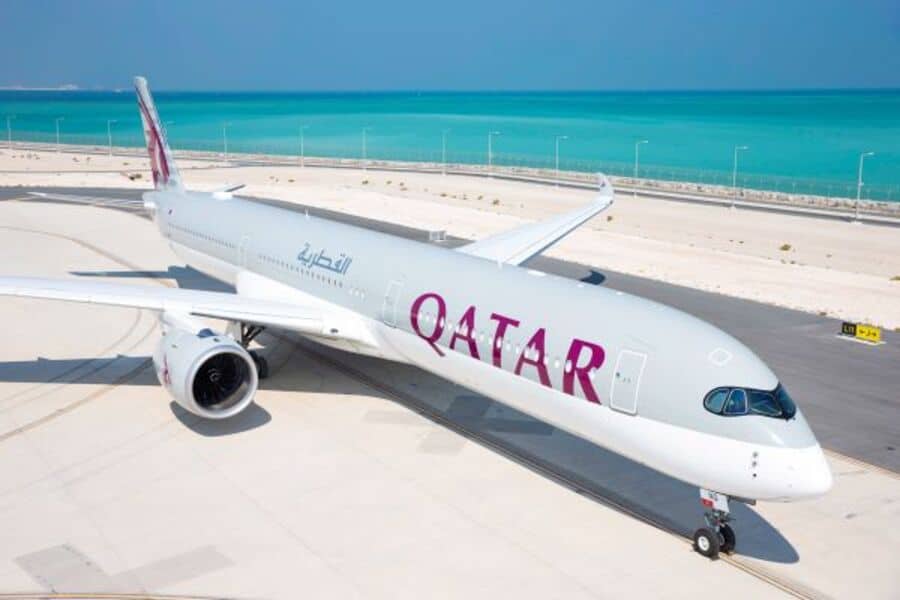
A broad Gulf aviation surge has been reflected in summer 2026, and Qatar has been placed at the center of it as Qatar Airways has been expanded to more than 160 international destinations from Doha, supported by 26 restored markets, more than 140 daily departures, and a stepped rise to five daily Dubai flights. The move has been framed by official Qatar sources as a restoration and growth drive, while the regional backdrop has been strengthened by official United Arab Emirates traffic and airline data, by Saudi Arabia growth in passengers routes and long term targets, and by Bahrain strategy cargo investment and operational resilience. The article tracks how network scale, frequency depth, industrial policy, route creation, and airport continuity have been advanced across the Gulf, and it explains why Qatar Airways has been positioned not as an isolated airline story but as part of a wider contest for travelers trade tourism and strategic aviation power. A category wise table also condenses the official developments, and the implications for connectivity are assessed in detail for the region and for Doha. 
A material change in the Qatar Airways network has been signaled by official bodies in Qatar rather than by market rumor. It has been stated by the Ministry of Foreign Affairs that Qatar Airways connects over 160 destinations worldwide to Doha, and the role of the national carrier in economic diversification and visitor access has thereby been reinforced. That broad figure has then been sharpened by the Qatar Civil Aviation Authority, where the summer 2026 push has been described as a move to over 160 gateways and a return to 26 destinations in key global markets. By official wording, the initiative has been tied to network restoration, not to a minor seasonal adjustment. The significance has therefore been made structural. What has been expanded is not only a flight map. A wider access platform for tourism, transfer traffic, and commercial reach has been reactivated from Doha.

The scale of the schedule has also been clarified through official aviation updates. In a separate authority note published in June 2026, the launch of the airline summer schedule was linked to more than 140 daily departures from Doha, showing that the importance of the expansion has not lain only in destination volume. It has also been expressed through frequency density, timing, and hub utility. A network becomes more powerful when additional destinations are not merely listed but are connected with enough daily rhythm to support smooth transfers between regions. That is why the summer 2026 program has been treated as more than a seasonal headline. By more departures, more wave connectivity can be supported, better schedule recovery can be enabled, and a broader choice of one stop routings can be created. In hub economics, that kind of density is often what allows a large map to be converted into a highly competitive platform. 
Specific route moves have further illustrated the pattern. It has been shown in official aviation listings in Qatar that service to Caracas and Bogota is to begin from 22 July 2026, while the return to Philadelphia is to take effect from 1 August 2026. In regional traffic, the service between Doha and Dubai has been expanded from the existing two daily flights to three daily flights first, followed by a fourth flight, and then by five daily flights from 1 July 2026. That progression has revealed how the expansion has been built on both long haul reach and short haul intensity. The airline network has therefore been widened in the Americas while simultaneously being thickened within the Gulf. Such a combination is usually associated with an effort in which both local demand and transfer demand are strengthened at the same time.
Advertisement
Advertisement

Another official point can explain the strategic weight of the expansion. Qatar has been described by the Ministry of Foreign Affairs as sitting at the crossroads of East and West, roughly six to seven hours from many major population centers and hubs. Set beside the network count, that geography strengthens the Doha model. By added frequency and reach, transfer traffic between Europe, Asia, Africa, and the Americas can be deepened.
This expansion has also been made more notable by the operating environment in which it has been advanced. In March 2026, it was said by the Qatar Civil Aviation Authority that the air transport sector remained under full operational control despite heightened regional tensions. When that assurance is read together with the June network announcements, the broader picture becomes clearer. By Qatar, routine scheduling has not simply been resumed. A larger competitive posture has been reasserted after a period in which operational continuity itself had to be defended. That matters for strategic interpretation. A carrier can restore routes after calm conditions return, but a more meaningful signal is sent when network depth, new points, and extra frequency are all placed into the market soon after resilience has been publicly affirmed. That is how the Qatar Airways summer program has come to stand out.
The argument that Qatar has joined a wider Gulf aviation climb is strengthened by what has been officially reported from the United Arab Emirates. In November 2025, it was reported by the UAE Cabinet in its review of civil aviation achievements for 2024 that the sector had contributed AED 340 billion, or 18.2 percent of national GDP, while the country airports handled about 148 million passengers through more than one million air traffic operations. Those figures matter because a regional surge cannot be credibly identified unless surrounding systems are also moved upward at scale. In the UAE, scale has clearly been present. The aviation economy has been shown not merely as an airline story but as a national growth engine touching infrastructure, tourism, logistics, and macroeconomic output.
At the airline level, record performance has also been shown through official Dubai government material. It was shown by the Dubai government media office that the Emirates Group achieved record results in the 2025 to 2026 financial year, including record revenue, record profit before tax, and record cash assets, while Emirates was identified as the most profitable airline in the world for that reporting period. In parallel, it was reported by flydubai through the same official government channel that its network had been expanded to 140 destinations in 58 countries, with nine new destinations added in 2025 and a peak day of more than 400 departures during December travel periods. By the same official update, connectivity across a joint network of 243 destinations in 103 countries via Dubai was enabled by the strategic partnership between Emirates and flydubai.
When those official data points are set beside the Qatar Airways summer 2026 announcement, a distinct regional pattern is revealed. Across the UAE, large scale passenger throughput, record airline profitability, route growth, and partnership expansion have been recorded together. That means the competitive context facing Qatar has been unusually intense. The Qatar Airways summer network therefore should be understood as a response to a neighboring system in which traffic mass, airline capital strength, and network breadth have all been reinforced by official performance data. In other words, the Qatar move has been made inside a marketplace where no Gulf leader has been left standing still.
An even more explicit official surge has been documented in Saudi Arabia. It was reported by the General Authority of Civil Aviation in January 2026 that the civil aviation sector achieved exceptional growth in 2025, with passenger numbers exceeding 140 million, an increase of about 9 percent, while international destinations rose to 176. In the same official announcement, it was said that three of the world busiest air routes were being maintained by the Kingdom. Those figures are highly relevant to the Qatar Airways story because they show that one of the largest neighboring aviation systems has been scaling up in both volume and connectivity. A regional growth wave is much easier to identify when official traffic and destination counts of that magnitude have been placed on record.
Key parts of the 2026 plan were also outlined by the regulator, and modest scope was not suggested by them. Airport development and capacity increases were highlighted, and the launch of more than 30 new routes was announced as a priority for the year ahead. In a separate 2026 official statement, Saudi national aviation targets were linked to 330 million annual passengers, more than 250 destinations worldwide, and 4.5 million tons of air cargo capacity under the broader strategy connected to national transformation goals. By that, an aviation project of exceptional scale has been signaled. What has been pursued in Saudi Arabia has not been limited to current performance. A much larger future footprint has also been formally mapped.
Because of that, the Qatar Airways summer 2026 build has gained additional meaning. It has been developed in the shadow of a neighboring market where passenger volume is larger, destination ambitions are rising quickly, and route creation has been programmed at national level. Yet a different structure has been chosen by Qatar. Rather than volume first, emphasis has been placed on frequency, transfer connectivity, and route restoration through a tightly coordinated hub in Doha. That distinction is important. By Saudi Arabia, outward scale and future targets have been pushed, while by Qatar, network precision, route recovery, and fast access across continents have been emphasized. Both models have contributed to the same regional surge, but they have been executed in visibly different ways.
The inclusion of Bahrain in the wider aviation acceleration is also supported by official government material, although the form has been somewhat different. It has been stated by the Ministry of Transportation and Telecommunications that the National Aviation Strategy 2026 to 2027 aspires to position Bahrain as a leading regional and global center of excellence in aviation. On the ministry linked government platform for flight permissions and scheduling, strategic objectives for civil aviation have included the development of infrastructure, the enhancement of Bahrain position as a regional air cargo hub, and the establishment of new destinations together with the attraction of new airlines.
What is seen here is not simply current traffic growth. A state level framework for aviation expansion has been laid down. That strategic direction has already been reinforced by project activity.
In November 2025, it was reported by the Bahrain News Agency that Bahrain Airport Company and DHL Express signed a letter of intent to establish an aircraft maintenance repair and overhaul facility at Bahrain International Airport. The project was described by the transport minister as a major step in the development of the aviation sector, while its significance for a regional cargo role and service center status was also stressed in the same official report. That matters because aviation surges are not driven only by passenger routes. They are also driven by industrial depth, cargo support, maintenance capability, and the ability to attract high value service investment around airport infrastructure.
Operational resilience has meanwhile been highlighted in 2026 government communications. In ministry material published in April 2026, reference was made to the resumption of airport operations and the departure of the first Gulf Air flight after disruption, indicating that continuity and restoration remained central policy concerns. When that resilience is read alongside the new strategy and the MRO investment, the Bahrain position becomes clearer. An aviation proposition has been built around regulation, continuity, cargo capacity, and selective expansion rather than sheer market size. That is why Bahrain still belongs in the same regional story. The surge has not been identical across the Gulf, but it has been unmistakably shared.
The comparison also shows that the Gulf surge has not been uniform. By Qatar, network optimization has been emphasized. By the UAE, established mass and profitable airline balance sheets have been leaned on. By Saudi Arabia, target led expansion has been accelerated. By Bahrain, strategy and ecosystem building have been advanced. By those different pathways, regional competition has been intensified.
The table below is used to condense the official developments into comparable categories. It shows that the headline on Qatar Airways and summer 2026 has been only one part of a broader Gulf pattern. In every market reviewed, expansion has been supported by official institutions, and the instruments of growth have varied. In Qatar, the lever has been route restoration and scheduling depth. In the UAE, it has been traffic scale and airline profitability. In Saudi Arabia, it has been national route creation and volume ambition. In Bahrain, it has been strategy, cargo, and operating resilience. The forms have differed, but the direction has been the same. Category Qatar United Arab Emirates Saudi Arabia Bahrain Network expansion Qatar Airways was moved to over 160 destinations, with 26 restored markets, new Americas links, and higher Dubai frequency flydubai was expanded to 140 destinations, while the joint Emirates and flydubai network reached 243 destinations in 103 countries International destinations were increased to 176, with more than 30 new routes planned for 2026 A strategy for new destinations and new airlines was formally launched Traffic scale More than 140 daily departures from Doha were linked to the summer schedule 148 million passengers and more than one million operations were reported at national level 140 million passengers were reported for 2025 Traffic statistics were said by government to be published monthly and annually, while the current emphasis in reviewed material was policy driven Strategic model Hub restoration, frequency density, premium transfer connectivity Large traffic base, record airline profitability, broad partnership reach Scale expansion, airport development, route creation, national transformation targets Regulatory positioning, cargo growth, infrastructure development, airline attraction Industrial and resilience signal Full operational control was officially maintained despite regional tension Record airline earnings and continued aviation momentum were officially reported Global investment and logistics targets were embedded in the aviation program MRO investment and airport operations resumption were officially highlighted
For travelers, the importance of the Qatar Airways expansion lies in optionality and flow. When more than 160 destinations are linked through Doha and when more than 140 daily departures are placed into the hub structure, greater itinerary flexibility is usually produced. Shorter connection windows can be supported, more city pairs can be welded into one stop journeys, and irregular operations can be managed with more recovery options. Those benefits are not always visible in a destination count alone, which is why the official QCAA reference to departure density is so revealing. The value of the Qatar move has not been contained in size only. It has also been contained in how efficiently the network can be used by passengers moving between continents.
For tourism and trade, the implications are similarly large. The official Qatar tourism profile has linked the national carrier directly with economic diversification, and that linkage is easy to understand. More destinations mean more feeder markets for leisure traffic, events, and stopovers. More frequency means more reliability for meetings, high value services, and cargo linked movement. When that formula is placed against official developments in the UAE, Saudi Arabia, and Bahrain, a common Gulf logic can be seen. Aviation has been treated as a gateway sector through which tourism receipts, business mobility, and logistics value can all be multiplied. That is why route maps have carried significance far beyond airline marketing.
For the regional competitive map, the main conclusion is sharper. A new stage of Gulf hub competition has been entered. By Qatar, premium connectivity and schedule density have been reinforced. By the UAE, giant throughput and multi airline network breadth have been leveraged. By Saudi Arabia, outward scale has been accelerated with state level route ambitions and infrastructure plans. By Bahrain, an aviation proposition has been sharpened through policy, cargo, and technical services. None of these moves have been isolated. By each of them, extra pressure has been placed on the others to improve frequency, widen reach, deepen airport ecosystems, and defend strategic relevance. That competitive pressure helps to explain why the Qatar Airways summer announcement has carried regional importance rather than local importance alone.
The core conclusion is straightforward. Qatar Airways has not merely expanded a summer timetable. Through official Qatar channels, a network of over 160 destinations, 26 restored markets, stronger Americas coverage, more than 140 daily departures, and expanded Dubai frequency has been signaled as a serious competitive statement for summer 2026. That statement has been made more consequential because it has arrived during a period when official data from the UAE, Saudi Arabia, and Bahrain has also pointed toward aviation enlargement, higher ambition, stronger infrastructure, or greater route opportunity. The result has been a regional picture in which Qatar has clearly been moving with the tide, but has also been trying to shape it.
What has been seen, then, is not an isolated airline update but a regional realignment. Across the Gulf, aviation has been treated as economic infrastructure, tourism machinery, logistics architecture, and soft power all at once. Within that context, the Qatar Airways summer move has been placed exactly where it was designed to land. It has been inserted into a contest for global relevance in which every added destination, every restored route, every extra frequency, and every industrial aviation project has been made to count. By that measure, Qatar has indeed joined the United Arab Emirates, Saudi Arabia, and Bahrain in a powerful aviation upswing, and the official record has shown that the contest is still accelerating. That contest appears set to remain intense through the rest of 2026. Plainly.
Advertisement
Advertisement
Advertisement













Saturday, September 5, 2026

Friday, September 4, 2026

Saturday, September 5, 2026

Saturday, September 5, 2026

Saturday, September 5, 2026

Thursday, September 3, 2026

Saturday, September 5, 2026

Saturday, September 5, 2026


