
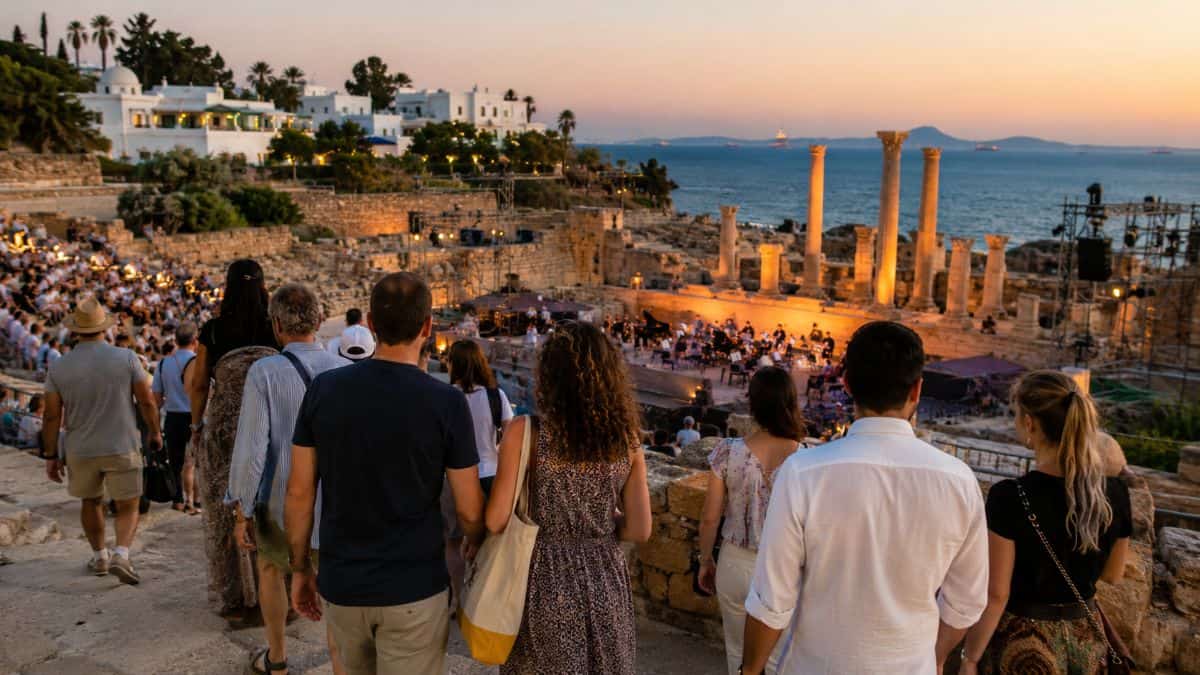
Image generated with Ai
Tunisia targets France, UK and more visitors as Carthage Festival expands heritage tourism across one of the Mediterranean’s strongest cultural destinations. The country already welcomes millions of foreign tourists, while France, the UK and other European markets remain important for hotel demand. Now, Tunisia targets France, UK and more visitors as Carthage Festival expands heritage tourism through live performances, UNESCO-listed archaeology and nearby coastal attractions. Therefore, travellers can combine festival nights with Carthage, Sidi Bou Said, La Marsa and Tunis. This wider experience helps Tunisia move beyond beach holidays and build stronger cultural, heritage and summer tourism appeal.
Tunisia recorded nearly 10.3 million foreign tourist arrivals and more than 27 million hotel overnight stays.
Europe remains the dominant international market. European travellers account for more than 64% of hotel overnight stays.
Major European source markets include:
Advertisement
Advertisement
These markets make an important contribution to Tunisia’s hotel activity and tourism revenues.
Domestic tourism is also becoming more important. Tunisian residents currently generate around 21% of total hotel overnight stays.
Regional and neighbouring travel remains significant as well, with local tourism accounting for a major share of arrivals across Tunisia’s borders.
Tunisia has developed a large tourism infrastructure to support its visitor economy.
Advertisement
Advertisement
The country currently has 696 tourist accommodation establishments with a combined capacity of around 230,000 beds.
The wider tourism network also includes:
This infrastructure gives Tunisia the capacity to serve beach travellers, cultural tourists, festival visitors, heritage travellers and organised groups.
The government is also working to improve the quality of existing accommodation.
Its Hotel Establishment Upgrading Program supports hotel modernisation and encourages the adoption of more sustainable operating standards.
Tunisia’s official tourism authority identifies July and August as the traditional period for the International Festival of Carthage.
For travellers interested in festival tourism, this creates a clear summer travel window.
Visitors can attend evening performances and use the daytime to explore archaeological sites, coastal areas and nearby cultural attractions.
This makes Carthage more than an event venue. It becomes part of a wider tourism itinerary.
Carthage has been recognised as a UNESCO World Heritage Site since 1979.
The ancient city was founded in the ninth century BC and later became one of the major commercial powers of the Mediterranean.
Its archaeological landscape contains remains from several historic periods, including Punic, Roman, Vandal, Paleochristian and Arab eras.
Important places within the archaeological area include:
These sites give festival visitors another reason to extend their stay.
Travellers attending the Carthage International Festival can also explore nearby Sidi Bou Said.
Tunisia’s official tourism portal promotes the destination for its blue-and-white architecture, hillside streets and Mediterranean views.
La Marsa and Gammarth add another layer to the same visitor experience.
These areas offer beaches, hotels, restaurants and coastal leisure. This allows travellers to combine culture, heritage and Mediterranean tourism within one trip.
The TGM suburban rail service connects Tunis, Carthage, Sidi Bou Said, La Marsa and La Goulette.
Tunis-Carthage International Airport is also located around 20 kilometres from the Gammarth hotel area.
Tunisia remains a major Mediterranean destination, but its tourism strategy is increasingly focused on diversification, competitiveness and sustainability.
Carthage fits naturally into this wider direction.
The festival combines international performances with archaeology, while nearby Sidi Bou Said, La Marsa and Gammarth add coastal travel, dining and accommodation.
This allows visitors to build a multi-day itinerary around several experiences rather than relying only on a conventional beach holiday.
The result is a tourism product that brings together festivals, UNESCO heritage, hotels, Mediterranean scenery, food, cultural experiences and summer travel.
That combination gives Tunisia a stronger opportunity to attract travellers seeking culture and heritage alongside its established resort offering.
Tunisia is targeting France, UK and more visitors because Carthage Festival adds a powerful cultural reason to travel beyond the country’s beaches. The festival connects live performances with UNESCO-listed Carthage, while nearby Sidi Bou Said, La Marsa and Tunis expand the visitor experience. France, the UK and other European markets already contribute strongly to Tunisia’s hotel activity. As Carthage Festival expands heritage tourism, travellers gain more reasons to stay longer, explore historic sites and combine culture with Mediterranean leisure. This mix supports Tunisia’s wider strategy to diversify tourism, strengthen hotels and attract visitors seeking deeper experiences.
Advertisement
Tags: Carthage Festival, Carthage tourism, France Travellers, Sidi Bou Said, Tunisia cultural tourism
Advertisement
Advertisement












Saturday, September 5, 2026

Saturday, September 5, 2026

Saturday, September 5, 2026

Saturday, September 5, 2026

Saturday, September 5, 2026
Saturday, September 5, 2026
Saturday, September 5, 2026

Saturday, September 5, 2026



