
Philippines Revives Catanduanes Maritime Access Through Tabaco After Luis, Launching Passenger and Vehicle Backlog Recovery Across the Bicol Ferry Network

Published
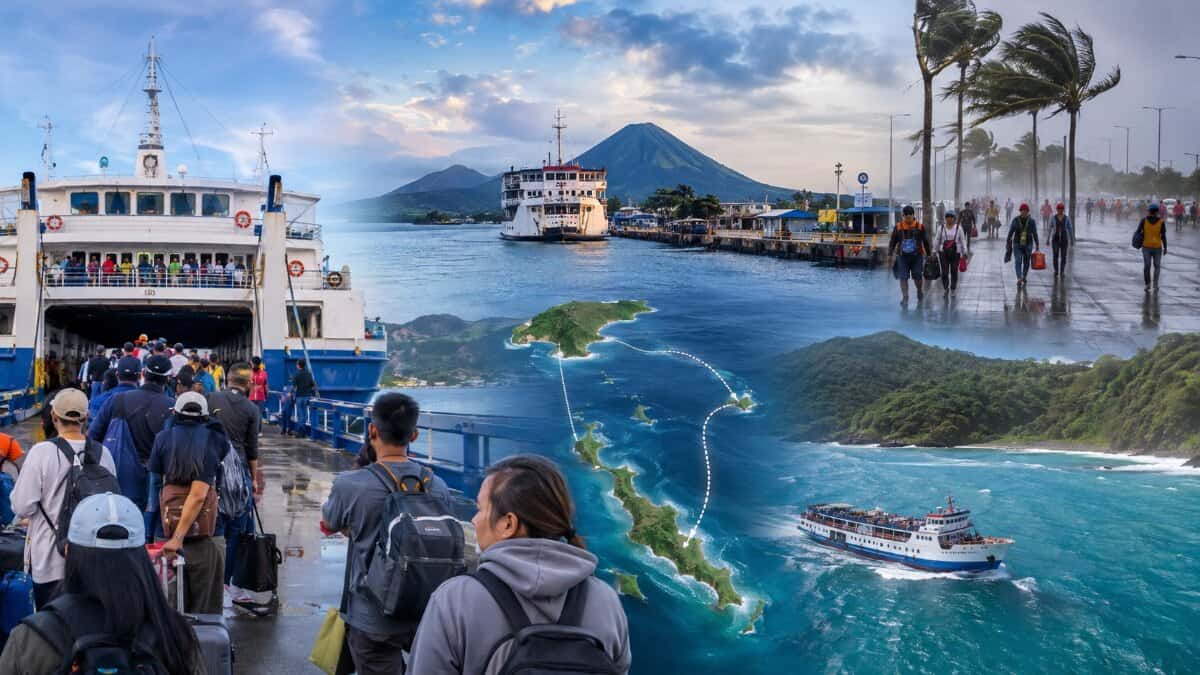
The Philippines reopened sea travel across Catanduanes, Camarines Sur and Camarines Norte on 3 August, but the trade-critical story on 4 August is passenger recovery rather than simple route restoration. Tabaco’s queue had reached 491 passengers, 45 rolling cargo units and five vessels during the final pre-clearance window. Travellers with cancelled tickets retain refund or revalidation rights under MARINA rules, while operators still control actual sailing times. PAGASA no longer listed an active tropical cyclone or gale warning, although local thunderstorms and last-minute maritime controls remained possible.
Philippines Ferry Recovery Moves Beyond the Reopening Announcement
Sea vessels and motorboats were permitted to resume operations across Catanduanes, Camarines Sur and Camarines Norte after tropical cyclone wind signals associated with Tropical Depression Luis were removed. According to the Philippine Information Agency, separate Philippine Coast Guard clearances allowed services to restart between late 2 August and the morning of 3 August. Tabaco Port subsequently returned to normal operating status.
Advertisement
Advertisement
The operational consequences did not disappear when the restriction ended. The official figures show how quickly a temporary maritime suspension can produce a concentrated recovery problem.
The government report recorded at least 356 passengers, truck drivers and cargo helpers stranded by Sunday afternoon, alongside 33 rolling cargo units. Philippine Coast Guard monitoring covering midnight to 4am on 3 August later recorded 491 people, 45 rolling cargo units and five vessels at Tabaco Port. The figures reflect different reporting windows rather than a confirmed contradiction. They indicate that the backlog was still accumulating close to the reopening period.
Advertisement
Advertisement
| Operational stage | Officially reported position | Significance for the travel trade |
|---|---|---|
| Sunday afternoon, 2 August | At least 356 passengers, drivers and helpers stranded; 33 rolling cargo units affected | Early evidence of a passenger and vehicle backlog |
| Midnight–4am, 3 August | 491 people, 45 rolling cargo units and five vessels recorded at Tabaco | Displaced demand remained concentrated immediately before recovery |
| Monday, 3 August | Sea travel resumed across Catanduanes, Camarines Sur and Camarines Norte | Regulatory clearance reopened the market |
| Tuesday, 4 August | No active tropical cyclone warning or gale warning listed by PAGASA | Lower regional weather risk, but not an unconditional sailing guarantee |
Sources: Philippine Information Agency, Philippine Coast Guard and PAGASA.
The Philippine Ports Authority also distinguishes between regulatory and commercial cancellations. A Coast Guard no-sail policy automatically prevents departure, while a shipping operator may separately cancel a voyage for operational reasons. Consequently, government clearance removes the legal weather restriction but does not oblige every listed ferry to depart immediately or at its original time.
Advertisement
Advertisement
Tabaco–San Andres and Tabaco–Virac Routes Face Different Recovery Conditions
The most important traveller corridors in the recovery are Tabaco–San Andres and Tabaco–Virac. Both connect mainland Albay with Catanduanes, but the availability of current primary-source scheduling information differs materially.
Regina Shipping Lines issued a specific recovery schedule for 3 August. It listed four departures from Tabaco to San Andres and four sailings in the opposite direction. This provided a clear first-day restoration plan, although it should not be treated as a permanent timetable for every subsequent date.
Advertisement
Advertisement
| Route | Operator or service evidence | Published recovery position | Booking implication on 4 August |
| Tabaco–San Andres | Regina Shipping Lines | Tabaco departures on 3 August at 6am, 8am, 10.30am and 1pm | Reconfirm the current departure before arranging land transfers |
| San Andres–Tabaco | Regina Shipping Lines | San Andres departures on 3 August at 6am, 8am, 1pm and 2pm | Allow for displaced passengers and rolling-cargo queues |
| Tabaco–Virac | Cardinal Silangan services were among the established corridor operations | General Coast Guard clearance covered the route, but no new 4 August operator timetable was located in the primary-source review | Avoid selling an unverified departure as confirmed |
| Tabaco–Virac | Santa Clara Shipping services, including MV Dawn Antonio, had been associated with the affected corridor | Regulatory clearance permits operation, subject to the company’s final sailing decision | Obtain direct operator confirmation before issuing connected arrangements |
The lack of a newly issued operator timetable should not be interpreted as proof that a route remains closed. It means only that a sufficiently current primary-source schedule could not be verified by publication time.
Why Tabaco City Matters More Than the Wider Camarines Label
Tabaco City is in Albay Province. It is not located in either Camarines Sur or Camarines Norte. This distinction matters because the principal Catanduanes ferry movements in the recovery use Tabaco as their mainland gateway. Legazpi is relevant as the nearby regional commercial centre used in wider Bicol itineraries, but Tabaco is the actual port city governing the immediate Catanduanes connection. Agents routing passengers through the Legazpi area should therefore treat the road transfer and ferry departure as separate operational components.
Camarines Sur and Camarines Norte remain part of the story because their respective maritime jurisdictions were included in the Coast Guard’s wider resumption. However, they should not be presented as the location of the Tabaco–Virac or Tabaco–San Andres services.
MARINA Passenger Rights Become the Central Rebooking Issue
The most important new information for affected travellers is contained in MARINA Circular No. 2018-07, which remains listed within the authority’s official circular framework. It defines minimum passenger rights for cancelled, delayed and uncompleted domestic voyages.
Advertisement
Advertisement
Under the circular, refund or ticket revalidation applies regardless of the nature or cause of a cancellation or delay, except where the passenger caused the problem. This provision is particularly important after weather disruption because force majeure does not automatically eliminate the basic choice between recovering the unused ticket value and transferring the journey.
| Passenger issue | MARINA entitlement | Practical consequence |
| Cancelled journey | Refund upon passenger request, processed within no more than seven calendar days under the stated cancellation provisions | Agents should document the request date and unused journey sector |
| Traveller still intends to sail | Ticket revalidation for the earliest available opportunity on the same route or an agreed alternative | A fresh full-fare purchase should not automatically be assumed |
| Recovery sailing has limited space | A displaced traveller should receive priority over walk-in customers under the applicable operator-attributable cancellation provisions | Booking desks should identify passengers from the cancelled departure |
| Original operator lacks capacity | Arrangements may be made on another operator serving the same route under the relevant conditions | Inter-operator recovery may be required where the rules apply |
| Refund calculation | No processing fee or similar cancellation-related deduction from the eligible untravelled portion | Agents should check that the refunded value matches the unused sector |
| Food, communication or lodging | Amenities can apply in qualifying cases, but force majeure and other listed exceptions may limit them | Weather cancellation does not guarantee hotel or meal reimbursement |
Sources: MARINA Circular No. 2018-07, Sections IV and VIII.
This distinction is crucial. Refund and revalidation protections are broader than the right to amenities. A weather event can restrict responsibility for accommodation, refreshments or compensation while the passenger’s refund or revalidation option remains protected.
Travel agents should also avoid stating that every affected ticket has already been automatically transferred. MARINA establishes an entitlement and an operator obligation, but the actual handling process may still require the passenger to present the ticket, identify the unused sector and select either refund or revalidation.
Current Weather Clearance Does Not Guarantee Every Departure
PAGASA’s 4 August severe-weather information showed Luis weakening into a low-pressure area, while its marine service displayed no active gale warning. This is a meaningful improvement from the conditions that triggered the suspension.
Nevertheless, the removal of a gale warning is not equivalent to a fixed operating guarantee. Local thunderstorms, port-specific decisions, vessel positioning, passenger loading, cargo clearance and safety assessments can still change a departure.
Advertisement
Advertisement
For itinerary design, the safest commercial approach is to verify three separate items: the Coast Guard clearance, the port’s operating condition and the shipping company’s final schedule. Confirmation from only one of those sources does not fully protect a connected booking.
Tabaco’s Passenger Volume Shows the Economic Cost of Short Closures
Preliminary Philippine Ports Authority statistics recorded 120,991 passenger movements at Tabaco in 2025, comprising 65,459 disembarking and 55,532 embarking passengers. The same statistical table records larger combined figures when other reporting classifications and movements are included, demonstrating the port’s continuing role in Bicol mobility.
This scale explains why even a relatively short weather suspension can affect hundreds of people. Island ferry disruption does not only interrupt leisure travel. It affects workers, family visits, goods movement, vehicle transport, accommodation arrivals and connections to wider Bicol itineraries.
According to the Philippine Statistics Authority, tourism generated PHP2.27 trillion in direct gross value added during 2025, representing 8.1 per cent of the national economy. Domestic tourism expenditure reached PHP3.26 trillion, while tourism industries supported an estimated 7.70 million jobs. Reliable domestic transport is therefore part of a much larger visitor-economy system rather than a peripheral local concern.
Recovery Speed Now Matters More Than Closure Duration
The deeper industry lesson is that disruption should be measured by recovery time, not only by the hours during which sailing was prohibited. A no-sail order can be lifted in a single advisory. Passenger demand cannot be cleared as quickly. Travellers from cancelled departures compete with customers holding reservations for the first normal operating day. Rolling cargo occupies finite vessel capacity. Delayed vehicles can slow terminal processing. Revalidated passengers may also need priority over new walk-in demand.
For tour operators, this turns ferry inventory into constrained recovery capacity. A service shown as operating may still be commercially unsuitable for an itinerary containing a same-day hotel arrival, flight, coach departure or organised excursion. The most resilient packages will separate the sea crossing from time-critical onward components. They will also include flexible accommodation, clear disruption wording and a documented process for claiming revalidation. This is especially important for international visitors who may be unfamiliar with local port procedures and who could interpret government clearance as confirmation of a specific vessel departure.
Advertisement
Advertisement
Critical Actions for Travel Agents and Tour Operators
- Reconfirm the named vessel and sailing time directly before sending travellers to Tabaco, Virac or San Andres.
- Retain the original ticket, booking reference, cancellation notice and proof of any additional payment.
- Ask the passenger to choose explicitly between refund and ticket revalidation.
- Identify displaced passengers to the operator rather than allowing them to re-enter the system as ordinary walk-in customers.
- Avoid tight onward connections through the wider Legazpi area until the accumulated queue has cleared.
- Use refundable or changeable accommodation for the first recovery days after a no-sail order.
- Do not promise meals, lodging or cash compensation without checking the force-majeure exceptions.
- Monitor PAGASA, the Philippine Coast Guard, the Philippine Ports Authority and the relevant operator as separate information sources.
- Treat an announced route reopening as regulatory permission, not an unconditional departure guarantee.
Long-Term Outlook for Philippine Island Tourism
The Catanduanes recovery illustrates a wider strategic challenge for island tourism markets. Safety-led suspensions are essential, but destination confidence depends equally on transparent reinstatement schedules, visible passenger-priority systems and rapid coordination between regulators, ports and operators.
A more integrated recovery process would allow travel companies to identify available seats, displaced-passenger priority and confirmed departures without relying on fragmented advisories. That would reduce missed connections and strengthen confidence in destinations reached through combined road, port and ferry journeys.
For the international market, the long-term opportunity lies in making domestic maritime disruption easier to manage. Reliable recovery information can protect tour itineraries, improve visitor confidence and support the continued growth of lesser-known Philippine islands beyond established aviation gateways. The immediate reopening has restored access. The effectiveness of rebooking, capacity management and passenger communication will determine whether the wider tourism system has genuinely recovered.
Advertisement
