
Uzbekistan Tourism Boom Stuns Global Travel Market As Silk Road Cities, Visa-Free Access, New Tashkent Airport Expansion And MICE Growth Push Central Asia Into The World’s Fastest-Rising Destination Race

Updated
Published
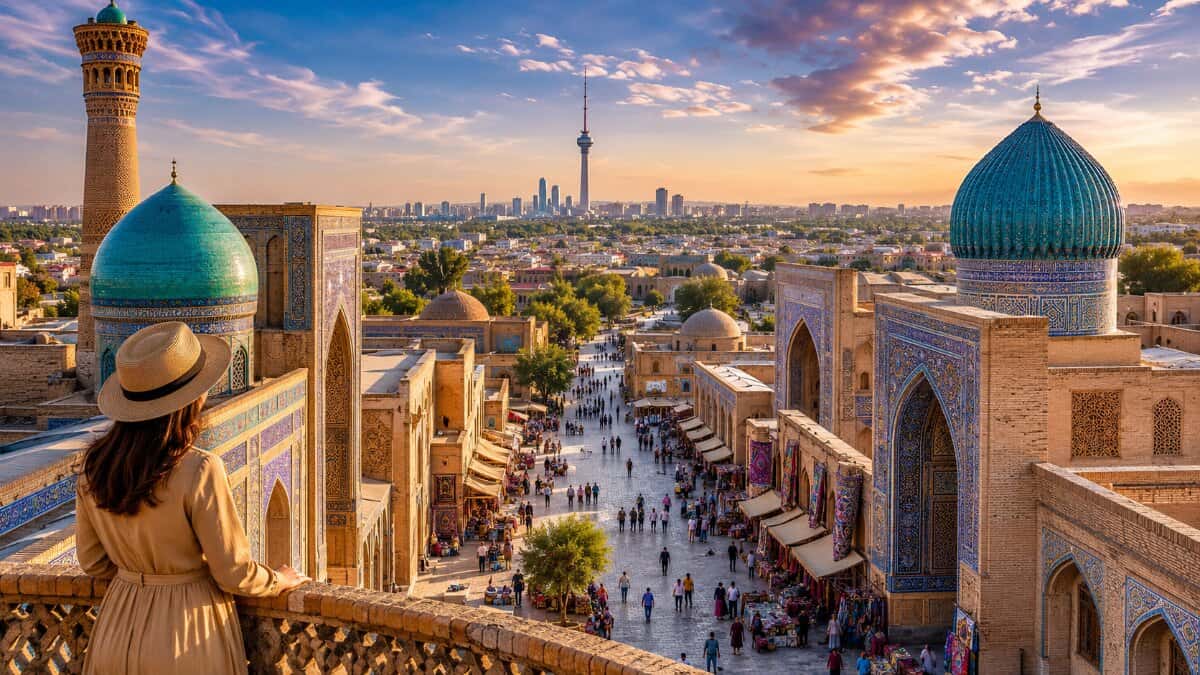
Image generated with Ai
Uzbekistan has moved into the top tier of global tourism growth in 2026, with UN Tourism data placing the country among the strongest performers for international arrivals in January–March. The national statistics base confirms 2.87 million inbound tourist trips in the first quarter, up 36.6 per cent, followed by 5.35 million foreign tourist visits in January–May from 203 countries. This growth is no longer only a heritage story. It is becoming a market-access story shaped by visa liberalisation, airport investment, domestic mobility, hotel development, business tourism and the global rediscovery of Samarkand, Bukhara, Khiva and Tashkent.
Uzbekistan Tourism Enters A Faster Global Growth Cycle
Uzbekistan is emerging as one of the most watched tourism markets in Central Asia because its 2026 growth curve is sharply ahead of the global average. UN Tourism’s May 2026 Barometer recorded 307 million international tourist arrivals worldwide in the first quarter, only two per cent higher than the same period in 2025. Against that slower global backdrop, Uzbekistan posted 37 per cent growth in international arrivals, placing it among the standout destinations listed by UN Tourism for the opening quarter of 2026.
That distinction needs careful wording for publication. Uzbekistan is not among the world’s top five destinations by total visitor volume. It is among the highest-growth destinations by percentage increase in international arrivals. This difference matters for B2B readers, because growth rate signals momentum, while absolute arrivals show market scale. Uzbekistan now has both a fast-growth narrative and a rising volume base.
The National Statistics Committee recorded 2.87 million tourist trips by foreign citizens in January–March 2026. That was 770,100 more trips than in the same period of 2025, equal to a 36.6 per cent increase.
Advertisement
Advertisement
| Indicator | January–March 2026 result | Year-on-year movement | Strategic meaning for travel trade |
|---|---|---|---|
| Inbound tourist trips | 2.87 million | Up 36.6 per cent | Strong early-year demand beyond peak summer season |
| Global international arrivals | 307 million | Up 2 per cent | Uzbekistan outpaced the world average sharply |
| Recreation and leisure trips | 476,500 | Up 83.6 per cent | Stronger FIT, group tour and heritage holiday potential |
| Business trips | 317,500 | Up 18 per cent | Growing MICE and corporate travel relevance |
| Visiting relatives | 1.93 million | Up 35 per cent | Regional diaspora and cross-border travel remain core volume drivers |
| Study trips | 15,100 | Up 2.3 times | Education-linked mobility is rising from a small base |
Silk Road Heritage Is Moving From Niche Product To Scalable Inventory
The centre of Uzbekistan’s international appeal remains its Silk Road product. But the commercial opportunity has widened. Samarkand, Bukhara, Khiva and Shakhrisabz give operators a compact cultural circuit with UNESCO validation, strong visual appeal and multi-night itinerary potential. UNESCO lists five cultural World Heritage properties in Uzbekistan, including the Historic Centre of Bukhara, Itchan Kala, Samarkand – Crossroad of Cultures, Historic Centre of Shakhrisabz and the Silk Roads: Zarafshan-Karakum Corridor.
For operators, this creates a rare sales proposition. Uzbekistan can be packaged as a history-led destination, a Central Asia gateway, a rail-and-road touring product, a gastronomy itinerary, a pilgrimage-linked market and a soft-adventure add-on. The product also works for travellers who want an alternative to saturated European heritage cities.
Advertisement
Advertisement
| Core destination | Primary product value | B2B packaging angle | Commercial note |
|---|---|---|---|
| Samarkand | Monumental Silk Road architecture and major heritage landmarks | Premium culture, photography, education groups, luxury touring | Strong anchor city for first-time travellers |
| Bukhara | Historic urban fabric and craft traditions | Slow travel, boutique hotels, food and craft-led itineraries | High value for longer stays |
| Khiva | Itchan Kala and compact walled-city experience | Short-stay heritage, family tours, immersive city walks | Better connectivity can increase western-route demand |
| Tashkent | Capital gateway and business hub | Stopovers, MICE, urban culture, regional connections | Essential for aviation and corporate travel |
| Shakhrisabz | Timurid heritage and regional extension | Add-on from Samarkand, cultural circuits | Useful for itinerary differentiation |
Visitor Data Shows Regional Strength But Long-Haul Potential Is Rising
Uzbekistan’s visitor mix remains heavily regional. January–April 2026 data show that Kyrgyzstan, Tajikistan and Kazakhstan generated the largest volumes, followed by Russia, Afghanistan, China and Turkmenistan. This pattern reflects land connectivity, family travel, trade links and shared regional mobility. Yet the same data also show growing long-haul relevance from China, Turkey, India and South Korea.
| Source market | January–April 2026 arrivals | What it signals |
|---|---|---|
| Kyrgyz Republic | 1,141,581 | Dominant cross-border regional demand |
| Tajikistan | 965,488 | Strong family, trade and regional movement |
| Kazakhstan | 935,003 | High-volume neighbouring market |
| Russia | 341,842 | Important air and diaspora-linked demand |
| Afghanistan | 161,537 | Regional movement and commercial travel |
| China | 132,240 | Strategic growth market for leisure and business |
| Turkmenistan | 108,433 | Regional access and corridor tourism potential |
| Turkey | 57,686 | Air connectivity and cultural affinity |
| India | 16,057 | Emerging outbound market with scope for group travel |
| Republic of Korea | 12,145 | Smaller but valuable long-haul market |
The January–May result adds another important signal. Uzbekistan received 5,351,868 foreign citizens for tourism purposes in the first five months of 2026, and these visitors came from 203 countries. That range gives the destination a more global demand profile than many still assume.
Advertisement
Advertisement
Visa Access Is Becoming A Major Competitive Advantage
Uzbekistan’s tourism rise is strongly linked to easier entry. Official diplomatic information states that visa-free entry is available for citizens of 94 countries, an electronic visa system is available for 52 countries, and a five-day visa-free transit regime applies to citizens of 45 countries.
This matters for wholesalers and destination management companies. Easier entry reduces friction for escorted groups. It helps last-minute bookings. It supports stopover product. It also allows Uzbekistan to compete against destinations where visa uncertainty still weakens conversion.
The Ministry of Foreign Affairs framework also includes specific provisions for transit passengers through Uzbekistan’s international airports when they hold onward tickets on Uzbekistan Airways. This supports short-stay city exploration and can turn aviation transit into incremental tourism spend.
| Access lever | Official status | Trade implication |
|---|---|---|
| Visa-free access | Available for 94 countries | Easier packaging for mainstream outbound markets |
| E-visa system | Available for 52 countries | Reduces paperwork and improves conversion |
| Five-day visa-free transit | Available for 45 countries under stated conditions | Creates stopover and short-break potential |
| US citizen visa-free access | Effective from January 2026 for up to 30 days | Supports higher-value North American demand |
| Under-16 visa-free provision | Available under defined conditions | Helps family travel planning |
Airport Expansion And Aviation Reform Are Reshaping The Travel Map
Uzbekistan’s tourism ambitions depend on capacity. The government’s transport programme links aviation, rail and road investment with the target of expanding international tourism. The new Tashkent International Airport is central to that plan. Official project data show a 1,300-hectare site, a first-stage investment of 2.5 billion US dollars, annual capacity of up to 20 million passengers and 129,000 tonnes of cargo, 30 take-offs and landings per hour, 14 telescopic ramps and space for 62 aircraft.
Advertisement
Advertisement
A later transport infrastructure review detailed a first-phase terminal of 208,400 square metres, two four-kilometre runways and parking for 169 aircraft.
| Infrastructure element | Official project detail | Tourism impact |
|---|---|---|
| New Tashkent airport site | 1,300 hectares | Enables hub-scale aviation growth |
| First-stage cost | 2.5 billion US dollars | Signals major capital commitment |
| Annual passenger capacity | Up to 20 million | Supports larger inbound volumes |
| Cargo capacity | 129,000 tonnes | Helps events, trade and premium retail logistics |
| Airfield capability | 30 movements per hour | Improves schedule density |
| Terminal size | 208,400 square metres | Supports passenger processing and service quality |
| Runways | Two, each four kilometres | Supports widebody and long-haul operations |
IATA’s aviation analysis adds the economic context. Aviation directly employs 12,400 people in Uzbekistan and generates 96.5 million US dollars in direct economic output. Wider supply chain, employee spending and tourism activity contribute 795.5 million US dollars to GDP and support 128,000 jobs.
Rail, Domestic Flights And Heritage Hotels Point To A Wider Tourism Economy
Uzbekistan’s next growth phase is not just about more arrivals. It is about dispersing visitors across regions and increasing spend. Government development material sets a five-year objective to double foreign tourists from 11 million to 20 million and raise tourism services to 20 billion US dollars. It also identifies infrastructure works in Samarkand, a tourism complex in Shakhrisabz, a mountain recreation area in Pop district, an immersive smart museum-city concept for Itchan Kala in Khiva, and a major archaeological route across Khorezm and Karakalpakstan.
The same policy direction includes the Heritage Hotels of Uzbekistan programme from 2026, designed to bring boutique accommodation into cultural heritage settings through public-private partnership. This could be especially important for premium FIT travellers, small luxury groups and culturally focused operators seeking higher-yield inventory.
Domestic mobility also matters. The government plan links tourism flows with a required doubling of passenger transport across aviation and railways, fleet growth from 105 to 120 aircraft in 2026 and a new domestic flight subsidy model.
Uzbekistan MICE Travel Is Moving Into The Strategic Frame
Uzbekistan is also positioning itself beyond leisure tourism. Official tourism forum material has identified business tourism, large corporate events, banks, associations and regional MICE facilities as part of the country’s development agenda. The same material highlights Bukhara, Kashkadarya, Samarkand, Tashkent city and Tashkent Region as areas with tourism and infrastructure potential.
Advertisement
Advertisement
For meeting planners, the main draw is a combination of novelty, value, heritage backdrop and improving aviation access. Tashkent can serve corporate and government-linked events. Samarkand can support prestige conferences and incentive travel. Bukhara and Khiva can support post-event cultural extensions.
| MICE segment | Best-fit location | Product opportunity |
|---|---|---|
| Corporate meetings | Tashkent | Capital access, hotels, aviation gateway |
| Incentive travel | Samarkand, Bukhara, Khiva | High-impact cultural backdrops |
| Association events | Tashkent, Samarkand | Regional knowledge exchange and heritage positioning |
| Financial and trade events | Tashkent | Business hub function |
| Post-event touring | Bukhara, Khiva, Shakhrisabz | Multi-night add-on revenue |
Critical Operational Takeaways For Travel Agents And Tour Operators
- Position Uzbekistan as a fastest-growing tourism destination, not as a top-five destination by total global arrivals.
- Lead with Samarkand, Bukhara, Khiva and Tashkent for first-time itineraries, then extend into Shakhrisabz, Khorezm, Karakalpakstan and mountain recreation areas.
- Use visa-free access, e-visa availability and transit rules as conversion tools in sales copy.
- Build short-break and stopover products around Tashkent where flight schedules allow.
- Treat regional markets as volume drivers and India, China, South Korea, Turkey, Europe and the United States as growth markets for higher-yield packages.
- Prepare premium product around boutique hotels, heritage stays, gastronomy, craft routes and small-group cultural touring.
- Watch airport and rail capacity upgrades closely because connectivity will determine how fast regional dispersal can scale.
- Develop MICE extensions that combine Tashkent or Samarkand meetings with Bukhara and Khiva cultural programmes.
Forward-Looking Summary
Uzbekistan’s 2026 tourism surge is strategically important because it shows how a landlocked Central Asian country can use heritage, visa openness, aviation investment and regional diplomacy to gain international travel relevance. The numbers confirm strong momentum. The product base confirms depth. The infrastructure pipeline confirms ambition. The opportunity for the travel trade now lies in turning fast arrival growth into higher-value, better-dispersed and more resilient tourism flows. If airport expansion, domestic transport subsidies, boutique heritage accommodation and MICE positioning advance as planned, Uzbekistan could move from a rising Silk Road destination into one of Central Asia’s most influential tourism growth engines.
Advertisement
