
Greece’s iconic Ionian Island of Corfu’s Tourism Hits €1 Billion Milestone — But New Studies Reveal a Paradise Under Pressure

Published
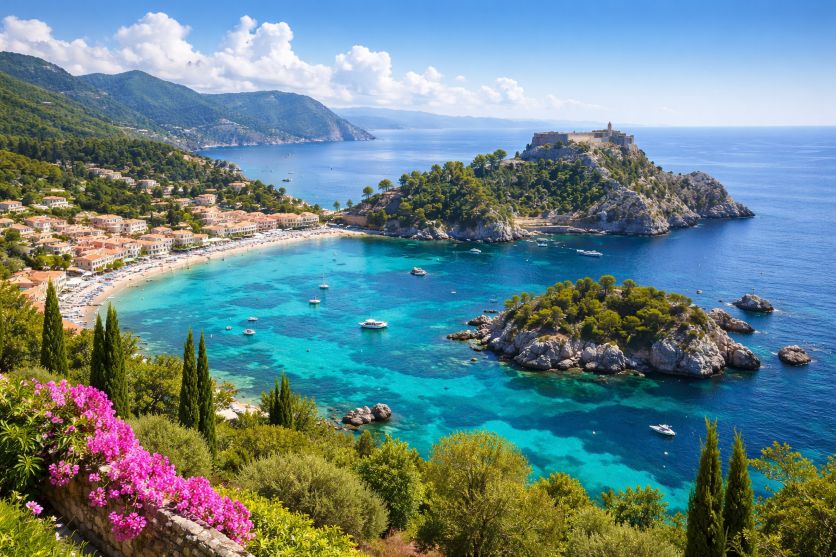 Image generated with Ai
Greece’s iconic Ionian island of Corfu has crossed a landmark economic threshold, with its tourism sector now generating approximately €1 billion in direct annual turnover — a figure that underscores both the extraordinary commercial power of the destination and the structural vulnerabilities quietly building beneath its sun-drenched surface.
Two comprehensive studies presented at the Corfu Chamber of Commerce on March 23, 2026, and conducted in collaboration with INEMY-ESEE (the Institute of Commerce and Services) and global audit firm KPMG, offer the most detailed economic portrait of the island’s tourism ecosystem to date. Together, they deliver a dual verdict: Corfu is performing at record levels — and it is running out of room to do so sustainably.
Advertisement
Advertisement
The €1 Billion Tourism Core: What the Numbers Actually Mean
The term “tourism core” as defined by the studies encompasses accommodation providers, food and beverage services, travel agencies, and rental operations. This cluster alone accounts for 36% of Corfu’s total economic activity — a concentration that would be extraordinary even for a city, let alone an island.
Accommodation leads the sector with a turnover of €614 million, reflecting sustained investment in hotel upgrades, boutique villa development, and the rapid expansion of short-term rental platforms across the island. Travel agencies, meanwhile, recorded a striking 60% increase in turnover over just three years — a figure that signals both the recovery of post-pandemic leisure travel and Corfu’s rising appeal as a premium Mediterranean destination.
Advertisement
Advertisement
When indirect economic contributions are factored in — including construction, real estate transactions, and professional services linked to tourism demand — the island’s total tourism-related economic impact exceeds €3 billion. That number, by itself, reframes Corfu not merely as a holiday destination but as a regional economic engine of considerable scale.
| Economic Metric | Value |
|---|---|
| Direct Tourism Core Turnover | ~€1 billion annually |
| Share of Total Island Economy | 36% |
| Accommodation Sector Turnover | €614 million |
| Travel Agency Turnover Growth (3 years) | +60% |
| Total Economic Contribution (incl. indirect) | €3 billion+ |
Visitor Satisfaction at 94.8% — But Infrastructure Cracks the Surface
The KPMG “voice of the customer” study draws on visitor feedback to assess how Corfu is perceived on the ground. The headline figure is striking: 94.8% of visitors rated their experience as “very or extremely satisfying.” Gastronomy and local hospitality emerged as the strongest drivers of that satisfaction — qualities deeply embedded in Greek island culture and difficult to replicate elsewhere.
Advertisement
Advertisement
Yet beneath that near-perfect approval rating lies a friction point that demands urgent attention. 1 in 5 visitors — 20% of the surveyed base — identified the road network as a significant problem. That is not a marginal complaint. In a destination receiving hundreds of thousands of international tourists each season, a 20% dissatisfaction rate on a single infrastructure variable represents a systemic gap with direct implications for repeat visitation, premium market positioning, and long-term brand equity.
The mobility problem is compounded by structural factors. The island’s geography, combined with heavy reliance on private car rentals and an underdeveloped public transport network, creates predictable congestion at peak hours and near major attractions. Visitor feedback also flagged concerns around cleanliness in public spaces and crowd management at landmark sites — early warning signals of the overtourism dynamics that have already transformed places like Santorini and Dubrovnik into cautionary tales.
Advertisement
Advertisement
Key Visitor Satisfaction Data Points
- 94.8% of visitors reported being “very or extremely satisfied” overall
- Top positives: Gastronomy, hospitality, natural landscape
- Top negative: Road network (cited by 20% of respondents)
- Secondary concerns: Public space maintenance, visitor flow management at high-traffic sites
- Mobility gap: Insufficient public transport options increasing reliance on private vehicles
The Seasonality Trap: A Boom-and-Bust Economy
The INEMY-ESEE component of the research identifies what may be the most structurally dangerous feature of Corfu’s current tourism model: extreme seasonal concentration. The island’s economy remains overwhelmingly dependent on the third quarter of the year — the summer months of July, August, and September — creating an almost binary economic rhythm of intense activity followed by prolonged dormancy.
This “boom and bust” cycle has well-documented consequences. Seasonal workers face income insecurity during the off-months. Local businesses invest heavily in capacity that sits idle for large portions of the year. Infrastructure — from water supply to waste management — is designed to handle peak-season volumes, making it both over-engineered for winter and chronically strained in summer.
The studies also highlight a missed opportunity of considerable economic significance: tourism has not been sufficiently linked to Corfu’s agricultural sector. The island produces olive oil, citrus products, and the distinctive kumquat fruit — all products with clear premium positioning potential in the culinary tourism and agritourism segments. A deliberate integration of local agriculture into the tourism supply chain would not only diversify revenue streams but distribute economic gains more broadly across the island’s population.
Infrastructure Investment Has Not Kept Pace With Private Sector Growth
One of the clearest findings across both studies is the widening gap between private sector development and public infrastructure delivery. Hotel and accommodation operators have moved decisively over the past several years — upgrading room quality, expanding capacity, and improving service standards in response to growing international demand. The 60% surge in travel agency revenues and the €614 million accommodation turnover reflect that private investment.
Advertisement
Advertisement
Public infrastructure, however, has not kept pace. Roads remain inadequate for peak-season traffic volumes. Water supply systems face summer scarcity as consumption peaks. Port facilities are strained as cruise arrivals and yacht tourism grow. The result is that a significant portion of Corfu’s private tourism businesses are operating at or near their physical and logistical limits — a condition that, if unaddressed, will increasingly constrain quality, suppress ratings, and eventually discourage higher-spending visitor segments.
Strategic Priorities: What Comes Next for Corfu
The findings from both studies are now informing a set of concrete development priorities being advanced by Greek government bodies and local authorities. These interventions reflect a recognition that the island has reached an inflection point — one where the absence of strategic action carries measurable economic and reputational risk.
Planned and Proposed Strategic Interventions
- Water Infrastructure Upgrades — Modernizing supply and distribution systems to address the recurring summer scarcity problem, particularly as climate variability increases pressure on freshwater resources across the Mediterranean.
- New Tourist Ports and Maritime Centers — Expanding maritime infrastructure to accommodate growing demand from yacht tourism and cruise operations while reducing congestion at existing facilities.
- Carrying Capacity Studies — Commissioning rigorous research to establish evidence-based limits on visitor volumes at specific sites and during specific periods, drawing on lessons from overtourism case studies in Santorini, Venice, and Barcelona.
- Agricultural-Tourism Integration — Developing frameworks to link local food production more directly to tourism supply chains, supporting agritourism development and expanding the economic benefits of tourism into non-coastal communities.
- Public Mobility Solutions — Evaluating expanded bus networks, shuttle systems, and mobility-as-a-service models to reduce private vehicle dependency and decongest peak-season arterial routes.
Corfu vs. The Overtourism Precedent
The explicit reference in the studies to “overtourism effects seen in places like Santorini” is not incidental. It signals that Corfu’s authorities and researchers are actively monitoring a trajectory that, if left unmanaged, could replicate some of the Aegean island’s most visible challenges — including resident displacement, environmental degradation, and the erosion of authentic local character.
Santorini’s experience has been well-documented: rapid tourism growth generated substantial short-term revenue while simultaneously driving up property costs, straining water and waste infrastructure, and creating visitor experiences that increasingly felt overcrowded and commercialized. The proactive deployment of carrying capacity studies and infrastructure investment at Corfu represents a deliberate attempt to intercept that trajectory before it becomes entrenched.
| Comparison Factor | Corfu (2026 Status) | Santorini (Reference Point) |
|---|---|---|
| Visitor Satisfaction | 94.8% | High, but declining in recent surveys |
| Infrastructure Pressure | Emerging | Acute |
| Carrying Capacity Studies | Planned | Retroactively implemented |
| Seasonality Dependency | High (Q3 dominant) | High |
| Overtourism Risk Level | Moderate and rising | Elevated |
A €3 Billion Economy at a Crossroads
The findings presented on March 23, 2026 establish Corfu as one of Greece’s most economically significant tourism destinations by any measure. A €3 billion total economic contribution, a 94.8% satisfaction rate, and 60% growth in key sub-sectors are not the metrics of a struggling destination — they are the metrics of a destination that has succeeded, perhaps faster than its supporting systems were designed to handle.
The dual nature of the research — one study mapping economic scale, the other capturing visitor experience — creates an unusually complete picture. Growth is real and substantial. So are the pressure points. Roads, water, seasonality, sector concentration, and the absence of agricultural integration are not peripheral concerns. They are structural variables that will determine whether Corfu’s billion-euro tourism economy continues to compound or begins to face the self-limiting dynamics that have humbled other Mediterranean icons.
The data is now public. The strategic agenda is taking shape. What happens next will depend on the speed and coherence with which public investment catches up to the private sector momentum that has already transformed this Ionian island into one of Europe’s most economically powerful tourism destinations.
Advertisement
