

Image generated with Ai
Greece’s travel economy has reached a defining turning point in 2026, with a powerful Tourism Revival emerging as Europe’s Biggest Travel Story of the year as demand from the UK, US and global markets fuels an extraordinary growth wave, transforming the country’s legendary islands, historic cities and hidden destinations into global holiday magnets. According to Official figures from the Hellenic Statistical Authority (ELSTAT), the Bank of Greece and updated tourism performance indicators, Greece has moved beyond a post-pandemic recovery cycle and entered a new phase of strategic tourism expansion. The country recorded 37.98 million international visitors in 2025, generating €23.6 billion in tourism receipts, while the first five months of 2026 delivered 8.57 million international arrivals, representing a 20.9% increase compared with the same period of 2025.
The surge has been supported by powerful demand from the United Kingdom, United States and global markets, alongside strong contributions from Germany, France, Italy, Serbia and Turkey. This unprecedented momentum is reshaping Greece’s tourism landscape, with iconic destinations such as Santorini and Mykonos adapting towards sustainable visitor management, while historic cities like Athens and emerging regions including Crete, Rhodes and Halkidiki are expanding their role in Europe’s next-generation travel economy.
Driven by rising visitor spending, improved airline connectivity, infrastructure investment, regional tourism growth and sustainability-focused strategies, Greece is transforming from a traditional Mediterranean holiday destination into a diversified global tourism powerhouse where famous islands and lesser-known regions are creating a stronger, more balanced and future-ready travel ecosystem.
The year 2025 represented a landmark moment for Greek tourism. International arrivals reached unprecedented levels, tourism revenue achieved a historic record and demand remained strong across both traditional European markets and emerging regional destinations.
Advertisement
Advertisement
However, the most important development was not only the increase in visitor numbers. Revenue growth exceeded arrival growth, indicating that Greece was attracting travellers with stronger spending patterns and higher-value experiences.Indicator 2025 Performance 2026 Early Performance International arrivals 37.98 million 8.57 million (Jan–May) Arrival growth +5.6% year-on-year +20.9% year-on-year Tourism receipts €23.6 billion €5.32 billion (Jan–May) Revenue growth +9% +25.8% Average visitor spending €602.20 Continued higher-value trend
In 2025, foreign accommodation arrivals reached 28.18 million, increasing from 27.38 million in 2024 and 26.28 million in 2023. Although growth slowed compared with the immediate post-COVID recovery years, the sector entered a more stable expansion phase.
By 2026, stronger momentum was visible across multiple segments. International arrivals increased sharply, while tourism receipts grew even faster, showing that Greece was benefiting from premium travel demand.
The changing tourism profile has been reflected in several areas:
For airlines, airports, hotels, cruise companies and tourism boards, the shift represents a move away from pure volume growth towards a more balanced tourism ecosystem.
Greece’s international tourism performance continues to depend heavily on its largest source markets, but the comparison between 2025 and 2026 shows that each market is contributing differently to the country’s travel economy. The United Kingdom strengthened its position as Greece’s leading foreign accommodation market in 2025. British arrivals reached 4.62 million, compared with 4.37 million in 2024 and 4.06 million in 2023. Over three years, the market expanded by approximately 13.8%, highlighting sustained demand for Greek islands, coastal resorts and premium holidays.
The UK market became even more valuable in 2026. Travel receipts from British visitors increased by 50.9% during the early months of the year, reaching €736.3 million. The increase demonstrated that British travellers were contributing significantly to Greece’s tourism economy through higher-value spending.
British demand has remained particularly strong for:
Germany continued to provide Greece with one of its strongest visitor foundations. In 2025, Germany remained the second-largest accommodation market with approximately 3.59 million arrivals, while overall German visitors reached around 5.65 million and generated approximately €3.61 billion in tourism revenue.
The German market has traditionally supported destinations such as Crete, Rhodes, Kos and mainland resorts. In early 2026, German arrivals reached 1.23 million, representing a 13.6% increase, while revenue reached €760.8 million. Although Germany continued leading in visitor volume, the UK demonstrated stronger revenue acceleration.
The United States remained Greece’s most valuable long-haul market. American visitors represented approximately 2.4 million arrivals in 2025, accounting for around 8.5% of foreign arrivals. While US arrivals declined slightly by 1.6% compared with 2024, American travellers generated approximately €1.54 billion in tourism receipts. Average spending reached around €958.66 per trip, making the US market significantly more valuable per visitor than the global average. In 2026, American tourism receipts increased by 19.4% to €539 million during the early reporting period.
The continued strength of the US market has been supported by demand for:
While the UK, Germany and US dominate attention, Greece’s broader European tourism network has remained essential for maintaining growth. France continued ranking among Greece’s important source markets, although arrivals remained slightly below previous levels. Italian travellers also maintained a strong presence, recording approximately 5.5% growth compared with 2023, despite a small decline during 2025.
Poland and the Netherlands emerged as increasingly important contributors.
Poland recorded:
The expansion reflected growing demand for Mediterranean holidays among Polish travellers, supported by increased air connectivity and competitive holiday packages.
The Netherlands crossed:
Dutch travellers continued showing strong interest in Greek islands, nature-based holidays and coastal resorts. The growth of these markets has helped Greece reduce dependence on a limited number of traditional source countries and build a more diversified tourism structure.
One of the biggest changes between 2025 and 2026 has been the rise of neighbouring markets, particularly Serbia and Turkey. Serbia recorded the strongest expansion among major source markets, increasing from 426,063 arrivals in 2023 to 705,037 arrivals in 2025, representing 65.5% growth over two years.
Turkey also recorded growth of more than 51% between 2023 and 2025. The increase from these markets has been particularly important for Northern Greece because visitors from neighbouring countries often travel through:
This trend has transformed Halkidiki and surrounding regions into some of Greece’s fastest-growing tourism areas. Unlike traditional island tourism, which depends heavily on international flights, regional tourism provides Greece with a more resilient visitor base throughout the season.
Santorini has become the clearest example of Greece’s changing tourism strategy. For years, the island represented the success of Greek tourism growth. However, increasing visitor concentration created pressure on infrastructure, natural resources and local communities.
In 2025, Santorini experienced a recalibration period. International air arrivals declined by approximately 13.6% to 19.1% year-on-year, influenced by early-year seismic activity and changing traveller preferences. At the same time, authorities introduced stronger tourism management measures.
Key measures included:Santorini Regulation Details Cruise passenger limit 8,000 passengers per day Peak sustainability fee €20 per cruise passenger Development restrictions Stronger controls in saturated areas
The island’s tourism strategy changed significantly. Instead of focusing only on increasing visitor numbers, Greece began prioritising destination quality and long-term sustainability. In 2026, Santorini continued operating under stricter cruise management rules, including improved scheduling controls and stronger enforcement measures.
The transformation of Santorini represents a wider shift across Greece: tourism growth must now be balanced with environmental protection and infrastructure capacity.
Mykonos followed a similar path to Santorini between 2025 and 2026, moving from a period of rapid tourism expansion towards a more controlled and value-driven luxury tourism model. The island remained one of Greece’s most internationally recognised destinations, attracting high-spending travellers through luxury accommodation, beach experiences, gastronomy and entertainment. However, changing visitor behaviour and growing pressure on local infrastructure encouraged a strategic shift away from pure volume growth.
In 2025, Mykonos experienced a period of adjustment after several years of exceptional post-pandemic demand. International air traffic showed signs of stabilisation, while domestic flights from Athens declined by approximately 9.6%. The moderation reflected a wider trend across Greece’s premium islands, where travellers increasingly began searching for less crowded destinations and more personalised experiences.
Despite the adjustment in air traffic, cruise tourism remained a major contributor. Mykonos continued ranking as Greece’s second-busiest cruise destination after Santorini, welcoming:Mykonos Cruise Performance 2025 Volume Cruise ship calls 762 Cruise passengers More than 1.22 million
By 2026, Mykonos continued focusing on tourism quality rather than unrestricted growth. The island remained included in Greece’s highest sustainability fee category, with a €20 peak-season climate levy applied to cruise passengers visiting during the busiest months.
The destination’s tourism strategy increasingly focused on:
The comparison between 2025 and 2026 shows that Mykonos remains one of Greece’s strongest global tourism brands, but its future direction is increasingly centred on maintaining exclusivity, improving visitor experience and reducing pressure during peak periods.
While Greece’s islands continue attracting global attention, Athens has emerged as one of the country’s strongest tourism growth engines between 2025 and 2026. The capital has successfully expanded beyond its traditional role as a transit point for island holidays and developed into a standalone international city-break destination.

Image generated with Ai
During 2025, Athens benefited from rising demand for cultural travel, heritage tourism, gastronomy experiences and short urban breaks. Visitors increasingly extended their stays in the capital before or after travelling to Greek islands, creating additional economic value for hotels, restaurants, museums and local businesses.
By 2026, Athens had strengthened its position as a year-round destination.Athens Tourism Indicator 2026 Performance Athens International Airport passenger growth +4.5% Passenger volume in first half of 2026 Approximately 15.75 million Peak summer short-term rental growth More than 10%
The increase in winter and spring tourism has been particularly significant. Traditionally dependent on summer travel patterns, Athens has benefited from growing demand outside the peak season.
The city’s tourism expansion has been supported by:
The comparison between 2025 and 2026 highlights Athens as a crucial part of Greece’s tourism diversification strategy. As some island destinations face capacity pressures, the capital provides additional opportunities for year-round visitor growth.
The rise of Halkidiki represents one of the most important changes in Greece’s tourism landscape between 2025 and 2026. While global attention has traditionally focused on destinations such as Santorini and Mykonos, Northern Greece has become a major growth region driven by regional markets. Halkidiki benefited significantly from increasing demand from neighbouring countries, especially:
The growth of these markets reshaped tourism patterns across Northern Greece.
Serbian arrivals increased from 426,063 in 2023 to 705,037 in 2025, representing a 65.5% increase. Turkey also recorded growth of more than 51% during the same period.
These markets have been especially valuable because many visitors travel through:
Halkidiki’s three peninsulas — Kassandra, Sithonia and Athos — benefited from travellers searching for Mediterranean beaches, family-friendly resorts and more affordable alternatives compared with some premium island destinations. The region also gained from stronger aviation connectivity through Thessaloniki Airport.
In 2025, Thessaloniki Airport recorded:
10.2% growth in international arrivals
This helped Central Macedonia, including Halkidiki and Thessaloniki, capture approximately 7% of Greece’s total tourism receipts. By 2026, Northern Greece had become a strategic growth area, helping Greece distribute tourism activity beyond heavily visited island destinations.
Crete continued demonstrating the strength of large-scale island tourism between 2025 and 2026. Unlike smaller islands facing severe capacity challenges, Crete benefited from its size, diverse tourism products and extensive accommodation infrastructure.
In 2025, Crete attracted strong demand from:
The island’s appeal remained based on a broad tourism offering, including:
A major milestone was achieved when Heraklion Airport exceeded 10 million passengers for the first time in 2025.
The achievement reflected:
In 2026, Crete continued benefiting from improved connectivity and international interest. The island’s biggest advantage has been its ability to absorb tourism growth across different regions. While destinations such as Santorini face visitor concentration challenges, Crete has greater geographical capacity, allowing tourism activity to spread more evenly. The comparison between 2025 and 2026 demonstrates why Crete remains central to Greece’s long-term tourism strategy. The island combines visitor growth with infrastructure capacity and destination diversity.
Rhodes remained one of Greece’s most important international tourism destinations during 2025 and 2026, strengthening its position through sustainability initiatives and improved destination management. In 2025, Rhodes continued attracting strong demand from Western European travellers, particularly repeat visitors seeking Mediterranean holidays.
The island benefited from:
During 2026, Rhodes increasingly focused on sustainability and resilience following previous environmental challenges.
Investment priorities included:
Unlike smaller islands facing extreme concentration problems, Rhodes benefits from its larger geography, allowing visitors to spread across different areas. The destination’s development approach reflects Greece’s wider tourism strategy: maintaining international competitiveness while protecting natural and cultural resources.
The tourism expansion between 2025 and 2026 created increasing pressure on Greece’s aviation infrastructure. In 2025, Greek airports handled a record:
83.33 million passengers
This represented:
4.9% annual growth
The increase reflected strong demand from European and long-haul markets, supported by expanding airline networks.
Major airport developments included:Airport Key Development Heraklion Airport Passed 10 million passengers Athens International Airport Continued passenger growth Thessaloniki Airport Supported Northern Greece expansion
By 2026, infrastructure investment became increasingly important. Greece focused on technology upgrades, operational improvements and passenger management systems to handle rising demand. The expansion of aviation connectivity has been one of the biggest factors behind Greece’s tourism success. More direct routes have allowed destinations beyond traditional hotspots to attract international visitors.
Cruise tourism became one of the most carefully managed sectors between 2025 and 2026. Santorini and Mykonos remained among Greece’s busiest cruise destinations, but increasing passenger concentration created pressure on local infrastructure. In response, Greece introduced stronger regulations.
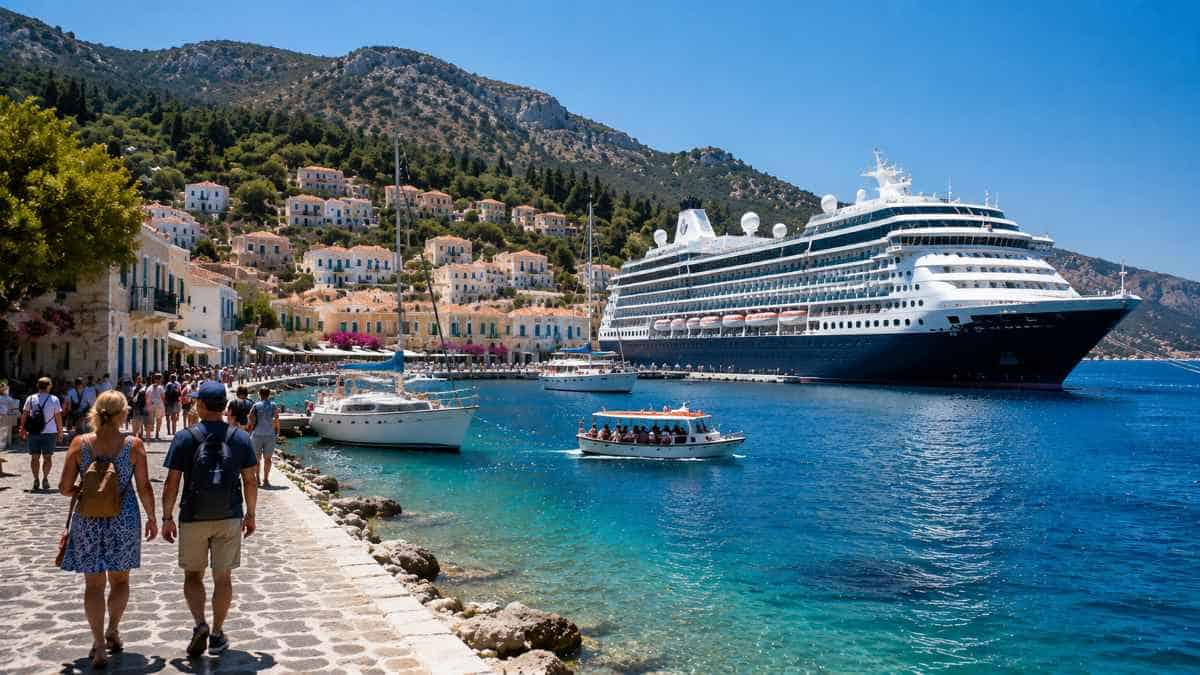
Image generated with Ai
Key measures included:Cruise Management Measure Details Santorini daily cruise cap 8,000 passengers Peak sustainability fee €20 per passenger Port scheduling controls Stronger coordination requirements
In 2026, cruise management became stricter. The calculation methodology for cruise capacity was tightened, requiring operators to consider full vessel capacity rather than lower operational estimates.
Authorities also introduced penalties:
These measures aimed to prevent inefficient port usage and reduce sudden visitor concentration. The policy shift demonstrates Greece’s changing approach to cruise tourism. The goal is no longer simply increasing passenger numbers but ensuring that cruise growth supports destinations without damaging local infrastructure.
The comparison between Greece’s tourism performance in 2025 and 2026 reveals a fundamental transformation. The 2025 season represented a historic achievement, with Greece reaching:
The 2026 season has demonstrated a more advanced tourism model built around:
The biggest changes can be summarised as:2025 Tourism Landscape 2026 Tourism Direction Recovery-driven growth Strategic expansion Island concentration Regional diversification Summer-focused demand Year-round tourism Visitor volume priority Visitor value priority Limited destination controls Strong sustainability management
Santorini and Mykonos are becoming examples of controlled tourism management. Athens is emerging as a major European city-break destination. Halkidiki is benefiting from Balkan market growth. Crete and Rhodes continue demonstrating how large islands can combine tourism expansion with sustainability.
Greece’s tourism economy in 2026 reflects a more balanced and resilient future. The country is not only attracting more visitors but also improving how tourism growth is distributed, managed and converted into long-term economic value.
With continued international demand, stronger connectivity and evolving destination strategies, Greece remains positioned among Europe’s leading tourism markets, entering a new era where growth and sustainability are increasingly connected.
Greece Tourism Revival becomes Europe’s Biggest Travel Story of 2026 as UK, US and global demand drive record growth, transforming islands, cities and hidden destinations into global holiday magnets through rising arrivals and spending.
Greece’s tourism journey from 2025 to 2026 highlights a powerful transformation from record recovery to strategic global expansion. Strong demand from the UK, Germany, US, France, Italy, Serbia and Turkey has strengthened visitor flows, while Santorini, Mykonos, Athens, Crete, Rhodes and Halkidiki demonstrate how destinations are adapting to new tourism realities. With rising revenues, improved connectivity, stronger infrastructure and sustainability-focused policies, Greece is building a more balanced travel economy. The country’s future growth will depend on maintaining this momentum while protecting destinations, enhancing visitor experiences and creating long-term value across its tourism ecosystem.
Advertisement
Tags: Athens Tourism, crete tourism, Europe tourism trends, Greece international arrivals, Greece tourism growth
Advertisement
Advertisement













Saturday, September 5, 2026

Friday, September 4, 2026

Saturday, September 5, 2026

Saturday, September 5, 2026

Thursday, September 3, 2026

Wednesday, September 2, 2026

Saturday, September 5, 2026