

US Proposes $70,000 OPT Fee That Could Change Post-Study Work Plans for International Students Worldwide

Published
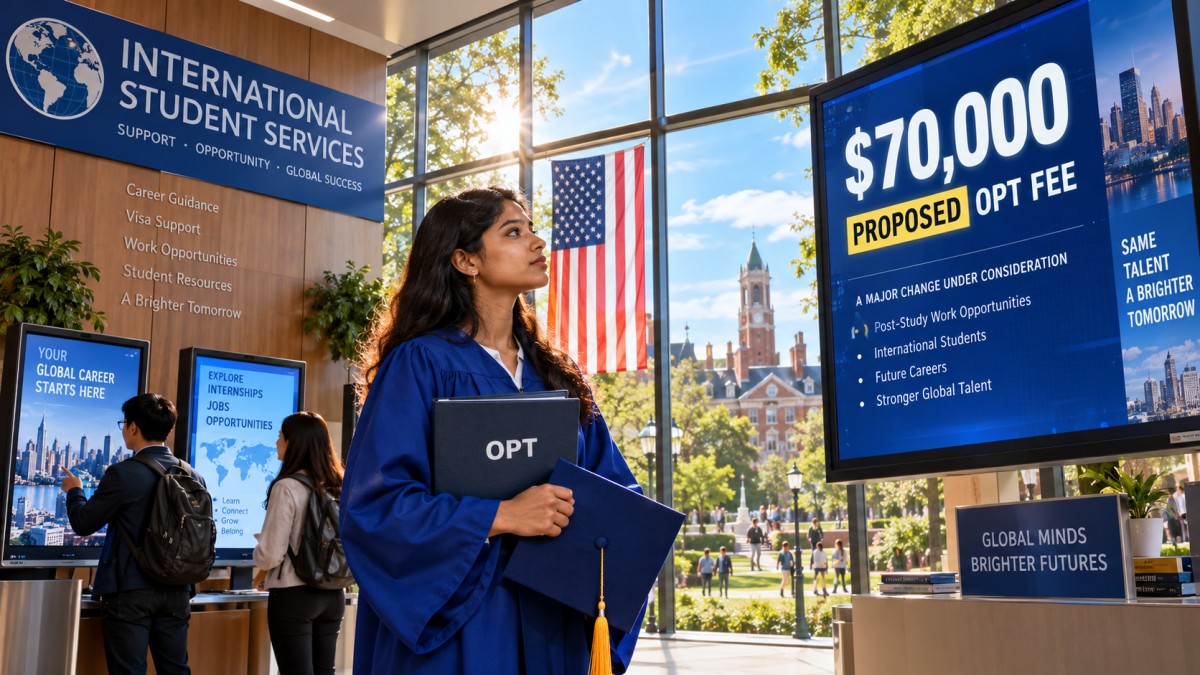
The United States has proposed a major change to its Optional Practical Training (OPT) programme that could make post-study employment significantly more expensive for international students, including thousands from India and China. On 7 October 2026, the US Department of Homeland Security (DHS) unveiled a proposal requiring universities and colleges to pay $70,000 for an international student’s initial OPT recommendation and $30,000 for subsequent authorisations, including qualifying STEM OPT extensions. The proposal could create a combined institutional fee of $100,000 for a student pursuing both stages of practical training. However, the new charges are not yet in effect.
The proposed regulation represents a significant shift in the financial structure of America’s international education system. For decades, OPT has helped eligible F-1 students gain professional experience connected to their degrees. It has also provided employers with access to graduates educated at American universities.
Advertisement
Advertisement
Now, the proposed charges could force institutions to reconsider how they support international graduates, while students may face greater uncertainty over their employment prospects after graduation.
According to the official DHS notice, the proposal is designed to address suspected programme abuse, protect American workers and strengthen immigration compliance. However, universities and international education organisations have raised concerns about its potential effects on student recruitment, research, innovation and workforce development.
Advertisement
Advertisement
What Is the New US OPT Fee Proposal for International Students?
The proposed rule, titled Optional Practical Training Fees, would introduce a new payment requirement for institutions certified under the Student and Exchange Visitor Program (SEVP).
Under the proposal, institutions would pay $70,000 before making an initial OPT recommendation for an eligible F-1 student. Any subsequent OPT recommendation, including an eligible 24-month STEM extension, would generally attract an additional $30,000 after the initial fee has been paid.
Advertisement
Advertisement
The distinction between the initial and subsequent recommendations is important. The proposed fees relate to institutional recommendations for practical training, rather than a direct replacement for the existing employment authorisation application process.
DHS released the proposal on 7 October, with Federal Register publication scheduled for 8 October 2026. The notice is identified as docket ICEB-2026-0100.
Proposed OPT Fee Structure
| OPT category | Proposed fee | Payment responsibility |
|---|---|---|
| Initial OPT recommendation | $70,000 | SEVP-certified institution |
| Subsequent OPT recommendation | $30,000 | SEVP-certified institution |
| STEM OPT extension following initial paid OPT | $30,000 | SEVP-certified institution |
| Initial OPT followed by one qualifying subsequent extension | $100,000 combined | Institution, with potential cost recovery |
The proposal would permit institutions to recover costs from students or employers, meaning students could still face considerable financial exposure despite not being the government’s directly designated payer.
How Does OPT Currently Work for F-1 Students in the United States?
Optional Practical Training allows eligible international students in F-1 status to undertake temporary employment directly related to their principal field of study.
The programme provides an important bridge between university education and professional experience in the United States.
Students can qualify for different forms of training depending on their academic programme, eligibility and employment circumstances.
Advertisement
Advertisement
Main Types of Practical Training
- Pre-completion OPT: Eligible employment authorisation during an academic programme, subject to applicable limits.
- Post-completion OPT: Generally permits up to 12 months of practical training following completion of an eligible programme.
- STEM OPT extension: Allows eligible graduates with qualifying science, technology, engineering or mathematics degrees to apply for another 24 months.
- Curricular Practical Training (CPT): A separate practical training arrangement that forms an integral part of an established curriculum.
Students qualifying for both regular post-completion OPT and the full STEM extension can potentially gain up to 36 months of work authorisation.
However, OPT is temporary employment permission, not a direct grant of permanent residence or an H-1B visa. Those seeking longer-term employment must satisfy the requirements of an appropriate immigration pathway.
The US Immigration and Customs Enforcement agency explains that practical training must remain connected to the student’s education, while applicable authorisation and reporting requirements continue throughout participation.
How Much Do International Students Currently Pay for OPT?
The existing OPT application system involves substantially smaller government charges than those proposed by DHS.
The standard Form I-765 employment authorisation filing fee listed in the referenced USCIS fee schedule is $470 for an eligible online application or $520 for a paper application.
Students seeking faster processing may also request premium processing through Form I-907, subject to eligibility.
Advertisement
Advertisement
A separate federal regulation increased the premium processing fee for eligible Form I-765 cases from $1,685 to $1,780, effective 1 March 2026.
Current Filing Charges Compared With the Proposal
| Application or service | Fee |
|---|---|
| Standard Form I-765 online filing | $470 |
| Standard Form I-765 paper filing | $520 |
| Optional premium processing | $1,780 |
| Online filing with premium processing | $2,250 |
| Paper filing with premium processing | $2,300 |
| Proposed initial institutional OPT charge | $70,000 |
| Proposed subsequent institutional OPT charge | $30,000 |
The combined filing figures assume the stated standard Form I-765 fee applies and premium processing is requested.
Importantly, the proposed institutional fees and existing USCIS application charges are different obligations. Students should not assume the proposal simply changes their Form I-765 filing fee to $70,000.
The existing filing process remains applicable while DHS considers whether to finalise the new institutional charges
Why Indian Students Could Face Major Challenges Under the Proposed OPT Fees
Indian students could be among the most affected groups because of their substantial presence in American higher education, particularly in science, technology, engineering and mathematics.
Official figures from US Immigration and Customs Enforcement highlight India’s importance in the country’s practical training system.
Advertisement
Advertisement
The agency’s 2024 Student and Exchange Visitor Program report recorded 165,524 international student records authorised for STEM OPT. The report also showed that Indian nationals accounted for 48 per cent of students participating in the post-completion STEM OPT extension.
Chinese students accounted for another 20.4 per cent.
These are historical figures from 2024, not projections for 2026 or forecasts of students who would pay the proposed charges.
For Indian families considering American universities, the possibility of significantly higher post-study employment costs could influence future education decisions.
Many international students evaluate overseas education based on academic quality, tuition fees, living expenses and opportunities to gain professional experience.
If institutions require students to cover part of the new fees, the overall cost of pursuing an American qualification could become substantially higher.
Advertisement
Advertisement
Even when universities absorb the charges, they may become more selective about recommending students for OPT.
However, the scale of any future decline in Indian enrolment remains uncertain. The proposal has not been implemented, and its eventual effect will depend on the final regulations and institutional responses.
Why This Matters
The proposed US OPT fees have implications extending beyond immigration administration. They raise questions about the competitiveness of American universities, graduate employment opportunities and international student mobility.
The United States remains an important destination for students seeking specialised education and practical training. OPT strengthens that attraction by connecting classroom learning with experience in American workplaces.
Introducing a substantial institutional charge could change the economics of that system.
Universities would need to decide whether to absorb the proposed costs, recover them from students or employers, establish financial assistance arrangements, or limit their participation.
Advertisement
Advertisement
Employers could also face increased recruitment costs if institutions seek financial contributions before recommending graduates for practical training.
For students, the uncertainty creates another consideration when choosing between education destinations.
Countries offering comparatively accessible post-study employment arrangements may become more attractive to some applicants. However, individual immigration eligibility, employment conditions and programme costs vary considerably between destinations.
The wider significance therefore lies not only in the proposed fee amount, but also in its potential to change how universities, graduates and employers approach international recruitment.
What Official US Data Reveals About the Scale of OPT Participation
The potential importance of the policy becomes clearer when examining historical participation figures.
According to the 2024 SEVIS report, 194,554 students participating in pre-completion or post-completion OPT had both employment authorisation documents and reported employment with an employer.
Advertisement
Advertisement
That represented a 21.1 per cent increase from the comparable 160,627 figure recorded in 2023.
The report separately recorded 165,524 SEVIS identifiers with STEM OPT authorisations in 2024. These measures should not be combined as though they represent completely separate groups of individuals.
| Official indicator | Historical figure | Reference period |
|---|---|---|
| OPT students with EADs and reported employment | 160,627 | 2023 |
| OPT students with EADs and reported employment | 194,554 | 2024 |
| Increase in comparable OPT employment figure | 21.1% | 2023–2024 |
| SEVIS identifiers with STEM OPT authorisation | 165,524 | 2024 |
| Indian share of post-completion STEM OPT participants | 48.0% | 2024 |
| Chinese share of post-completion STEM OPT participants | 20.4% | 2024 |
| Active F-1 and M-1 student records | 1,582,808 | 2024 |
These official statistics show the programme’s substantial scale before the October 2026 proposal.
They also illustrate why any major change to OPT participation costs could affect universities and employers across different sectors.
Importantly, historical OPT authorisations do not establish how many institutions would actually pay the proposed fees if the rule takes effect.
Could the US Government Collect Billions From the Proposed OPT Charges?
DHS has published economic estimates suggesting the proposed rule could generate substantial annual fee transfers to the federal government.
Advertisement
Advertisement
Its regulatory impact analysis projects a range of approximately $8.4 billion to $16.5 billion in annual OPT and STEM OPT fees under different participation assumptions.
The department’s primary estimate is approximately $12.4 billion annually.
DHS Revenue Projections
| DHS modelling scenario | Projected annual fees |
|---|---|
| Lower participation scenario | $8.4 billion |
| Primary scenario | $12.4 billion |
| Higher participation scenario | $16.5 billion |
These are government modelling estimates, not collected revenue or confirmed financial results.
They depend on assumptions about participation and payments. Actual collections could differ if institutions, students or employers change their behaviour in response to the policy.
DHS also models potential opportunity costs if schools decide not to support OPT applications because of the financial requirements.
The department acknowledges that institutions unable or unwilling to pay the charges could affect international students and prospective employers.
Advertisement
Advertisement
How Could US Universities and Employers Respond?
American universities would occupy a central position under the proposed system because they would bear the formal payment obligation.
Currently, designated school officials recommend eligible students for OPT through the Student and Exchange Visitor Information System. Students then pursue employment authorisation through USCIS.
The proposed rule would insert a substantial fee obligation before the institutional recommendation.
For universities supporting large international graduate populations, this could create considerable financial planning challenges.
Some institutions might consider direct financial support for selected students. Others could explore employer-funded arrangements where permitted.
Employers recruiting international graduates could consequently face new negotiations about who bears the cost of practical training.
Advertisement
Advertisement
Technology companies, engineering businesses, research organisations and other employers that recruit STEM graduates may need to reassess graduate recruitment budgets.
Higher education organisations have already expressed concerns about the broader consequences. NAFSA, the Association of International Educators, warned that policies discouraging international graduates could damage American innovation, economic activity and workforce development.
These outcomes remain potential consequences rather than confirmed effects of the proposed regulation.
When Could the New US OPT Fee Rules Take Effect?
The proposed fees do not apply automatically following the DHS announcement.
The notice is scheduled for publication in the Federal Register on 8 October 2026. A 30-day public comment process follows publication for the substantive proposed rule.
DHS must consider relevant comments before deciding whether and how to issue a final regulation.
Advertisement
Advertisement
The proposal also contains a separate 60-day comment period for the associated information-collection provisions. This should not be confused with the main 30-day rulemaking consultation.
If DHS finalises the policy using the proposed implementation timetable, the rule would take effect 60 days after publication of the final rule.
The agency has not established a confirmed final implementation date.
The proposed transition provision would apply the new initial charge to qualifying OPT recommendations dated on or after the eventual effective date.
The administration could modify the proposal during rulemaking, and litigation could influence implementation.
What Travellers Should Know
International students planning to travel to the United States for education should distinguish the proposed institutional OPT charges from the rules governing F-1 student visas, admission to universities and existing practical training authorisations.
Advertisement
Advertisement
The proposed fee does not mean every international visitor or every F-1 visa applicant must pay $70,000.
It concerns a specific employment-related training process undertaken through SEVP-certified educational institutions.
Students should therefore avoid changing travel or study arrangements solely because of headlines suggesting that the new amount has already become mandatory.
Before Booking or Applying for OPT
- Check the policy status: Confirm whether DHS has published a final regulation before treating the proposed fees as mandatory.
- Contact the university: Ask the designated school official how the institution is interpreting the proposal and supporting affected students.
- Review employment eligibility: Confirm the relevant requirements for pre-completion OPT, post-completion OPT or a STEM extension.
- Verify application deadlines: Continue following applicable USCIS filing windows and SEVIS recommendation requirements.
- Assess financial exposure: Ask whether any future institutional charge could be passed on to students or employers.
- Follow official information: Use DHS, USCIS, ICE and Federal Register resources rather than unverified payment requests.
Students already participating in OPT should continue observing their existing authorisation periods, employment reporting duties and immigration conditions.
For future students, the most practical response is to maintain flexible education and financial plans while monitoring the final outcome.
Could the New OPT Fees Affect Students Who Already Hold Work Authorisation?
Students with existing OPT authorisations should pay particular attention to the proposal’s transition provisions.
Advertisement
Advertisement
The draft regulation bases its new payment requirement on the date of an OPT recommendation issued by a designated school official.
Under the proposed transition arrangement, schools would pay the $70,000 initial charge for recommendations dated on or after the eventual effective date.
Subsequent recommendations would attract the $30,000 charge where the initial proposed fee had already been paid.
This means the proposal does not automatically establish a retrospective payment obligation for every existing OPT authorisation. However, students seeking further training should not assume that previously approved OPT guarantees exemption from future charges.
The proposed regulation also addresses refunds. Institutions could seek refunds under specified circumstances where employment authorisation had not been issued. Refund decisions would remain discretionary, and the draft does not provide a refund once the relevant authorisation has been granted.
These provisions are subject to change before any final rule is issued.
Advertisement
Advertisement
What Happens Next to the Controversial US OPT Fee Proposal?
The next stage is the federal rulemaking process, during which universities, employers, students and other interested parties can submit comments.
DHS identifies docket ICEB-2026-0100 for the proposed regulation. Interested parties can review the notice and submit relevant information through Regulations.gov.
The department will then decide whether to proceed with the proposed charges, modify their structure or take another regulatory approach.
For students considering the United States, the central issue remains the same: whether the opportunity to gain professional experience after graduation will remain financially accessible.
The proposed $70,000 initial fee and $30,000 subsequent charge would represent a fundamental change in the costs associated with OPT if implemented.
For now, the existing OPT system remains in operation, and the proposed institutional fees are not legally effective. The final outcome will be important for American universities, international graduates and employers that depend on access to globally educated talent.
Advertisement
Advertisement
Frequently Asked Questions About the US OPT Fee Proposal
1. Has the United States introduced a $70,000 OPT fee?
No. As of 8 October 2026, the $70,000 initial OPT fee remains a proposal. The government must complete the applicable rulemaking process before introducing a final regulation.
2. Who would pay the proposed $70,000 OPT charge?
SEVP-certified universities and colleges would be formally responsible for paying the initial fee before recommending eligible students for OPT. The proposal would permit institutions to recover costs from students or employers.
3. Would STEM graduates face an additional $30,000 charge?
Under the proposed framework, a subsequent qualifying OPT recommendation, including a STEM OPT extension, would generally attract a $30,000 institutional fee after the initial $70,000 charge had been paid.
4. Would Indian students be affected?
Yes. Eligible Indian nationals studying in F-1 status could be affected if the regulation is finalised. India has historically accounted for a substantial share of international students participating in STEM OPT.
5. Can international students still apply for OPT?
Yes. Eligible students can continue using the existing OPT application process while the proposal remains under review. Applicants must comply with the applicable USCIS and SEVIS requirements.
write closing update for this news
Advertisement
Advertisement
Closing Update
As of 8 October 2026, the proposed $70,000 initial OPT fee and $30,000 charge for subsequent OPT and STEM OPT extensions remain subject to the US federal rulemaking process. The proposed changes could significantly increase the financial burden on American universities and potentially affect international students, particularly those from India and China who rely on post-study employment opportunities.
For now, eligible F-1 students can continue applying for OPT under existing regulations and applicable USCIS filing fees. The crucial next step will be the public consultation and DHS’s decision on whether to finalise, revise or withdraw the proposed charges. International students, universities and employers should monitor official government announcements before making financial, academic or employment decisions based on the proposal.
Advertisement
