
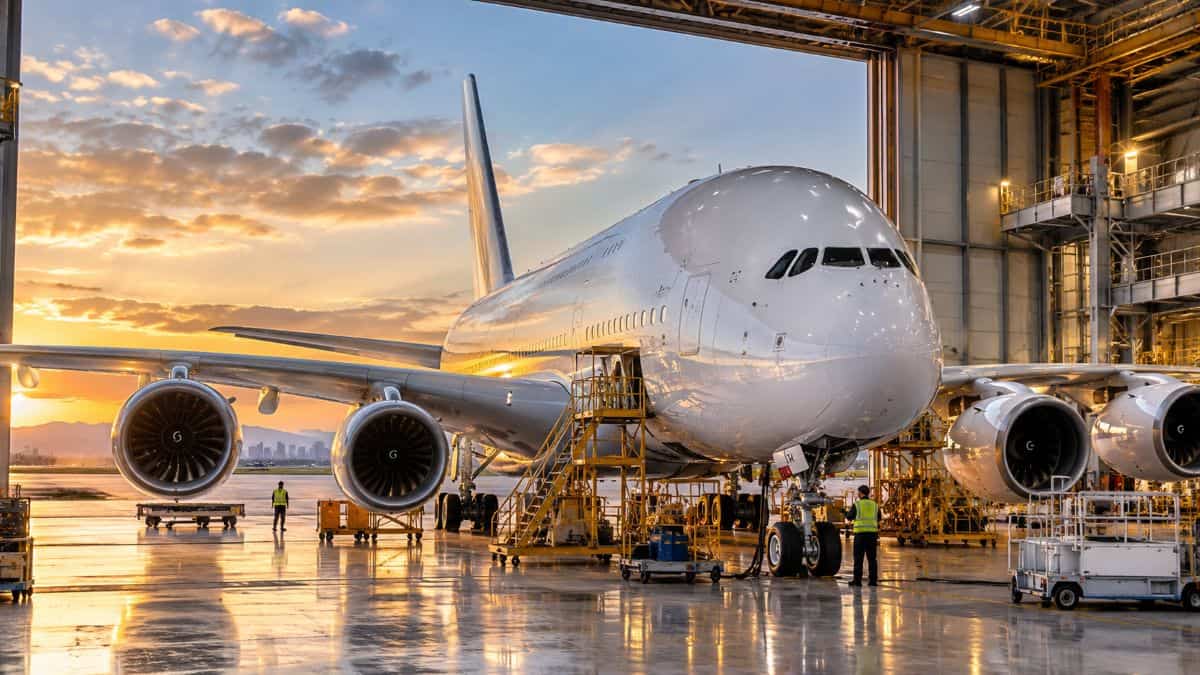
Image generated with Ai
Lufthansa Technik and Emirates have strengthened a long-running aviation partnership with a new multi-year agreement that will keep Airbus A380 heavy maintenance work in the Philippines through 2030. The arrangement is significant for international aviation because Emirates remains the world’s largest operator of the double-deck aircraft, while Lufthansa Technik Philippines is expanding its widebody maintenance capabilities in the region. The programme is already operating at the company’s Manila facility, where two dedicated maintenance lines have been allocated to Emirates A380 aircraft.
The agreement also carries an important future dimension for air travel and aviation infrastructure. Emirates is set to become the launch customer for Lufthansa Technik Philippines’ new maintenance facility at Clark International Airport when operations begin. With more than 30 A380 checks already completed for Emirates since the partnership began in 2023, the extended contract provides continuity for one of the most recognisable aircraft types in global long-haul travel. At the same time, the expansion strengthens the Philippines’ role as an Asian aviation maintenance hub and supports the wider ecosystem required to keep high-capacity aircraft operating reliably on international routes.
Advertisement
The new agreement connects three important aviation markets through aircraft maintenance rather than a conventional passenger route. Germany contributes Lufthansa Technik’s engineering and maintenance expertise, the United Arab Emirates provides Emirates’ extensive A380 operation, and the Philippines serves as the location for major heavy-maintenance activity.
This relationship illustrates how international aviation increasingly depends on specialised infrastructure located beyond an airline’s home market. For passengers, aircraft maintenance can appear distant from the travel experience, but it directly influences fleet availability, operational reliability and the ability of airlines to sustain long-haul services.
Advertisement
Advertisement
Emirates operates the A380 on major international routes connecting Dubai with destinations across Europe, Asia, Africa, Australia and the Americas. Keeping these aircraft in service requires substantial inspection, repair and overhaul capabilities. The extended partnership therefore provides an important maintenance foundation behind the airline’s continuing A380 operations.
For the Philippines, the agreement also reinforces the country’s growing importance in the Asia-Pacific MRO sector. Manila already hosts Lufthansa Technik Philippines’ established operation, while Clark is becoming the next stage of the company’s capacity expansion.
Under the multi-year contract, Lufthansa Technik Philippines will continue performing heavy checks on Emirates’ A380 fleet until 2030. The work is taking place at the existing Manila facility, where two dedicated base-maintenance lines have been assigned to the airline.
Heavy maintenance is substantially more comprehensive than routine aircraft servicing. During a major check, aircraft systems, structures and components are inspected according to detailed maintenance requirements. Depending on findings, engineers can carry out repairs, replacements and additional inspections before the aircraft returns to commercial operation.
Advertisement
Advertisement
The scale of the Emirates relationship is reflected in the number of completed aircraft checks. Lufthansa Technik Philippines has already performed more than 30 A380 checks for the airline since 2023.
The continuation of this work is particularly relevant as airlines around the world increasingly focus on extending the useful operational life of existing aircraft. Maintaining mature widebody fleets can provide carriers with additional capacity while new aircraft deliveries remain constrained by production schedules, supply-chain challenges and certification timelines.
| Category | Details |
|---|---|
| Airlines and MRO partners | Emirates and Lufthansa Technik Philippines |
| Aircraft | Airbus A380 |
| Contract duration | Through 2030 |
| Existing maintenance location | Manila, Philippines |
| Dedicated Emirates lines | Two |
| Completed Emirates A380 checks | More than 30 since 2023 |
| Future facility | Clark International Airport |
| Emirates position | World’s largest A380 operator |
| Lufthansa Technik Philippines portfolio | A330, A340, A380 and Boeing 777 |
| Planned additional aircraft | Airbus A350 and Boeing 787 Dreamliner |
The most important development beyond the contract extension is Emirates’ planned role as the launch customer for Lufthansa Technik Philippines’ new Clark facility.
Clark International Airport has been developing as an increasingly important aviation gateway in the Philippines. The arrival of additional MRO capacity could broaden its significance beyond passenger and cargo operations by creating a specialised base for large commercial aircraft maintenance.
For the aviation industry, a new widebody maintenance centre can create advantages across several areas. Airlines gain access to additional maintenance capacity, while the region can benefit from engineering employment, technical training, aviation supply chains and related business activity.
The Clark facility also gives Lufthansa Technik Philippines room to expand its capabilities. The company intends to add the Airbus A350 and Boeing 787 Dreamliner to its portfolio, placing greater emphasis on newer-generation widebody aircraft alongside established platforms such as the A330, A340, A380 and Boeing 777.
This diversification is strategically important because the global widebody fleet is changing. New-generation aircraft such as the A350 and 787 are becoming increasingly important to long-haul networks, while the A380 continues to serve high-demand routes where its large passenger capacity remains commercially valuable.
The significance of the deal extends beyond the MRO industry because aircraft availability has a direct relationship with international travel capacity.
The A380 was designed for high-density long-haul operations, making it particularly suitable for routes with substantial passenger demand. Emirates has built a distinctive global network around the aircraft, using its capacity to connect Dubai with numerous major tourism and business markets.
A reliable maintenance network supports the airline’s ability to keep these aircraft available for scheduled operations. While a maintenance contract does not itself create new passenger routes, it contributes to the operational resilience required to maintain existing international connectivity.
For travellers, this can translate into greater consistency across long-haul networks. The A380 also remains popular with many passengers because of its spacious cabin architecture, quiet operating environment and distinctive double-deck design. Continued investment in its maintenance therefore has relevance for the passenger experience as well as airline fleet planning.
The agreement additionally demonstrates the importance of specialised aviation services to the broader travel economy. Hotels, tourism businesses, airports and destination authorities depend on reliable air connectivity, while airlines depend on maintenance providers to keep aircraft available.
Lufthansa Technik Philippines is a joint venture between Lufthansa Technik and MacroAsia Corporation. It has provided MRO services from Manila for more than 25 years and operates as Lufthansa Technik’s competence centre for widebody aircraft maintenance in Asia.
Its established expertise includes Airbus A330, A340 and A380 aircraft as well as Boeing 777s. The planned expansion into A350 and Boeing 787 maintenance reflects an effort to align its capabilities with the evolving international widebody fleet.
The move is also relevant from an industry skills perspective. Modern aircraft require highly specialised technical knowledge, advanced inspection capabilities and strict adherence to regulatory maintenance standards. Expanding the aircraft types supported by an MRO organisation can strengthen the depth and breadth of technical expertise available within a regional aviation market.
For the Philippines, this provides an opportunity to further position the country as a destination for high-value aviation services rather than simply a market for passenger traffic.
The Emirates-Lufthansa Technik agreement arrives at a time when the future of the A380 remains a subject of considerable interest within the aviation industry. Many airlines have retired their A380 fleets, particularly as twin-engine widebody aircraft offer airlines greater flexibility and efficiency across a broader range of routes.
Emirates, however, has maintained a different strategy. The airline continues to operate the aircraft on selected high-volume international routes, making maintenance support particularly important to its fleet strategy.
The continuation of specialist A380 maintenance through 2030 indicates that there remains a long-term requirement for technical capabilities supporting the aircraft. For MRO providers, that creates opportunities to develop highly specialised expertise around a type that requires considerable infrastructure and engineering knowledge.
From a travel perspective, the A380’s continued presence also gives passengers access to a distinctive long-haul aircraft experience that has become increasingly uncommon elsewhere.
The agreement ultimately highlights how global aviation relies on partnerships that extend well beyond airline-to-airline relationships.
A passenger travelling between continents may see only the airport, aircraft and cabin service, but a complex network of engineers, maintenance facilities, component suppliers and aviation specialists supports every commercial flight. The Lufthansa Technik Philippines and Emirates relationship demonstrates how that infrastructure can span several countries while supporting a single global fleet.
Germany’s engineering expertise, the Philippines’ MRO infrastructure and the UAE carrier’s international network therefore converge around the A380. The Clark expansion adds another layer to this cooperation and could strengthen the region’s position in the international widebody maintenance market.
For the travel industry, the broader message is clear: maintaining reliable aircraft capacity is as important to global connectivity as launching new routes. As Emirates continues operating one of the world’s largest A380 fleets, long-term maintenance partnerships will remain central to keeping its flagship aircraft flying across major international markets.
What is the new Emirates and Lufthansa Technik agreement?
It is a multi-year contract extending heavy maintenance services for Emirates A380 aircraft at Lufthansa Technik Philippines through 2030.
Where is Emirates’ A380 maintenance currently being performed?
The work is currently being carried out at Lufthansa Technik Philippines’ existing maintenance facility in Manila.
How many dedicated maintenance lines are assigned to Emirates?
Two dedicated base-maintenance lines at the Manila facility have been assigned to Emirates A380 aircraft.
How many Emirates A380 checks has Lufthansa Technik Philippines completed?
More than 30 A380 checks have been successfully completed for Emirates since the partnership began in 2023.
Which airport will host Lufthansa Technik Philippines’ new facility?
The company is expanding with a second facility at Clark International Airport in the Philippines.
Will Emirates use the Clark facility?
Yes. Emirates is expected to become the launch customer for the new Clark facility once operations commence.
Why is A380 maintenance important for Emirates?
Emirates is the world’s largest A380 operator, so specialised heavy-maintenance capacity is essential for supporting its long-term fleet operations.
Which aircraft does Lufthansa Technik Philippines currently support?
Its portfolio includes Airbus A330, A340 and A380 aircraft and Boeing 777 aircraft.
Which additional aircraft types does the company plan to support?
Lufthansa Technik Philippines intends to add the Airbus A350 and Boeing 787 Dreamliner to its portfolio.
How can the agreement affect international travel?
Reliable heavy-maintenance capacity can support aircraft availability and operational resilience, helping airlines sustain long-haul connectivity across international markets.
Advertisement
Tags: A380 fleet, A380 maintenance, aircraft maintenance, Aviation industry, clark international airport
Advertisement
Advertisement













Monday, September 7, 2026

Monday, September 7, 2026

Monday, September 7, 2026

Monday, September 7, 2026

Monday, September 7, 2026

Monday, September 7, 2026