

Canada Accelerates Dual-Use Arctic Aviation Upgrade Amid Russia–China Activity, Linking New NORAD Radar, Flexible Airspace and Remote Airport Technology to Stronger Polar Travel Resilience

Updated
Published
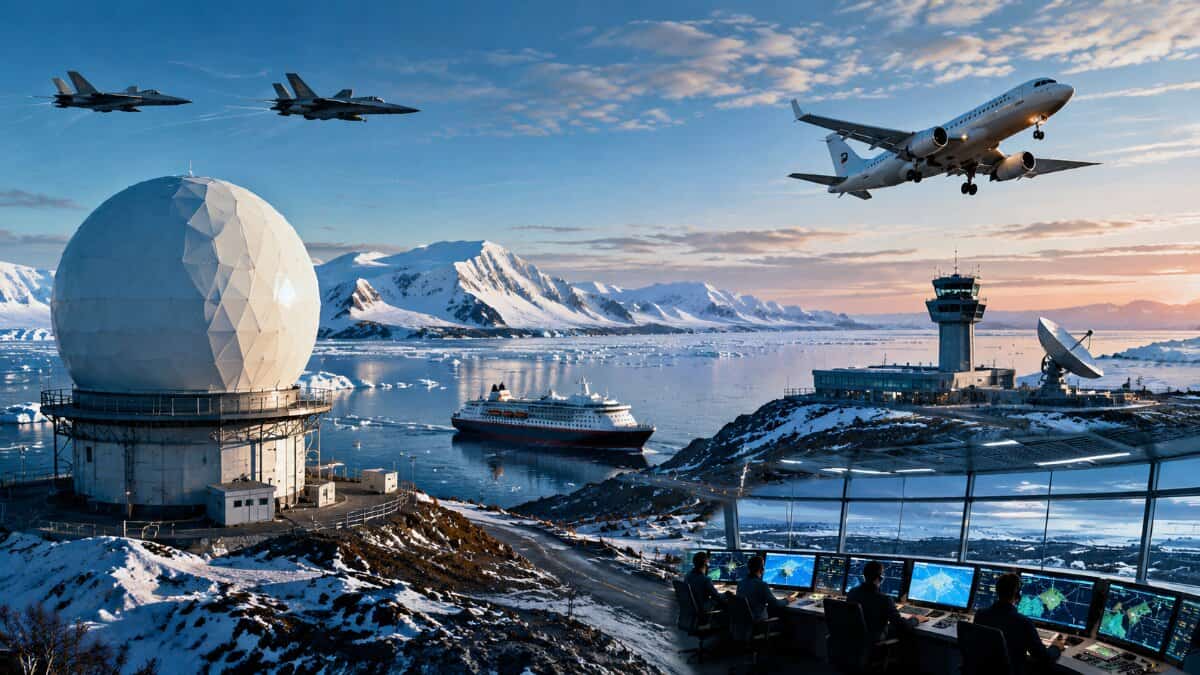
Canada is moving a major Arctic surveillance programme into delivery while its civil air-navigation system is being redesigned to support both commercial flights and continental defence. The overlooked travel impact lies beyond military radar. Flexible airspace, satellite communications, non-GPS navigation and digital airport services could strengthen polar-flight reliability, remote-community access and northern tourism connectivity. However, no official authority has announced Arctic passenger-route closures or identified an immediate threat to civilian aviation. Most traveller benefits will depend on infrastructure integration between 2026 and the early 2030s.
Canada’s Arctic Aviation Story Moves Beyond Defence
Growing Russian and Chinese cooperation in the Arctic has become an important driver of North American defence planning. A March 2026 posture statement submitted to the United States Senate identified combined Russian-Chinese air and maritime operations in the Arctic as evidence of closer strategic alignment. It also recorded five Chinese research vessels operating in the Arctic during 2025, the highest annual number identified in the statement, with part of that activity assessed as potentially supporting future military deployments.
Advertisement
Advertisement
The same document reported that United States and Canadian NORAD aircraft completed 16 interceptions of long-range Russian aircraft inside American and Canadian Air Defence Identification Zones during 2025. Four further interceptions had been completed by the time the statement was submitted in March 2026. These figures show an increase in surveillance and response activity, but an Air Defence Identification Zone remains international airspace beyond sovereign airspace rather than an extension of a national border.
The publicly documented February and March 2026 encounters involved Russian aircraft rather than joint Russian-Chinese formations. On 19 February, NORAD detected two Tu-95 bombers, two Su-35 fighters and one A-50 aircraft in the Alaskan Air Defence Identification Zone. On 4 March, two Russian Tu-142 maritime patrol aircraft were detected in the same zone. In both cases, NORAD confirmed that the aircraft remained in international airspace and were not considered an immediate threat.
Advertisement
Advertisement
Verified Arctic Security Picture and Travel Meaning
| Official development | Verified detail | Practical travel interpretation |
|---|---|---|
| Russia–China Arctic alignment | NORAD identified combined air and maritime operations as evidence of growing cooperation | Greater civil–military coordination may be required, but no passenger restriction was announced |
| Chinese research presence | Five research vessels operated in the Arctic during 2025 | Maritime monitoring is increasing, although the vessels were not officially classified as warships |
| Russian aviation activity | Sixteen NORAD interceptions occurred in 2025, with four completed by March 2026 | Interceptions show increased defence activity, not closure of civilian polar airspace |
| February 2026 encounter | Two Tu-95s, two Su-35s and one A-50 were detected | Aircraft remained outside United States and Canadian sovereign airspace |
| March 2026 encounter | Two Tu-142 aircraft were intercepted by American and Canadian assets | NORAD again reported no sovereign-airspace penetration |
| Civilian operations | No reviewed NORAD release announced a commercial route suspension or Arctic airport closure | This remains an infrastructure-resilience story rather than an immediate travel alert |
Canada Moves Arctic Radar From Planning Into Delivery
Canada’s clearest new action came on 22 June 2026, when agreements with Australia and BAE Systems Australia moved the Arctic Over-the-Horizon Radar project from planning into delivery. Work under the arrangement was scheduled to begin on 1 July 2026. The wider programme is valued at more than C$6 billion, including C$2.5 billion allocated to procurement of the radar system and additional expenditure covering infrastructure, installation and integration.
The radar will use signals reflected through the ionosphere to detect airborne and maritime activity beyond the range of conventional line-of-sight systems. Its purpose is to provide earlier warning of threats approaching Canada and North America through northern and Arctic regions. It is a defence surveillance system and should not be described as a civilian air-traffic-control radar.
Advertisement
Advertisement
The June announcement placed anticipated initial capability in December 2029. A separate Canadian NORAD modernisation timeline still lists initial operational capability in 2028 and full operational capability in 2031. The difference suggests that public programme pages are not yet fully aligned. For planning purposes, the dated June 2026 delivery announcement provides the newest publicly available milestone, while 2031 remains the published target for wider operational completion.
Canada’s Dual-Use Aviation Network Creates the Travel Angle
The connection to travel is established more directly in NAV CANADA’s Air Navigation System Outlook for 2026 to 2031. The organisation classifies Canadian air-navigation infrastructure as inherently dual-use because the same systems support normal commercial operations, NORAD activity, Arctic mobility, emergency response, military readiness and allied interoperability.
Advertisement
Advertisement
NAV CANADA has invested more than C$3.5 billion in infrastructure and advanced systems since its privatisation. Its latest outlook projects a 60 per cent increase in Canadian air traffic by 2050, placing pressure on airspace capacity, communications, staffing and ageing airport facilities. The convergence of commercial growth and expanded defence activity means northern airspace must accommodate passenger aircraft, military operations, remotely piloted systems and emergency traffic without reducing safety or reliability.
Canada Arctic Aviation Infrastructure Roadmap
| Capability | Latest official milestone | Core purpose | Potential travel relevance |
| Arctic Over-the-Horizon Radar | Initial capability anticipated in December 2029 | Long-range detection of airborne and maritime approaches | Earlier domain awareness may support more coordinated airspace management |
| Polar Over-the-Horizon Radar | Initial capability listed for 2032 and full capability for 2033 | Coverage over and beyond the Canadian Arctic Archipelago | Broader surveillance of northern approaches used by military and civil aviation |
| Air Navigation Aid Systems Replacement | Initial capability listed for 2030 | Navigation in remote areas without exclusive dependence on GPS | Improved resilience during satellite interference or system degradation |
| High and Low Frequency Communications | Initial capability listed for 2029 | Long-range military command and control | Stronger northern communications infrastructure may support coordinated operations |
| Air Weapons Control Coverage Expansion | Initial capability listed for 2031 | Expanded digital radio coverage linked with NAV CANADA centres | Better civil–military ground-to-air coordination |
| Northern Basing Infrastructure | Initial capability listed for 2034 | Upgrades at Inuvik, Yellowknife, Iqaluit and Goose Bay | Possible multi-purpose infrastructure benefits where local agreements permit |
| Flexible Use Airspace | Development planned during 2026 to 2031 | Dynamic allocation between civilian and military users | Reduced need for permanently restricted routing |
| Digital Aerodrome Services | National hub model planned over the longer term | Remote delivery of airport air-traffic services | More resilient staffing and service coverage at regional airports |
Source basis: Government of Canada NORAD modernisation schedule and NAV CANADA Air Navigation System Outlook.
Flexible Airspace Could Protect Airlines From Permanent Detours
NAV CANADA plans to introduce Flexible Use Airspace as military requirements grow. Under this concept, airspace can be allocated dynamically according to real operational demand rather than being permanently reserved for either defence or civilian users. Free Route Airspace is also being developed to give aircraft greater freedom from fixed airway structures.
This matters because greater Arctic military activity does not automatically need to produce permanent passenger detours. Airspace required for exercises or interception activity could be activated for limited periods and released when no longer needed. Once mature, NAV CANADA expects flexible and free-route concepts to shorten flight paths, reduce fuel consumption and improve horizontal flight efficiency. These are projected benefits rather than measured outcomes from current Arctic operations.
Advertisement
Advertisement
For airlines, the commercial value would come from improved predictability. Better coordination between air-navigation authorities, military planners, airports and carriers could reduce unnecessary fuel loading, protect connection schedules and limit prolonged diversions. However, no specific polar route has yet been identified as receiving a confirmed time or fuel saving from the programme.
Digital Airport Technology Could Strengthen Remote Connectivity
Digital Aerodrome Air Traffic Services form another important part of the dual-use transition. NAV CANADA is developing centralised facilities that use high-resolution cameras, external microphones, sensors and digital displays to provide services remotely. The Kingston Digital Facility will initially support Kingston Flight Service Station and remote services for Hamilton Tower, subject to regulatory processes and operational validation.
The longer-term plan calls for five or six digital hubs across Canada, with each hub potentially supporting as many as 20 airports. Centralised technology could reduce dependence on ageing control towers and allow specialist staff to serve airports with different traffic levels, weather conditions and infrastructure profiles.
No specific Arctic airport has been publicly confirmed for this national hub network. Even so, the technology offers a potentially important model for northern destinations where low traffic volumes, staff shortages and high construction costs can constrain aviation services. Reliable regional airports remain essential to Indigenous communities, tour operators, expedition businesses, emergency services and travellers visiting remote parts of Canada.
Polar Communications Remain a Critical Airline Risk
Canada’s current aeronautical information identifies significant satellite-communication limitations in northern airspace. In the Edmonton Flight Information Region, Inmarsat services may become unreliable north of 72 degrees north. Inmarsat satellite voice service is unavailable north of 80 degrees north, while Iridium service remains available. Operators equipped with both systems are advised to change to Iridium before flying beyond the affected latitude.
These limitations explain why polar operations require more than access to a shorter geographical route. Airlines must consider communications coverage, space weather, navigation reliability, diversion airports, emergency response, ground equipment and passenger recovery capacity.
Advertisement
Advertisement
The United States Federal Aviation Administration requires operators seeking polar-route approval to complete a tabletop exercise and a validation flight. A simulated diversion must be planned at an approved en-route airport, with communications, navigation, surveillance, airport facilities, weather data, notices to air missions, space-weather information and ground-equipment availability assessed during the process.
Original Trade Analysis: The Real Benefit Is System Integration
The principal travel benefit will not come from Arctic radar operating alone. An over-the-horizon system can detect distant activity, but it does not direct commercial aircraft, staff regional airports or guarantee diversion support. Value for airlines and travellers emerges only when radar awareness is connected with civil air-traffic management, satellite communications, non-GPS navigation, weather information, flexible airspace and functioning northern airports.
This creates an important distinction for the travel industry. Canada is not announcing a new passenger route or an immediate increase in airport capacity. It is building the systems that could prevent rising defence activity from becoming a permanent operational barrier to commercial aviation.
Flexible airspace could allow military restrictions to be narrowed by location and duration. Digital aerodromes could give smaller airports access to centralised expertise. Alternative positioning and communication systems could provide resilience when GPS or satellite coverage becomes unreliable. Improved information sharing could also help airlines decide earlier whether to continue, reroute or divert.
The economic effect will depend on execution. Regulatory approvals, cyber resilience, staff training, Indigenous consultation, infrastructure delivery and compatibility between military and civilian platforms will determine whether the programme produces measurable gains for passenger operations.
Maritime Investment Adds a Northern Tourism Dimension
The United States Coast Guard confirmed on 11 June 2026 that its first two Arctic Security Cutters will be based at Kodiak, with a third expected to operate from Seward when supporting infrastructure is ready. The first delivery is anticipated in 2028, supported by US$3.5 billion in fiscal-year 2025 reconciliation funding.
Advertisement
Advertisement
The cutters are being acquired for security, sovereignty and sustained Arctic operations rather than tourism. Nevertheless, a larger ice-capable fleet may increase the number of government assets operating in regions used by expedition cruises, research vessels and local shipping. No official source has promised additional cruise itineraries or guaranteed shorter emergency-response times, so any passenger benefit remains a secondary possibility rather than a confirmed programme outcome.
Operational Takeaways for Travel Agents and Tour Operators
- Monitor official notices to air missions and operator updates before selling complex polar itineraries, northern charters or tightly timed connections.
- Distinguish an Air Defence Identification Zone encounter from a breach of sovereign airspace when briefing clients or preparing travel alerts.
- Confirm that aviation suppliers operating beyond 72 degrees north have suitable satellite-communication capability and documented contingency procedures.
- Review diversion-airport capacity, passenger accommodation, medical support, ground handling and recovery transport before contracting remote-air services.
- Avoid describing Canada’s radar investment as an immediate airport or passenger-service upgrade because its primary function remains defence surveillance.
- Build additional schedule flexibility into Arctic packages where weather, military exercises, communications limitations and restricted diversion choices may combine.
- Track digital aerodrome and northern-basing consultations because specific airport participation will determine where commercial benefits eventually appear.
- Maintain crisis-response agreements with airlines, destination partners and accommodation providers for unplanned northern diversions or itinerary changes.
Long-Term Outlook for Canada and Global Polar Travel
Canada’s Arctic modernisation programme could influence international travel most strongly between 2029 and 2033, when major radar, navigation, communications and airspace-management milestones are expected to converge. The strategic value lies in creating a northern aviation system that can accommodate rising commercial traffic while supporting defence, sovereignty and emergency operations.
Canada’s projected 60 per cent traffic increase by 2050 will make that integration increasingly important. Airlines will require efficient polar routing, stronger communications and reliable access to diversion airports. Northern communities and tourism operators will need regional services that can withstand staffing shortages, extreme weather and growing operational complexity.
The current Russia–China security narrative therefore reveals a wider travel transformation. Canada is gradually treating radar, airspace, remote airports and communications as parts of one national resilience system. The programme is not yet delivering new passenger routes, but it may determine how safely and efficiently future travellers cross, visit and connect through the Arctic.
Advertisement
