
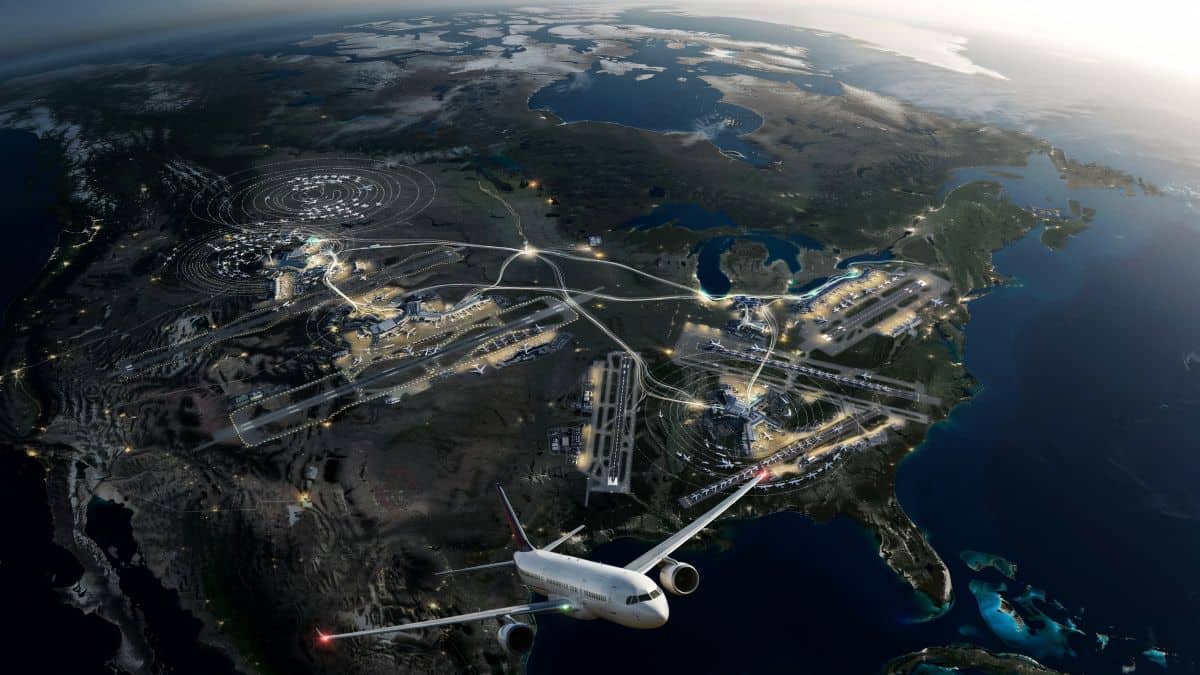
Image generated with Ai
Canada’s alignment with the US, Mexico, Brazil and other key aviation stakeholders reflects a continent-wide strain on American air transport systems as FIFA World Cup 2026 travel demand converges with pre-existing capacity constraints across major hubs and cross-border air corridors. The development highlights a synchronized pressure point across interconnected aviation markets spanning North America and parts of South America, where passenger flows are increasingly shaped by regulated throughput limits rather than unconstrained demand growth.
The integration of World Cup-related travel surges into already tightly managed airspace networks is amplifying operational stress across major gateway airports, including New York, Chicago, Mexico City and Toronto, with spillover effects extending into feeder routes from Brazil and Colombia. This has elevated coordination requirements between US, Canadian and Mexican air traffic authorities at a time when structural constraints such as staffing gaps and runway throughput ceilings continue to define system capacity.
According to aviation oversight frameworks and capacity assessments referenced by institutions including the US Federal Aviation Administration (FAA), Transport Canada, NAV CANADA, the International Civil Aviation Organization (ICAO), and system-wide air traffic flow management data used by global aviation regulators, North American airspace continues to operate under managed demand conditions where scheduling controls and flow restrictions are necessary to maintain safety and operational stability during peak traffic cycles.
Air travel across the Americas is heading into a structurally constrained phase as FIFA World Cup 2026 demand overlaps with already stretched aviation infrastructure in the United States, Canada, and Mexico. According to operational frameworks published by the US Federal Aviation Administration (FAA), Transport Canada, and NAV CANADA, the region’s airspace is functioning under sustained capacity management rather than expansion-led growth.
Advertisement
Advertisement
The tournament is expected to generate between 6 million and 10 million international travellers across 16 host cities, creating one of the largest coordinated passenger surges in modern aviation history. Unlike traditional peak seasons, this demand is distributed across multiple countries and hundreds of airport pairs, placing simultaneous pressure on interconnected air traffic systems.
The result is a continent-wide operational challenge where congestion is no longer localised but network-wide, affecting flight schedules, routing strategies, and airport capacity management across the hemisphere.
The National Airspace System in the United States operates under continuous balancing mechanisms designed to prevent overload. These include Ground Delay Programs (GDPs), Air Traffic Flow Management measures, and airport-specific operational caps.
FAA reporting and congressional aviation oversight documents confirm that the system continues to face a significant shortage of air traffic controllers, estimated at approximately 3,000 personnel below required staffing levels in recent operational assessments. This shortage directly affects airspace throughput and limits the ability to expand flight operations during peak demand periods.
As a result, the system is increasingly dependent on demand regulation rather than infrastructure expansion. This approach is particularly evident during summer travel peaks, when weather volatility and tourism demand intensify congestion across major hubs.
Key structural pressures include:
These conditions form the operational baseline against which World Cup-related demand is being absorbed.

Image generated with Ai
The FIFA World Cup 2026 represents a uniquely complex aviation demand scenario due to its scale, geographic distribution, and duration.
Official tournament planning frameworks confirm:
Unlike single-city global events, the World Cup is distributed across a tri-national network involving the United States, Canada, and Mexico. This structure significantly increases air traffic complexity, as passenger flows are distributed across multiple major and secondary airports simultaneously.
Aviation authorities and transport planners classify this type of demand as a “network load event,” where congestion is not localised but system-wide.
Key aviation demand drivers include:
Canada plays a critical supporting role in the North American aviation network through NAV CANADA, the country’s air navigation service provider responsible for managing Canadian-controlled airspace.
During the World Cup period, Canadian airports such as Toronto Pearson International Airport and Vancouver International Airport are expected to function as redistribution and transit nodes for international arrivals, particularly from Europe and Asia.
Operational pressures include:
Transport Canada and NAV CANADA operational frameworks emphasise coordinated flow management across North American airspace to reduce congestion spillover between countries.
Several major US airports are already operating under FAA-imposed or FAA-coordinated capacity controls to manage congestion risks.
The New York aviation system represents one of the most constrained airspace environments in the country. FAA coordination measures have extended flight limitations across the region due to persistent congestion and staffing shortages.
Operational characteristics include:
FAA data and operational guidance indicate that the New York metro area accounts for a disproportionately high share of national flight delays, with cascading effects across the broader US network.
Chicago O’Hare, one of the world’s busiest aviation hubs, has been subject to structured operational limits during peak summer seasons. FAA regulatory measures have introduced daily flight caps to stabilise system performance during high-demand periods.
This reflects broader capacity management strategies aimed at preventing systemic delay propagation across national and international routes.
Large US airports such as Atlanta, Dallas–Fort Worth, and Los Angeles function as critical redistribution nodes within the national airspace system. When congestion occurs at any of these hubs, delays propagate across multiple regional and international routes due to tightly integrated scheduling networks.
Mexico’s aviation system is positioned at the centre of World Cup operational pressure due to its role as both host and transit hub.
Key host cities include Mexico City, Guadalajara, and Monterrey. Mexico City International Airport (AICM) already operates near saturation during peak hours, leading to ongoing reliance on Mexico’s newer Felipe Ángeles International Airport (AIFA) as a secondary distribution hub.
Operational challenges include:
This dual-airport model is intended to distribute demand but also introduces additional coordination complexity during peak international arrivals.
While not primary host regions, Brazil and Colombia significantly influence aviation demand into the North American system during the World Cup period.
According to international aviation traffic trends documented by civil aviation authorities, South America remains one of the fastest-growing feeder regions for US-bound tourism during peak summer seasons.
Key impacts include:
These flows add incremental pressure to already constrained US gateway airports.

Image generated with Ai
A defining feature of the North American aviation system is its interconnected hub-and-spoke architecture. This structure allows for efficient connectivity but also creates vulnerability during high-demand periods.
Key congestion mechanisms include:
These are implemented when airport arrival demand exceeds safe runway capacity. Flights are delayed at their origin airports to regulate traffic flow into congested destinations.
Delays at major hubs such as New York or Chicago can propagate across national schedules, affecting hundreds of downstream flights within hours.
Summer weather patterns in the United States, particularly convective storm activity across the Midwest and Southeast, regularly compound congestion-related delays.
The FAA is actively pursuing modernization initiatives aimed at improving airspace efficiency. One key development is the deployment of advanced airspace management systems designed to improve predictive scheduling and reduce congestion-related delays.
However, these systems are still in phased implementation and are not expected to fully offset peak World Cup demand pressures.
Mitigation strategies currently in use include:
Despite these measures, capacity constraints remain structurally embedded in the system.
As of mid-2026, the aviation environment across the Americas is best characterised as a managed capacity system operating under sustained structural pressure.
Key defining factors include:
Rather than a system collapse scenario, the current environment reflects a controlled equilibrium in which demand is continuously regulated to match constrained supply.
In conclusion, Canada joins US, Mexico, Brazil and others as FIFA World Cup 2026 demand triggers unprecedented aviation congestion across Americas impacting millions of travelers, confirming a continent-wide shift in how American airspace is managed under peak global demand. The combined pressure of FIFA World Cup 2026 travel flows across the United States, Canada, Mexico, and Brazil is intensifying congestion at major aviation hubs, where capacity limits and coordinated flow controls are shaping passenger movement patterns. As a result, millions of travelers are expected to face tightly managed schedules across interconnected routes. Ultimately, Canada aligns with US, Mexico, Brazil and others as FIFA World Cup 2026 demand triggers unprecedented aviation congestion across Americas impacting millions of travelers due to structural constraints and synchronized cross-border aviation dependencies.
Advertisement
Advertisement
Advertisement













Saturday, September 5, 2026

Friday, September 4, 2026

Saturday, September 5, 2026

Saturday, September 5, 2026

Thursday, September 3, 2026

Wednesday, September 2, 2026

Saturday, September 5, 2026

Saturday, September 5, 2026


