
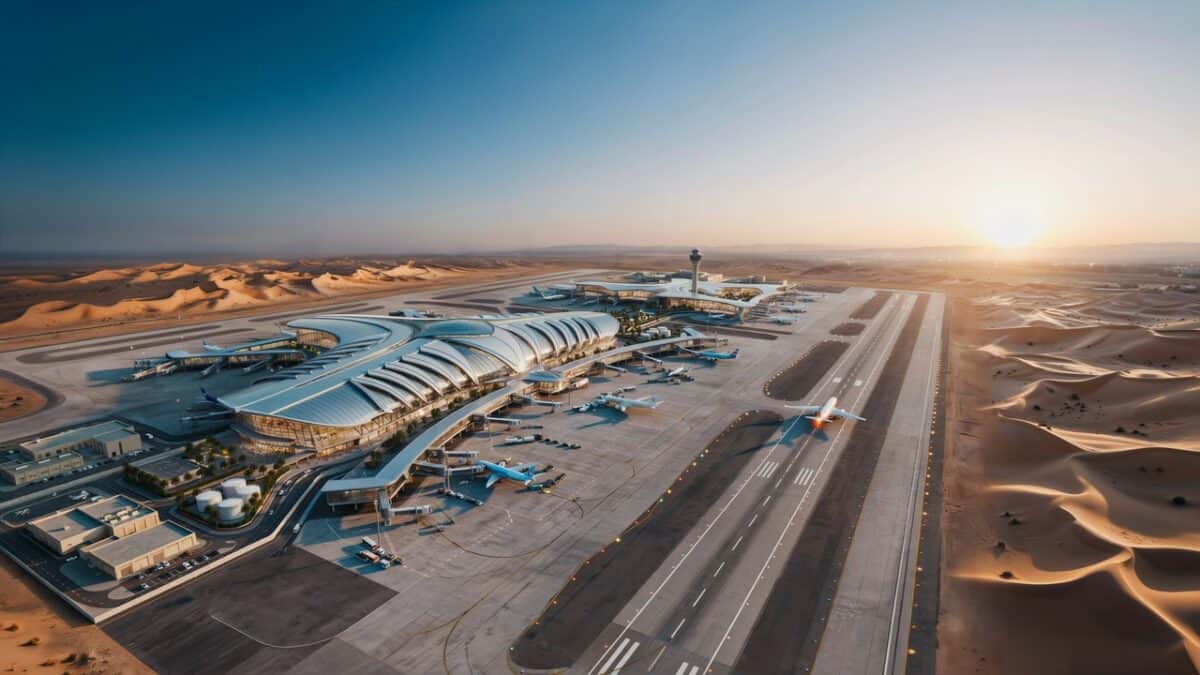
Image generated with Ai
Saudi Arabia is building King Salman International Airport in Riyadh, a $30 billion mega aviation hub designed to handle up to 185 million passengers annually. Backed by the Public Investment Fund and aligned with Vision 2030, the project aims to transform Riyadh into a global transit powerhouse, reshaping Middle East aviation competition against Dubai, Doha, and Istanbul while accelerating tourism growth and connectivity.
Saudi Arabia is rewriting the global aviation map with the construction of King Salman International Airport in Riyadh. This is not a routine infrastructure upgrade. It is a strategic national transformation. The airport is designed to become one of the world’s largest aviation hubs, reshaping passenger flows across Europe, Asia, and Africa.
Advertisement
The project comes at a time when global travel demand is rebounding, airline networks are expanding, and Gulf competition for transit dominance is intensifying.
The timing of the King Salman International Airport project is tightly linked to Saudi Arabia’s Vision 2030 strategy. The Kingdom is actively shifting its economy away from oil dependency and positioning aviation as a central growth engine.
Advertisement
Advertisement
Riyadh already sits on one of the most strategic air corridors in the world, connecting East and West. The airport’s design capacity of 185 million passengers places it far ahead of current global leaders like Atlanta, Dubai, and Istanbul.
This expansion is also driven by three global aviation trends:
Unlike earlier mega airport concepts in the region, Riyadh’s project is directly tied to airline expansion and national tourism targets, making it structurally more demand-driven.
The biggest beneficiaries of King Salman International Airport are not just airlines but entire economic sectors.
Saudi Arabia’s sovereign wealth fund, the Public Investment Fund, expects the airport to generate billions in non-oil GDP annually and create more than 100,000 long-term jobs.
Key beneficiaries include:
Saudi Arabia’s push to reach 150 million annual visitors is directly tied to aviation capacity expansion. The airport acts as the gateway to religious tourism, business travel, and emerging leisure destinations like NEOM and the Red Sea coast.
Passengers travelling between Europe and Asia will benefit from shorter connection routes and potentially reduced congestion compared to Dubai or Doha.
The project also strengthens Saudi Arabia’s competitive positioning against established hubs like Dubai International Airport and Istanbul Airport.
For international travellers, King Salman International Airport will redefine the transit experience.
The airport is designed around speed, automation, and seamless connectivity. Unlike traditional mega hubs that suffer from long transfer times, Riyadh’s layout prioritises:
The airport’s six-runway system will significantly increase aircraft movement efficiency, allowing Riyadh to handle peak global traffic without the congestion issues seen in older hubs like London Heathrow.
For passengers, this means:
The airport is also expected to become a destination itself, integrating retail, hospitality, and urban infrastructure within its aerotropolis model.
The Middle East already hosts three dominant aviation hubs: Dubai, Doha, and Istanbul. Riyadh’s entry changes the competitive equation.
Dubai International currently leads in international passenger volume, while Doha’s Hamad International dominates premium transit services. Istanbul Airport has rapidly expanded its global connectivity footprint.
King Salman International Airport introduces a fourth mega hub with distinct advantages:
However, aviation analysts remain cautious. Previous mega airport projects globally have struggled to meet projected passenger volumes due to airline dependency and demand gaps.
Riyadh’s advantage lies in timing and coordination: airport construction, airline growth, and tourism expansion are happening simultaneously rather than sequentially.
The airport is currently under phased development, with early runway and infrastructure works already underway. Initial operational capacity is expected in the coming years, gradually scaling toward full deployment in the 2030s and beyond.
The long-term roadmap includes:
The ultimate target of 185 million passengers annually places it in a category beyond current global aviation benchmarks.
Whether this figure is fully achieved will depend on airline fleet expansion, global travel demand, and geopolitical stability, but the structural foundation is already in motion.
King Salman International Airport is not just a Saudi project. It represents a structural shift in global aviation power.
For decades, global transit has been dominated by a small number of mega hubs. Riyadh is positioning itself as the next-generation connector between continents.
If successful, the airport could:
The project signals a future where aviation infrastructure is no longer just about capacity but about geopolitical influence, economic transformation, and national branding.
Advertisement
Advertisement
Advertisement












Saturday, September 5, 2026

Saturday, September 5, 2026

Saturday, September 5, 2026

Saturday, September 5, 2026

Saturday, September 5, 2026
Saturday, September 5, 2026

Saturday, September 5, 2026

Saturday, September 5, 2026



