
Los Angeles and More Hotels Embrace AI Automation Amid Rising Labour Costs Across US

Published
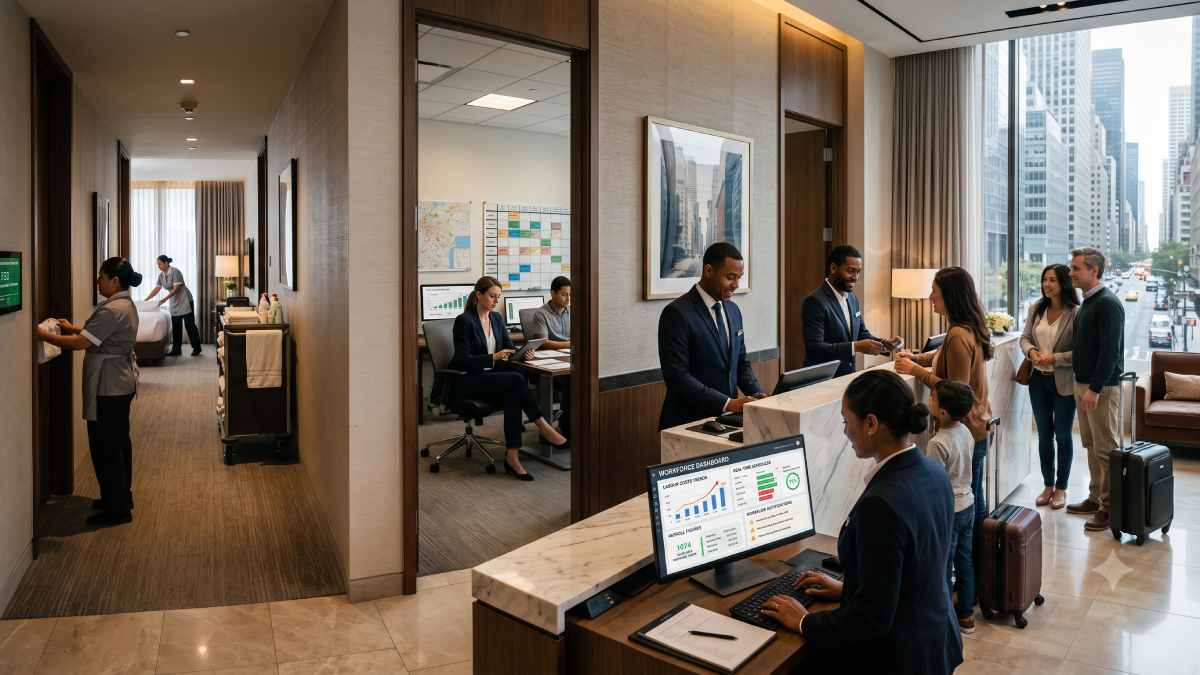
Image generated with Ai
Global portfolios of hotels struggle with severe margin compression owing to disparate regulatory environments and rising operating costs within significant transatlantic markets. While the problem of stringent penalties from municipal predictive scheduling laws and room cleaning workload limits confronts American hoteliers, that of statutory caps on working hours, compulsory rest provisions, and hefty social security payments is encountered by their European counterparts. In order to ensure their bottom lines do not suffer, enterprises in the industry are quickly doing away with traditional manual administration processes to rely on algorithmic back office control mechanisms. Through aligning live property management projections with numerous statutory considerations, unpredictable guest demands are reconciled with labor compliance requirements using the automated process in question.
The Macro Paradigm Shift in Hotel Back-Office Operations
Hospitality administrative operations have historically been grounded upon fragmented, highly reactive workflows. For decades, departmental rotas were compiled days in advance by property-level managers using static occupancy estimates, room attendant productivity was tracked via handwritten clipboards, and vendor disbursements were processed weeks after inventory delivery. While this decentralized, manual model functioned adequately during periods of wage stability and predictable guest booking patterns, it has broken down under contemporary macroeconomic and regulatory conditions. Administrative inefficiencies have been transformed into substantial drains on gross operating profit by compressed booking windows, persistent operational wage inflation, and aggressive regulatory enforcement.
Advertisement
Advertisement
It has been underscored by data published by the Organisation for Economic Co-operation and Development (OECD) that services and hospitality wages have escalated significantly across member countries, with operating expenses across the sector being elevated by structural skill mismatches and recruitment bottlenecks. Simultaneously, it has been documented by the US Bureau of Labor Statistics that total employer compensation costs in the leisure and hospitality sector have reached record highs, compounding pressure on operating margins. These mounting cost pressures are exacerbated by sweeping legislative reforms across major metropolitan areas, where departmental profits can rapidly be eliminated by statutory penalties for scheduling oversights.
In response to these compounding headwinds, an operational transition toward continuous, data-driven administrative loops governed by algorithmic back-office orchestration is being executed by multi-property portfolios. Rather than workforce scheduling and operating expenses being evaluated as historical line items, automated, bidirectional data exchanges between front-of-house demand signals and back-of-house compliance engines are created by modern enterprise software platforms. By connecting real-time property management system reservation data with digital scheduling guardrails, operational liabilities can be identified and mitigated before they occur. General managers or department supervisors are not sought to be displaced by this structural shift; instead, routine administrative friction is eliminated, allowing hotel leadership to focus on guest service delivery and margin defense.
Advertisement
Advertisement
The Transatlantic Regulatory Battlefield: Fragmented Volatility Versus Statutory Rigidity
The operational friction facing hotel portfolios diverges sharply between the United States and the European Union. While assets in both markets are confronted with margin compression, opposing philosophies of labour governance are reflected in the regulatory origins of this pressure.
An employment framework that is largely decentralized and at-will at the federal level is operated under in the United States hospitality market, governed primarily by the Fair Labor Standards Act, under which overtime is assessed after forty hours of work in a single workweek. However, this baseline is increasingly overshadowed by a proliferation of municipal and state regulations. Over the past decade, aggressive fair workweek statutes and hotel worker protection ordinances have been enacted by major metropolitan centers, mandating advance schedule notices, imposing severe financial penalties for short-notice roster adjustments, and setting strict daily physical workload limits for housekeeping personnel. Short-notice volatility and unexpected statutory fines triggered by standard managerial roster adjustments therefore constitute the primary operational risk for American operators.
Advertisement
Advertisement
Conversely, macro-statutory rigidity established by European Union directives, national labour codes, and binding sectoral collective bargaining agreements is operated under by European hotel properties. Operating conditions across key tourism markets including France, Germany, Spain, and Italy are shaped by the European Union Working Time Directive and the Directive on Transparent and Predictable Working Conditions. Strict legal limits on maximum working hours, uninterrupted daily rest periods, and advance schedule transparency are established by these directives.
Furthermore, it has been shown by data from Eurostat and national statistical authorities that non-wage labour costs—encompassing mandatory employer social security contributions, healthcare levies, and statutory retirement provisions—add substantial overhead to base wages, frequently representing between a quarter and a half of total labour costs in Western European nations. Rather than short-notice financial penalties being managed, structural staffing caps, statutory works council approvals, and permanent contractual liabilities must be navigated by European hoteliers.
Advertisement
Advertisement
| Operational Dimension | United States Framework (State and Municipal) | European Union Framework (National and CBA) |
| Primary Regulatory Drivers | Municipal and State Fair Workweek Ordinances; Hotel Worker Protection Ordinances | EU Working Time Directive; Directive on Transparent and Predictable Working Conditions; National Labour Codes; Sectoral CBAs |
| Scheduling Notice Window | Advance posting of one to two weeks mandated in regulated cities | Notice required weeks to months in advance via cyclical rosters, annualised time agreements, or CBA protocols |
| Schedule Adjustment Liability | Statutory predictability pay assessed (extra wage hours or partial pay for cancelled shifts) | Procedural prohibitions; invalidation of unilateral schedule adjustments; works council disputes |
| Mandatory Rest Constraints | Clopening restrictions enforced (specified rest required; violations trigger wage premiums or flat fines) | Statutory minimum of eleven consecutive hours of daily rest; uninterrupted weekly rest |
| Weekly Hour Ceilings | Statutory overtime pay triggered beyond weekly standard | Maximum average weekly ceilings enforced; statutory reference workweeks applied |
| Non-Wage Payroll Burdens | Moderate employer payroll taxes assessed | Substantial mandatory social security contributions and levies assessed |
| FinTech and Invoice Mandates | Commercial virtual cards and real-time automated three-way invoice matching adopted | Mandatory nationwide B2B e-invoicing clearance systems and strict cross-border tax controls enforced |
| Core Automation Objective | Prevention of statutory penalty triggers and dampening of payroll volatility from demand swings | Management of fixed contractual hours, works council compliance, and non-wage social burdens |
Granular United States Municipal Enforcement: The Cost of Scheduling Friction
In the United States, managing hotel portfolios requires navigating a patchwork of municipal labor ordinances where severe statutory liabilities are carried by operational oversights.
California: Workload Ceilings and Housekeeping Protection Ordinances
One of the most operationally demanding regulatory landscapes for hospitality operators in North America is represented by California municipal policies. In jurisdictions including Los Angeles, Santa Monica, West Hollywood, and Long Beach, stringent hotel worker protection ordinances have been enacted to regulate room-cleaning workloads and enhance employee physical safety.
Under the City of Los Angeles Hotel Worker Protection Ordinance and the corresponding Los Angeles County measure governing unincorporated areas, housekeeping assignments are subjected to statutory square-footage limitations per eight-hour shift. Regular room cleaning assignments are capped at specified floor space ceilings based on operational room count thresholds.
Aggressive deductions to these square-footage caps based on property layouts are mandated by the statute. If an attendant is required to clean floor space in more than one hotel building during a single workday, the total allowable square footage is reduced by a set statutory deduction for each additional building. Furthermore, reductions are triggered or multiple cleaning units are counted when assignments span multiple floors or contain rollaway beds. Whenever an employee is assigned cleaning duties that exceed these dynamic limits, compensation for all hours worked during that shift must statutorily be provided by the hotel employer at double the employee’s regular rate of pay.
Advertisement
Advertisement
Under Los Angeles County rules, covered hotel employers are also required to ensure that certified housekeeping instruction is completed by room attendants to obtain a Public Housekeeping Certificate. Operators are exposed to daily statutory penalties per aggrieved employee, collective daily penalty ceilings, and treble damages for willful violations if comprehensive digital logs of individual room dimensions, actual square footage cleaned, rollaway bed assignments, overtime consent documents, and panic button system verifications fail to be maintained.
New York City: Predictive Scheduling and Predictive Pay Penalties
In New York City, labor mandates intersect with hospitality operations through both the New York City Fair Workweek Law enforced by the Department of Consumer and Worker Protection and the Safe Hotels Act, which regulates hotel operational licensing and staffing structures. For hospitality and retail entities covered under municipal predictive scheduling provisions, written work schedules must be published by employers at least two weeks before the beginning of each scheduling cycle.
Mandatory predictability pay is incurred by the business whenever a published schedule is altered by an employer—whether by modifying shift hours, adding unexpected shifts, or subtracting scheduled time due to unexpected cancellations. Predetermined statutory penalty premiums are triggered per occurrence according to the amount of advance notice provided, with higher fees being assessed for short-notice cancellations. Furthermore, back-to-back closing and opening shifts separated by fewer than eleven hours of rest are strictly prohibited, unless written consent is provided by the worker and a mandatory flat predictability premium is received.
Chicago: Fair Workweek Rules and Clopening Restrictions
A stringent predictive scheduling enforcement framework is established by Chicago’s Fair Workweek Ordinance, overseen by the Department of Business Affairs and Consumer Protection. Covering hotel employers meeting designated employee thresholds, schedules are required to be posted two weeks in advance.
Under the Chicago framework, predictability pay equal to an additional wage increment at the standard rate is earned by the employee for any employer-instigated schedule modification within the advance notification window. If a shift is cancelled or reduced in length with short notice, a proportion of the employee’s regular rate for all unworked hours must be paid by the hotel.
Additionally, an explicit standard regarding the right to rest is enforced. The statutory right to decline work shifts scheduled fewer than ten hours after the conclusion of a prior shift is held by workers. Should consent to work within that rest window be voluntarily provided in writing by an employee, an elevated wage premium for all hours worked during that subsequent shift is legally required to be paid by the operator. Substantial back-wage liabilities and municipal enforcement audits are rapidly generated across multi-property portfolios by unannounced schedule practices that quietly violate these mandates.
Advertisement
Advertisement
Oregon: Statewide Predictive Scheduling and Audit Trails
A comprehensive statewide Fair Workweek statute encompassing hospitality, retail, and food service businesses meeting enterprise employment thresholds is enforced by Oregon. Multi-property hospitality operators are required by the statute to provide new hires with a written good-faith estimate of their median work hours and typical shift patterns at the time of recruitment.
Schedules must be published two weeks in advance, and back-to-back shifts separated by fewer than ten hours require both explicit employee consent and overtime compensation calculated at a premium wage rate. Predictability compensation is required for any schedule adjustment inside the advance notice window, taking the form of extra wage hours for added shifts or partial pay for hours eliminated. Crucially, verifiable records of written schedules, consent forms, and schedule adjustments are required by the Oregon Bureau of Labor and Industries to be retained for a multi-year period, necessitating immutable digital audit trails across multi-unit operations.
The Granular European Regulatory Landscape: Macro-Statutory Caps and Social Costs
Operating hotel portfolios in Western and Southern Europe requires compliance with codified national employment statutes, constitutional rest entitlements, and institutional trade union oversight.
France: The Statutory Workweek, RTT Management, and Mandatory B2B E-Invoicing
In France, hotel back-office administration is operated under the framework of the French Labour Code, anchored to the statutory standard workweek. In the hospitality sector, while variations in weekly scheduling are permitted by sector-level collective bargaining agreements, any hours worked beyond the statutory threshold must be compensated via premium pay or balanced through the accrual of compensatory leave.
Systemic audits conducted by the labour inspectorate represent the primary operational risk for a hotelier in France, rather than financial predictability penalties for short-notice shifts. Properties are examined by labour inspectors to ensure adherence to mandatory daily rest intervals and continuous weekly rest mandates. Severe administrative penalties, retroactive payroll levies, and criminal liabilities for corporate directors under statutes governing concealed employment can be triggered by unrecorded overtime or poorly tracked compensatory leave balances.
Furthermore, high non-salary social charges are faced by French hotel operations, with substantial overhead being added to gross salary costs by employer social security contributions for health insurance, family allowances, unemployment funds, and pensions. Coupled with the nationwide rollout of mandatory business-to-business electronic invoicing routing commercial invoices through partner dematerialisation platforms and the national portal, invoice clearances must be automated by hotel accounts payable departments to maintain complete tax audit compliance.
Advertisement
Advertisement
Germany: Works Councils and Co-Determination Under the Betriebsverfassungsgesetz
The German hospitality operational model is governed by co-determination. Under the Works Constitution Act, hotel properties where a works council has been established by employees are legally barred from unilaterally determining or altering employee work schedules.
Pursuant to statutory co-determination provisions, an enforceable right is possessed by the works council over the beginning and end of daily working hours, break schedules, the distribution of working time across days of the week, and any temporary extension or reduction of normal operating hours. It has been established by the Federal Labour Court that a duty roster published without the explicit, formal agreement of the works council is legally void. If shifts are attempted to be adjusted by a department head to manage an unexpected influx of guests without works council consent, an immediate cease-and-desist injunction can be sought before the labour court, halting operational schedule changes.
Moreover, co-determination rights are granted to works councils over the introduction and utilization of technical systems designed to monitor the performance or conduct of employees. Any workforce management software or algorithmic scheduling mechanism that tracks employee velocity, logs check-in times, or automatically assigns housekeeping rosters must be formally vetted through an agreed Works Agreement before property deployment.
Spain and Italy: Managing Seasonal Staffing Cycles, Fijo-Discontinuo Reforms, and Anti-Precarity Mandates
In Spain and Italy, substantial seasonal volatility is contended with by tourism-heavy economies while operating under stringent national employment legislation designed to curtail temporary contracting. In Spain, the hospitality employment model was restructured by landmark labour reforms that effectively abolished traditional temporary contracts for specific works and services. Consequently, the permanent-seasonal contract must be utilized by hotels for cyclical operating peaks.
Under the permanent-seasonal framework, workers remain permanent members of the workforce whose contractual duties and pay are suspended during low-occupancy off-seasons. When seasonal demand resurges, rigorous statutory procedures for recalling employees must be followed by operators, adhering strictly to seniority rankings and department rosters registered with the state employment service. Hotel owners are exposed to substantial administrative fines and mandatory contract reclassification if statutory recall protocols are deviated from or if permanent seasonal duties are misclassified as temporary staffing.
In Italy, hospitality operations are similarly bound by national sector agreements and the National Social Security Institute. Inflexible contractual classifications, combined with substantial employer social contributions relative to total compensation, require rigorous roster management so that fixed labor overheads can be controlled without violating European anti-precarity mandates.
Advertisement
Advertisement
Automating the Exception: Technical Architecture of Algorithmic Back-Office Orchestration
Operating profitably within this fragmented regulatory landscape requires replacing manual scheduling with algorithmic back-office orchestration. Modern orchestration architectures operate as intelligent middleware, establishing continuous bidirectional communication between property management systems, operational departments, and jurisdictional compliance engines.
Continuous API Integration: Linking Property Management Systems to Predictive Scheduling Engines
The programmatic consumption of real-time property management system data forms the foundation of modern back-office orchestration. Rather than schedules being generated based on weekly occupancy snapshots, live changes in guest bookings, group arrivals, early check-outs, and travel disruptions are evaluated by automated engines. When a reservation cancels or extends unexpectedly, operational labor requirements across all core divisions—including front desk, food and beverage, and housekeeping—are automatically recalculated by the orchestration layer.
Crucially, labor adjustments are evaluated against local regulatory rule sets by the algorithm before a recommended schedule is generated. The marginal cost of altering a shift is computed by the engine in heavily regulated municipalities: the expense of paying an existing worker overtime or predictability pay is balanced against the statutory fee incurred by cancelling a scheduled shift or adding an extra worker on short notice.
If an adjustment is operationally necessary, an automated shift-swapping module is deployed by the platform. Under many fair workweek statutes, employer predictability pay penalties are not triggered by voluntary shift swaps between qualified co-workers. Open shifts are broadcast by the software to eligible employees who can accept assignments via mobile applications, creating an auditable, employee-consented schedule change.
In Germany, works council notification and approval cycles are factored into shift generation by the orchestration system. Scheduling variations are modeled weeks in advance by the platform, ensuring that baseline duty rosters are submitted to the works council with complete transparency regarding rest intervals, shift rotations, and overtime distributions, pre-empting costly administrative disputes.
Dynamic Housekeeping Workload Allocation: Enforcement of Physical Ceilings
Nowhere is the necessity for automated orchestration more acute than in housekeeping management. Under complex municipal measures such as the Los Angeles Hotel Worker Protection Ordinance, distributing room assignments by unit count alone is recognized as a direct route to financial penalty triggers.
Advertisement
Advertisement
Detailed architectural metadata—such as the exact square footage of each room, property layouts across separate detached buildings, and floor configurations—are integrated directly into daily assignment algorithms by modern housekeeping management systems. Real-time check-out information is ingested from the property management system, and room attendant assignments are dynamically compiled while hard operational constraints are executed:
- Cumulative daily square footage is tracked against statutory ceilings based on property capacity thresholds.
- Allowable square footage thresholds are automatically reduced by statutory deductions if rooms across separate wings or detached structures are assigned to an attendant.
- Calibrated workload weights are applied to special cleanings, stay-overs, check-outs, and extra rollaway beds to ensure that standard-time thresholds are not breached without explicit management awareness.
- If the statutory ceiling is projected to be crossed by an attendant’s assignment, the operational exception is flagged in real time, and the executive housekeeper and financial controller are notified of the exact premium wage impact prior to dispatch.
- Simultaneously, shift intervals are automatically checked by the system to prevent scheduling attendants on consecutive shifts separated by insufficient rest, eliminating clopening penalty triggers across relevant jurisdictions.
All assignments, actual square footage cleaned, mobile task completion timestamps, and digital employee acknowledgments are permanently archived in cloud-based compliance vaults. Multi-year, indisputable audit trails are thereby provided to protect operators against prospective municipal enforcement actions or collective civil claims.
Next-Generation Technology Stack: Unifying Labour Optimization with FinTech and Automated Procurement
A truly orchestrated hotel back office goes beyond workforce scheduling; dynamic labor management is bridged with real-time financial technology and automated procurement systems. Historically, operational success was evaluated by general managers through static monthly profit and loss statements delivered weeks after period close. In contrast, labor planning engines are unified with automated procurement by modern orchestration platforms to compute daily gross operating profit.
Commercial Virtual Cards and Automated Three-Way Invoice Verification
Procurement in hospitality involves hundreds of decentralized transactions weekly, ranging from food and beverage provisions to linen replenishment and contracted engineering services. Delays, missing accruals, and vulnerability to duplicate billing are created by traditional manual invoice processing. This operational workflow is automated by modern financial orchestration tools through commercial virtual cards and automated three-way invoice matching:
- Dynamic Virtual Commercial Cards: Merchant-locked, single-use, or fixed-limit virtual credit cards are issued by the finance platform when approved operational purchases must be made by property-level managers. Specific purchase order metadata, general ledger account codes, and departmental cost centers are automatically attached to these cards at the instant of transaction.
- Automated Three-Way Matching: Vendor invoices are ingested by optical character recognition engines, cross-referencing invoice line items automatically against purchase orders and receiving logs stored in the property’s materials management software. Discrepancies exceeding defined tolerances are instantly routed for operational review.
- European E-Invoicing Compliance: Where commercial invoice delivery is dictated by government-mandated clearinghouse models, structured electronic invoices are validated in real time by orchestration platforms. Cross-border tax accuracy and supplier payment compliance under statutory payment directives are thereby secured.
Real-Time Visibility Over Gross Operating Profit
Daily operational visibility over gross operating profit is obtained by hotel general managers and regional asset directors through the linking of labor optimization engines with automated procurement workflows. Instead of accounting reconciliations being waited upon, daily operational revenues from the property management system are calculated by the platform and offset against live operational expenses:
- Real-Time Labour Costs: Calculated dynamically based on actual employee hours clocked, scheduled shifts, statutory benefit burdens, accrued overtime, compensatory leave provisions, and local predictability pay premiums.
- Real-Time Direct Operating Expenses: Calculated from executed purchase orders, virtual card charges, and approved inventory requisitions.
Margin degradation can be identified and corrected in real time as a result of this unified financial transparency. If room departmental profit margins are threatened by an unforeseen drop in midweek occupancy, algorithmically suggested operational adjustments—such as consolidating service shifts via voluntary swaps, reallocating cross-trained staff across properties, or adjusting variable purchasing orders—can be reviewed by the executive team without statutory rest intervals being violated or predictive scheduling fines being triggered.
Advertisement
Advertisement
Economic and Tourism Industry Implications: Margin Defense in an Era of Persistent Inflation
The broader economic implications of back-office orchestration extend directly to asset valuation, capital investment, and debt service coverage ratios for hospitality real estate owners. It has been shown by analytical studies published by the OECD and UN Tourism that hospitality enterprises operate with structural vulnerability to inflationary input shocks because the overwhelming majority of their cost baseline is constituted by labour and direct operating expenses. Payroll and related employment taxes routinely represent a substantial portion of total gross operating revenue in mature metropolitan hospitality markets, meaning that outsized impacts on net cash flows are exerted by minor percentage shifts in labour efficiency.
When unpredictable scheduling penalties or square-footage caps are introduced by municipalities, these charges are absorbed as recurring operational losses by un-orchestrated properties. Substantial cumulative annual predictability pay and overtime penalties can easily be incurred by a full-service hotel operating without compliance automation. Net operating income is reduced by these recurring losses, suppressing underlying asset capitalisation values for commercial real estate investment trusts and institutional property owners.
Conversely, superior operating margin resilience is demonstrated by hotel portfolios that deploy algorithmic back-office orchestration. Hotel profit conversion ratios are protected by these platforms through the elimination of compliance penalties, the standardisation of procurement outlays, and the maintenance of dynamic workforce allocations that scale smoothly alongside actual guest demand. Furthermore, employee burnout is mitigated by preventing non-compliant consecutive shifts and chaotic on-call scheduling, stabilizing property-level retention in an industry historically plagued by expensive turnover.
Future Regulatory Outlook and Strategic Imperatives for Transatlantic Portfolios
It is suggested by the regulatory trajectory across both sides of the Atlantic that labor oversight will intensify throughout the coming decade, making algorithmic management a permanent operational imperative.
In the United States, legislative momentum around predictive scheduling is migrating beyond coastal metropolises into secondary markets. As hotel-specific protections modeled after square-footage caps and licensing-linked operational requirements continue to be considered by more municipalities, disparate local payroll solutions can no longer be relied upon by portfolio operators. Technical infrastructure must be utilized to address compliance risk rather than outsourcing it solely to property-level human resource managers. Enterprise software systems must be architected with localized compliance rule engines capable of updating municipal wage thresholds, notice timelines, and premium formulas without complete system redesigns being required.
Across the European Union, heightened transparency, reduced casualisation, and stricter algorithmic accountability are pointed toward by the regulatory trajectory. It is established by the Directive on Transparent and Predictable Working Conditions that baseline predictability must be provided by shift patterns, restricting the use of precarious on-demand scheduling models across member states.
Advertisement
Advertisement
Furthermore, rigorous standards for automated systems deployed in human resource management and worker monitoring are introduced by the implementation of the European Union Artificial Intelligence Act. Transparent operation, comprehensive technical documentation, adherence to co-determination frameworks, and regular audits to eliminate discriminatory assignment practices must be maintained by algorithmic scheduling software deployed across European properties.
A unified administrative approach is required for international hotel portfolios managing these cross-Atlantic operational dynamics. Technology must serve as an enabling operational layer that neutralizes compliance friction, protects corporate operating margins, and provides frontline leaders with the tools required to manage properties effectively. Operating margins will be defended effectively by those enterprises that successfully bridge predictive operational planning with dynamic regulatory compliance; profitability will continue to be eroded by escalating labor penalties and administrative inefficiency in organizations that rely on obsolete manual processes.
Traditional hotel administration cannot survive escalating statutory complexity across the transatlantic landscape. An essential operational safeguard is provided to enterprise hoteliers through the deployment of algorithmic back-office orchestration, transforming volatile property occupancy shifts and procurement records into compliant, margin-defending workflows. Margin leakage is eliminated as automated compliance engines pre-empt punitive predictive scheduling fees across United States municipalities and manage statutory working-time limits, works council approvals, and social tax burdens across Europe. Continuous gross operating profit visibility is gained by property leadership, liberating general managers from reactive administration so that focus can be directed entirely toward guest service quality, staff engagement, and resilient commercial performance across competing markets.
Conclusion
AI-enabled back-office automation is transforming the hospitality industry due to increased labor costs and regulatory requirements in the United States. Automation helps in streamlining processes such as scheduling, payroll, and procurement, enhancing compliance and efficiency while providing instant financial insights that help hotels cope with labor demands and remain profitable.
Advertisement
