
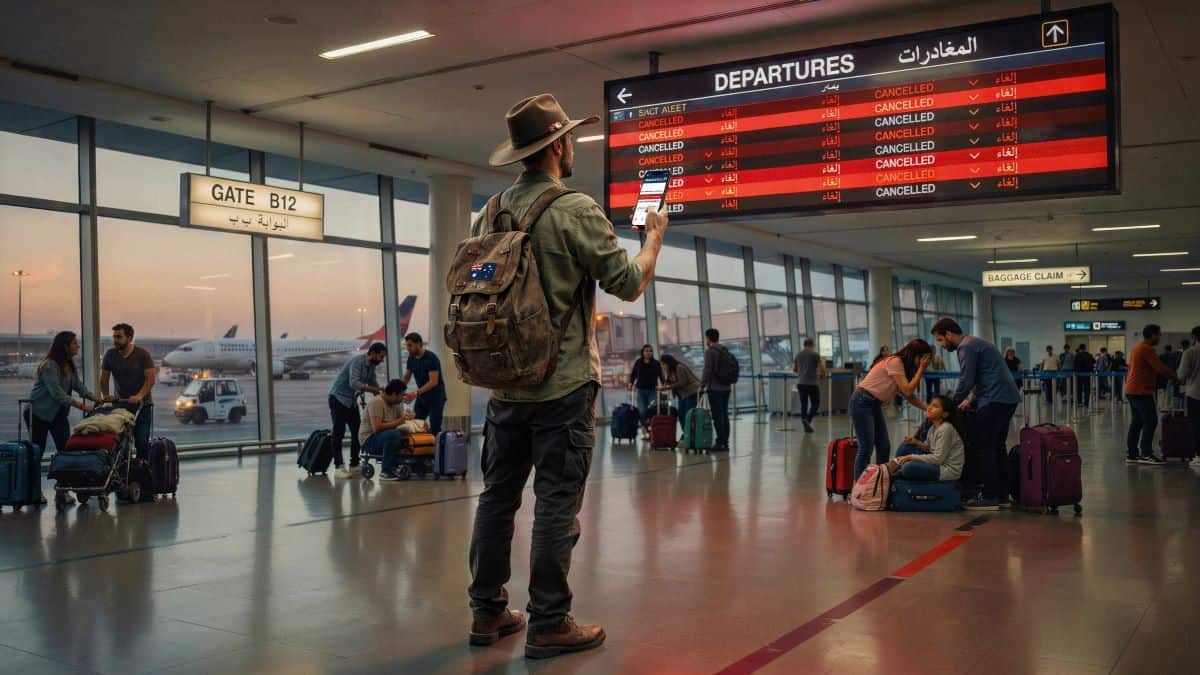
Image generated with Ai
In response to worsening regional security, major governments worldwide including Australia, the US, and the UK, have updated their travel warnings for the Middle East. Following the U.S. State Department’s worldwide caution alert and updated travel guidance from the UK Foreign, Commonwealth & Development Office (FCDO), the Australian Government issued a fresh warning update on July 25, 2026, cautioning citizens about volatile regional conditions, unpredictable airspace closures, and severe flight disruptions across the Middle East.
Through the Department of Foreign Affairs and Trade (DFAT) and its Smartraveller portal, Australian authorities recommend that citizens avoid non-essential travel to regional hubs and stay out of active conflict zones. For those currently located in designated high-risk areas, the Australian Government urges immediate preparation to depart via available commercial transport provided safe routes exist.
Advertisement
Official updates issued by the Australian Department of Foreign Affairs and Trade (DFAT) on Smartraveller divide regional destinations into two primary safety tiers:Destination Official Advice Level Key Safety Directives & Regional Risks Bahrain Level 4: Do Not Travel Raised to Level 4 due to military strikes, drone threats, and regional escalation risks. Iran Level 4: Do Not Travel Extreme risk of military strikes, severe airspace closures, and arbitrary detention. Iraq Level 4: Do Not Travel Ongoing armed conflict, military engagement, and compromised civilian safety. Kuwait Level 4: Do Not Travel Raised to Level 4 following drone attacks targeting defense infrastructure and airspace hazards. Lebanon Level 4: Do Not Travel Active hostilities, frequent aerial bombardments, and severe airport disruptions. Palestine Level 4: Do Not Travel Intense military action, high risk to human life, and restricted border transit. Syria Level 4: Do Not Travel Persistent armed conflict, active combat zones, and total absence of consular care. Yemen Level 4: Do Not Travel Widespread warfare, military operations, and maritime security hazards. Israel Level 3: Reconsider Need to Travel Rocket activity, unpredictable air attacks, and volatile internal security. Jordan Level 3: Reconsider Need to Travel Spillover risks from military engagements, localized protests, and border instability. Oman Level 3: Reconsider Need to Travel Escalated regional tensions, maritime incidents, and air transit warnings. Qatar Level 3: Reconsider Need to Travel Major aviation transit hub subject to sudden air space restrictions and delays. Saudi Arabia Level 3: Reconsider Need to Travel Drone and missile threats targeted at military assets and critical infrastructure. United Arab Emirates (UAE) Level 3: Reconsider Need to Travel Key hub facing potential airspace disruptions, flight delays, and elevated security protocols.
Understanding foreign office warnings helps travelers assess safety conditions, transit viability, and emergency assistance availability. Sovereign governments evaluate threat levels using four distinct tiers, with Levels 3 and 4 representing elevated risks.
Advertisement
Advertisement
Level 4 is the highest security warning issued by diplomatic agencies. A country or region receives a “Do Not Travel” designation when conditions pose an immediate threat to life. Primary triggers for Level 4 advisories include:
When a location is placed under a Level 4 advisory, government authorities advise citizens against visiting under any circumstances. Those already present are urged to leave by commercial means while routes remain available.
A Level 3 advisory flags serious security risks that require individuals to reassess their travel necessity. Reasons for placing a country under Level 3 include:
While travel to Level 3 areas is not legally banned, foreign offices urge citizens to cancel non-essential trips, avoid connecting flights through high-risk transit hubs, and ensure comprehensive contingency planning.
The updated advisories reflect rising risks across multiple domains, affecting civil aviation, critical infrastructure, and ground movement.
Recent developments have caused widespread disruption to commercial flights across major Middle Eastern hubs:
Government security alerts explicitly identify specific locations as potential targets during periods of heightened conflict:
For individuals currently in the Middle East, taking measured, proactive steps can help reduce personal exposure to emergency situations.
While diplomatic posts provide assistance to citizens abroad, operational constraints during active conflicts can limit on-the-ground support.
+61 2 6261 33051300 555 135+1 202-501-4444+44 20 7008 5000In conclusion, Australia follows US, UK and others by updating new Middle East travel advisory issuing “Do Not Travel” for all destinations across Iran, Bahrain, UAE, Kuwait and beyond amid escalating conflict, flight disruptions and security threats to safeguard citizens against extreme hazards. Unpredictable military strikes, drone attacks, and airspace shutdowns present unprecedented operational dangers to international transit. With critical hubs facing severe flight disruptions and heightened security threats, allied foreign offices strongly urge individuals to postpone non-essential trips. By designating critical regional hubs under high alert levels, governments ensure travelers recognize the immediate risks, maintain heightened personal security, and prepare for potential emergency evacuations while commercial routes remain accessible.
FAQ 1. How does a Level 4 warning impact standard travel insurance policies?
A: Most travel insurance policies contain “known event” or “government advisory” exclusions. Entering a country subject to a Level 4 (“Do Not Travel”) warning typically voids coverage for trip disruptions, medical evacuations, and security-related cancellations. Check your insurer’s Product Disclosure Statement (PDS) for specifics.
FAQ 2. What should travelers do if stuck in a transit hub during a flight cancellation?
A: Avoid canceling tickets without consulting your air carrier. Contact airline representatives directly to request rebooking on alternative routes, seek temporary accommodation assistance, and monitor official airport communication channels for updated departure schedules.
FAQ 3. Are government evacuation flights provided when travel advisories are updated?
A: Government-assisted evacuations are rare and typically treated as a last resort when commercial transport options are entirely exhausted. Authorities strongly advise using remaining commercial flights or land crossings while they remain operational.
FAQ 4. How can relatives in Australia check on family members traveling in the region?
A: Relatives can contact DFAT’s 24-hour Consular Emergency Centre on 1300 555 135 within Australia to register details or request assistance on behalf of family members facing severe communication disruptions overseas.
Advertisement
Advertisement
Advertisement













Saturday, September 5, 2026

Friday, September 4, 2026

Saturday, September 5, 2026

Saturday, September 5, 2026

Thursday, September 3, 2026

Wednesday, September 2, 2026

Saturday, September 5, 2026