
Lufthansa Joins American, Southwest, JetBlue, Ryanair, Air India, Aer Lingus, and More Airlines in an Exclusive Global Aviation Shake-Up Slashing Routes, Exiting Airports and Rebuilding Hub Networks Amid Fuel Shock, Capacity Crunch and Rising Costs

Published
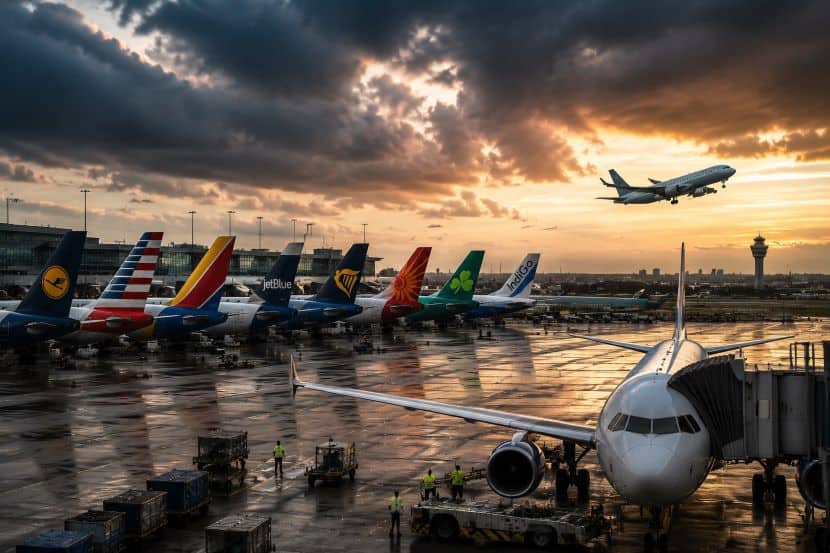
Global aviation is undergoing a pronounced structural reset as Lufthansa joins American Airlines, Southwest Airlines, JetBlue Airways, Ryanair, Air India, Aer Lingus and IndiGo in an exclusive industry-wide shake-up that is reshaping how air networks are built, priced and operated across Europe, the United States, the United Kingdom, Ireland, Germany and India. The shift is defined by airlines slashing routes, exiting airports and rebuilding hub networks at scale, not as isolated schedule adjustments but as a coordinated response to mounting operational and financial strain across the global aviation system.
At the centre of this transition is a fuel shock that has pushed operating costs higher across both long-haul and short-haul segments, forcing carriers to reassess marginal routes that no longer meet profitability thresholds. This is compounded by a capacity crunch driven by aircraft delivery delays, maintenance constraints and limited fleet flexibility, which reduces airlines’ ability to replace or expand services while demand patterns remain uneven across markets. Rising airport charges, labour costs and regulatory compliance pressures further intensify the need for network optimisation, pushing airlines toward fewer but stronger hub-focused operations.
In this environment, Lufthansa is tightening its Frankfurt and Munich hubs, American Airlines is rationalising domestic U.S. routes, Southwest Airlines is consolidating airport presence, JetBlue is retreating from selected international markets, Ryanair is exiting weaker European airports, Air India is reducing long-haul exposure, Aer Lingus is concentrating traffic through Dublin, and IndiGo is compressing domestic capacity. The result is a global aviation system moving decisively from expansion to consolidation, where efficiency and hub strength define connectivity.
Lufthansa: Germany’s Flag Carrier Tightens Hub-Centric Network Strategy
Lufthansa is operating within a structurally expensive aviation environment in Germany, where airport charges, labour costs and regulatory compliance expenses continue to pressure short-haul profitability. The airline is increasingly concentrating its operations around Frankfurt and Munich, while reassessing the viability of lower-yield domestic and intra-European feeder routes.
Advertisement
Advertisement
Lufthansa Network Adjustments (Key Structural Trends)
- Berlin–Frankfurt corridor under review for potential capacity reduction
- Select German domestic feeder routes facing frequency adjustments
- Short-haul European connections to Frankfurt and Munich being rationalised
- Reduced emphasis on marginal intra-European city pairs
- Long-haul hub banks prioritised over low-yield feeder density
- Increased reliance on subsidiary carriers for short-haul efficiency
A key structural change is the redistribution of short-haul flying within the Lufthansa Group. Lufthansa City Airlines is emerging as a primary platform for handling European feeder traffic that no longer fits mainline cost structures. Brussels Airlines also plays a supporting role in absorbing selected European routes where group efficiency can be improved.
Operational Strategy Shift
- Mainline Lufthansa focused on long-haul and premium routes
- Lufthansa City Airlines handling short-haul European feed
- Brussels Airlines supporting selected intra-European segments
- Hub banks at Frankfurt and Munich prioritised for long-haul connectivity
- Reduced daily frequencies on weaker city pairs
For passengers, the impact is often indirect. Instead of visible cancellations, changes appear as aircraft substitutions, altered departure times, reduced frequency options or modified connection banks that affect onward international travel.
Advertisement
Advertisement
Germany’s policy environment adds partial relief. The federal government has reduced air passenger duty from July 2026 and introduced wider aviation cost relief measures, including lower aviation security charges and reduced air traffic control costs. These measures aim to improve competitiveness but do not fully offset structural cost pressures facing German aviation.
Germany Aviation Policy Adjustments
- Air passenger duty reduced across all distance bands from July 2026
- Short-haul: €15.53 → €13.03
- Medium-haul: €39.34 → €33.01
- Long-haul: €70.83 → €59.43
- Reduced aviation security and ATC charges until 2029
- Broader aviation competitiveness strategy introduced
Despite these reforms, Lufthansa continues to prioritise high-yield routes and consolidate marginal flying, particularly where demand volatility limits profitability.
Advertisement
Advertisement
American Airlines: Late-Summer Domestic Route Rationalisation
American Airlines is implementing targeted seasonal adjustments focused on underperforming domestic routes during the late-summer and early-autumn travel window.
Identified Route Adjustments
From Los Angeles:
- Los Angeles – Cleveland (temporary pause)
- Los Angeles – Columbus (temporary pause)
- Los Angeles – Pittsburgh (temporary pause)
- Los Angeles – Washington Dulles (temporary pause)
From Charlotte:
- Charlotte – Ontario, California (temporary pause)
- Charlotte – Sacramento (temporary pause)
These adjustments reflect demand softening after peak summer travel and the economic pressure of maintaining long-haul domestic segments under elevated operating costs.
Advertisement
Advertisement
Structural Drivers
- Post-peak seasonal demand decline
- Elevated aviation fuel costs affecting marginal routes
- Hub optimisation around Dallas/Fort Worth and Charlotte
- Reduced profitability on secondary domestic city pairs
- Increased reliance on connecting hub structures
American Airlines continues to rely heavily on its hub network strategy, using large connecting airports to maintain route flexibility while reducing direct point-to-point exposure where demand is weaker.
Southwest Airlines: Airport Exit Strategy and Network Consolidation
Southwest Airlines is executing a more structural withdrawal from select airports, reflecting a shift toward operational concentration and fleet efficiency.
Airport Exits
- Bellingham International Airport (Washington) – full exit
- Syracuse Hancock International Airport (New York) – full exit
- Houston George Bush Intercontinental Airport – full exit
- Cozumel International Airport (Mexico) – full exit
The consolidation of Houston operations at Hobby Airport is the most significant structural change, improving aircraft utilisation and simplifying operational complexity.
Structural Drivers
- Aircraft delivery delays limiting fleet expansion
- Increased pressure to maximise aircraft utilisation
- Higher importance of quick aircraft turnaround cycles
- Reduction of overlapping airport coverage in major regions
- Simplification of network design to improve efficiency
Southwest’s business model depends on high-frequency aircraft rotation. When fleet growth slows, maintaining lower-performing stations becomes less sustainable, leading to airport exits rather than incremental reductions.
JetBlue Airways: International Retrenchment and Network Refocus
JetBlue Airways is reducing exposure to international expansion markets, particularly in Latin America and selected transatlantic routes.
Network Adjustments
- Full exit from Bogotá (Colombia)
- Full exit from Quito (Ecuador)
- Full exit from Lima (Peru)
- Exit from Kansas City domestic operations
- Reduced frequency on London, Paris and Amsterdam routes
Strategic Shift
- Focus on core domestic US markets
- Reduction of long-haul competitive exposure
- Withdrawal from lower-margin Latin American expansion
- Concentration on stronger leisure and domestic demand corridors
JetBlue’s restructuring reflects a shift from expansion-led strategy toward financial consolidation and network simplification.
Advertisement
Advertisement
Ryanair: Aggressive European Airport Exit Program
Ryanair continues one of the most extensive network restructuring programs in European aviation.
Airport and Route Exits
Portugal:
- Full exit from Azores region (six routes removed)
Spain:
- Exit from Asturias and Vigo
- Closure of Santiago de Compostela base
- Removal of Tenerife North, Jerez and Valladolid services
Germany:
- Suspensions at Dresden, Dortmund, Leipzig/Halle
- Reduced operations at Berlin, Hamburg and Cologne
Other European exits:
- Aalborg and Billund
- Lappeenranta
- Örebro
- Poprad-Tatry
- Brive and Strasbourg
Belgium:
Advertisement
Advertisement
- Major reductions at Brussels and Charleroi
- Removal of 20 routes and approximately 1 million seats
Ireland:
- Cork route exits including destinations in Poland and Italy
Structural Drivers
- High airport taxes and passenger charges
- Rising regulatory and environmental compliance costs
- Low-fare sensitivity to cost increases
- Concentration on high-density, low-cost airports
- Elimination of marginal regional bases
Air India: Long-Haul Network Rationalisation Under Fuel Pressure
Air India is undergoing significant international restructuring across long-haul and regional networks.
Route Suspensions
- Delhi – Chicago (suspended)
- Delhi – Newark (suspended)
- Mumbai – New York JFK (suspended)
- Delhi – Shanghai (suspended)
- Chennai – Singapore (suspended)
- Mumbai – Dhaka (suspended)
- Delhi – Malé (suspended)
Frequency Reductions
North America:
- Delhi–San Francisco reduced from 10 to 7 weekly
- Delhi–Vancouver reduced from 7 to 5 weekly
- Delhi–Toronto reduced to 5 weekly
Europe:
- Delhi–Paris reduced from 14 to 7 weekly
- Multiple European routes reduced across major hubs
Asia-Pacific:
- Delhi–Sydney and Melbourne reduced from daily to 4 weekly
- Delhi–Singapore significantly reduced
- Mumbai–Singapore halved
Structural Drivers
- Extreme aviation turbine fuel volatility
- Airspace restrictions increasing flight distances
- Reduced international demand on select routes
- Higher per-seat operating costs on long-haul sectors
IndiGo: Domestic Capacity Compression Across India
IndiGo is facing domestic network tightening alongside Air India due to fuel and maintenance constraints.
Advertisement
Advertisement
Key Impact Areas
- Delhi–Mumbai frequency reductions
- Delhi–Bengaluru consolidation
- Mumbai–Bengaluru adjustments
- Pune–Bengaluru frequency cuts
- Estimated 250 daily domestic flights reduced across major carriers
Structural Drivers
- Elevated aviation turbine fuel costs
- Engine maintenance constraints affecting fleet availability
- High demand concentration on metro routes
- Limited spare capacity in peak domestic corridors
Aer Lingus: Corporate Restructuring and Hub Consolidation
Aer Lingus is shifting toward a tighter long-haul hub model centered on Dublin.
Key Changes
- Corporate restructuring and senior management reductions
- Consolidation of long-haul operations in Dublin
- Closure of Manchester long-haul base
- End of transatlantic operations from Manchester (including JFK, Orlando, Barbados)
- Summer schedule reduction exceeding 500 flights (reported adjustment level)
Structural Drivers
- Parent company margin pressure
- Hub concentration strategy in Ireland
- Dublin Airport capacity constraints and regulatory framework
- Removal of secondary UK long-haul operations
Global Impact: A Unified Airline Network Reset
Across all carriers, the pattern is consistent:
- Reduction in marginal routes
- Concentration of traffic into major hubs
- Increased reliance on connecting itineraries
- Airport exits in low-yield regions
- Higher sensitivity to fuel and operational costs
- Reduced schedule flexibility for passengers
Lufthansa joins American, Southwest, JetBlue, Ryanair, Air India, Aer Lingus and IndiGo in a global shake-up, slashing routes and exiting airports due to fuel shock, high costs and capacity crunch.
Conclusion: From Expansion Era to Controlled Aviation Networks
The global airline industry is entering a structural reset defined by consolidation, cost discipline and hub concentration rather than network expansion. Across Lufthansa, American Airlines, Southwest, JetBlue, Ryanair, Air India, Aer Lingus, IndiGo and United Airlines, carriers are cutting marginal routes, exiting smaller airports and tightening frequency on weaker demand segments. Rising fuel costs, aircraft delivery delays, airport congestion and regulatory pressures are accelerating this shift. The result is a leaner but less flexible global network, where connectivity is increasingly routed through major hubs and resilience depends on efficient aircraft use rather than route redundancy or expansive point-to-point coverage.
Advertisement
