
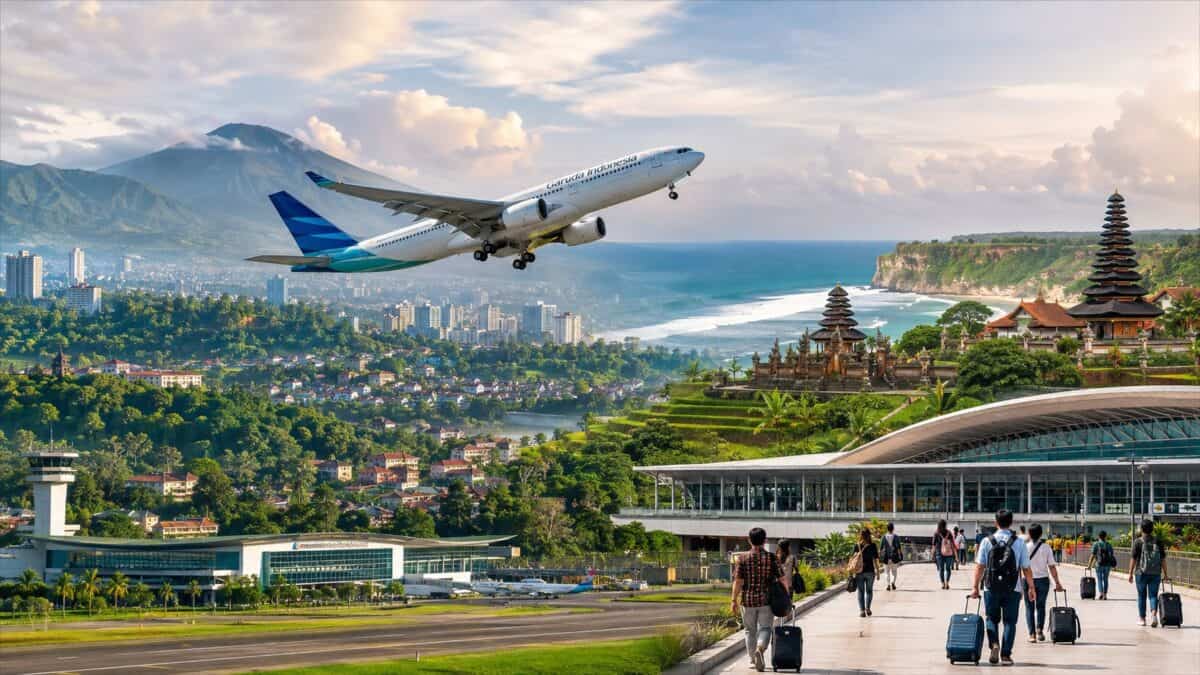
Image generated with Ai
On August 14, 2026, Indonesia’s domestic aviation career progresses once more. Direct air links connecting Bandung’s Husein Sastranegara Airport (BDO) to Bali’s I Gusti Ngurah Rai International Airport (DPS) via Garuda Indonesia’s Bandung-Bali service will be reestablished. Reopening this link will allow one of Indonesia’s largest urban and educational hubs to take more direct access to the country’s most popular tourist destination, while bringing less congestion to the now more active Bandung City Airport, since the service will eliminate the need to take a direct flight from Bandung to Bali through Jakarta. The West Java Provincial Government’s efforts to speed up the recovery plan for Husein Sastranegara Airport to improve air access, airport services, tourism, and domestic integration, are aligned with this service. It will facilitate the transport of vacationers and business travellers, professionals attending events, students, and the domestic tourist market.
For travellers in West Java, the return of a direct connection to Bali represents far more than an additional flight. It restores a strategically important domestic corridor that had become increasingly dependent on indirect routings, longer ground transfers and additional travel time.
Advertisement
Bandung is Indonesia’s fourth-largest metropolitan area and serves as the economic, educational and creative capital of West Java. Bali, meanwhile, remains Indonesia’s flagship tourism destination, attracting millions of domestic and international visitors annually. Linking the two cities through a nonstop scheduled service effectively reconnects two of the country’s strongest visitor economies.
Unlike itineraries requiring transfers through Jakarta or other gateways, the revived service simplifies travel planning for holidaymakers, business travellers and conference delegates alike. Shorter journeys also improve weekend travel opportunities, encouraging higher-frequency domestic trips and increasing tourism spending across both destinations.
Advertisement
Advertisement
The route also complements the Indonesian government’s continued emphasis on strengthening domestic connectivity as an important component of national tourism development.
The timing of the route is equally significant because it coincides with the operational reactivation of Husein Sastranegara Airport.
Following extensive preparations by Bandung authorities, airport infrastructure, landside access, passenger circulation areas and transport arrangements have been upgraded ahead of resumed commercial operations. The reopening is intended to restore convenience for residents who previously faced considerably longer journeys to alternative airports outside the city.
For Bandung’s tourism economy, the airport has historically played an important role by providing rapid access to:
Its renewed domestic network is therefore expected to strengthen visitor accessibility while improving overall travel efficiency.
| Category | Details |
|---|---|
| Airport | Husein Sastranegara Airport (BDO) |
| Destination | I Gusti Ngurah Rai International Airport (DPS) |
| Route Launch | 14 August 2026 |
| Operator | Garuda Indonesia |
| Market Focus | Domestic leisure, corporate, education and MICE travel |
| Strategic Importance | Restores direct West Java–Bali connectivity |
Many domestic routes primarily serve local mobility. However, the Bandung Bali route functions as a tourism bridge between two destinations with distinctly different visitor profiles.
Bandung has long established itself as Indonesia’s preferred short-break destination, recognised for heritage architecture, mountain scenery, shopping districts, culinary tourism and creative culture. Bali remains internationally renowned for beaches, wellness tourism, luxury hospitality, cultural heritage, diving and family holidays.
Direct connectivity therefore creates reciprocal visitor flows rather than one-way demand.
Residents of West Java gain easier access to Bali’s tourism products, while Bali-based travellers obtain more convenient access to Bandung’s urban experiences without navigating Jakarta’s congested airport system.
The service is also expected to stimulate:Tourism Segment Expected Benefit Family holidays Reduced travel complexity Weekend breaks Faster city-to-resort access Meetings & Events Easier corporate mobility University travel Improved student connectivity Medical travel Better domestic accessibility Creative economy Stronger inter-regional business exchanges
Indonesia possesses one of the world’s largest domestic travel markets.
According to Badan Pusat Statistik (BPS), domestic tourism has recovered strongly following the pandemic years, supported by improving airline capacity, rising consumer confidence and increasing short-haul leisure demand.
Rather than depending solely on international arrivals, Indonesia has increasingly relied upon domestic visitors to sustain hotel occupancy, restaurants, attractions and regional tourism economies.
Within this context, restoring direct links between major population centres becomes strategically important.
The Bandung metropolitan area represents millions of potential travellers who can now access Bali more efficiently without unnecessary detours.
At the same time, Bali gains improved access to one of Indonesia’s strongest domestic source markets.
One of the less visible implications of the restored service lies in network diversification.
For many years, passengers travelling between Bandung and Bali frequently routed through Jakarta, adding additional flight sectors, longer transfer windows and increased uncertainty during peak travel periods.
A direct service offers several operational advantages.
Passengers avoid multiple check-ins, reduce missed-connection risks and experience shorter overall journey times.
For airlines, direct point-to-point services can distribute passenger demand more evenly across Indonesia’s aviation network rather than concentrating traffic at a single metropolitan hub.
That evolution aligns with broader regional aviation trends across Southeast Asia, where airlines are increasingly developing direct secondary-city links to accommodate changing traveller behaviour.
Although Bali is widely recognised for leisure tourism, it has also become one of Southeast Asia’s leading destinations for meetings, incentives, conferences and exhibitions.
Similarly, Bandung hosts numerous universities, technology companies, manufacturers and creative enterprises that generate substantial corporate travel demand throughout the year.
The restored route therefore serves multiple economic sectors beyond tourism alone.
Business travellers benefit from improved scheduling flexibility, while conference organisers gain another direct access option for delegates travelling between West Java and Bali.
The route may also encourage greater collaboration across Indonesia’s education, innovation and creative economy sectors.
| Passenger Category | Primary Advantage |
|---|---|
| Leisure travellers | Faster holiday access |
| Corporate travellers | Improved productivity |
| Event delegates | Direct conference travel |
| Students | Easier university mobility |
| Visiting relatives | Reduced travel time |
| Tourism operators | Expanded domestic packages |
The reinstated Bandung service also reinforces Garuda Indonesia’s position within Indonesia’s premium full-service domestic market.
Rather than focusing exclusively on trunk routes linking Jakarta with major cities, the carrier continues expanding strategically important regional connections capable of generating sustained demand from both leisure and corporate passengers.
The Bandung–Denpasar service complements Garuda’s wider domestic network while enhancing connectivity between Western Indonesia and one of the country’s strongest tourism gateways. Scheduled services between the two destinations are available from 14 August 2026, with bookings already opened through the airline’s reservation channels.
The restoration of the Garuda Indonesia Bandung Bali route carries implications that extend well beyond airport operations. Direct air links frequently reshape tourism patterns by reducing travel friction, encouraging spontaneous travel decisions and supporting year-round visitor flows rather than concentrating demand during holiday peaks.
West Java is already one of Indonesia’s most diverse tourism regions, offering volcanic landscapes, tea plantations, heritage architecture, culinary districts and shopping destinations. Bandung, often referred to as the “Paris of Java”, attracts visitors seeking cooler highland climates, creative industries and weekend escapes.
Bali, meanwhile, remains Indonesia’s flagship tourism gateway, with an economy deeply interconnected with aviation. Easier access from Bandung is expected to stimulate domestic demand across accommodation providers, tour operators, restaurants, transport companies and visitor attractions.
Unlike international markets that remain vulnerable to global economic fluctuations, domestic tourism generally demonstrates greater resilience because travellers can plan shorter journeys with lower overall costs. Consequently, strengthening direct links between major population centres has become an increasingly important strategy for sustaining visitor economies throughout the year.
| Destination | Primary Tourism Strength | Likely Benefit from Direct Flights |
|---|---|---|
| Bandung | Heritage, shopping, culinary tourism, creative economy | Easier inbound leisure and corporate travel |
| Bali | Beaches, wellness, luxury resorts, culture, MICE | Expanded domestic visitor market from West Java |
| West Java | Nature, education, business travel | Improved national accessibility |
| Indonesia | Domestic tourism development | Stronger regional aviation balance |
Indonesia’s geography presents one of the world’s greatest aviation challenges. Stretching across more than 17,000 islands, the country depends heavily on air transport to connect economic centres, tourism destinations and regional communities.
Historically, Jakarta has functioned as the dominant aviation hub for domestic travel. While this model efficiently concentrates airline operations, it can also increase congestion, prolong journeys and reduce convenience for passengers travelling between secondary cities.
The return of direct Bandung–Denpasar flights reflects a broader industry trend towards point-to-point connectivity, allowing passengers to travel directly between regional cities without unnecessary transfers.
This approach has become increasingly important across Southeast Asia as airlines seek to optimise fleet deployment while responding to changing traveller expectations. Passengers today increasingly prioritise convenience, shorter journey times and reduced transit complexity over traditional hub-and-spoke itineraries.
For Indonesia’s aviation network, every restored regional route contributes towards a more balanced distribution of passenger traffic and strengthens connectivity beyond the country’s principal gateways.
Indonesia remains one of Asia’s largest domestic aviation markets, supported by its vast population, expanding middle class and geographically dispersed communities.
Government tourism policies have increasingly promoted domestic holidays alongside international arrivals, recognising that Indonesian residents generate substantial visitor expenditure throughout the year.
According to Statistics Indonesia (BPS), domestic travel has remained a significant contributor to tourism activity, supporting hotels, restaurants, transport providers, attractions and local enterprises across multiple provinces. Meanwhile, Bali continues to rank among Indonesia’s strongest-performing tourism economies, welcoming millions of international visitors annually while simultaneously attracting substantial domestic demand.
The reinstated Bandung–Bali service therefore aligns with broader national objectives to strengthen regional accessibility while distributing tourism benefits more evenly across Indonesia’s diverse destinations.
| Sector | Potential Impact |
|---|---|
| Hotels | Higher domestic occupancy |
| Airlines | Additional premium domestic demand |
| Restaurants | Increased visitor spending |
| Tour Operators | Expanded package opportunities |
| Retail | Higher shopping expenditure |
| Transport Providers | Greater airport transfer demand |
| Convention Industry | Improved delegate accessibility |
For travellers, the restored route provides several practical advantages beyond shorter flight times.
Passengers departing from Bandung benefit from a city-centre airport location that reduces surface travel compared with alternative airports located farther from the metropolitan core. This convenience is particularly valuable for business travellers, families travelling with children and short-break visitors seeking efficient weekend itineraries.
The route also creates opportunities for multi-centre holidays. Visitors arriving in Bali can combine coastal leisure experiences with subsequent journeys to Bandung, where mountain scenery, heritage neighbourhoods, factory outlets and culinary attractions provide a distinctly different tourism offering.
Likewise, Bandung residents gain direct access to Bali’s internationally recognised beaches, wellness retreats, cultural landmarks and marine tourism without requiring intermediate connections.
Travellers should nevertheless continue monitoring baggage allowances, fare conditions and schedule updates through Garuda Indonesia’s official booking platform, particularly during the initial launch period when operational schedules may be refined.
| Item | Information |
|---|---|
| Airline | Garuda Indonesia |
| Route | Bandung (BDO) – Denpasar (DPS) |
| Launch Date | 14 August 2026 |
| Service Type | Nonstop scheduled domestic service |
| Primary Markets | Leisure, corporate, education, MICE, VFR |
| Booking | Available through official Garuda Indonesia channels |
The return of the Garuda Indonesia Bandung Bali route shows how regional aviation can transform tourism beyond both of the connected airports. The reinstating of direct flights to West Java’s largest metropolitan area and Indonesia’s premier holiday island will improve travel time and enhance travel Kiranne’s competition. This route will provide additional travel options for leisure and business travelers. As other airline routes continue to optimize internal airline routes within Indonesia, Bandung to Denpasar routes will become more important regional air routes that will facilitate the tourism goals of sustainable travel. For travelers, the restored flights will be more convenient, and the restored travel routes will benefit the travel and tourism industry more with a flexible and less concentrated travel network that will accommodate travel to varied destinations.
Garuda Indonesia will commence its nonstop Bandung (BDO)–Denpasar (DPS) service on 14 August 2026, restoring direct air connectivity between West Java and Bali after a period without scheduled nonstop flights.
The route connects Husein Sastranegara Airport (BDO) in Bandung, West Java, with I Gusti Ngurah Rai International Airport (DPS) in Denpasar, Bali.
The reinstated service eliminates the need for many passengers to transit through Jakarta, reducing overall journey time, simplifying travel and improving convenience for leisure travellers, business passengers, students and MICE delegates.
The service is expected to benefit holidaymakers, corporate travellers, conference attendees, university students, families visiting relatives, tour operators, hotels, restaurants and local tourism businesses in both West Java and Bali.
By reconnecting one of Indonesia’s largest metropolitan regions with its leading tourism destination, the route is expected to stimulate domestic visitor numbers, increase tourism spending, improve hotel occupancy and strengthen regional economic activity.
Yes. The launch forms part of the broader reactivation of Husein Sastranegara Airport, supporting increased commercial operations, improved passenger accessibility and the airport’s renewed role in Indonesia’s domestic aviation network.
Yes. Besides leisure tourism, the Bandung–Bali service supports corporate travel, meetings, incentives, conferences and exhibitions (MICE), educational exchanges and inter-regional business connectivity.
Travellers can book tickets through Garuda Indonesia’s official website, mobile application, customer service channels and authorised travel agents.
Indonesia’s vast archipelagic geography makes direct regional air links increasingly valuable. Point-to-point routes reduce dependence on major hubs, shorten travel times, ease airport congestion and improve accessibility between important economic and tourism centres.
Visitors can experience Bandung’s heritage architecture, culinary scene, shopping districts, tea plantations and mountain landscapes, while Bali offers beaches, cultural temples, wellness retreats, luxury resorts, marine tourism, rice terraces and world-renowned hospitality.
Advertisement
Tags: aviation news, Bali, Bandung, Denpasar, domestic flights
Advertisement
Advertisement













Saturday, September 5, 2026

Saturday, September 5, 2026

Saturday, September 5, 2026

Saturday, September 5, 2026

Saturday, September 5, 2026
Saturday, September 5, 2026

Saturday, September 5, 2026

Saturday, September 5, 2026



