
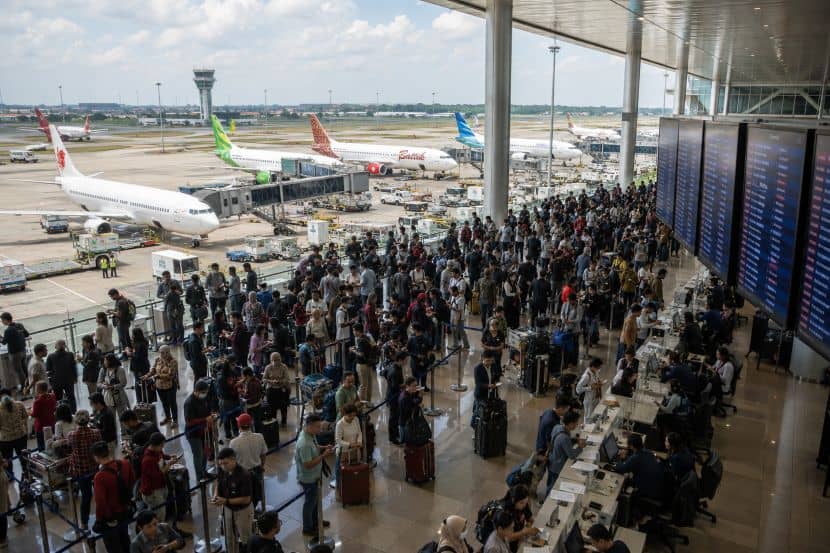
Image generated with Ai
Travellers using Jakarta-Soekarno-Hatta International Airport today, June 23, 2026, experienced notable operational disruption as airlines cancelled 17 flights while 99 additional services were delayed, according to the latest operational data. Although airport operations continued throughout the day, the disruption affected both domestic and international passengers, forcing many to revise travel plans, wait longer for departures or seek alternative flight options.
The latest figures show that the overwhelming majority of cancellations were concentrated within a single carrier, while delays were spread across a wide range of Indonesian and regional airlines. The uneven distribution highlights how airline-specific operational challenges can significantly influence airport-wide performance even when the airport itself remains operational. For thousands of passengers travelling for business, tourism and family commitments, the delays created uncertainty across check-in halls, boarding gates and connecting flights.
Advertisement
| Airport | Cancelled Flights | Delayed Flights |
|---|---|---|
| Jakarta-Soekarno-Hatta International Airport | 17 | 99 |
The airport-wide figures indicate a moderate but significant operational disruption rather than a complete breakdown of services. With 17 cancelled flights and 99 delayed departures or arrivals, the airport continued handling the majority of its scheduled operations. However, passengers travelling on affected services experienced schedule changes ranging from short delays to complete itinerary disruption.
Unlike widespread shutdowns caused by airport closures, today’s data suggests that operations remained active across terminals while individual airlines dealt with varying operational pressures. Such situations typically create ripple effects throughout the day, particularly for passengers holding connecting itineraries or travelling during peak departure windows.
Advertisement
Advertisement
An important observation from today’s figures is that delays substantially outnumbered cancellations. This generally indicates that airlines were attempting to recover schedules rather than eliminating large portions of their operations. While delays are inconvenient, they often allow airlines to preserve flight networks and minimise passenger displacement compared with outright cancellations.
| Airline | Cancelled | Cancellation % | Delayed | Delay % |
| Batik Air | 16 | 8% | 13 | 6% |
| Malindo Air | 1 | 7% | 1 | 7% |
| Indonesia AirAsia | 0 | 0% | 7 | 19% |
| AirAsia | 0 | 0% | 2 | 16% |
| Shandong Airlines | 0 | 0% | 1 | 50% |
| Citilink | 0 | 0% | 21 | 12% |
| Garuda Indonesia | 0 | 0% | 12 | 6% |
| NAM Air | 0 | 0% | 3 | 27% |
| Lion Air | 0 | 0% | 12 | 11% |
| Malaysia Airlines | 0 | 0% | 2 | 16% |
| My Indo Airlines | 0 | 0% | 1 | 16% |
| Pelita Air Service P.t. | 0 | 0% | 3 | 5% |
| Super Air Jet | 0 | 0% | 9 | 7% |
| Starlux | 0 | 0% | 1 | 50% |
| Sriwijaya Air | 0 | 0% | 3 | 14% |
| TransNusa | 0 | 0% | 8 | 21% |
The data clearly identifies Batik Air as the airline most heavily affected by today’s disruption. Out of the airport’s 17 total cancellations, 16 were operated by Batik Air, representing more than 94% of all cancelled flights at Jakarta-Soekarno-Hatta International Airport. In addition, the airline also recorded 13 delayed flights, showing that operational challenges extended beyond outright cancellations.
This concentration suggests that today’s disruption was driven primarily by airline-specific operational constraints rather than a system-wide airport shutdown. Fleet rotation issues, aircraft availability, crew scheduling adjustments or maintenance requirements can all result in such concentrated cancellation patterns while other airlines continue operating relatively normally.
Malindo Air accounted for the remaining one cancelled flight, together with one delayed service. Although the numbers remain relatively small, even a single cancellation can significantly affect passengers because international itineraries often involve onward connections and limited alternative departures.
Advertisement
Advertisement
While Batik Air dominated cancellations, Citilink recorded the largest number of delayed operations, with 21 delayed flights, representing a 12% delay rate.
Rather than cancelling services, Citilink appears to have prioritised keeping flights operating despite schedule disruptions. This operational approach helps reduce passenger displacement but may increase waiting times at departure gates and create cascading delays throughout the network.
For travellers with multiple flight connections, extended delays can sometimes become nearly as disruptive as cancellations, particularly if onward flights are missed.
Indonesia’s national carrier, Garuda Indonesia, avoided cancellations entirely but reported 12 delayed flights, corresponding to a 6% delay rate.
The absence of cancellations indicates that Garuda maintained network continuity despite operational challenges. For premium and international travellers, maintaining scheduled departures—even with moderate delays—often results in fewer disruptions than outright flight cancellations.
Lion Air matched Garuda Indonesia with 12 delayed flights, although its reported delay percentage stood at 11%.
As one of Indonesia’s largest domestic carriers, Lion Air operates an extensive network connecting Jakarta with destinations across the archipelago. Delays within such a large network can affect aircraft rotations and scheduling throughout the day, potentially extending operational impacts beyond Jakarta itself.
Super Air Jet experienced nine delayed flights, while TransNusa recorded eight delays, representing one of the higher delay percentages in today’s dataset at 21%.
Although neither airline cancelled services, passengers likely encountered revised boarding times, gate changes and extended waiting periods. Airlines often attempt to recover schedules later in the day by adjusting aircraft rotations and turnaround times.
Indonesia AirAsia completed the day without cancellations but reported seven delayed flights, producing a relatively high 19% delay rate.
Maintaining zero cancellations demonstrates operational resilience despite schedule challenges. Nevertheless, a delay rate approaching one-fifth of scheduled services indicates meaningful disruption for travellers relying on punctual departures.
Several carriers experienced smaller numbers of delays while avoiding cancellations entirely.
Because these airlines generally operate smaller schedules than Indonesia’s largest carriers, even a handful of delayed flights can produce noticeably higher delay percentages.
The operational impact on foreign and regional airlines remained comparatively limited.
AirAsia reported two delayed flights, while Malaysia Airlines also experienced two delays, each recording a 16% delay rate.
Meanwhile, Shandong Airlines, My Indo Airlines and Starlux each recorded one delayed flight. Although the numerical impact was small, both Shandong Airlines and Starlux displayed 50% delay rates, illustrating how airlines operating fewer daily services can exhibit high percentages from a single delayed flight.
For international passengers, even isolated delays can affect immigration timing, onward international connections and accommodation arrangements.
Although no single official cause has been attributed to every affected flight, aviation disruptions at a major hub such as Jakarta-Soekarno-Hatta International Airport are often driven by multiple operational factors occurring simultaneously.
Some of the most common contributing factors include:
Today’s statistics suggest that while airport infrastructure continued functioning, airline-specific operational recovery efforts played a far greater role in determining which flights departed on schedule and which did not.
Today’s disruption at Jakarta-Soekarno-Hatta International Airport extends beyond delayed departure times. For many travellers, the impact continues long after the aircraft eventually departs. Missed meetings, disrupted holidays, additional accommodation costs and uncertainty over onward travel are among the most immediate consequences.
Passengers whose flights were cancelled or delayed should remain in close contact with their airline, monitor official flight status updates and keep records of all travel-related expenses in case reimbursement or rebooking assistance becomes available.
Passengers affected by cancellations or significant delays should first contact their airline directly before making alternative travel arrangements.
Depending on the airline’s conditions of carriage and the reason for the disruption, travellers may be offered:
Travellers should preserve boarding passes, booking confirmations, baggage receipts and any receipts for additional expenses. These documents may prove useful when submitting refund requests or customer service claims.
Passengers are encouraged to check the official website of Jakarta-Soekarno-Hatta International Airport and the official websites of their respective airlines for the latest operational updates before travelling to the airport.
Indonesia welcomes millions of domestic and international visitors every year, with Jakarta serving as one of the country’s principal aviation gateways. Even relatively modest disruption at Soekarno-Hatta can create wider effects across the tourism ecosystem.
International visitors arriving late may shorten planned itineraries, postpone domestic connections or cancel excursions altogether. Tour operators, transport providers and hotels may experience last-minute changes as visitors adjust their schedules.
Business travellers also face challenges, particularly those attending conferences, trade meetings or regional events where precise arrival times are important.
Although today’s disruption is unlikely to significantly reduce visitor numbers on its own, repeated operational issues can influence traveller confidence, particularly among passengers choosing between competing regional aviation hubs.
Flight delays and cancellations create financial consequences for both airlines and the wider economy.
Airlines often incur additional expenses through aircraft repositioning, revised crew schedules, passenger accommodation and customer service operations. Airport retailers and food outlets may experience unpredictable customer flows, while transport operators face sudden demand fluctuations.
Businesses relying on time-sensitive cargo or executive travel may also encounter indirect costs when deliveries or meetings are delayed.
While today’s figures remain manageable compared with major airport shutdowns, they nevertheless demonstrate how even a limited number of cancellations can produce broader economic effects across the aviation supply chain.
The relatively low number of cancellations compared with delays suggests that airlines are attempting to restore normal schedules rather than remove large portions of their operations.
If weather conditions improve and aircraft rotations stabilise, many delayed flights may operate later in the day. However, delays during busy operating periods often continue to affect subsequent departures as aircraft and crews work through revised schedules.
Passengers travelling over the next 24 hours should continue checking flight status before leaving for the airport.
A total of 17 flights operating within, into or out of Jakarta-Soekarno-Hatta International Airport were cancelled.
The airport recorded 99 delayed flights during today’s operations.
Batik Air accounted for 16 of the 17 cancelled flights, making it the airline most affected by today’s disruption.
Citilink reported 21 delayed flights, the highest number among all airlines listed.
Yes, unless your airline has informed you otherwise. Since most flights are still operating, passengers should check their flight status before departing for the airport.
Passengers whose flights have been cancelled should contact their airline regarding refund eligibility, rebooking options or travel credits based on their ticket conditions.
Travellers flying through Jakarta-Soekarno-Hatta International Airport over the coming days should build extra flexibility into their itineraries. Arriving at the airport earlier than usual, enabling airline notifications and checking flight status several times before departure can reduce uncertainty.
Passengers with international connections should consider allowing additional transit time where possible. Keeping travel insurance details, booking confirmations and important documents easily accessible may also simplify the process if schedules change unexpectedly.
While today’s disruption affected a relatively small proportion of the airport’s total operations, the data highlights how quickly delays can spread across multiple airlines during periods of operational pressure.
From my perspective, today’s figures tell an interesting story. At first glance, 17 cancellations may not appear particularly severe for one of Southeast Asia’s busiest airports. However, the 99 delays reveal that the operational impact extended much further than the cancellation count alone suggests.
What stands out most is how heavily the disruption was concentrated within a single airline while many others continued operating with delays instead of widespread cancellations. That reflects the complexity of modern airline operations—one carrier can face significant scheduling challenges even when the airport itself remains open.
For passengers, timely communication matters just as much as operational recovery. Clear updates, efficient rebooking and proactive customer service can often make the difference between a frustrating travel day and a manageable one.
Advertisement
Advertisement
Advertisement













Saturday, September 5, 2026

Friday, September 4, 2026

Saturday, September 5, 2026
Saturday, September 5, 2026

Thursday, September 3, 2026

Wednesday, September 2, 2026

Saturday, September 5, 2026

Saturday, September 5, 2026


