
Japan Advances With South Korea and Others as Cherry Blossom Tourism Shapes Spring Travel

Updated
Published
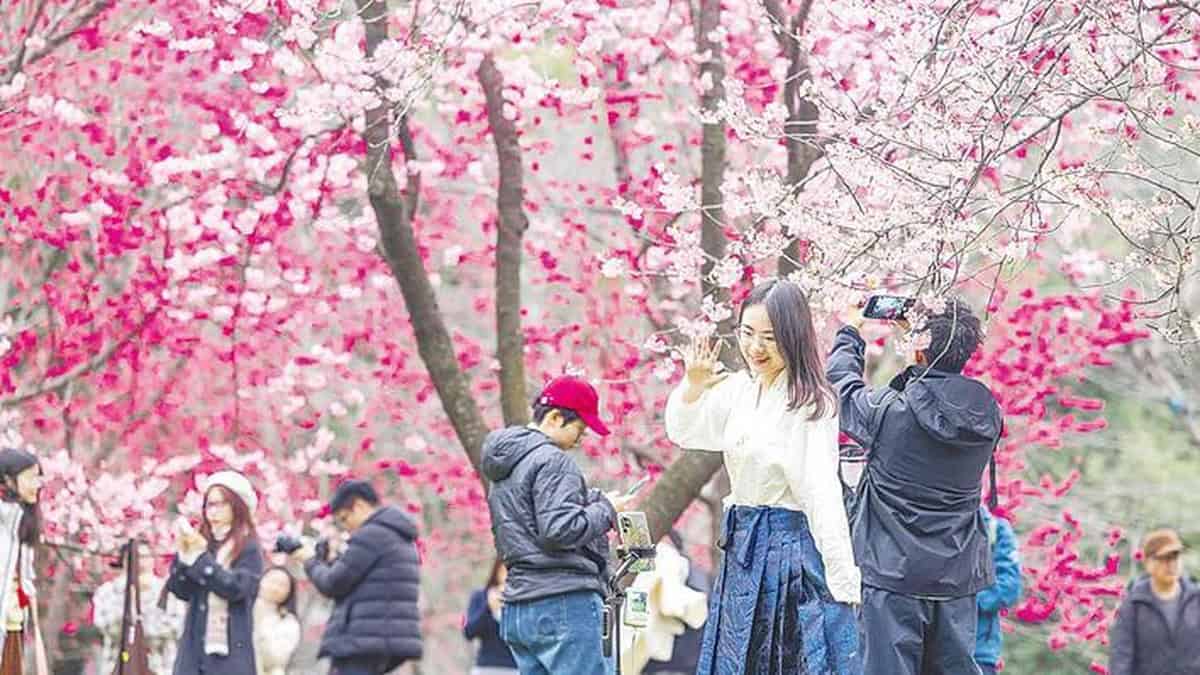
Japan, South Korea, China and Taiwan are already shaping their next spring tourism season through destination monitoring, packaged blossom tours, dedicated transport and visitor-management systems. Even though precise 2027 cherry-blossom forecasts remain unavailable as of 21 September 2026. In Japan, Tokyo and Kyoto provide increasingly detailed bloom information for travellers while South Korea links blossoms with tourism packages. China supports peak-season movements with dedicated transport and crowd controls and Taiwan has placed cherry-blossom rail experiences within its 2026–2027 tourism calendar. The emerging 2027 story is therefore moving beyond bloom dates towards how East Asia manages alongside packages and monetises one of its most weather-sensitive seasonal tourism draws.
Japan 2027 Sakura Forecast Remains Pending As Tourism Planning Starts Earlier
There is an important distinction for travellers and tour operators planning spring 2027: Japan currently has no published 2027 nationwide sakura forecast on the principal official tourism and forecasting pages checked as of 21 September 2026. JNTO’s current dedicated page remains the 2026 forecast, while the Japan Weather Association explains that its blossom forecasting cycle normally operates from January through April.
Advertisement
Advertisement
The 2026 cycle illustrates why September is too early for precise 2027 dates. Japan Weather Association issued its first 2026 national forecast on 29 January for 53 locations. Later releases expanded the coverage, and its final forecast was issued on 8 April for 84 locations. Temperature observations since the previous autumn and projected temperatures approaching the flowering period form part of the forecasting methodology.
That means travel businesses can legitimately begin capacity planning, hotel contracting, itinerary design and event packaging now, but exact 2027 full-bloom promises would go beyond the currently available official evidence.
Advertisement
Advertisement
A second factor makes spring 2027 particularly noteworthy. The International Horticultural Expo in Yokohama will run from 19 March to 26 September 2027, with organisers projecting 15 million participants, including more than 10 million paying visitors. The confirmed opening creates a major fixed spring tourism event close to Tokyo at broadly the same time of year in which central Japan usually enters sakura season, although no assumption should yet be made about the actual 2027 flowering dates.
Tokyo Shows Why Forecast Flexibility Matters More Than A Single Date
JNTO describes Japan’s cherry-blossom season as progressing across the country from the latter half of March into early May. Its current 2026 table lists Tokyo’s first bloom at Chiyoda on 19 March, compared with an average date of 24 March. Sapporo appeared much later on 19 April, while Kushiro was listed for 5 May. The geographical spread demonstrates why Japan cannot sensibly be marketed around one nationwide sakura date.
Advertisement
Advertisement
Tokyo’s official tourism guide identifies late March to early April as the principal cherry-blossom period in the capital and advises visitors to arrange spring accommodation well in advance because of the season’s popularity. The same official guide initially used Japan Weather Association data forecasting Tokyo flowering from 21 March 2026, illustrating how the planning picture can evolve as temperatures and actual conditions develop.
This is commercially important. A package built around a single fixed full-bloom day has a higher weather-related expectation risk than an itinerary offering several viewing areas, multiple varieties, longer stays and alternative spring attractions.
Advertisement
Advertisement
Kyoto Builds A More Granular Model For Blossom Tourism
Kyoto demonstrates another direction for seasonal tourism management. The city’s official 2026 Cherry Blossom Calendar did not treat Kyoto as one uniform flowering zone. It tracked individual sites across central Kyoto, Gion and Kiyomizu, the Philosopher’s Path and Okazaki, Arashiyama, Fushimi, northern districts and other areas. The authority specifically notes that blossom timing changes according to species and elevation.
Updates continued through 10 April 2026. By the final update, the main peak had passed across much of the city while blossoms could still be found in northern areas. This site-level approach offers a practical model for the travel trade: monitor conditions locally rather than treating Kyoto’s entire sakura experience as one immovable date.
Japan’s broader tourism strategy makes this type of demand management increasingly relevant. The Japan Tourism Agency’s 2026–2030 Tourism Nation Promotion Basic Plan retains targets of 60 million international visitors and ¥15 trillion in inbound tourism spending by 2030, while also prioritising regional dispersal, overtourism prevention, transport integration, sustainable growth and a balance between visitors and residents.
Japan’s Latest Visitor Data Makes The Regional Connection More Important
JNTO recorded 27,626,300 international visitor arrivals from January through August 2026, down 2.7 per cent from the same period of 2025. August alone brought 3,098,900 arrivals. South Korea, China and Taiwan are particularly relevant to this blossom-tourism comparison because each is both a major East Asian tourism market and a destination with its own established spring-flower travel economy.
Advertisement
Advertisement
| Market feeding Japan | Jan–Aug 2026 arrivals | Year-on-year change | August 2026 arrivals | August change |
|---|---|---|---|---|
| South Korea | 7,420,300 | +21.2% | 850,500 | +28.7% |
| Taiwan | 5,402,000 | +19.8% | 666,000 | +7.3% |
| China | 2,904,600 | −56.7% | 418,000 | −59.0% |
These figures should not be interpreted as cherry-blossom visitor numbers. They are total inbound arrivals to Japan. Their significance is structural: the same East Asian markets participating heavily in Japan’s tourism economy are also developing their own spring blossom products.
South Korea Turns Cherry Blossoms Into Packaged Seasonal Tourism
South Korea provides one of the clearest comparisons with Japan. According to the Korea Tourism Organization, its 2026 cherry blossoms were expected to flower two to seven days earlier than average, beginning around 25 March in Jeju and Busan, followed by 28 March in Jeonju and Gyeongju, 1 April in Gangneung, 3 April in Seoul and 7 April in Incheon. Actual dates remained weather-dependent.
The tourism infrastructure around those blooms is increasingly sophisticated. KTO identified around 360,000 cherry trees in Jinhae, where the 2026 Gunhangje Festival ran from 27 March to 5 April. Seoul’s Yeouido Cherry Blossom Road stretches approximately 1.7 kilometres and has around 1,800 trees, with its 2026 spring festival scheduled from 3 to 7 April.
More importantly for B2B planners, Gyeongsangnam-do’s official 2026 spring campaign incorporated package tours departing from Seoul and Busan, while a spring-themed visitor area was established in the arrivals hall at Gimhae International Airport during the principal festival period. Blossom tourism was therefore being handled not simply as sightseeing but as a connected arrival, transport, event and accommodation product.
China Uses Transport And Crowd Management To Extend Blossom Tourism
China offers a particularly strong infrastructure example through Wuhan. The Wuhan municipal government launched its 2026 cherry-blossom season with a flowering period approaching two months, supported by planting early, middle and late-blooming varieties. Authorities identified 45 blossom-viewing corridors, more than 100 public spaces, 78 parks and more than 30 themed events.
The city also introduced 10 customised bus routes linking major blossom attractions with Wuhan Railway Station, universities, commercial areas and metro stations. This directly addresses one of the central challenges of seasonal tourism: large numbers of visitors converging on a limited attraction within a short biological window.
Advertisement
Advertisement
The scale became evident at East Lake Cherry Blossom Garden, which contains more than 10,000 cherry trees. The attraction recorded 77,000 visitors on 28 March 2026, its highest single-day figure of that season.
Beijing provides another visitor-management example. Yuyuantan Park’s 2026 Cherry Blossom Culture Event ran from 18 March into mid-May depending on flowering conditions, while visitors were advised to avoid peak weekend and public-holiday periods between 09:00 and 16:00. The municipal park system also permits foreign visitors to make passport-based bookings one to seven days in advance.
Taiwan Gives The Trade A Rare Multi-Year Blossom Tourism Signal
Taiwan has already gone further than a single-season campaign. Its Tourism Administration published a 2026–2027 Tourism Biennial Calendar containing 109 events, with newly added products including the Alishan Forest Railway Cherry Blossom and Autumn Foliage Themed Train Tours and the Fushoushan Farm cherry-blossom season.
That does not constitute a meteorological forecast for the exact 2027 bloom. It does, however, give tour operators something valuable months before weather-based forecasts become meaningful: confirmation that blossom-related tourism products are built into a multi-year national events framework.
The Alishan National Scenic Area’s official information states that cherry blossoms emerge progressively from December through March across the wider destination, while the Alishan National Forest Recreation Area concentrates much of its flowering from around mid-March into mid-April.
Northern Taiwan also has a substantial blossom product in Sanzhi, New Taipei City. The official Tourism Administration describes a roughly 70-kilometre cherry-blossom trail containing more than 15,000 trees, with public-transport connections available via Taipei, the MRT network and local buses.
Advertisement
Advertisement
Four Destinations Now Share One Tourism Challenge
| Destination | Official 2026 planning benchmark | Tourism system supporting demand | What remains uncertain for 2027 |
|---|---|---|---|
| Japan | Main sakura progression from late March towards early May; Tokyo listed from 19 March in 2026 | Tokyo seasonal guidance, Kyoto site-level monitoring, national regional-dispersal policy; Yokohama Expo opens 19 March 2027 | Exact 2027 bloom and full-bloom dates |
| South Korea | Jeju and Busan around 25 March; Seoul around 3 April in the 2026 forecast | Festival packages, airport activation, major city blossom corridors | Exact 2027 flowering progression |
| China | Wuhan season extended through multiple flowering varieties; Beijing event operated from March into May in 2026 | Dedicated buses, viewing corridors, advance park booking and crowd-management measures | Weather-dependent 2027 peaks |
| Taiwan | Alishan blossom periods extend across winter and spring depending on altitude and location | 2026–2027 tourism calendar, themed railway products and extensive Sanzhi blossom route | Precise 2027 peak dates |
The Real 2027 Opportunity Is Bigger Than Forecast Chasing
The deeper industry development is a shift from forecast-led sakura selling to infrastructure-led seasonal tourism management.
Flowering dates remain important, but destinations are making the product more resilient by adding transport, timed reservations, night viewing, multiple cultivars, airport activation, rail experiences, urban blossom corridors and geographically dispersed viewing areas.
For tour operators, this changes product design. The safer approach is not to guarantee peak bloom months in advance. It is to sell a flexible spring experience in which sakura is the central draw but not the only deliverable.
Japan has an additional 2027 opportunity because the Yokohama horticultural expo opens on 19 March. That creates a confirmed horticulture-led attraction that can be paired with Tokyo, Kyoto and wider spring travel even before exact sakura dates become knowable. The expo organisers’ projection of 15 million participants also makes advance capacity planning relevant, although that figure remains an expectation rather than an attendance result.
Critical Takeaways For Travel Agents And Tour Operators
- Do not advertise fixed 2027 Japanese bloom dates yet. JNTO’s current national page remains focused on 2026, while Japan Weather Association normally issues forecasts between January and April.
- Separate confirmed events from biological forecasts. Yokohama’s Expo dates are fixed; cherry-blossom flowering is not.
- Use city-level monitoring. Tokyo and Kyoto demonstrate why local conditions, varieties and elevation matter more than a single national date.
- Build flexible accommodation and transport conditions into blossom packages wherever commercial contracts permit.
- Spread itineraries across several viewing areas and flowering varieties to reduce dependence on one park or one predicted peak.
- Monitor transport and reservation requirements, particularly in high-demand locations such as Beijing’s Yuyuantan and major Chinese blossom attractions.
- Treat 2026 dates as planning evidence, not 2027 promises. Temperature and weather remain fundamental variables across the region.
Outlook
Spring blossom tourism in East Asia is becoming a more sophisticated travel product. Japan remains the global reference point, but South Korea, China and Taiwan demonstrate the same underlying transition: a short-lived natural spectacle is increasingly supported by transport planning, reservations, event programming, railway products and visitor-dispersal strategies.
For 2027, the most important development as of 21 September 2026 is therefore not an early sakura forecast. None should be invented.
Advertisement
Advertisement
The stronger tourism story is that the commercial framework around blossom travel is already taking shape months before flowers can be forecast reliably. Tokyo and Kyoto provide the destination-monitoring model. South Korea is packaging spring demand. Chinese cities are engineering mobility around peak crowds. Taiwan has placed blossom-linked rail products into a multi-year tourism calendar. Japan, meanwhile, will enter spring 2027 with the additional pull of a major international horticultural expo in Yokohama.
That creates a broader opportunity for the travel trade: sell spring as a flexible regional season, while allowing verified meteorological forecasts to determine the final blossom timing closer to departure.
FAQs
Has Japan released its 2027 cherry-blossom forecast?
No nationwide 2027 forecast was found on the current JNTO or Japan Weather Association forecast pages checked as of 21 September 2026. JNTO’s dedicated page remains focused on 2026, while JWA normally publishes forecasts from January through April.
When does Japan’s cherry-blossom season normally take place?
JNTO describes the wider season as running from the latter half of March into early May, progressing from warmer parts of Japan towards cooler northern areas and higher elevations.
Why are Tokyo and Kyoto important for 2027 sakura planning?
Tokyo provides a major urban spring tourism market with official seasonal guidance, while Kyoto operates detailed location-level blossom monitoring showing how flowering differs by area, variety and elevation.
What connects Japan, South Korea, China and Taiwan in this story?
All four have developed significant spring blossom tourism products, but the commonality now extends beyond flowers. Official sources show increasing use of festivals, package tours, transport services, timed reservations, dedicated rail experiences and destination-level visitor management.
Can travellers use 2026 blossom dates to book their 2027 holiday?
They can be used as historical planning benchmarks, but not as guaranteed 2027 dates. Weather and temperature materially affect flowering, and updated forecasts should be checked closer to the season.
Advertisement
