
Norway Alongside Canada and Other Countries Pioneer Autonomous De-Icing Drones and Turnaround Automation

Published
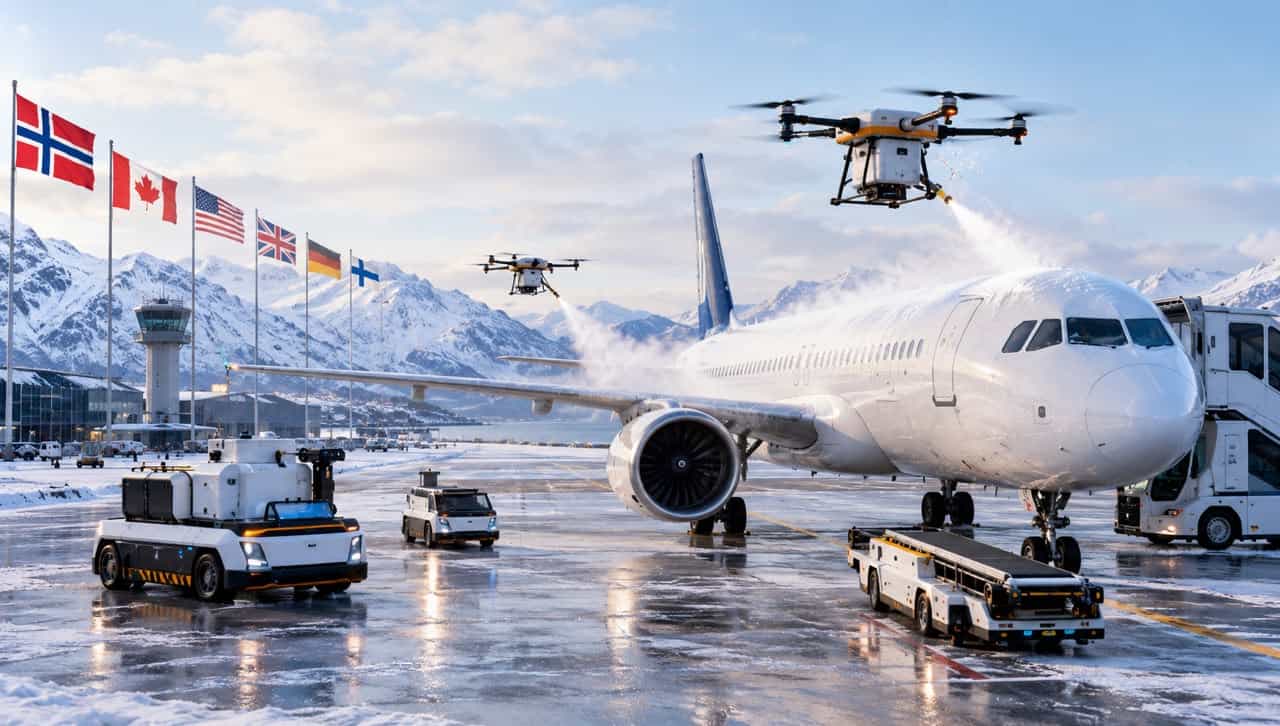
Image generated with Ai
Norway, along with Canada and other countries, are pioneering drones that can de-ice planes and automate airport turns to eliminate freezing delays. As a result, a growing number of airports are using faster robots to replace slower trucks. In addition smart aviation technology changes winter operations today.
Norway, along with Canada and other countries, are pioneering drones that can de-ice planes and automate airport turns revolutionizing aviation. Winter gound handling prcoesses are failing mian airports. Today, innovative technoligists around the world are developing smarter robotic solutions right now. Finally, these new technologies remove dangerous human error from winter operations altogether.
Advertisement
Advertisement
Autonomous aircraft de-icing drones and robotic cold-weather turnaround automation are revolutionizing winter airport operations by replacing manual truck crews with precision thermal sensors and targeted fluid-spraying nozzles, thereby eliminating weather delays, drastically reducing chemical waste, and securing safer gate departures across global aviation hubs.
Why are traditional winter de-icing methods failing modern airports?
Conventional winter ground operations have long relied upon manual, truck-mounted chemical de-icing crews operating in elevated baskets during freezing storms. This traditional approach introduces substantial human error, inconsistent fluid application, and multi-hour weather bottlenecks that severely cripple airport schedules. When airlines must rely entirely on subjective visual inspections from human operators, the risk of overlooked structural frost remains dangerously high. Furthermore, maneuvering multiple heavy diesel trucks around massive wide-body aircraft creates severe logistical gridlock on icy tarmac surfaces. As global flight frequencies increase, these outdated manual workflows simply cannot keep pace with the strict turnaround demands of modern commercial aviation. Consequently, airports frequently experience cascading flight cancellations and massive financial losses because their de-icing infrastructure lacks speed and precision.
Advertisement
Advertisement
How do autonomous drones and robotic arms solve ice accumulation?
Next-generation aviation technology replaces human crews with autonomous, tethered de-icing drones and precision-engineered robotic spray arms equipped with advanced thermal sensors. These intelligent systems rapidly scan aircraft wings in real time to map exact frost distribution and ice accumulation without human guesswork. By utilizing thermal imaging, the technology identifies micro-layers of frozen precipitation that are entirely invisible to the naked eye during blinding snowstorms. Once the precise location and thickness of the ice are established, automated nozzles apply eco-friendly de-icing fluids directly to the affected areas. This targeted application eliminates excessive fluid waste while ensuring that composite wing structures achieve absolute aerodynamic cleanliness in a mere fraction of the usual time.
What role are Canadian aviation tech hubs playing in this transition?
Canadian aviation researchers and major northern transport hubs are aggressively piloting automated de-icing systems to combat severe winter storm delays. Because Canada routinely experiences extreme sub-zero temperatures and heavy snowfall, its airports serve as the ultimate testing ground for weather-resilient robotics. Ground handlers are successfully deploying tethered drone architectures capable of maintaining stable flight controls amidst high winds and blinding blizzard conditions. These robust trial programs demonstrate that automated technologies can withstand harsh northern climates while drastically accelerating aircraft turnaround times. By integrating these systems directly into busy gate management workflows, Canadian operators are effectively preventing regional fleet paralyzation during peak winter weather events.
Advertisement
Advertisement
For more details on civil aviation regulations and safety standards, visit Transport Canada’s official aviation portal.
How are Scandinavian carriers optimizing precision thermal scanning?
Scandinavian airlines and Norwegian airport authorities are pioneering the use of advanced optical and thermal frost-detection methodologies for cold-weather clearance. Their operational focus centers on identifying minute traces of structural frost on modern composite wing materials before aircraft push back from the gate. By feeding accurate thermal profiles directly to automated sprayers, these northern European hubs minimize chemical volumes while guaranteeing optimal safety. This meticulous approach not only protects airframe integrity against dangerous boundary-layer disruptions but also significantly reduces the overall duration of pre-flight preparation. Through continuous technological refinement, Scandinavian aviation leaders prove that extreme precision and rapid turnaround times can successfully coexist in freezing environments.
“The rapid shift toward autonomous de-icing drones and robotic turnaround automation marks a monumental turning point for modern commercial aviation. For decades, our industry has relied on slow, manual truck-mounted crews that inherently introduce costly delays and environmental runoff during severe winter storms. By harnessing precision thermal sensors and targeted fluid application, these advanced robotic systems eliminate human error entirely. Consequently, northern aviation hubs can now achieve unprecedented turnaround speeds, drastically reduce chemical waste, and safeguard network-wide schedule integrity. This technological breakthrough proves that safety, efficiency, and environmental sustainability can finally fly together.”
— Anup Kumar Keshan, Founder and Editor-in-Chief, Travel And Tour World
Why are German engineering firms focusing on environmental recovery?
German engineering firms are spearheading the design of automated chemical-recovery fluid systems to eliminate toxic environmental runoff during winter operations. Traditional de-icing processes often result in massive quantities of glycol-laden fluid escaping into local watersheds and soil ecosystems around airports. To combat this ecological hazard, German innovators have developed closed-loop, pad-integrated recovery networks that work in seamless tandem with robotic spray arms. These sophisticated ground systems capture, filter, and recycle de-icing chemicals on-site immediately after application, ensuring strict compliance with stringent European environmental regulations. By merging high-speed robotic de-icing with sustainable fluid reclamation, Germany is setting a vital new global benchmark for green aviation infrastructure.
How are United States domestic hubs maintaining winter schedule integrity?
Domestic carriers across the United States snowbelt are currently turning to high throughput ground clearing automation to protect the integrity of their network-wide schedules. Mega hubs process thousands of daily departures so that any de-icing hold can lead to widespread schedule disruptions throughout the continental U.S. flight network. By turning to automated gantries and drone-assisted arrays, American airports are able to sidestep the logistical bottleneck of having to position multiple de-icing trucks. Such automated installations enable the rapid transit of aircraft from the terminal gate to the active runway without having to incur schedule-breaking layovers or holding patterns. Overall, the large-scale adoption of this technology has helped ensure commercial airlines can maintain punctual and safe operations even during the most volatile winter months.
Advertisement
Advertisement
Freezing winter storms typically disrupt airline travel around the world due to the large-scale operational delays caused by current de-icing procedures. Newer robotic procedures utilizing precision-spraying drones and robotic arms can resolve this crisis as the combination of specialized thermal sensors and rapid application reduces both the time spent on the procedure and the overall wastage of de-icing fluids. This swift progress is possible due to the removal of subjective human factors from the equations, thus both improving the safety and the efficiency of the operation, negating large-scale weather-related delays.
In the end, the implementation of automated winter operations would create a vastly more efficient future for the global airline industry. By removing both toxic chemical waste and expensive weather-related delays, the new robotic procedures promise to keep commercial aviation safety standards high even in the dead of the northern winter. Thus, the gates of the progressive northern hubs will remain open for passengers despite the freezing blast of the season.
Advertisement
