
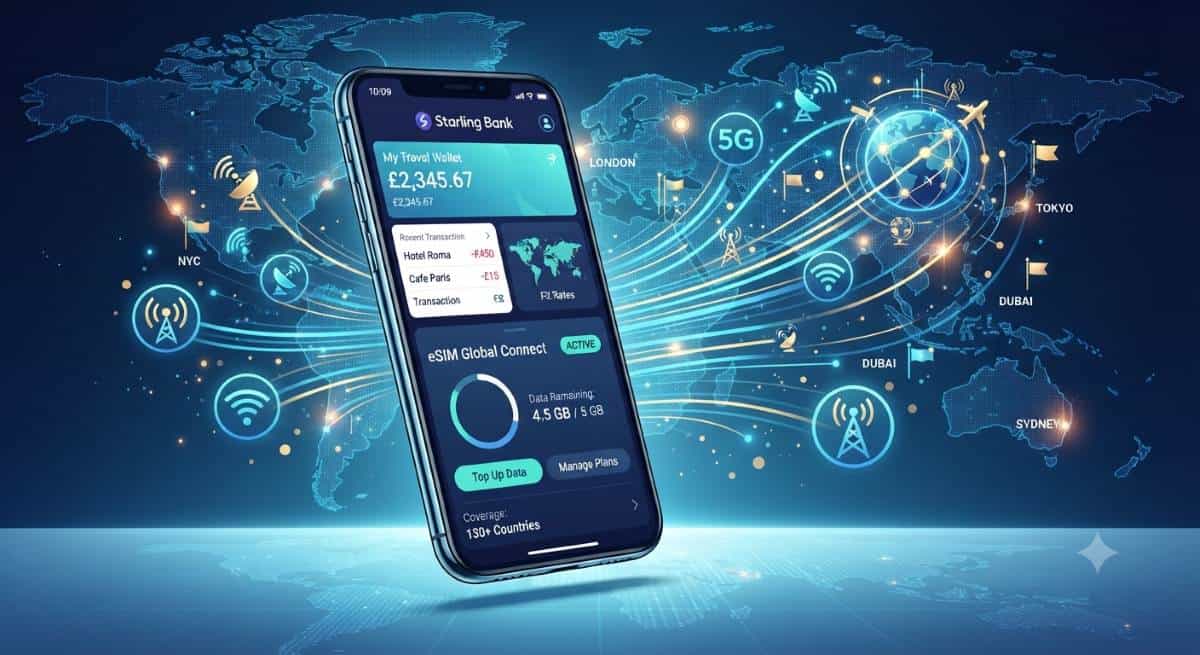
Image generated with Ai
Starling Bank has officially expanded its operational scope far beyond traditional financial services through the introduction of an innovative travel eSIM capability designed for international voyagers. Historically recognized as a pioneer in fee-free overseas expenditure, the digital institution has chosen to integrate global telecommunications functionality directly into its proprietary mobile application ecosystem.
This strategic evolution has been executed via a formal partnership with the prominent mobile services platform Gigs, enabling the delivery of flexible data plans across more than 130 countries worldwide. The overarching intent behind this development is to complement existing travel functionalities—such as zero-fee card utilization abroad and generous ATM withdrawal allowances—by solving a persistent friction point experienced by international tourists: maintaining reliable, high-speed mobile connectivity upon arrival at foreign destinations.
The integration of embedded subscriber identity modules fundamentally transforms the international travel experience by eliminating the conventional anxieties associated with expensive roaming charges and erratic local Wi-Fi networks. Under the newly introduced scheme, customers are granted access to a variety of data allocations—specifically 1GB, 3GB, 5GB, and 10GB plans—each configured with a 30-day validity period.
These packages are purchased seamlessly through the digital bank interface prior to departure and are programmed to activate automatically the moment the user touches down abroad. Furthermore, an innovative fail-safe mechanism has been engineered into the platform: even if a consumer exhausts their entire data allowance, uninterrupted access to the financial application is persistently maintained.
Advertisement
Advertisement
This crucial design choice ensures that account holders can continue managing finances, reviewing transactions, and replenishing data packages without incurring penalty fees or facing sudden digital isolation at critical moments.
Market analysts view this development as a watershed moment for the telemedia and banking sectors, signaling a broader macroeconomic shift toward embedded digital services. Instead of functioning as a conventional mobile network operator, the institution has successfully weaponized contextual data, utilizing insights from international card transactions and currency searches to offer connectivity precisely when it is most relevant.
Industry observers note that the emergence of cloud-based enablement infrastructure allows consumer-facing brands to bypass the historic complexities of building standalone telecoms architecture.
Consequently, collaboration models driven by providers like Gigs are redefining how mobile products are distributed. This trend highlights a fundamental migration of value within the digital ecosystem; while physical networks continue to deliver the underlying connectivity infrastructure, consumer-facing applications retain ultimate control over the user interface, customer context, and the point of sale.
For practical implementation, the service has been designed to operate with maximum administrative simplicity for the end user. Plans are procured entirely inside the software application before travel commences, removing the need for physical SIM card swaps or visits to foreign kiosks.
The underlying technology automatically interfaces with the highest-quality local carrier available within the Gigs provider footprint to guarantee optimal signal strength.
Moreover, travellers are equipped with an array of supplementary in-app utilities, including real-time currency exchange rate trackers, spending categorisation tags, and detailed analytics designed to monitor holiday budgets comprehensively. Should extra data be required while overseas, instantaneous top-up options remain accessible through the same unified digital dashboard, ensuring uninterrupted navigation and communication throughout the entire journey.
When evaluated against historic market precedents and earlier developments within the fintech landscape, this initiative represents a sophisticated maturation of digital product bundling. Ten years ago, the initial market disruption created by the bank centered strictly on removing cross-border transaction fees and ATM charges, which forced legacy institutions to modernize their international banking terms.
However, previous offerings left a distinct gap regarding internet access, frequently forcing consumers to rely on third-party roaming providers or expensive local tourist SIM cards. The current deployment bridges that final gap by incorporating telecommunications directly into the financial toolkit.
Furthermore, this move parallels recent strategic maneuvers by non-telecoms entities—such as prominent retailers launching branded mobile propositions—demonstrating a wider industry trend where trusted consumer brands leverage connectivity to deepen user engagement, diversify revenue channels, and fortify their digital ecosystems against external competition.
Advertisement
Tags: digital banking, eSIM, FinTech, giga partnership, innovation
Advertisement
Advertisement













Saturday, September 5, 2026

Saturday, September 5, 2026

Saturday, September 5, 2026

Saturday, September 5, 2026

Saturday, September 5, 2026

Saturday, September 5, 2026

Saturday, September 5, 2026

Saturday, September 5, 2026



