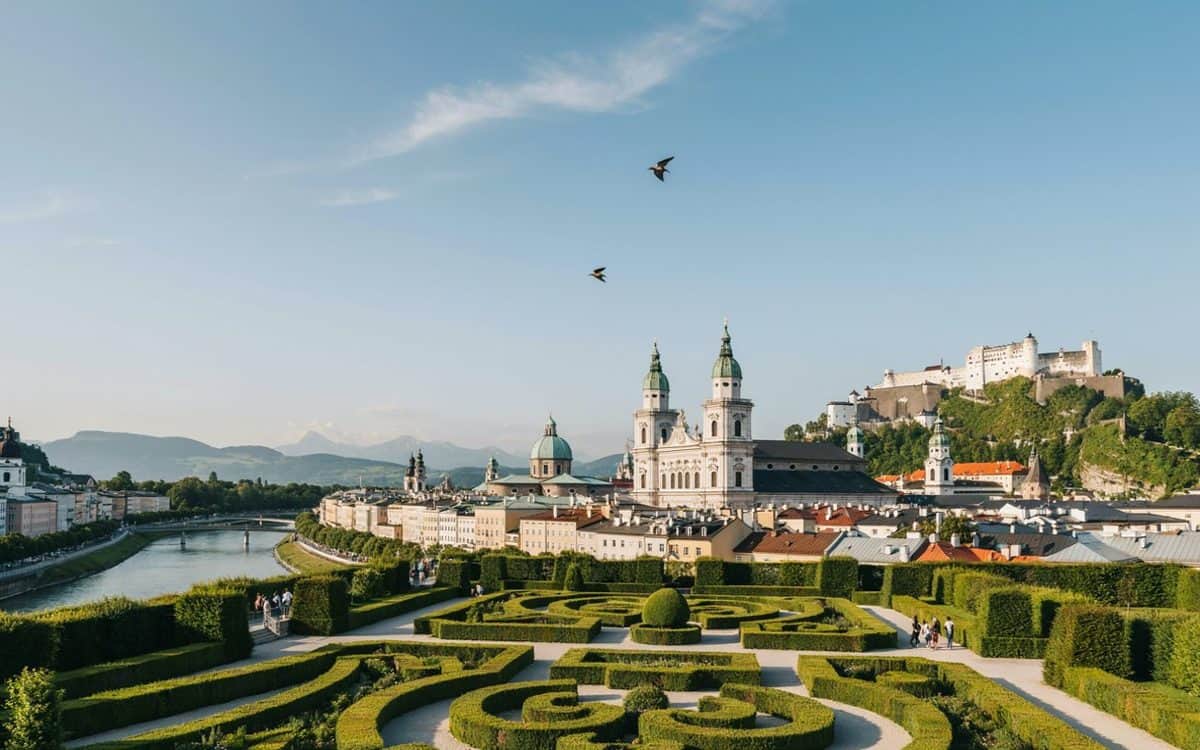
Image generated with Ai
New day trip escapes in Austria: Salzburg links to Wachau Valley and beyond. Travelers are suddenly ditching traditional stays for rapid regional hops. Transport networks have upgraded dramatically this year. High-speed rail routes now connect historic cities seamlessly. Travelers move from alpine peaks to Danube vineyards in record time. Morning coffee in a mountain shadow becomes afternoon wine tasting on a riverbank. This shift changes European travel culture overnight. Tourism boards report unprecedented single-day bookings. Modern infrastructure makes multi-city exploration effortless. You no longer need weeks to experience the entire nation.
| Destination | Best Hub Base | Travel Time (One Way) | Main Vibe & Appeal | Top Highlights & Experiences |
| Salzburg | Vienna or Munich | 2h 20m (Train) | Baroque architecture, classical music, and alpine scenery. | Hohensalzburg Fortress, Mozart’s Birthplace, Getreidegasse, Sound of Music tours. |
| Wachau Valley (Melk & Dürnstein) | Vienna | 1h 15m (Train/Boat) | UNESCO river landscape, vineyards, and medieval ruins. | Melk Benedictine Abbey, Dürnstein Castle ruins, Danube river cruises, wine tasting. |
| Hallstatt | Salzburg or Vienna | 1h 30m (from Salzburg) 3h 30m (from Vienna) | Iconic alpine lakeside village, ancient salt mining. | Lake Hallstätter See ferry, 7,000-year-old Salt Mine tour, Market Square. |
| Innsbruck | Salzburg | 1h 50m (Train) | “Capital of the Alps,” combining urban culture with high peak access. | The Golden Roof (Goldenes Dachl), Nordkette Cable Car, Imperial Palace, Swarovski Crystal Worlds (Wattens). |
| Graz | Vienna | 2h 30m (Train) | Austria’s culinary capital, relaxed vibe, historic meets futuristic. | Schlossberg & Clock Tower, UNESCO Old Town courtyards, Kunsthaus Graz (modern art museum). |
| Zell am See | Salzburg | 1h 30m (Train) | Alpine lake resort with year-round mountain activities. | Lake Zell cruises, Kitzsteinhorn Glacier, Schmittenhöhe cable cars, cycling paths. |
| Linz | Vienna or Salzburg | 1h 15m (from Vienna) 1h 05m (from Salzburg) | Tech-forward art hub, contemporary history, food culture. | Ars Electronica Center, Lentos Art Museum, Pöstlingberg mountain railway, authentic Linzer Torte. |
| Baden bei Wien | Vienna | 45m (Tram/Train) | Historical Biedermeier spa town with thermal waters. | Römertherme baths, Kurpark gardens, historic Casino Baden, surrounding thermal region wineries. |
| Bregenz | Innsbruck | 2h 30m (Train) | Scenic lakefront city on the edge of Lake Constance (Bodensee). | Pfänderbahn cable car, lakeside promenades, floating stage (Seebühne), Vorarlberg Museum. |
For decades, digital transformation meant giving human employees better software to perform manual tasks. Today, that paradigm has collapsed. Legacy enterprise tools require constant human oversight, manual data entry, and manual decision-making. In contrast, modern agentic systems act as self-sufficient collaborators. They do not merely display data on a dashboard; they interpret context, negotiate variables, and execute complex workflows without requiring step-by-step human prompts.
Advertisement
This shift is fundamentally driven by the need for speed and scale. By delegating cognitive logistics—such as supply chain adjustments, automated financial reconciliation, and dynamic risk assessment—to intelligent systems, organizations unlock non-linear productivity. Businesses no longer measure efficiency by how quickly an employee uses a application, but by how effectively an autonomous workflow manages end-to-end operations. Consequently, enterprise software is evolving from static software into proactive, real-time digital labor.
Unlike single-prompt models, multi-agent frameworks divide massive, multifaceted projects into specialized roles. Imagine a virtual corporate department: one specialized model conducts market research, another drafts strategic proposals, a third reviews compliance risks, and an orchestration model evaluates the final output before execution.
Advertisement
Advertisement
By leveraging dedicated memory layers and real-time environment feedback, these interconnected systems cross-examine each other’s work. If the compliance model flags a regulatory conflict, it automatically routes the project back to the research model with specific parameters for correction. This automated feedback loop eliminates bottlenecks, ensuring that outputs are thoroughly vetted before reaching a human supervisor. As a result, operations that once required entire cross-functional teams and weeks of coordination are now completed seamlessly within minutes.
The financial incentives driving adoption are impossible for executive boards to ignore. Early enterprise adopters report drastic reductions in operational expenditure (OpEx), largely fueled by the elimination of manual administrative overhead.
By replacing fragmented software subscriptions with unified autonomous orchestrators, companies are simultaneously lowering their technology spend while significantly increasing operational output.
Granting autonomous systems the authority to make real-world decisions—such as issuing financial transfers, altering production schedules, or updating database records—introduces novel security and governance risks. Traditional cybersecurity models designed for human access controls are often unequipped to monitor autonomous agent actions.
Advertisement
Advertisement
Organizations must implement zero-trust frameworks specifically tailored for autonomous digital workers. Security teams are deploying deterministic guardrails that limit an agent’s operational boundaries, ensuring it cannot exceed pre-approved execution parameters. Furthermore, real-time audit logging and continuous identity verification are critical to prevent malicious prompt injection attacks from hijacking enterprise workflows. Without robust system safeguards, an agent’s speed can turn an isolated logic error into a widespread security breach.
The rise of autonomous software does not signal the absolute end of human labor, but rather its complete structural redesign. The traditional workplace role—centered around task execution—is shifting rapidly toward task governance and system architecture.
Instead of spending hours writing code, analyzing spreadsheets, or drafting routine documentation, professionals are stepping into the role of system managers. They are tasked with framing business objectives, defining boundary conditions, and evaluating agent-generated results. Upskilling has consequently become an immediate corporate imperative; workers who master agent orchestrations are outperforming their peers, while legacy operational skills are losing relevance across global markets.
Deploying autonomous technology requires a calculated strategy rather than a rushed, blanket deployment. Organizations that successfully navigate this shift typically follow a phased integration model:
By prioritizing governance, security, and human-AI collaboration early on, forward-thinking enterprises are ensuring that their digital transformation yields durable, scalable competitive advantages.
Rapid high-speed rail expansion and integrated ÖBB transit timetables transformed regional transit links. Modern travel infrastructure transformed historic destinations into effortless, interconnected single-day excursions. Travelers want maximum exploration without the constant hassle of changing hotel rooms. Seamless connections let visitors experience diverse cultural hubs in hours. Efficient routes eliminate transit stress completely. Regional travel keeps growing faster because instant accessibility unlocks hidden gems effortless across the country. Day trips are officially the smartest way to tour Austria.
Advertisement
Advertisement
Advertisement













Friday, September 4, 2026

Friday, September 4, 2026

Friday, September 4, 2026

Friday, September 4, 2026

Thursday, September 3, 2026

Wednesday, September 2, 2026

Friday, September 4, 2026