
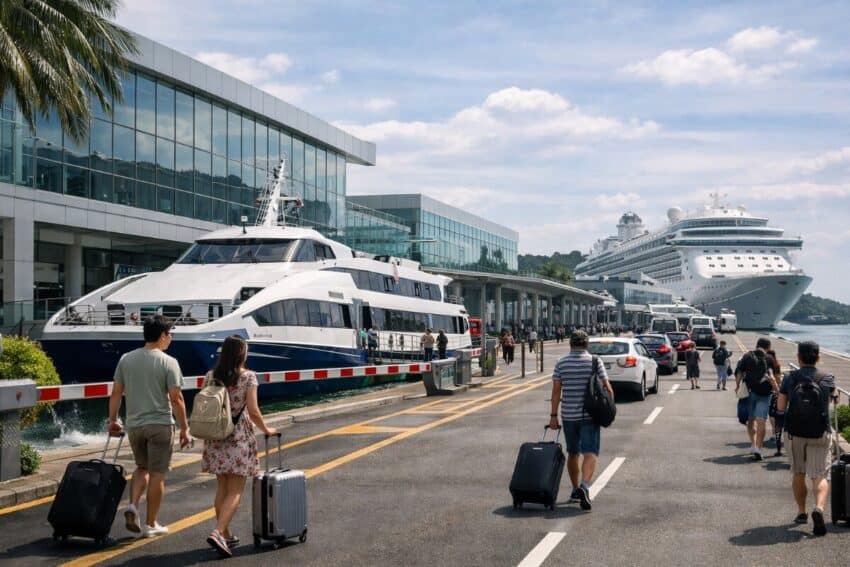
Image generated with Ai
Singapore’s cruise and ferry travel network is entering a major operational reset as Singapore Cruise Centre prepares to move HarbourFront Passenger Terminal operations to a new terminal at 5 HarbourFront Avenue in July 2026. BatamFast begins the first phase on 7 July, while the wider HarbourFront relocation takes effect from 15 July. The move protects sea links to Indonesia and regional cruise services while HarbourFront Centre heads towards major redevelopment. For travel sellers, the key change is terminal location, not route availability, sailing demand or Singapore’s wider cruise growth story.
Singapore Cruise Centre’s HarbourFront move is not a minor address change. It is a strategic passenger-flow adjustment inside one of Singapore’s most important sea travel precincts. The new terminal location sits at 5 HarbourFront Avenue, within the same wider HarbourFront ecosystem. That matters for travel agents, ferry sellers, cruise handlers, hotel partners and destination management companies because the core regional travel chain remains intact.
The relocation comes as HarbourFront Centre moves towards closure and redevelopment. This creates two parallel changes. First, Singapore keeps its ferry and cruise services running through a new terminal setting. Second, the HarbourFront precinct begins a long urban renewal cycle that will reshape commercial, retail and visitor movement around the southern waterfront.
For passengers, the practical message is simple. The boarding point changes. The core travel intent does not. Singapore remains a gateway for short-haul ferry trips, regional leisure escapes, business travel between Singapore and Indonesia, and cruise movements across Southeast Asia.
Advertisement
Advertisement
The transition begins before the full HarbourFront move takes effect. BatamFast starts operating from the new HarbourFront Ferry Terminal on 7 July 2026. The wider relocation of the HarbourFront Passenger Terminal takes effect from 15 July 2026. Other ferry operators serving Indonesian routes are expected to move in the second phase from that date, while cruise operations also shift into the new operating arrangement.Date in 2026 Operational change Travel trade impact Passenger message 7 July BatamFast begins at the new HarbourFront Ferry Terminal Agents selling Singapore to Batam products must update terminal instructions for BatamFast customers Use the new HarbourFront terminal for BatamFast sailings 15 July HarbourFront Passenger Terminal relocation takes effect Tour operators, cruise handlers and ferry sellers must update vouchers, transfers and pre-departure notes Proceed to 5 HarbourFront Avenue 27 July HarbourFront Centre ceases operations ahead of redevelopment Retail, meet-up, transfer and waiting-point arrangements around the old mall require revision Do not use the old mall as the main terminal reference 1H 2031 New HarbourFront commercial project expected to be completed Long-term opportunity for MICE, retail, cruise-linked hospitality and waterfront tourism packaging HarbourFront will re-emerge as a larger integrated precinct
This phased transition helps reduce operational shock. It also gives agents a short but important window to correct customer documents before the wider July move.
The most important commercial detail is continuity. The relocation does not signal a loss of sea connectivity. It supports the same broader ferry and cruise demand pattern while shifting operations into a new terminal environment.
Singapore Cruise Centre’s ferry schedule ecosystem continues to cover regional ferry operators and destinations such as Batam Centre, Harbour Bay, Nongsapura, Sekupang, Tanjung Balai, Tanjung Pinang, Teluk Sebong, Tanjung Pengelih and other nearby points. This keeps Singapore positioned as a high-frequency maritime gateway for short breaks, cross-border family visits, business travel and packaged island holidays.
Advertisement
Advertisement
For the travel trade, this makes the relocation a fulfilment issue rather than a product withdrawal. Agents do not need to rebuild the destination proposition. They need to rebuild directions, meeting points, transfer instructions and service notes.
The relocation lands at a time when Singapore’s cruise market has regained scale. Official government data shows cruise passenger throughput at both Singapore Cruise Centre and Marina Bay Cruise Centre Singapore reached 2,005,050 in 2025. Cruise ship calls reached 375 in the same year.
That performance matters because terminal clarity directly affects guest experience. As passenger numbers grow, errors around pick-up points, luggage handling and arrival timing can produce delays across group movements, cruise transfers and ferry departures.Indicator 2024 2025 Change Trade meaning Cruise ship calls 340 375 Up about 10.3 per cent More ship activity increases pressure on ground transport and terminal coordination Cruise passenger throughput 1,846,843 2,005,050 Up about 8.6 per cent Passenger handling quality becomes more important for destination reputation Passenger throughput versus 2019 1,818,351 in 2019 2,005,050 in 2025 Above 2019 level Singapore has moved beyond recovery into renewed cruise scale Ship calls versus 2019 414 in 2019 375 in 2025 Below 2019 level Larger ships or stronger load factors can lift throughput even when calls remain lower
The numbers show a key pattern. Singapore can carry more cruise passengers even with fewer ship calls than 2019. That places more importance on terminal flow, transport staging, baggage movement and digital passenger communication.
The terminal move also connects with a larger real estate and destination story. HarbourFront Centre is being transformed as part of Mapletree’s HarbourFront Precinct rejuvenation. The future project is planned as a 123,000 square metre flagship commercial development in Singapore’s Greater Southern Waterfront.
The project includes a 33-storey landmark with Grade A office space, an upscale retail podium, direct HarbourFront MRT connectivity, a waterfront setting and sustainability targets. It is expected to complete in the first half of 2031.
This makes the cruise centre relocation a bridge between old and new HarbourFront. In the short term, the travel industry must manage passenger redirection. In the long term, Singapore may gain a stronger waterfront business and leisure node that can serve office workers, cruise guests, ferry passengers, shoppers and MICE delegates in one precinct.
Indonesia remains central to the HarbourFront ferry proposition. Batam is one of the clearest beneficiaries because the Singapore to Batam ferry market serves many travel needs. It supports weekend leisure, resort stays, business movement, family visits and short regional escapes.
BatamFast’s early move on 7 July gives the market a practical test phase before the wider relocation begins. For agents, this is useful. It gives them a clear first operator change to communicate. It also allows group handlers and ferry consolidators to observe early passenger behaviour around the new terminal.
The key risk is not route loss. The key risk is passenger confusion. Wrong terminal arrival, old parking assumptions, outdated PDF vouchers and incorrect meet-up notes can cause missed sailings. This is especially important for first-time travellers, senior travellers, families with luggage and group passengers moving through tight itineraries.
Singapore Tourism Board identifies cruise as a growth pillar for Singapore’s tourism economy. Singapore benefits from air connectivity, strategic location in Asia Pacific, cruise infrastructure investment and a supportive cruise ecosystem. The country also operates through two cruise terminals, Singapore Cruise Centre and Marina Bay Cruise Centre Singapore.
This dual-terminal model gives Singapore flexibility. HarbourFront supports regional ferry and cruise activity near Sentosa and the southern waterfront. Marina Bay Cruise Centre supports larger cruise infrastructure needs and has already undergone major upgrading to improve check-in, ground transport, baggage and passenger services.
Together, these assets support Singapore’s role as a cruise hub rather than a single-terminal destination. The HarbourFront relocation therefore fits a broader infrastructure pattern. Singapore is not only preserving capacity. It is preparing its maritime tourism system for higher expectations from cruise lines, ferry operators and international passengers.
The redevelopment of HarbourFront Centre could also support Singapore’s business events economy. The future commercial project’s office, retail, MRT and waterfront components can create stronger visitor circulation around the southern gateway.
For MICE planners, this matters because Singapore competes on access, convenience and bundled experiences. Cruise, ferry, Sentosa, VivoCity, MRT links, hotels and future office activity can support incentive groups, corporate retreats and pre or post-event leisure. The HarbourFront precinct can serve as a connector between business districts, leisure islands and regional sea links.Segment Short-term effect Long-term opportunity Ferry agents Update terminal address and passenger instructions Stronger packaging for Singapore, Batam and Bintan combinations Cruise handlers Recheck transfer flows and baggage timing Better integration with future waterfront commercial amenities Hotels Revise pick-up and drop-off guidance More cruise and ferry linked stay extensions MICE planners Avoid old HarbourFront Centre meeting points Build future southern waterfront programmes Retail and dining partners Prepare for old mall closure disruption Benefit from new integrated retail podium after redevelopment
Singapore’s HarbourFront relocation is a small-distance move with large strategic meaning. It protects ferry and cruise continuity during a major redevelopment cycle, while giving the travel trade a clear operational test in July 2026. The immediate story is passenger redirection. The deeper story is Singapore’s long-term effort to future-proof cruise, ferry, MICE and waterfront tourism infrastructure.
By 2031, the HarbourFront precinct may carry a stronger mix of office, retail, ferry, cruise, leisure and business event demand. This can help Singapore defend its position as a high-value travel hub in Southeast Asia. For global market growth, the development signals a wider trend. Leading destinations are no longer treating terminals as isolated transport buildings. They are placing maritime gateways inside larger mixed-use tourism economies where mobility, retail, hospitality, events and regional connectivity work together.
Advertisement
Advertisement
Advertisement













Saturday, September 5, 2026

Friday, September 4, 2026

Saturday, September 5, 2026

Friday, September 4, 2026

Thursday, September 3, 2026

Wednesday, September 2, 2026
Saturday, September 5, 2026