
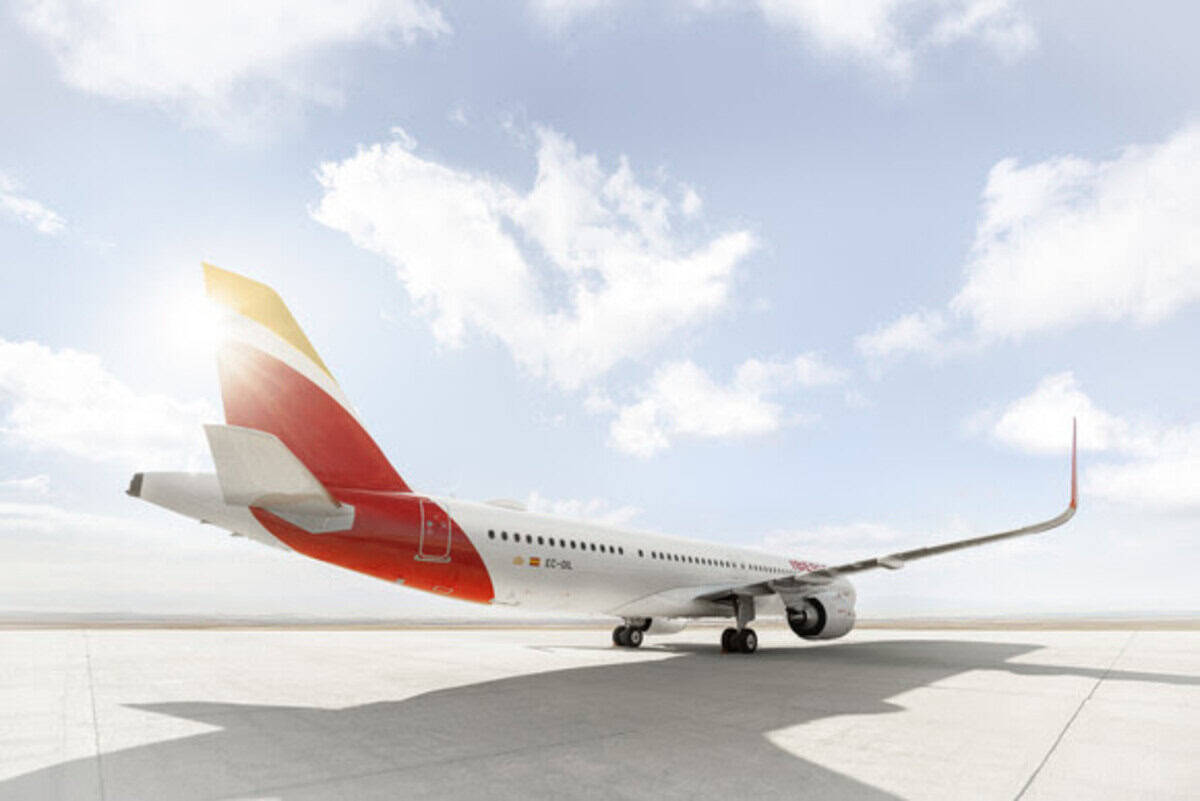
Image generated with Ai
Iberia’s special IB1473 eclipse flight will carry scientists above northern Spain aboard an Airbus A321XLR, using high-altitude observation and Starlink connectivity to study and broadcast the August 12, 2026 total solar eclipse.
The August 12, 2026 solar eclipse is creating a new opportunity for aviation and tourism, with airlines and specialist charter operators planning dedicated flights that allow travellers to experience the celestial event from the air.
Advertisement
The 2026 solar eclipse is becoming more than an astronomical attraction, as aviation companies are transforming it into a distinctive travel experience for passengers seeking a different perspective. Iberia, Brussels Airlines, Air Charter Service and ASL Group are taking different approaches, ranging from scientific observation and specialist astronomy programmes to premium charter travel.
Iberia is putting scientific observation at the heart of its eclipse operation with a specially planned flight from Madrid. The Spanish airline is operating IB1473 on August 12 using an Airbus A321XLR, with the aircraft scheduled to position itself towards the Palencia area to provide passengers and researchers with an aerial perspective of the eclipse.
Advertisement
Advertisement
The operation combines aviation, science and tourism in a single journey, with researchers from the Shelios project participating in the observation programme. Iberia is also using its onboard connectivity capabilities to support the experience, demonstrating how modern airline technology can add another dimension to specialist travel events.
The flight is particularly significant for tourism because passengers are not simply travelling to an eclipse destination; they are making the journey itself part of the attraction. This approach could encourage more airlines to consider aircraft-based experiences for future astronomical events and other time-sensitive natural phenomena.
Iberia will operate special flight IB1473 from Adolfo Suárez Madrid-Barajas Airport, departing at 18:45 local time before following a carefully planned route over Palencia in northern Spain. The symbolic flight number references 1473, the birth year of astronomer Nicolaus Copernicus, while the aircraft will climb to approximately 33,000 feet to provide researchers with a clear perspective of the eclipse.
The flight will carry around 30 astronomers and scientific researchers associated with the Shelios project and the Instituto de Astrofísica de Canarias (IAC). Led by astronomer Dr Miquel Serra-Ricart, the team will use the rare opportunity to study the solar corona while also observing other celestial bodies, including Mercury and Venus.
Operating at cruising altitude provides an important scientific advantage by reducing the impact of cloud cover and some atmospheric interference that can complicate ground-based observations. Researchers will focus particularly on the structure of the solar corona, which becomes visible during totality when the Moon completely covers the Sun.
The Airbus A321XLR will be commanded by Captain Javier Lopera Alcalá, supported by pilot Javier Meana Fernández, whose academic background includes astrophysics. Their combined aviation and scientific expertise will support the carefully timed operation required during the brief period of totality.
Although the flight is not open to the general public, Iberia plans to share the experience with viewers worldwide through a live broadcast. The airline will use its Starlink high-speed satellite Wi-Fi to transmit high-definition footage from the aircraft to its official social media channels.
The onboard production will feature three high-definition cameras capturing the eclipse and scientific activities, alongside a dedicated cockpit GoPro. The flight-deck camera is intended to record the Moon’s shadow moving rapidly across the Earth and the cloud tops below.
Before the main astronomical event, the crew will conduct a carefully planned test manoeuvre between 7:42 p.m. and 7:44 p.m. CEST. The exercise is designed to check camera alignment, confirm framing and ensure that the aircraft’s trajectory is correctly positioned for the eclipse.
For Iberia, the operation represents a notable intersection of commercial aviation, scientific research and technological innovation. The airline is using one of its newest aircraft as a mobile observation platform for an exceptional astronomical event.
Brussels Airlines is offering another dedicated aviation experience, combining air travel with astronomy and passenger education. The airline is operating a special Airbus A320 flight from Brussels towards western France, allowing passengers to observe a very deep partial eclipse from cruising altitude.
The experience has been developed with astronomy organisations and academic partners, creating a tourism product that goes beyond a conventional flight. Passengers receive eclipse-viewing equipment and specialist guidance, while the limited number of seats gives the operation an exclusive character.
The airline’s strategy demonstrates how tourism businesses can use specialist interests to create demand around a single event. Rather than selling a conventional destination holiday, Brussels Airlines is selling access to a carefully timed experience in which the flight, viewing position and astronomical event are all connected.
Air Charter Service is approaching eclipse travel from a different angle by giving passengers greater flexibility over the eventual viewing location. Its dedicated charter from London Stansted can target destinations including Valladolid, the Balearic Islands and Keflavik, allowing the operation to respond to weather conditions.
This strategy addresses one of the biggest uncertainties surrounding eclipse tourism: clouds can spoil an otherwise carefully planned viewing experience. A charter aircraft can provide greater operational flexibility than a traveller staying at one fixed ground location, although weather, air traffic and operational considerations will still influence the final decision.
For the travel industry, the model is particularly interesting because it links aviation with real-time destination selection. Instead of choosing a tourism destination months in advance and accepting the weather risk, passengers can participate in a journey designed around the conditions expected on the day.
ASL Group is adding a premium aviation option through a dedicated eclipse flight from Liège. Working with Urania, the operator is using an Embraer ERJ-135 for an exclusive passenger experience designed around aerial eclipse observation.
The smaller aircraft creates a more intimate tourism proposition than a conventional airline flight, appealing to travellers who are prepared to pay for limited availability and a specialist experience. The operation illustrates how major natural events can generate demand across different segments of the aviation market, from mainstream airlines to private and charter operators.
The emergence of dedicated eclipse flights reflects a broader change in travel, where passengers increasingly seek experiences rather than simply transportation between two destinations. A rare astronomical event provides airlines with an opportunity to combine route planning, specialist knowledge, technology and tourism marketing into a single product.
Aerial viewing also offers an important practical advantage because aircraft can operate above much of the lower-level cloud that could affect observers on the ground. However, passengers should not assume that an aircraft guarantees perfect visibility, because flight timing, atmospheric conditions, air traffic restrictions and operational requirements remain important factors.
The eclipse is expected to generate additional travel interest across parts of Europe, particularly destinations positioned close to the path of totality or areas offering strong partial-eclipse visibility. Spain and Iceland are especially relevant to the wider tourism story, while Belgium, France and the United Kingdom are also connected through dedicated aviation experiences.
The economic opportunity extends beyond airlines, because eclipse visitors can generate demand for accommodation, restaurants, transport, attractions and local excursions. For destination marketers, the event therefore represents a short but potentially powerful tourism window capable of encouraging travellers to combine eclipse viewing with longer European holidays.
The most important development is that airlines are no longer treating the aircraft simply as a means of reaching an attraction. Iberia is combining science and aviation, Brussels Airlines is creating an astronomy-focused passenger experience, Air Charter Service is using charter flexibility and ASL Group is targeting premium tourism.
Together, these approaches show how aviation can become an attraction in its own right. As travellers increasingly seek unusual and memorable experiences, specialist flights around astronomical events could become a valuable niche within the wider travel and tourism industry.
Iberia and Brussels Airlines are the principal conventional airlines offering dedicated flights for the August 12, 2026 eclipse, while Air Charter Service and ASL Group are providing charter-based experiences.
Iberia’s IB1473 is a specially planned Madrid flight using an Airbus A321XLR, designed around aerial observation of the eclipse near Palencia.
The dedicated charter departs from London Stansted, with potential viewing destinations including Valladolid, the Balearic Islands and Keflavik.
Brussels Airlines’ dedicated flight is designed to provide passengers with a very deep partial eclipse, rather than placing the aircraft in the central path of totality.
Eclipse flights demonstrate how airlines can turn rare natural events into specialised travel products, generating demand not only for aviation but also for accommodation, destinations, attractions and wider tourism services.
Advertisement
Advertisement
Advertisement













Saturday, September 5, 2026

Friday, September 4, 2026

Saturday, September 5, 2026

Saturday, September 5, 2026

Thursday, September 3, 2026

Wednesday, September 2, 2026

Saturday, September 5, 2026

Saturday, September 5, 2026


