
Singapore Emerges Alongside Tokyo and Other Asian Hubs as Airport-to-Hotel Journeys Reveal a Battle for Tourist Convenience

Published
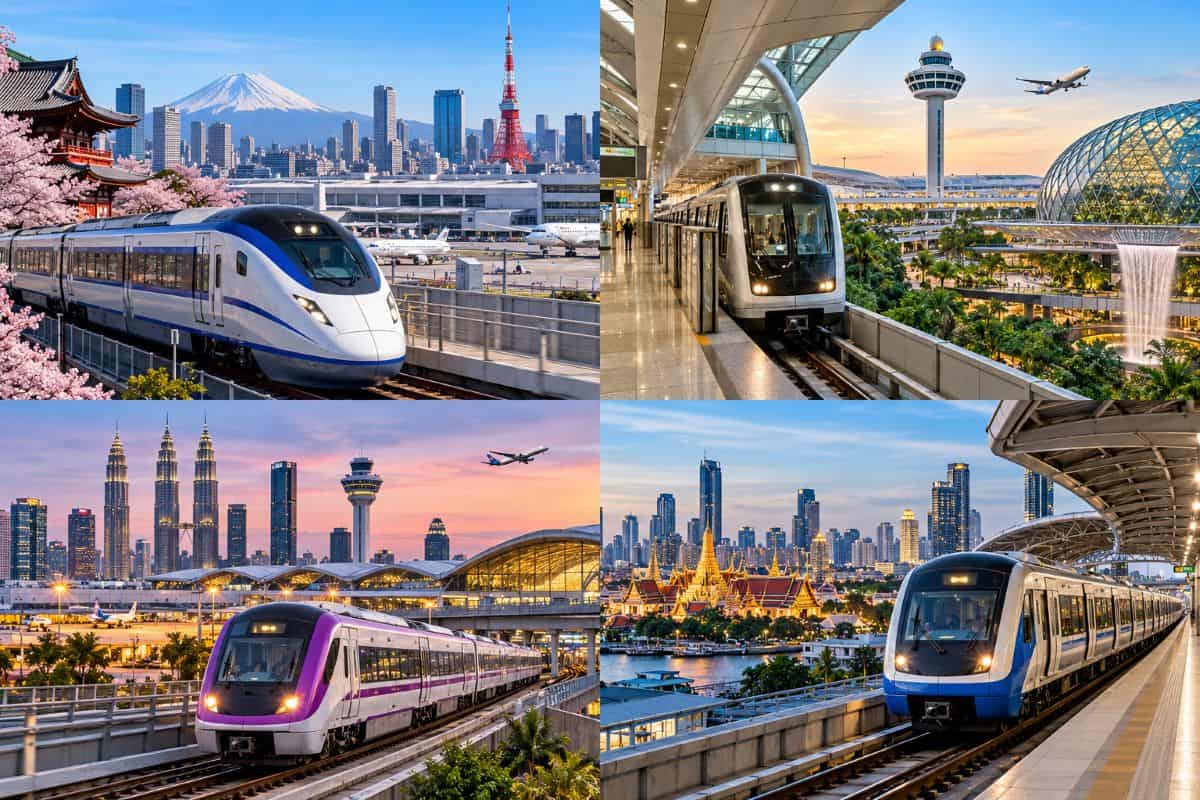
International visitors arriving in Tokyo, Singapore, Kuala Lumpur and Bangkok face four distinct transport systems, each balancing speed, fares and onward connectivity. Airport-to-hotel transport in Asia offers a revealing measure of how effectively major gateways connect arriving passengers with the districts where they stay. Tokyo combines two major airports with competing railway options, while Singapore integrates its airport into the urban MRT network. Kuala Lumpur offers a dedicated express service alongside stopping trains, whereas Bangkok provides a comparatively inexpensive airport railway. However, headline journey times tell only part of the story. Transfer requirements, operating hours, luggage, ticket costs and the final walk to accommodation determine the real arrival experience. These differences matter to holidaymakers, business travellers and tourism planners.
Tokyo’s Dual-Airport Choice Changes the Arrival Equation
Tokyo presents the most important qualification in this comparison: the arrival airport can determine the entire ground-transport strategy. Haneda sits closer to central Tokyo, while Narita requires a longer journey from the metropolitan area’s principal hotel districts. Consequently, visitors should compare flight prices and airport-transfer costs together, rather than assuming both airports offer equivalent access.
Advertisement
Advertisement
The Tokyo Monorail connects Haneda with Hamamatsucho in as little as 13 minutes. From there, passengers can continue towards destinations including Tokyo Station and other central districts. Narita’s Keisei Skyliner, meanwhile, reaches Nippori in 36 minutes at its fastest, with three departures an hour. Its standard adult ticket costs ¥2,580, although eligible advance purchases can reduce that price to ¥2,310.
| Tokyo connection | Published journey | Adult one-way fare | Main consideration |
|---|---|---|---|
| Haneda–Hamamatsucho, Tokyo Monorail | From 13 minutes | ¥520 | Additional travel may be needed |
| Narita–Nippori, Keisei Skyliner | From 36 minutes | ¥2,580 | Reserved seating and luggage space |
| Narita–central Tokyo, conventional Keisei services | Route-dependent | From approximately ¥1,000 on selected routes | Longer journey may offer better value |
Fares and journey times are indicative. The Tokyo Monorail fare shown is for Hamamatsucho, while Keisei fares vary by service and destination.
Advertisement
Advertisement
Tokyo’s advantage lies in choice rather than one universal solution. The Skyliner offers reserved seating and dedicated luggage space, which can matter after a long international flight. However, visitors staying in Shinjuku, Shibuya or another district may need an onward connection from the arrival station. A cheaper conventional service may therefore suit budget-conscious passengers, provided they accept the additional travel time.
For tourism planners, the lesson is equally important. Airport proximity, rail competition and interchange design jointly shape the arrival experience. Tokyo’s two-airport system makes itinerary-specific advice essential, particularly for first-time visitors who might otherwise choose flights without considering their final accommodation.
Advertisement
Advertisement
Singapore Makes Transfers Part of the Journey
Singapore’s Changi Airport offers a different model, connecting directly to the MRT at a station serving Terminals 2 and 3. Travellers can reach the city using the East-West Line via Tanah Merah or the Downtown Line via Expo. However, most visitors heading to central hotel districts must account for an interchange rather than a single uninterrupted airport train.
The airport authority lists the first train from Tanah Merah towards Changi Airport at 5.20am from Monday to Saturday and 5.47am on Sundays and public holidays. The last listed service departs at 11.50pm daily. In the opposite direction, the first train from Changi Airport leaves at 5.31am on weekdays and Saturdays, or 5.59am on Sundays and public holidays. These timings make advance planning important for passengers arriving on overnight flights.
| Singapore arrival consideration | Practical detail |
|---|---|
| Airport railway | MRT station linked directly to Terminals 2 and 3 |
| Main city connections | Tanah Merah and Expo interchanges |
| First train towards the airport | 5.20am weekdays and Saturdays from Tanah Merah |
| Last train towards the airport | 11.50pm from Tanah Merah |
| Payment options | Contactless bank cards, mobile wallets and stored-value cards |
| Alternative for groups | Taxi, with a published city journey of about 30 minutes |
The train times above describe services towards Changi Airport. The airport’s published taxi estimate is approximately 30 minutes, with a fare range of S$25–S$45. Actual costs and journey times vary.
Singapore’s principal strength is the wider public-transport network rather than a dedicated nonstop airport express. Travellers can continue towards Marina Bay, Orchard Road and other accommodation districts without purchasing a separate premium airport-train ticket. The precise fare depends on the route, while foreign-issued bank cards may incur administrative fees.
For hotel operators and destination marketers, this network creates opportunities to promote public transport as part of a seamless arrival experience. Nevertheless, visitors must still consider interchange walking distances, platform changes and the final route from the station. An accessible railway does not automatically guarantee an accessible hotel entrance.
Kuala Lumpur Balances Speed Against Ticket Price
Kuala Lumpur’s airport connection illustrates the trade-off between premium express travel and a broader stopping service. The KLIA Ekspres connects Kuala Lumpur International Airport with KL Sentral, the city’s principal rail interchange. Its published journey takes 28 minutes from Terminal 1, followed by another three minutes between Terminals 1 and 2. The service currently operates every 20 minutes throughout the day, including weekends and public holidays.
Advertisement
Advertisement
The standard adult fare is RM55 one way or RM100 return. Children aged six to 15 pay RM25 for a single journey, while children below six can travel free under the operator’s conditions. Online purchases receive a published 10% discount, making advance booking worth checking before departure.
| KLIA Ekspres fare | Standard adult price | Child price, ages 6–15 |
|---|---|---|
| One way | RM55 | RM25 |
| Return | RM100 | RM45 |
| One way with advertised 10% online discount | RM49.50 | RM22.50 |
Online prices are calculated from the operator’s published discount and should be confirmed during booking.
The stopping KLIA Transit service offers a different proposition. It serves Bandar Tasik Selatan, Putrajaya and Cyberjaya, and Salak Tinggi before reaching the airport. For passengers travelling to intermediate destinations, this can provide a more suitable itinerary than the nonstop express. However, the airport-to-KL Sentral fare remains RM55 under the current standard tariff.
A major development also warrants attention. The operator has announced that adult KLIA Ekspres single fares will rise to RM65 from 1 January 2027, with return fares increasing to RM118. The operator also plans to increase service frequency to every 15 minutes during the first quarter of 2027. These are announced future changes, not fares or frequencies currently in effect on 21 October 2026.
For visitors staying near KL Sentral, the express train offers a relatively predictable arrival. Those staying in Bukit Bintang or other districts must budget for another rail journey, a taxi or a walk. That additional expense can materially alter the comparison with Bangkok or Singapore, especially for a family travelling together.
Bangkok Keeps Airport Rail Travel Within Reach
Bangkok’s Airport Rail Link provides a low-cost alternative to private airport transfers. It connects Suvarnabhumi Airport with Phaya Thai, where passengers can change to the BTS Skytrain. The route also serves Makkasan, which connects with the MRT Blue Line at Phetchaburi. This arrangement gives visitors several ways to reach accommodation across the capital.
Advertisement
Advertisement
Thailand’s government travel guidance lists fares from ฿15 to ฿45, depending on distance, and daily operating hours from 5.30am until midnight. The full journey between Suvarnabhumi and Phaya Thai takes no more than 30 minutes. However, this is a city-line service with intermediate stops, not a separate nonstop airport express.
| Bangkok connection | Published information | Value for visitors |
|---|---|---|
| Airport Rail Link fare | ฿15–฿45 | Low-cost access to the city |
| Operating window | 5.30am–midnight | Requires alternatives outside service hours |
| Full-route journey | Up to 30 minutes | Predictable rail journey |
| Phaya Thai interchange | BTS Skytrain | Useful for connected city districts |
| Makkasan interchange | MRT Blue Line at Phetchaburi | Alternative onward route |
Published figures come from Thailand’s government travel guidance. Visitors should verify current service information before travelling.
The rail link is particularly attractive to solo travellers and budget-conscious visitors staying near connected stations. Yet the low fare does not tell the complete story for passengers heading to Sukhumvit, Siam or hotels away from the railway. An onward train ticket, a longer walk or a road transfer adds to both cost and journey time.
Bangkok’s experience demonstrates why a low airport fare should not be confused with a universally convenient arrival. The final connection matters, especially for families, travellers with bulky luggage and visitors unfamiliar with the city’s transport network. Even so, an affordable railway can provide a valuable alternative to road transfers affected by congestion.
Four Cities Reveal Different Travel Trade-Offs
A direct comparison must distinguish airport-to-station performance from airport-to-hotel convenience. The figures below use representative airport connections, but they do not constitute a controlled ranking. The destination stations differ, and onward journeys depend on the hotel location.
| City | Representative rail connection | Adult one-way fare | Main trade-off |
|---|---|---|---|
| Tokyo | Narita–Nippori, Skyliner | ¥2,580 | Fast, reserved service, but onward travel may be needed |
| Singapore | Changi Airport MRT | Route-dependent | Integrated urban network, usually requiring a transfer |
| Kuala Lumpur | KLIA T1–KL Sentral, Ekspres | RM55 | Fast and predictable, but relatively expensive |
| Bangkok | Suvarnabhumi–Phaya Thai, Airport Rail Link | ฿15–฿45 | Low fare, with additional travel potentially required |
All prices are in local currencies and reflect the cited published tariffs available for this research. Tokyo’s fare refers to the Skyliner, not every airport train. Kuala Lumpur’s stated fare changes from 1 January 2027.
Advertisement
Advertisement
The table exposes four different priorities. Tokyo offers competing airport links and several route choices, Singapore integrates airport access with the urban network, Kuala Lumpur emphasises speed, and Bangkok prioritises affordability. None automatically wins every category because a traveller’s destination and circumstances change the result.
The comparison also highlights an important distinction for travel businesses. A premium rail fare may be worthwhile when it saves time and reduces uncertainty. Conversely, a cheaper public service may offer better overall value when the hotel lies close to a station and the passenger has limited luggage.
The Hotel District Determines the Real Cost
The most useful comparison for readers begins at the arrivals hall and ends at the hotel entrance. A station-to-station journey excludes walking through the airport, ticket purchase, waiting, interchange movements and the final leg to accommodation. These omitted stages can significantly affect the traveller’s experience.
For a consistent editorial test, the four cities should be assessed using representative hotel districts. Tokyo’s Shinjuku and Tokyo Station areas, Singapore’s Marina Bay and Orchard Road, Kuala Lumpur’s KL Sentral and Bukit Bintang, and Bangkok’s Sukhumvit and Siam provide useful examples. Each pair should be tested separately because even central districts can have very different railway connections.
| Destination | Suggested hotel districts | Essential last-mile question |
|---|---|---|
| Tokyo | Shinjuku, Tokyo Station | Does the airport train reach the hotel district directly? |
| Singapore | Marina Bay, Orchard Road | How many interchanges and walking minutes are needed? |
| Kuala Lumpur | KL Sentral, Bukit Bintang | What additional transfer follows the express train? |
| Bangkok | Sukhumvit, Siam | Is the final BTS or MRT connection convenient with luggage? |
The resulting comparison should record total travel time, the complete public-transport fare, scheduled frequency and walking distance. It should also distinguish advertised minimum journey times from realistic estimates that include waiting and transfers. Without those distinctions, a seemingly precise ranking could mislead readers.
Private transfers deserve inclusion, but only with clear qualifications. Changi Airport publishes a typical taxi journey of about 30 minutes to the city, with a stated fare range of S$25–S$45. Equivalent estimates for the other destinations should be collected from official airport guidance or clearly identified as estimates. Road times can vary considerably with traffic, while taxi pricing may depend on surcharges, tolls and demand.
Advertisement
Advertisement
Late Arrivals and Luggage Change the Equation
Operating hours are not minor details for international travellers. Passengers arriving after the last train may need a taxi or pre-arranged transfer, while early-morning departures can make the first service equally important. Singapore’s published airport MRT times, Kuala Lumpur’s late-night operating arrangements and Bangkok’s midnight closing time demonstrate why the arrival clock must form part of the comparison.
Luggage also affects the practical value of each connection. Tokyo’s Skyliner offers reserved seating and dedicated luggage space, while KLIA Ekspres advertises luggage space, wheelchair-friendly carriages and onboard Wi-Fi. These features can improve the experience for passengers travelling with suitcases or requiring additional assistance. However, visitors should check lift access, station layouts and the walking distance to their specific accommodation.
Families and groups should compare total party costs rather than single-ticket fares alone. Four individual premium rail tickets may cost more than a shared road transfer, although congestion and luggage capacity can influence the final decision. Conversely, solo travellers may find a public railway significantly more economical than hiring a car.
The strongest practical advice is to check the last train, identify the correct terminal and map the final station-to-hotel leg before departure. Travellers should also verify whether their payment card works on the local network and whether foreign-card fees apply. These simple checks reduce uncertainty without requiring visitors to memorise an entire transport system.
What Tourism Planners Can Learn From Airport Railways
Airport connectivity is part of a destination’s visitor infrastructure, not merely a transport issue. Clear signage, understandable fares, reliable interchanges and accessible station exits influence how easily visitors can navigate unfamiliar cities. The four gateways illustrate different ways to address that challenge, from competing railway services to integrated networks and dedicated airport trains.
The most useful industry benchmark is therefore arrival friction: the effort, uncertainty and additional expense passengers encounter between landing and checking into a hotel. Transport agencies can reduce this friction through consistent multilingual information, transparent ticketing, accessible interchange routes and better coordination between airport operators and urban transport providers.
Advertisement
Advertisement
For hotels, destination marketing organisations and travel-management companies, accurate arrival guidance can also improve the customer experience. Accommodation providers can explain the best station, recommend suitable transfers and warn guests about late-night service limitations. Travel businesses can use the same information to develop arrival instructions tailored to business visitors, families and independent tourists.
However, transport convenience alone cannot establish a destination’s overall tourism competitiveness. Accommodation prices, flight availability, safety, accessibility and the wider visitor experience also matter. Any claim that one airport railway increases tourism demand would require separate evidence, such as passenger data, visitor surveys or research examining the relationship between connectivity and destination choice.
The Next Fare Changes Matter for Travellers
The comparison is especially relevant because airport transport products can change even when their underlying railway routes remain stable. Kuala Lumpur provides a concrete example: the announced January 2027 KLIA Ekspres fare adjustment will increase the adult single ticket from RM55 to RM65. The operator also plans to increase frequency from every 20 minutes to every 15 minutes in the first quarter of 2027.
These changes illustrate why published fares and service intervals need an effective date. A higher fare may coincide with a more frequent service, but the overall value depends on whether the additional departures reduce waiting times or improve connections for particular travellers. Other cities should be assessed using the same method whenever operators announce timetable, ticketing or network changes.
For readers planning a trip, the most reliable approach is to consult official transport information shortly before travel. For tourism businesses, regularly updated airport-transfer guidance can prevent outdated prices and schedules from undermining an otherwise useful visitor service. The long-term comparison should retain a consistent methodology while refreshing the underlying figures.
Which City Makes Arrival Easier?
Tokyo, Singapore, Kuala Lumpur and Bangkok demonstrate that a good airport connection is about more than reaching a central station quickly. Tokyo offers choice across two major airports, Singapore benefits from integrated urban rail, Kuala Lumpur provides a fast dedicated express, and Bangkok keeps its airport railway comparatively affordable. Yet each system has limitations involving transfers, fares, operating hours or hotel proximity.
Advertisement
Advertisement
For travellers, the best option depends on where they are staying, when they land, how much luggage they carry and how many people are travelling together. For tourism planners, the broader lesson is clear: the most valuable airport connection is the one that makes the entire arrival journey predictable, accessible and easy to complete.
Advertisement
