
Pitcairn Islands Cruise Travel Faces Capacity Test as Costa Serena Allows Only Four Hours for Visit

Updated
Published
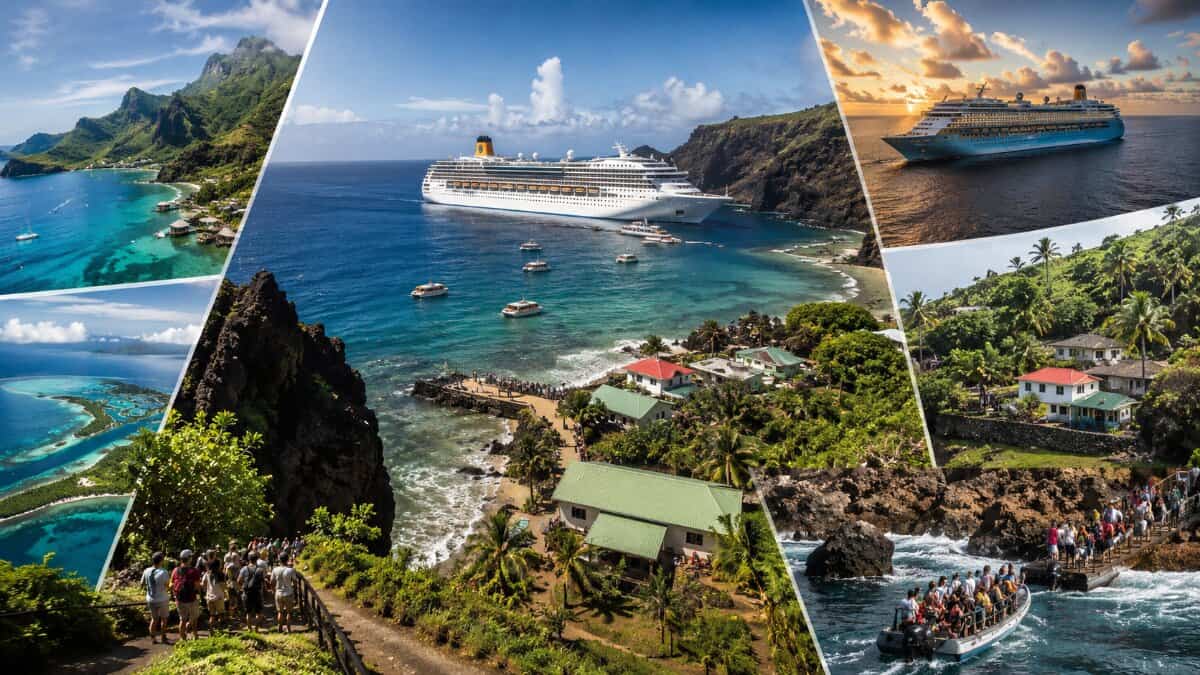
Image generated with Ai
Pitcairn Islands’ late-2026 cruise calendar reveals a significant destination-capacity issue. Costa Serena is scheduled to call on 29 November from 08:00 to 12:00 with capacity listed at 3,780 passengers yet Pitcairn Islands Tourism recommends at least five to six hours for ships carrying more than 1,000 guests. Before that call three expedition vessels converge around Adamstown from 21 to 24 October while the island’s 12-passenger supply ship Silver Supporter is also scheduled to be present. Every cruise landing remains dependent on sea conditions and the captain’s decision.
The Pitcairn Islands are notably heading towards an unusual test of cruise-tourism capacity in the final months of 2026 as the official vessel calendar combines closely spaced expedition calls with one of the largest passenger ships that is scheduled to visit this remote South Pacific territory.
The focus of the story is the cruise ship Costa Serena. The Pitcairn Islands Tourism has set a visit for it on Sunday 29 November 2026 from eight o’clock in the morning until noon. The official schedule, for the destination lists the ship’s capacity: 3,780 passengers and 1,100 crew members.
Those figures become considerably more significant when placed beside Pitcairn’s resident base. According to the Government of the Pitcairn Islands the territory has a population of only around 50, with Adamstown serving as the capital above Bounty Bay. At published passenger capacity, Costa Serena therefore represents roughly 76 passenger berths for every resident. This is a capacity comparison, not a forecast that all passengers will land.
Advertisement
Advertisement
Pitcairn Cruise Capacity Story Changes When Call Duration Is Examined
The most consequential detail in the November schedule is not simply Costa Serena’s size. It is the amount of time allocated to the call.
Pitcairn Islands Tourism’s official cruise schedule currently provides a four-hour window for Costa Serena. Separately, the destination’s guidance for cruise operators states that ships carrying 1,000 passengers or more frequently allocate around three hours, which it considers insufficient. The tourism authority recommends a minimum of five to six hours.
Advertisement
Advertisement
Costa Serena’s currently published four-hour visit consequently falls at least one hour below the lower end of Pitcairn’s own recommended window for large passenger vessels.
That gap matters commercially. Pitcairn has no conventional cruise terminal capable of absorbing thousands of passengers through gangways directly into a city centre. When landing conditions permit, passengers are transferred towards Bounty Bay, before continuing up the steep Hill of Difficulty into Adamstown. The final landing decision remains dependent upon weather, sea conditions and the ship captain.
Late-2026 Pitcairn Vessel Capacity Pressure
| Vessel | Pitcairn schedule | Published passenger capacity* | Capacity versus population of around 50 | Principal operational issue |
|---|---|---|---|---|
| Silver Cloud | 21–22 Oct | 254 | 5.1 times | Multi-day Adamstown call overlaps 22 October traffic |
| Seabourn Pursuit | 22 Oct | 264 | 5.3 times | Arrives on same date as Silver Supporter |
| National Geographic Resolution | 24 Oct | 138 | 2.8 times | Part of compressed expedition sequence |
| Silver Supporter | At Pitcairn 22–25 Oct | 12 | 0.24 times | Passenger and supply lifeline operating during cruise cluster |
| Island Sky | 7–10 Nov | 118 | 2.4 times | Extended Pitcairn-group expedition programme |
| Le Jacques Cartier | 22–23 Nov | 184 | 3.7 times | Expedition-scale call immediately before larger ship |
| Costa Serena | 29 Nov | 3,780 | 75.6 times | Four-hour published visit against five-to-six-hour large-ship guidance |
*Current cruise-line capacities are used where directly available from operators; the Costa Serena figure comes from the official Pitcairn cruise schedule. Capacity ratios measure ship berths against the government’s approximate resident population and do not represent expected landings.
October Creates an Overlooked Seventy-Two-Hour Vessel Convergence
The November Costa Serena call is only the most visible pressure point. A second, arguably more operationally revealing pattern appears in October 2026.
Pitcairn’s official cruise calendar lists Silver Cloud for 21–22 October, Seabourn Pursuit on 22 October and National Geographic Resolution on 24 October. Meanwhile, the separate government-supported passenger shipping timetable shows Silver Supporter departing Mangareva on 20 October, arriving at Pitcairn on 22 October and remaining until 25 October.
That creates an unusually concentrated period around a community numbered only in dozens.
Advertisement
Advertisement
Based on current operator capacities, Silver Cloud, Seabourn Pursuit, National Geographic Resolution and Silver Supporter together represent approximately 668 passenger berths across vessels touching the Pitcairn operation during this compressed window, or more than 13 times the territory’s approximate resident population.
Again, those passengers will not necessarily be ashore simultaneously. The figure instead illustrates the scale of operational throughput potentially interacting with the same tiny destination system.
Silver Supporter Makes the October Overlap More Important Than a Normal Cruise Cluster
Silver Supporter is not another expedition cruise ship. It is part of Pitcairn’s essential passenger and supply connection with Mangareva in French Polynesia, carrying just 12 passengers.
Its presence during the expedition sequence means Pitcairn will potentially be managing its regular lifeline operation while responding to separate cruise-vessel requirements.
This distinguishes the October event from an ordinary multi-ship port day at a developed destination. Pitcairn has an extremely small labour pool, limited physical infrastructure and no large cruise terminal through which vessel movements can be compartmentalised.
For cruise planners, this makes human carrying capacity almost as important as physical carrying capacity.
Advertisement
Advertisement
Papeete Emerges as the Regional Gateway Behind Pitcairn Cruise Access
Papeete, in French Polynesia, also has a strategic role in the wider geography of these journeys.
Silversea’s official 2026 expedition itinerary places Silver Cloud on a Papeete-to-Valparaiso voyage beginning on 12 October, travelling through French Polynesia before reaching the Pitcairn sector. Silversea lists Silver Cloud with capacity for 254 guests and 212 crew.
The itinerary passes through Mangareva before Adamstown, illustrating how Papeete, French Polynesia and Pitcairn form part of the same remote South Pacific expedition corridor.
Costa’s official 2026 world-cruise programme similarly confirms that Costa Serena will cross the Pacific on its Sydney–San Antonio sector, visiting eight islands and including Tahiti and Easter Island in that section of the journey. Costa describes the complete 2026 programme as a 66-day voyage covering 15 countries and three continents, beginning on 18 October.
Costa’s own French Polynesia port directory identifies Papeete, Tahiti as its destination in the territory.
For the travel trade, this reinforces Papeete’s function as more than an SEO-associated city. It is part of the practical maritime and aviation gateway network feeding remote Pacific itineraries towards Pitcairn.
Advertisement
Advertisement
Weather Can Instantly Turn a Shore Visit Into an Onboard Tourism Economy
Pitcairn’s greatest cruise constraint cannot be solved through schedule optimisation alone.
The official cruise calendar explicitly states that landing depends on sea conditions and the discretion of the ship captain. Pitcairn Tourism also explains that when passengers cannot safely reach shore, the visitor economy can effectively move from Adamstown onto the cruise ship.
The tourism authority indicates that approximately 35 to 45 residents may travel out to a vessel when passengers cannot land, enabling local crafts and other visitor-facing activity to take place aboard.
Against a government population estimate of around 50, that means a weather-driven offshore operation can involve a remarkably large share of the entire resident community.
This is one reason vessel capacity alone is the wrong metric for assessing Pitcairn. The meaningful measurement is the intersection of passenger capacity, landing probability, transfer time, resident workforce availability and the number of hours the ship remains within reach of the island.
Pitcairn Has Built Revenue Mechanisms Around Both Access and Uncertainty
The Government of the Pitcairn Islands maintains an active Guide for Visiting Vessels dated March 2026, alongside a cruise ship trading policy updated in December 2025.
Advertisement
Advertisement
According to the March 2026 government vessel guide, passenger landing charges and vessel-related charges form part of the formal structure governing visits. The guide provides for an adult landing fee of NZ$100, a reduced charge for younger visitors, and a NZ$2 passenger head levy applying to cruise and tour vessel bookings entering Pitcairn waters under the specified conditions. It also establishes services that can remain relevant when normal landing arrangements change, including passport processing and local presentations.
This provides an unusually adaptable micro-tourism model. Revenue opportunities do not disappear entirely simply because a large passenger landing becomes impossible. However, the economic profile changes considerably depending on whether hundreds reach Adamstown or the community instead conducts commercial activity offshore.
How Pitcairn’s Cruise Model Responds to Operational Conditions
| Operating condition | Destination response | Economic implication |
| Seas permit landing | Tender transfers through Bounty Bay | Visitor expenditure can spread into Adamstown |
| Landing prohibited | Community can travel to ship | Crafts and visitor engagement shift offshore |
| Large ship has short call | Transfer window becomes compressed | Potential shore throughput decreases |
| Several vessels arrive close together | Same resident workforce supports repeated operations | Staffing and preparation become critical |
| Supply ship overlaps cruise calls | Essential transport and visitor activity coincide | Infrastructure flexibility becomes more important |
| Weather changes after arrival | Landing plan can change rapidly | Agents need strong expectation management |
Official Schedule Differences Create Another Risk for Cruise Sellers
There is a further detail travel agents should not overlook: official destination and cruise-line records do not always carry identical ship information.
Pitcairn’s schedule currently gives Silver Cloud capacity as 296 passengers, while Silversea’s current fleet information lists 254 guests. Similar differences appear in some other vessel metadata on the destination calendar.
That does not mean the underlying visit is invalid. It does mean agents should avoid using static destination-page ship specifications as live inventory data.
Silversea’s own itinerary also provides more granular Adamstown timing than the local destination calendar, another reason bookings should be reconfirmed against the cruise operator before departure.
Advertisement
Advertisement
The discrepancy is itself useful evidence of the operational complexity surrounding remote expedition calls: schedules are assembled across destination authorities, vessel operators and changing expedition plans rather than through a conventional high-frequency port environment.
Why the Costa Serena Call Matters Beyond Pitcairn Islands
Costa Serena turns the late-2026 calendar into a broader test of how mega-capacity cruise itineraries interact with ultra-small destinations.
The ship is not inherently too large to visit Pitcairn waters. The challenge is converting a vessel carrying thousands into a meaningful destination experience when landing infrastructure, tender operations, sea state, resident staffing and time alongside are all restrictive.
A four-hour scheduled call intensifies those constraints.
For expedition vessels carrying roughly 100 to 300 guests, transfers can be managed on a fundamentally different scale. A ship with capacity approaching 4,000 creates a different operating equation even if only part of its passenger complement is expected ashore.
Pitcairn therefore offers the cruise sector a particularly clear case study: destination carrying capacity cannot be measured simply by how many passengers a ship holds or how many ships appear on a calendar. Time, accessibility and local operating capacity can matter more than theoretical demand.
Advertisement
Advertisement
Critical Takeaways for Travel Agents and Cruise Tour Operators
- Sell Pitcairn as a conditional landing destination. A scheduled call does not guarantee that passengers will reach Adamstown because the final decision depends on sea conditions and the captain.
- Flag Costa Serena’s current four-hour schedule. As of 28 August 2026, it is shorter than Pitcairn Tourism’s five-to-six-hour recommendation for ships carrying more than 1,000 passengers.
- Reconfirm October arrangements near departure. Silver Cloud, Seabourn Pursuit, National Geographic Resolution and Silver Supporter create an unusually compressed operating period.
- Separate ship capacity from actual visitor numbers. The 76-to-one Costa Serena comparison describes berth capacity against residents, not expected shore footfall.
- Prepare clients for an offshore alternative. Pitcairn has a system enabling community engagement and local commerce aboard ships when landings become unsafe.
- Verify operator data rather than relying on a single timetable. Current ship capacities and timings can differ between destination and cruise-line publications.
- Treat Papeete and Mangareva as critical regional access nodes. The French Polynesian connection remains central to both expedition routing and Pitcairn’s passenger-supply system.
- Build weather and access risk into premium cruise advice. Remote Pacific calls require more flexible expectations than conventional port-intensive itineraries.
Pitcairn Could Become a Blueprint for Managing Cruise Growth Without Chasing Volume
Pitcairn’s late-2026 cruise programme significantly demonstrates why the future of remote-destination cruising may depend less on attracting ever greater visitor numbers and more on designing calls around realistic access capacity.
Adamstown cannot operate like Barcelona and Miami or Southampton nor should its tourism strategy be judged against those ports. Its comparative advantage is rarity with remoteness and direct interaction with an exceptionally small community.
The October expedition concentration and November Costa Serena call expose two sides of the same market. Small expedition vessels can generate repeated, highly concentrated destination activity, while a world-cruise ship can create enormous theoretical demand that physical conditions may never allow ashore at one time.
For cruise lines, agents and destination planners, the strategic lesson is increasingly relevant as itineraries push deeper into remote regions. The most valuable port call may not be the one bringing the greatest passenger capacity. It may be the one whose schedule, vessel scale and landing plan give the destination enough time to deliver what passengers were sold.
As of 28 August 2026, Pitcairn’s official calendar suggests that question will be tested twice: first during the tightly compressed expedition activity around 21–24 October, and then more dramatically when Costa Serena reaches the Pitcairn Islands on 29 November with four scheduled hours against a destination recommendation beginning at five.
Advertisement
