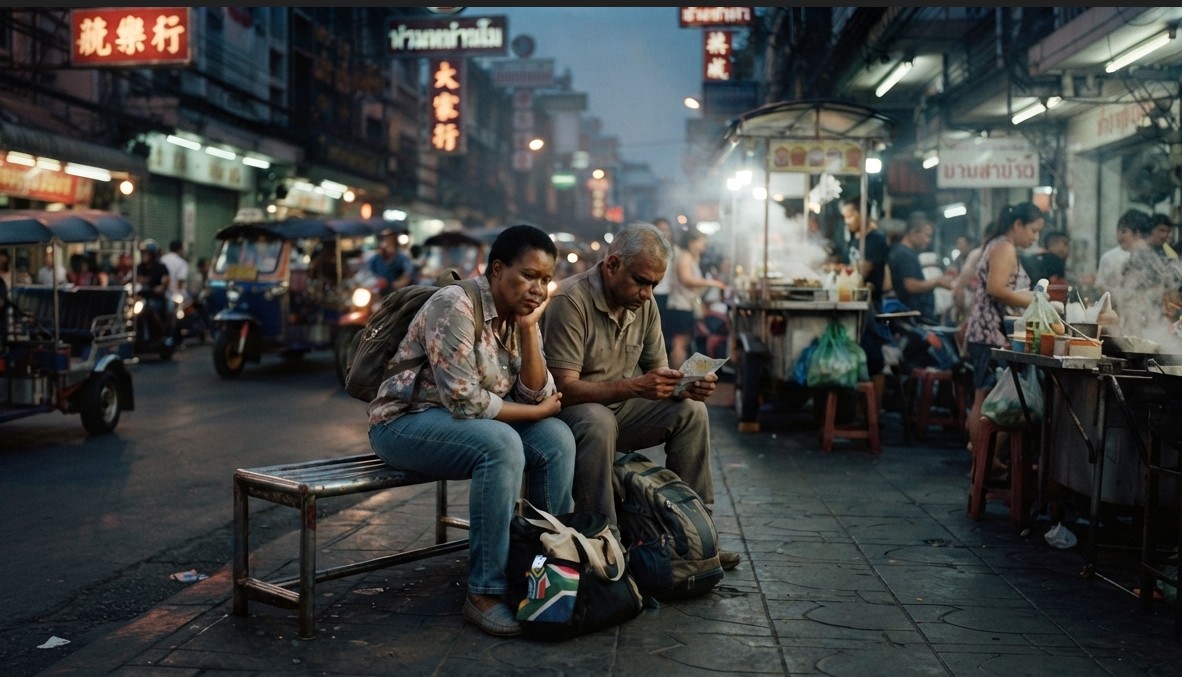
Image generated with Ai
The world’s tourism market has been shaken up post-Aug 2026 and will have far-reaching economic implications. What will truly mark 2026 is the fact that South Africa overtook Seychelles and more countries as Thailand’s tourism suffered a post-COVID slump after a 29% drop in July 2026 arrivals. While South Africa celebrates rapid arrival increase, many others suffer. Thailand struggles with rapid market shrinkage, and the Seychelles has a huge drop in international visitors. This report will analyze the latest government statistics and shifts in policies and the economic impacts that will disrupt personal international travel preferences today.
The international travel sector is currently undergoing a profound geographical shift, heavily influenced by shifting consumer preferences, geopolitical tensions, and aggressive government interventions. As of August 2026, official datasets from multiple national statistical agencies reveal a surprising truth: traditional market leaders are faltering while emerging destinations are breaking historical records. This realignment of international visitor arrivals is fundamentally changing the way governments calculate their gross domestic product contributions from the hospitality industry.
A close examination of the global tourism statistics 2026 highlights glaring disparities between the African continent and the Asia-Pacific region. While the broader African tourism market reported welcoming over 81.3 million international visitors—representing a robust 7.8 percent increase from the previous year—certain Asian powerhouses are struggling to maintain their baseline figures. This macroeconomic data provides a clear picture of how travellers are redistributing their wealth across different hemispheres.
Multiple overlapping factors are causing this unprecedented shift. First, enhanced air connectivity, particularly new direct flight routes between emerging economies, is bypassing traditional aviation hubs. Second, electronic visa systems and diplomatic visa waivers are making certain nations vastly more accessible. Finally, geopolitical instability and airspace closures have artificially suppressed demand in previously thriving regions, severely restricting long-haul transit and forcing leisure tourists to seek alternative destinations.
Advertisement
Advertisement
While many nations are struggling to match their pre-pandemic peaks, South Africa has emphatically cemented its position as the premier destination on the African continent. The nation’s deliberate focus on product diversification, infrastructure investment, and targeted international marketing is yielding phenomenal dividends, effectively allowing it to outpace its continental and global competitors.
According to official figures released by the South Africa Department of Tourism, the country welcomed a staggering 6.58 million international tourists between January and July 2026. This represents a monumental 12.4 percent increase compared to the exact same period in 2025. This exceptional growth trajectory suggests that South Africa is not merely recovering but fundamentally expanding its global market share at the direct expense of other holiday destinations.
July 2026 proved to be a particularly historic month for the South African hospitality sector. Statistics South Africa (Stats SA) officially recorded 991,696 international tourist arrivals during July alone, marking a 12.5 percent year-on-year increase. When including all cross-border port entries, the broader measure of foreign arrivals reached 1.27 million for the month. This sustained momentum proves that the country is successfully mitigating seasonal dips and establishing a more consistent year-round visitor economy.
The influx of these foreign tourist arrivals is largely facilitated by the country’s world-class aviation infrastructure. OR Tambo International Airport in Johannesburg continues to function as the dominant gateway, having processed over 163,255 airborne tourist arrivals in just a single month earlier in the year. Meanwhile, Cape Town International Airport and King Shaka International Airport in Durban continue to report elevated passenger volumes, distributing wealth across multiple provincial economies.
South Africa’s diverse portfolio of attractions remains its strongest competitive advantage. Cape Town alone welcomed 1.44 million foreign overnight visitors recently, generating an estimated R19 billion in direct local expenditure. The wildlife sector is equally robust; Kruger National Park recorded 1.87 million visitors in the recent financial cycle, while the Garden Route National Park and Addo Elephant National Park saw their numbers swell to 476,452 and 230,351 respectively. This geographical spread ensures that the tourism sector economic impact is felt nationwide.
The Minister of Tourism, Patricia de Lille, publicly attributed this success to strategic governance and targeted diplomacy. Highlighting the 14.3 percent increase in arrivals from the African continent and the 5.7 percent increase in overseas visitors, the Minister noted that the deliberate decision to diversify tourism products is yielding highly positive results. The implementation of government initiatives, particularly through the Operation Vulindlela partnership spearheaded by President Cyril Ramaphosa, has explicitly positioned tourism as a foundational pillar for inclusive economic growth.
This influx of nearly seven million visitors in just seven months translates into immense economic activity. Hotels, boutique lodges, and wildlife reserves are reporting higher average daily rates and exceptional occupancy levels. Furthermore, small and medium enterprises (SMEs) operating within the broader tourism value chain—including transport operators, independent tour guides, and local restaurateurs—are experiencing a financial renaissance, heavily contributing to domestic job creation.
In stark contrast to South Africa’s booming success, the idyllic island nation of the Seychelles is experiencing a concerning contraction. Long considered the ultimate luxury benchmark for Indian Ocean tourism, the archipelago is currently facing structural headwinds that have suppressed its traditional arrival metrics.
Data officially published by the Seychelles National Bureau of Statistics (NBS) paints a sobering picture for 2026. As of late August, the year-to-date figures show that only 232,342 visitors had disembarked in the Seychelles. When compared directly to the 254,142 visitors recorded during the exact same timeframe in 2025, this represents a significant 8.6 percent contraction.
The mid-year statistics further illuminate this downward trend. During July 2026, the Seychelles welcomed a modest 31,628 visitors. While subsequent weeks in August (such as Week 32 which saw 8,990 arrivals, and Week 35 which saw 6,275 arrivals) offered slight fluctuations, the overall trajectory remains subdued. The nation continues to rely heavily on its traditional European source markets, specifically France, the United Kingdom, Germany, Italy, and Switzerland, but volume from these territories has not expanded fast enough to offset broader market losses.
The Seychelles is highly sensitive to external macroeconomic pressures. Unlike larger mainland destinations, the islands cannot easily rely on cross-border terrestrial traffic. High aviation fuel costs, limited airline seat capacity, and fierce price competition from neighbouring island nations like Mauritius and the Maldives have collectively eroded the Seychelles’ competitive edge.
Because the Seychelles economy is overwhelmingly reliant on hospitality, this 8.6 percent drop has outsized implications for the national Gross Domestic Product. Luxury resorts are being forced to aggressively adjust their yield management strategies, while local employment in the service sector faces increased precarity. The government is currently exploring new strategic marketing initiatives to recapture market share and stimulate demand before the critical year-end high season.
The most dramatic narrative in the 2026 global travel landscape is unfolding in Southeast Asia. Thailand, historically one of the world’s most resilient and voluminous tourist destinations, is battling severe headwinds that have suppressed its mid-year performance metrics and prompted urgent governmental interventions.
The core catalyst for Thailand’s current anxiety stems from highly publicised regional drops, most notably a severe 29 percent decline in specific Middle Eastern and Israeli arrivals during July and extending into the third quarter. This specific 29% arrival decline in key demographics was triggered heavily by external geopolitical tensions, airspace closures, and subsequent flight cancellations that stranded passengers and devastated forward bookings from crucial high-spending source markets.
Broader national data confirms this deceleration. According to the Thailand Ministry of Tourism and Sports, the country welcomed 16.21 million foreign tourists between January 1 and July 4, 2026. While superficially massive, this figure actually represents a 3.11 percent decline year-on-year. The failure to match previous annual benchmarks has triggered widespread concern across the nation’s vast hospitality infrastructure.
Stalling at 16.21 million arrivals for the first half of the year indicates that the recovery remains highly uneven. In July 2026, Thailand recorded roughly 2.54 million monthly visitors—an improvement from June’s 1.84 million, yet still reflecting a heavily suppressed growth curve compared to pre-pandemic and 2025 trajectories. Weekly arrivals hovered around the 533,000 mark in early July, supported mildly by European and Chinese school holidays, but lacking the explosive growth seen in competing destinations.
Despite the decline in sheer volume, the economic extraction from visiting tourists remains robust due to inflation and longer average stays. Foreign tourists generated an impressive 782.57 billion baht in direct spending during the first half of 2026. This revenue remains a vital economic lifeline for Thai hotels, domestic airlines, retail conglomerates, and the millions of citizens employed in the informal tourism sector.
A detailed breakdown of the official source markets reveals a heavy reliance on a few key nations. From January to July 2026, China remained the dominant market with 2.65 million visitors, followed closely by Malaysia (2.11 million), India (1.23 million), Russia (1.02 million), and South Korea (596,673). However, the ministry explicitly noted a slowdown in short-haul traffic as the Chinese summer holiday period entered its final stages, severely impacting forward projections.
The ripple effects of global instability have hit Thailand’s aviation accessibility hard. The ongoing Israel-Iran conflict and broader Middle Eastern airspace restrictions severely constrained airline routing. The Thai Tourism and Sports Minister, Sorawong Thienthong, publicly highlighted that these airspace closures acted as a massive barrier, directly leading to the aforementioned steep 29 percent decline in the Israeli tourist market for July and the broader third quarter, effectively wiping out the Tourism Authority of Thailand’s (TAT) earlier projections of a 52 percent growth in that specific demographic.
Beyond geopolitical conflicts, Thailand’s traditional short-haul border markets are exhibiting fatigue. For example, Cambodian casinos in Poipet have launched aggressive promotions to retain Thai patrons, altering cross-border tourism flows. Concurrently, long-haul European markets are contending with high inflation and exorbitant long-haul airfares, leading many potential visitors to seek holiday destinations closer to their home countries.
In a desperate bid to reverse this downward trend, the Thai government has implemented aggressive policy mechanisms. This includes the strategic deployment of 30-day visa-free stays specifically targeted at securing 2.7 million Indian tourists. Furthermore, the Meetings, Incentives, Conferences, and Exhibitions (MICE) industry is being heavily promoted in coastal cities like Hua Hin to offset the decline in pure leisure travel.
The isolated statistics of South Africa, Seychelles, and Thailand are actually indicative of a much larger macroeconomic shift. In 2026, the African continent officially overtook the Asia-Pacific region as the fastest-growing continental tourism market, fundamentally altering global investment strategies.
Recent analyses of international border data confirm that the African continent welcomed approximately 81.3 million international visitors in the preceding tracking period. This represents a highly impressive 7.8 percent year-on-year growth rate. This collective surge proves that international travellers are actively diversifying their portfolios, seeking out new cultural, historical, and wildlife experiences away from heavily congested Asian mega-cities.
This geographic redistribution is catastrophic for nations that have historically relied on guaranteed year-on-year growth. As South Africa absorbs massive volumes of both intra-continental and overseas tourists, traditional giants in Asia and the Indian Ocean must come to terms with a permanently altered competitive landscape where they no longer possess a monopolistic hold on long-haul leisure travel.
The contrasting fortunes of these nations are not entirely accidental; they are the direct result of proactive—or reactive—government legislation regarding border control, aviation rights, and destination marketing.
A massive catalyst for South Africa’s 12.4 percent growth is the successful rollout and refinement of its Electronic Travel Authorisation (ETA) system. By aggressively streamlining the immigration process and stripping away bureaucratic friction, the South African government made the country infinitely more accessible to highly lucrative source markets. This digital overhaul is universally praised by industry stakeholders as a masterclass in modern tourism facilitation.
Conversely, Thailand’s policy shifts are currently highly reactive. The Ministry of Tourism and Sports is desperately attempting to plug the 3.11 percent arrival deficit by relaxing visa requirements for emerging markets and increasing marketing spend in secondary Chinese cities. However, these initiatives take time to filter through the complex global distribution systems utilized by international travel agents.
Aviation logistics dictate tourism success. South Africa secured a massive victory in July 2026 by inaugurating a direct LATAM airlines route connecting Cape Town directly to São Paulo, Brazil. This single route instantly opened the South African market to millions of high-net-worth South American travellers. Meanwhile, Thailand is battling airline hesitancy and high fuel surcharges on long-haul routes from the West.
The macro-level data trickles down instantly to the operational realities of the hospitality sector, fundamentally dictating the financial viability of millions of businesses globally.
Airlines are ruthlessly pragmatic, shifting their expensive assets to routes displaying the highest yield and demand. The surge in South African popularity has led to expanded flight frequencies into Johannesburg and Cape Town. In contrast, the 29 percent decline in specific demographics travelling to Thailand has forced certain carriers to downgrade aircraft size or consolidate their flight schedules to maintain acceptable load factors.
In Cape Town and the areas surrounding Kruger National Park, premium lodges and five-star hotels are reporting record forward bookings for the remainder of 2026. This allows them to drive up their Average Daily Rate (ADR) and maximize profitability. In Thailand, hoteliers in traditionally packed destinations like Phuket and Pattaya are being forced into aggressive price discounting to capture a shrinking pool of short-haul regional tourists.
The true economic impact is felt by SMEs. In South Africa, the boom has sparked a wave of hiring among local tour operators, transport logistics companies, and independent guides. In the Seychelles and Thailand, however, the slowdown is causing severe anxiety among street vendors, independent taxi drivers, and family-owned guesthouses who lack the financial reserves of massive international hotel conglomerates.
As the global industry moves toward the highly lucrative year-end festive season, governments and private sector analysts are urgently recalibrating their forecasts.
Thailand is anxiously monitoring the final weeks of the European and Chinese summer school holidays, hoping for a late surge of family travellers to artificially inflate their Q3 statistics. South Africa, meanwhile, is comfortably transitioning from its winter safari peak into its highly anticipated summer beach season, virtually guaranteeing continued statistical dominance through December.
Industry consensus suggests that while Thailand will undoubtedly remain one of the world’s most visited countries, it will fail to reach its ambitious 2026 internal growth targets. The Seychelles faces an uphill battle to reverse its 8.6 percent deficit and must rely on heavy discounting in the European winter to drive volume. South Africa is currently on track to comfortably break historical records, solidifying its status as the tourism success story of the decade.
The era of guaranteed tourism growth based purely on historical reputation is officially over. As South Africa Overtakes Seychelles and More Countries as Thailand Tourism Slowdown After 29% Arrival Decline In July clearly demonstrates, agility, digital visa facilitation, and geopolitical stability are now the ultimate currencies in the global travel economy. Destinations that fail to adapt to these modern metrics will continue to lose their market share to more aggressive, welcoming, and innovative nations.
Advertisement
Tags: global tourism statistics 2026, Ministry of Tourism and Sports, Seychelles travel stats, south africa tourism, Stats SA
Advertisement
Advertisement












Thursday, September 3, 2026

Thursday, September 3, 2026

Thursday, September 3, 2026

Thursday, September 3, 2026

Wednesday, September 2, 2026

Wednesday, September 2, 2026

Thursday, September 3, 2026

Thursday, September 3, 2026



