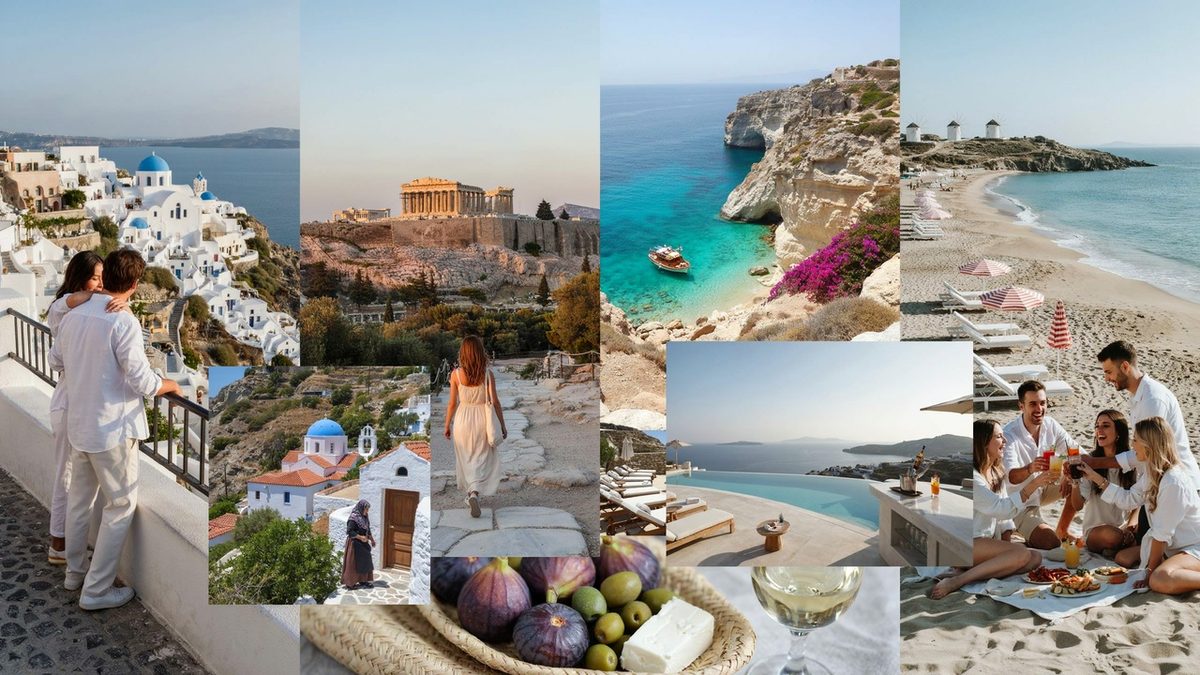
Image generated with Ai
Greece is poised to enter a new phase of tourism development as it improves its reputation as one of the major Mediterranean countries in Europe and continues to grow its attractiveness among tourists from all over the world with the help of its islands, sites with historical and cultural significance, and year-round travel options.
The tourism industry in Greece is no longer limited to the summer resorts, meaning that people from different parts of the world come to Greece not only to enjoy the Mediterranean resort but also to indulge in the activities of cultural appreciation, luxurious vacations, gastronomy tours, travelling between islands, and learning about the place’s history.
Advertisement
The measures taken by Greece’s tourism industry to popularize the country in the competitive environment have already given the necessary results, which can be reflected in the number of tourists coming from different countries of Europe, including Spain, Italy, Portugal, and Croatia.
There has been a change in the process of choosing travel destinations all over the world. Instead of just going to the destination for a beach vacation, more and more people tend to explore the culture of the country they visit.
Advertisement
Advertisement
The robust nature of Greece’s tourism is reflected in its capacity to showcase diverse travel experiences in one location.
Basically, other Mediterranean tourist destinations are promoting themselves with the coastal attractions but Greece has thousand of islands, ancient sites, and places of historical importance, beautiful villages, and hospitality of the highest class.
Moreover, the fact that Greece has managed to make progress is due to the network of international transport links, enhanced marketing strategy, and increased interest from large countries.
| Growth Driver | Impact on Greek Tourism |
|---|---|
| Island diversity | Attracts beach, luxury and adventure travellers |
| Cultural heritage | Supports history and educational tourism |
| Mediterranean lifestyle | Appeals to international holidaymakers |
| Luxury developments | Increases premium tourism demand |
| Year-round experiences | Reduces dependence on peak summer months |
| Strong air connectivity | Improves access from global markets |
Greece’s ability to combine traditional attractions with modern travel experiences has helped it maintain strong competitiveness across the Mediterranean region.
Advertisement
Advertisement
Greece has reported a considerable increase in tourism, with the last few years showing some of the highest visitor figures in history.
Greece’s official tourism statistics show that both arrivals and expenditures have increased. Thus, in 2025, the number of inbound trips reached approximately 37.98 million, marking a rise compared to the prior year.
The data for early 2026 gives confidence about the future, revealing that from January to April Greece hosted 5.24 million visitors, which indicates a 27.1% increase compared to the same period in 2025.
| Period | Tourism Performance |
|---|---|
| 2024 | Around 40.7 million inbound travellers recorded |
| 2025 | 37.98 million inbound visitors |
| January–April 2026 | 5.24 million visitors, strong year-on-year increase |
The figures highlight Greece’s continued ability to attract visitors despite increasing competition from other Mediterranean destinations.
Greece is known for its tourism appeals as both the world-famous islands and the inland wonders of the country.
Seven wonders such as Santorini, Mykonos, Crete and others are the most commonly pointed out when Greece is in question by people all over the globe.
| Destination | Tourism Appeal |
|---|---|
| Athens | Ancient history, museums, city breaks and cultural tourism |
| Santorini | Iconic landscapes, luxury stays and romantic travel |
| Mykonos | Premium tourism, nightlife and beach experiences |
| Crete | Heritage, cuisine, beaches and outdoor activities |
| Rhodes | History, coastal tourism and family holidays |
| Corfu | Nature, architecture and island experiences |
| Thessaloniki | Food, culture and urban tourism |
| Peloponnese | Archaeology, landscapes and authentic Greek traditions |
This destination diversity gives Greece an advantage by allowing visitors to create different types of holidays within one country.
Greece is gradually moving away from a tourism model focused only on summer months.
Athens has developed into an attractive city-break destination, offering museums, ancient landmarks, restaurants and cultural events throughout the year.
Meanwhile, Greek islands are expanding their tourism seasons through wellness retreats, gastronomy, nature activities and luxury experiences.
| Traditional Tourism Model | New Tourism Approach |
|---|---|
| Summer beach holidays | All-season experiences |
| Island-focused travel | Mainland and island combination trips |
| Short peak season | Extended visitor periods |
| Leisure only | Culture, wellness and adventure tourism |
This evolution helps Greece increase visitor spending while reducing pressure on popular destinations during peak months.
Greece competes with some of the world’s strongest tourism markets, including Spain and Italy.
Spain remains one of Europe’s largest tourism destinations due to its extensive coastline, cities and infrastructure. Italy continues attracting travellers through heritage, cuisine and iconic cultural landmarks.
However, Greece has created a distinctive position by combining island experiences, ancient history and authentic local culture.
| Country | Main Tourism Strength |
|---|---|
| Greece | Islands, heritage, beaches and authentic experiences |
| Spain | Large-scale tourism infrastructure, beaches and cities |
| Italy | History, gastronomy, art and cultural attractions |
| Portugal | Coastal tourism, landscapes and city breaks |
| Croatia | Adriatic coastline and historic towns |
Greece’s ability to offer unique island experiences gives it a powerful advantage in the competitive Mediterranean market.
International demand remains a major driver of Greece’s tourism performance.
European markets continue to provide a significant share of visitors, while long-haul markets are adding further growth opportunities.
| Market | Contribution |
|---|---|
| Germany | One of Greece’s strongest European markets |
| United Kingdom | Major source of island and leisure visitors |
| France | Important Mediterranean travel market |
| Italy | Growing European visitor market |
| United States | Strong demand for cultural and luxury travel |
In 2025, visitors from Germany increased significantly, while travel from the United Kingdom and Italy also contributed to Greece’s tourism growth.
Greece is investing in tourism experiences that appeal to travellers seeking more than seaside holidays.
The country is promoting:
| Segment | Example Experiences |
|---|---|
| Cultural tourism | Ancient ruins, museums and historic cities |
| Gastronomy tourism | Greek cuisine, local products and wine routes |
| Adventure tourism | Hiking, sailing and outdoor exploration |
| Wellness tourism | Retreats, nature stays and relaxation experiences |
| Sustainable tourism | Eco-friendly destinations and responsible travel |
This diversification is helping Greece attract visitors throughout the year.
Luxury tourism has emerged as one of thieves fastest growing segments of Greece’s tourist market.
Expensive villas and luxurious hotel chains are drawing Travellers from various parts of the planet.
Mykonos, Santorini and the Aegean islands have turned into the landmarks of luxury travels in the Mediterranean.
Meanwhile, the country tries to promote luxury tourism not just on the famous islands, while also improving new hotels in other regions of Greece.
Greece combines ancient history, world-famous islands, natural beauty, cuisine and luxury experiences, making it attractive to different types of travellers.
Yes. Greece competes strongly with Spain and Italy by offering distinctive island experiences, heritage tourism and authentic cultural attractions.
Athens, Santorini, Mykonos, Crete, Rhodes and Corfu remain among the country’s best-known destinations.
Yes. Spring and autumn are increasingly popular because of comfortable weather, cultural activities and fewer crowds.
Visitors are increasingly combining island holidays with cultural experiences, food tourism and mainland exploration.
Strong international demand, improved connectivity, diverse attractions and investment in tourism infrastructure are key factors behind the country’s expansion.
Greece is increasingly establishing itself as one of the most important tourism centers in the Mediterranean through the effective combination of heritage, natural beauty and contemporary travel experience, thus emphasizing that today’s successful tourism relies not only on the beaches.
Given that Greece keeps on developing a broad range of tourism opportunities beyond seasonal summer tourism, its competition in the Mediterranean will last for long on a much higher level compared to the previously existing.
Advertisement
Tags: Athens Travel, Europe tourism growth, Greece Holidays, Greece tourism 2026, Greek islands tourism
Advertisement
Advertisement











Thursday, September 3, 2026

Thursday, September 3, 2026

Thursday, September 3, 2026

Thursday, September 3, 2026

Wednesday, September 2, 2026

Wednesday, September 2, 2026

Thursday, September 3, 2026
Thursday, September 3, 2026



