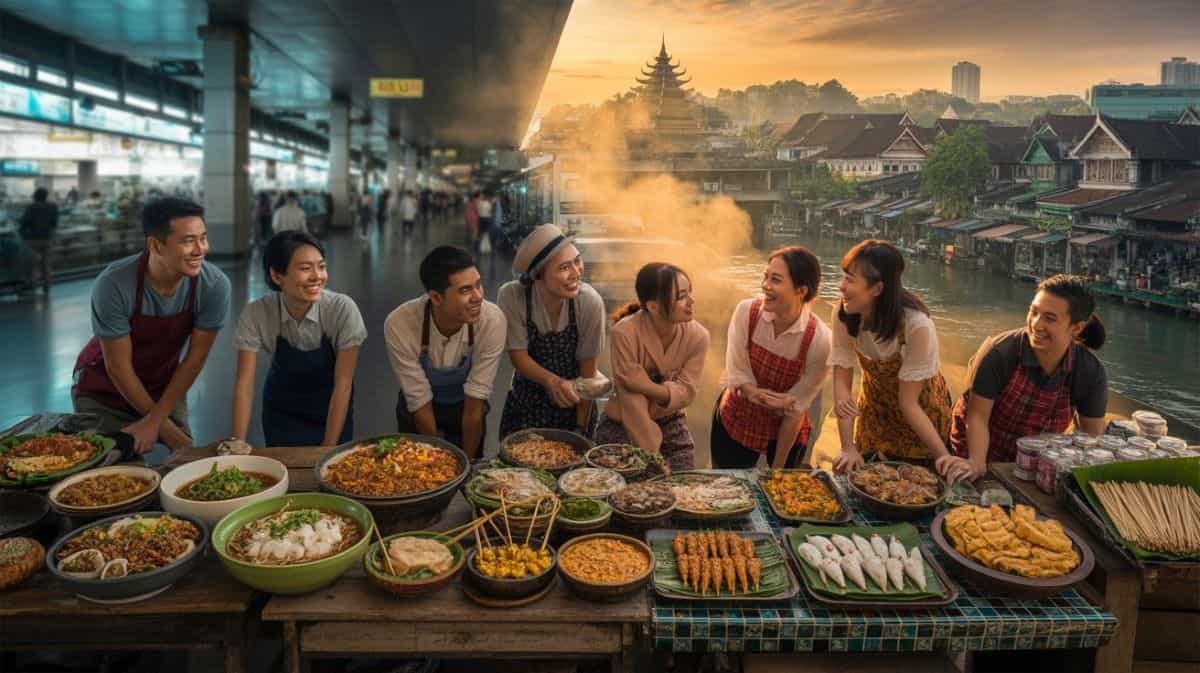
Image generated with Ai
A fresh invitation to explore Southeast Asia through its food has been extended by Changi Airport through the A Taste of Asia campaign. Under the initiative, Changi Airport, Southeast Asian travel, culinary tourism and authentic Asian cuisine have been brought together to encourage travellers to discover the region through its flavours. Street food, local delicacies and culturally rooted dining experiences have been placed at the heart of the journey. Singapore Changi Airport has meanwhile been presented as a convenient gateway from which food-led holidays across the region can be planned.
Singapore Changi Airport has been promoted as the gateway through which the featured culinary journeys can be accessed. The campaign has emphasised that a regional food adventure can be reached by air through Changi Airport, making the hub part of the holiday-planning process rather than simply a transit point.
Advertisement
The concept has been supported by a broad selection of destinations across Cambodia, Thailand, Vietnam, Indonesia, Laos, Malaysia and the Philippines. Major tourism centres have been included alongside places that may be less familiar to international visitors. As a result, both established holidays and more adventurous regional itineraries can be considered.
A practical travel message has therefore been combined with strong sensory inspiration. The flavours of Southeast Asia have been used to create interest, while Changi Airport has been placed at the centre of the resulting journey.
Advertisement
Advertisement
Chiang Mai in Thailand, Da Nang in Vietnam and Phnom Penh in Cambodia have been given prominent positions within the campaign through its See the Wonders of Asia section. Each destination offers a different setting in which culinary discovery can be combined with a wider travel experience.
In Chiang Mai, an introduction to northern Thailand can be experienced through the city and its surrounding cultural landscape. In Da Nang, a coastal holiday can be paired with exploration of Vietnamese food traditions. In Phnom Penh, Cambodian cuisine can be encountered alongside the capital’s urban and cultural character.
By placing these destinations together, the diversity of Southeast Asian travel has been demonstrated. Mountain landscapes, coastlines and capital-city experiences have all been connected through food. Travellers are consequently being shown that no single model of a culinary holiday has been imposed.
Bali, identified as Bali (Denpasar), has been joined by Labuan Bajo and Yogyakarta in the Indonesian section of the campaign. This combination has expanded the travel message beyond a single internationally recognised island.
Advertisement
Advertisement
Bali (Denpasar) can be selected by travellers seeking a familiar tropical gateway. Labuan Bajo can be considered by those who are drawn towards a different Indonesian island experience. Yogyakarta can be chosen when culture, heritage and urban exploration are being prioritised.
Through the inclusion of these three places, the scale and diversity of Indonesia have been acknowledged. Different regional cuisines and travel environments can be encountered across the country. Food-led exploration can consequently be used to move travellers beyond established routes and towards a more varied understanding of Indonesia.
Kuala Lumpur, Penang, Malacca, Sibu and Miri have been listed by Changi Airport as part of the campaign. The Malaysian selection is one of the most geographically varied within the initiative.
A major metropolitan experience can be planned in Kuala Lumpur. Penang can be considered for a journey strongly associated with food and heritage. Malacca can be incorporated into a historically focused itinerary. Sibu and Miri can be explored by travellers seeking regional experiences beyond the most internationally familiar Malaysian destinations.
This range supports the campaign’s central message. Southeast Asia can be experienced through multiple layers, and smaller or less frequently selected cities can be given greater attention when food is used as a source of travel inspiration.
Vientiane in Laos and Cebu in the Philippines have also been featured. Their inclusion has ensured that the campaign extends across a wider part of Southeast Asia rather than being concentrated only on its largest tourism markets.
A visit to Vientiane can be shaped around the pace and character of the Lao capital. Cebu can be considered for a Philippine journey in which urban experiences and island travel may be combined. In both cases, culinary discovery can be used to build a more locally grounded holiday.
By being placed alongside better-known regional destinations, Vientiane and Cebu have been given stronger visibility. Travellers who may initially be attracted by familiar food capitals can also be encouraged to consider alternative routes and new cultural experiences.
The campaign has been built around rich and diverse flavours, street food, local favourites and regional delicacies. Authenticity has therefore been positioned as the main attraction. Food is not being used merely as decoration for conventional destination marketing. It is being treated as a reason to travel.
This approach can be especially valuable for visitors who want to move beyond standard itineraries. A destination can be explored through neighbourhood eateries, traditional dishes and everyday dining customs. Greater engagement with local culture can be encouraged, while tourism spending may be distributed across restaurants, markets and small food businesses.
Travel can consequently be made more memorable. A dish can remain associated with a street, a city or an entire country long after the journey has ended.
Through A Taste of Asia, Changi Airport has connected aviation, destination promotion and culinary curiosity within one regional message. Singapore has been presented as the convenient starting point, while the wider Southeast Asian experience has been allowed to take centre stage.
The campaign’s strength has been found in its variety. Famous tourism centres have been featured, but regional cities and emerging destinations have also been included. Food lovers, beach visitors, heritage travellers and urban explorers can all be addressed through the same initiative.
Most importantly, Southeast Asia has been presented not as one uniform destination but as a collection of distinctive cultures. Every city has been given its own potential flavour, atmosphere and travel experience. From Bangkok and Bali (Denpasar) to Vientiane, Sibu and Cebu, another journey can be inspired by another plate.
[Source:- Mi-3.com.au.]
Advertisement
Advertisement
Advertisement













Saturday, September 5, 2026

Friday, September 4, 2026

Saturday, September 5, 2026

Thursday, September 3, 2026

Wednesday, September 2, 2026

Saturday, September 5, 2026
Saturday, September 5, 2026