
Middle East Travel Safety Advisory and Guide by The United States

Published
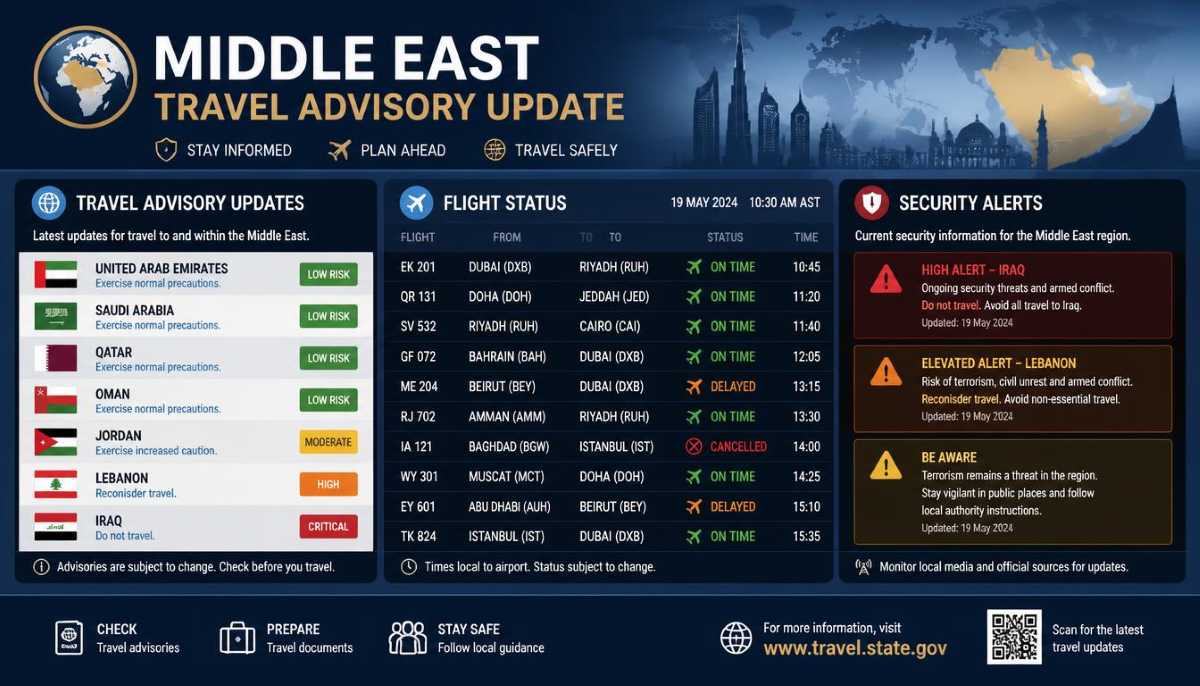
Recent international developments have prompted the United States Department of State to update its official safety guidelines, highlighting a Level 3 Travel Advisory: Reconsider Travel for Saudi Arabia, alongside a strict Level 4: Do Not Travel warning for specific high-risk border regions such as the Yemen border due to ongoing armed conflict, terrorism, and drone or missile targeting. The security landscape across the broader Middle East has grown increasingly complex, driven by hostilities involving Iran and Iranian-supported groups like the Houthis targeting critical infrastructure, civilian airports, and American interests.
Official directives emphasize that travelers and residents must maintain heightened vigilance as regional tensions fluctuate. The situation necessitates careful evaluation by anyone planning international journeys or business operations within the region. Security assessments continuously factor in the risk of falling debris from intercepted aerial threats, potential disruptions to regional stability, and stringent enforcement of local statutes.
Advertisement
Advertisement
Impact on Travelers
For tourists and expatriates currently navigating the region, the primary concerns involve operational disruptions and flight reliability. Potential flight cancellations, unexpected airspace closures, and immediate travel delays are reported across various transit hubs. Air travelers are strongly advised to check departure statuses directly with airlines or through regional airport flight boards before heading to terminals.
Beyond aviation challenges, visitors are subjected to strict local laws and regulations. Incidents involving the unauthorized filming or photographing of security events, official facilities, or restricted areas have led to detentions, fines, and exit bans. Furthermore, individuals are encouraged to keep a low profile, avoid public demonstrations or large gatherings, and steer clear of heavy police presence or locations publicly associated with the United States. Utilizing alternative ground transportation networks, such as registered trains and private or public bus providers, is recommended when air transit is constrained, provided schedules are verified beforehand.
Advertisement
Advertisement
Industry Insights and Expert Analysis
International aviation bodies, tourism boards, and global corporate mobility managers are closely monitoring the unfolding situation based on direct field data and intelligence reports. Airlines operating within the Persian Gulf and the Gulf of Oman are reviewing flight paths and safety protocols in response to Federal Aviation Administration warnings and regional threat indicators. Hospitality providers and corporate travel agencies have ramped up communication channels to support stranded or affected passengers, ensuring that contingency plans are readily available.
Industry analysts note that corporate entities with personnel stationed near critical energy infrastructure or military installations face elevated risk profiles. Consequently, organizations are updating their duty-of-care frameworks, restricting non-essential corporate travel, and mandating registration through official government programs to track and safeguard employees abroad.
Advertisement
Advertisement
Practical Information for Travelers to the Middle East
Travelers navigating the current environment are urged to implement several concrete safety precautions:
- Enrollment: Register immediately in the Department of State’s Smart Traveler Enrollment Program (STEP) to receive timely security updates and facilitate emergency contact by local embassies or consulates.
- Communication: Maintain fully charged mobile devices pre-programmed with local emergency numbers, including unified emergency services (911), police (999), ambulance services (997), and consular contact details.
- Emergency Preparedness: In the event of an aerial attack or security incident, individuals must stay away from glass doors, windows, and fallen debris while continuously monitoring local media and official government channels for instructions.
- Consular Support: Regular and emergency consular services remain accessible through U.S. embassies and consulates located in Riyadh, Jeddah, and Dhahran for citizens requiring urgent assistance.
Comparison with Previous Policies or Developments
In contrast to prior periods of relative regional stability where standard travel advisories focused primarily on routine tourism precautions and seasonal weather patterns, current directives reflect an escalated risk matrix. Previous frameworks allowed for smoother transit through major regional hubs with minimal airspace interventions. The updated 2026 guidelines introduce rigorous restrictions, explicit warnings against travel to Middle East border zones like Yemen, and heightened scrutiny surrounding digital media activity, local photography laws, and critical infrastructure proximity. These adjustments signify a structural shift toward proactive containment of regional security threats and enhanced traveler accountability.
Advertisement
Advertisement
Advertisement
