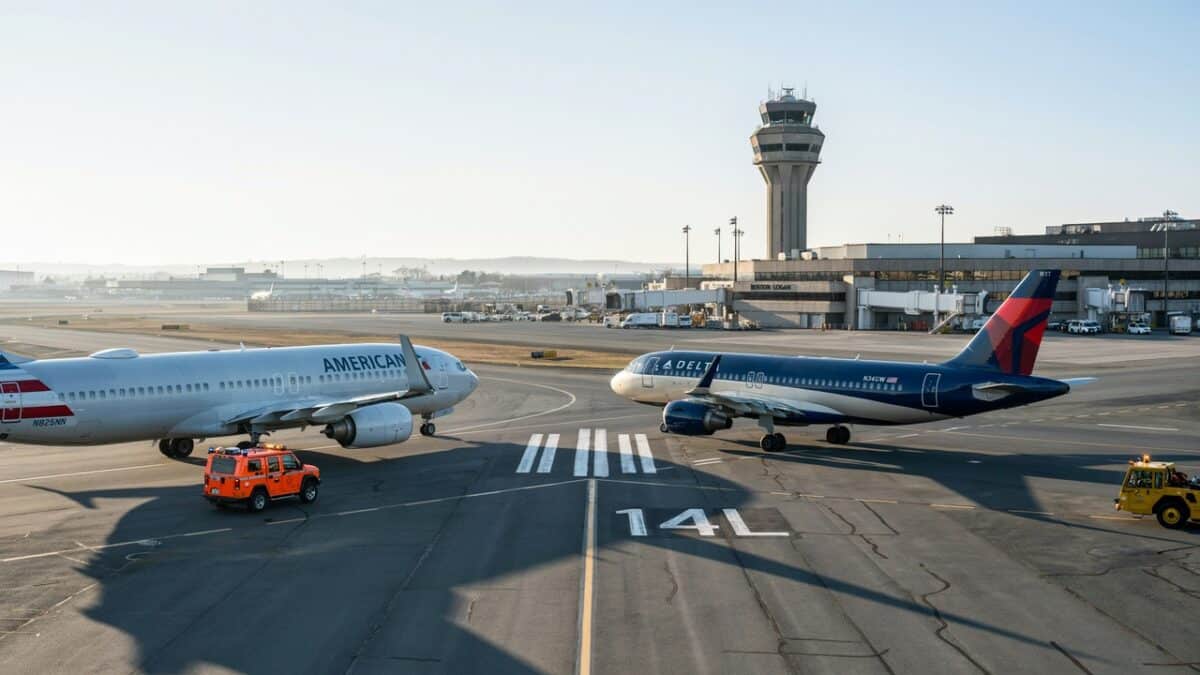
Image generated with Ai
Boston Logan International Airport avoided a potentially catastrophic aviation accident after a Delta Air Lines Airbus A319 and an American Airlines Boeing 737-800 came dangerously close during a runway conflict. The incident has triggered a National Transportation Safety Board investigation into air traffic control communication, runway management and situational awareness.
The event highlights a growing challenge facing modern aviation. Airports are handling record passenger demand, increasingly complex flight movements and tighter operational schedules. While commercial aviation remains one of the safest forms of transport, runway incursions continue to be one of the industry’s most closely monitored risks.
Advertisement
For travellers, the incident provides an important reminder that aviation safety depends on thousands of coordinated decisions made by pilots, controllers, airport teams and safety regulators.
The incident occurred on 20 June 2026 at Boston Logan International Airport.
Advertisement
Delta Air Lines Flight 2351 was approaching Boston from Dallas/Fort Worth International Airport with an Airbus A319 carrying 131 passengers and five crew members.
At the same time, American Airlines Flight 3161 was preparing to depart for Charlotte Douglas International Airport using a Boeing 737-800 carrying 176 passengers and six crew members.
According to the NTSB preliminary report, the Delta aircraft was cleared to land on Runway 33L while the American aircraft received take-off clearance from an intersecting runway.
The situation became dangerous when the American aircraft began its take-off roll while Delta was approaching the runway intersection.
The Delta pilots identified the conflict and immediately initiated a go-around procedure, allowing the aircraft to avoid the runway conflict.
The NTSB estimated that both aircraft came within approximately 670 feet (204 metres) of each other.
The biggest concern is not only the distance between the two aircraft but the chain of events that allowed the situation to develop.
Modern airports operate through highly detailed coordination systems.
Every aircraft movement requires:
The NTSB investigation found that the controller believed the American aircraft would continue its take-off roll after receiving clearance. However, the aircraft temporarily stopped because of a cockpit warning before restarting the take-off process.
This created a critical timing problem.
The controller’s attention moved towards managing another aircraft movement, while the American aircraft later resumed its departure.
The incident demonstrates how small operational misunderstandings can create serious safety challenges in busy airport environments.
The Boston Logan incident comes during a period when aviation systems worldwide are managing increasing operational pressure.
According to the US Federal Aviation Administration (FAA), the United States National Airspace System manages millions of aircraft movements every year, requiring continuous coordination between airports, airlines and air traffic controllers.
FAA data shows that the US aviation network handles more than 45,000 flights every day, highlighting the enormous complexity of managing modern air travel.
As passenger demand grows, airports must balance:
For travellers, this means safety systems must constantly evolve.
The NTSB investigation remains ongoing, but the preliminary findings provide important lessons.
The investigation identified no major distractions or unusual conditions inside the control tower during the incident. Controllers described traffic conditions as moderate to low complexity at the time.
However, the event shows that aviation safety does not depend on one person or one system.
Instead, safety depends on multiple layers working together.
These include:
The quick response from Delta pilots prevented the situation from becoming a serious accident.
Passengers often see aviation safety only through delays, cancellations or security checks.
However, behind every safe flight is a complex safety system designed to prevent incidents before they happen.
Runway safety is especially important because airports are environments where hundreds of aircraft movements happen daily.
Travellers should understand that:
The Boston Logan event ended without injuries or aircraft damage, demonstrating how safety procedures and pilot actions can prevent accidents.
The aviation industry continues investing in technology and procedures to reduce runway risks.
Key safety improvements include:
Modern airports use radar, surveillance technology and automated alerts to improve aircraft tracking.
Air traffic controllers receive continuous training focused on communication, workload management and emergency response.
Aircraft systems provide pilots with additional warnings about runway conditions and potential conflicts.
Agencies such as the NTSB analyse incidents to identify improvements before accidents occur.
The Boston Logan runway near miss offers a powerful lesson for the future of aviation.
Airlines today operate with some of the most advanced aircraft and safety technology ever developed. However, aviation remains a human-coordinated system.
Technology can provide warnings, but people must interpret information correctly and act quickly.
The Delta pilots’ decision to perform a go-around demonstrates why trained human judgement remains essential.
As airports become busier, the future of aviation safety will depend on combining smarter technology with stronger communication, better training and careful operational planning.
The FAA manages one of the world’s largest aviation systems, overseeing more than 45,000 daily flight operations across the United States.
This enormous network requires constant coordination between thousands of aviation professionals.
According to the International Civil Aviation Organization (ICAO), global air passenger demand has continued recovering strongly after the pandemic period, increasing pressure on airports and aviation infrastructure.
More passengers mean more flights, making runway safety systems increasingly important.
Travellers can reduce stress during operational disruptions by following simple steps:
Always monitor airline notifications before travelling.
Busy airports require additional time for check-in and security.
Operational pauses often protect passengers rather than create inconvenience.
Flight crews are trained to manage unexpected situations safely.
A Delta Airbus A319 approaching to land and an American Airlines Boeing 737-800 preparing for take-off came close during a runway conflict at Boston Logan Airport.
The NTSB estimated the aircraft came within approximately 670 feet (204 metres) of each other.
No passengers or crew members were injured, and no aircraft damage was reported.
A runway incursion occurs when an aircraft, vehicle or person incorrectly occupies a runway area where another aircraft movement creates a safety risk.
The investigation is focused on improving safety procedures. Travellers should continue normal travel plans while checking airline updates.
Advertisement
Tags: American Airlines Delta, aviation safety, Boston Logan Airport, NTSB investigation, runway incursion
Advertisement
Advertisement













Friday, September 4, 2026

Friday, September 4, 2026

Friday, September 4, 2026

Friday, September 4, 2026

Thursday, September 3, 2026

Wednesday, September 2, 2026

Friday, September 4, 2026