
Greece Sets New Global Benchmark in Wildfire Monitoring as Four Thermal CubeSats Strengthen National Fire Detection, Emergency Response and Summer Tourism Security

Updated
Published
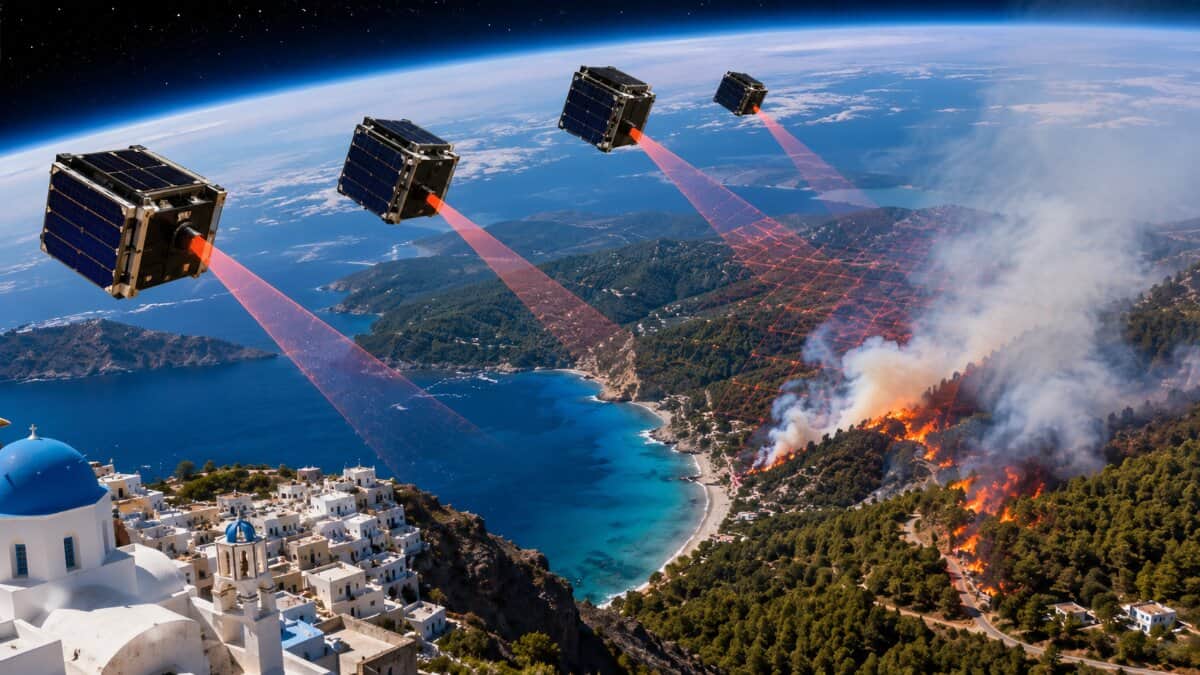
Greece has launched the Hellenic Fire System, a national constellation of four thermal CubeSats built to detect, monitor and track wildfires in near real time. The system gives Greece a sovereign space-based fire-monitoring capability at a critical moment for summer tourism, island mobility, cruise operations, hotel risk planning and protected-area travel. It also connects wildfire intelligence with wider public administration through the Government Earth Observation Hub.
Greece Wildfire Satellite System Marks A Strategic Shift In Travel Safety
Greece has moved wildfire detection from a ground-heavy emergency model into a new space-enabled national safety system. The Hellenic Fire System is not a general weather satellite project. It is a dedicated wildfire detection and monitoring capability built around thermal observation.
Advertisement
Advertisement
For the travel trade, this matters because wildfire disruption has become a direct operational risk. It affects island transfers, resort access roads, hotel evacuation plans, ferry schedules, cruise excursions, destination weddings, outdoor MICE programmes and protected natural attractions. Greece depends heavily on safe, predictable summer movement. The satellite system therefore sits at the intersection of civil protection, destination resilience and tourism continuity.
The project also changes how Greece presents itself to international travel buyers. It signals that wildfire risk is no longer treated only as a seasonal emergency. It is now part of national infrastructure planning, digital governance and climate adaptation.
Advertisement
Advertisement
Greece Uses Four Thermal CubeSats To Monitor Fire Activity From Orbit
The Hellenic Fire System consists of four infrared imaging CubeSats. Each satellite is based on an 8U CubeSat platform. Each carries two infrared imagers working across midwave and longwave infrared bands. This allows the constellation to identify active fires, detect thermal anomalies and measure fire radiative intensity.
The satellites were launched on 3 May 2026 from Vandenberg Space Force Base in California aboard a SpaceX Falcon 9 CAS500-2 mission. They form the second operational Earth observation mission under the Greek National Small Satellite Programme, following earlier radar satellites.
Advertisement
Advertisement
The Greek programme is designed to reach thirteen satellites organised into four mission groups. Its wider purpose goes beyond wildfire response. It supports disaster management, environmental monitoring, national security, innovation and economic growth.
Verified System Architecture
| Component | Verified Detail | Tourism And Travel Relevance |
|---|---|---|
| Country | Greece | Primary destination focus for wildfire resilience |
| System name | Hellenic Fire System | National wildfire monitoring capability |
| Satellite count | Four thermal CubeSats | Systematic national coverage for fire detection |
| Satellite type | 8U CubeSat platform | Compact, low-earth-orbit monitoring asset |
| Sensor profile | Midwave and longwave infrared imagers | Detection of heat signatures, hotspots and active fire behaviour |
| Launch date | 3 May 2026 | Enters the 2026 summer risk cycle |
| Launch site | Vandenberg Space Force Base, California | International launch infrastructure supporting Greek civil protection |
| Launch vehicle | SpaceX Falcon 9 CAS500-2 mission | Multimission payload deployment |
| Programme umbrella | Greek National Small Satellite Programme | Part of broader Greek space and resilience infrastructure |
| Institutional oversight | Greek Ministry of Digital Governance, Hellenic Space Center, ESA support | Public-sector operational alignment |
| Funding framework | EU Recovery and Resilience Facility through Greece 2.0 | Climate resilience linked with national recovery investment |
Greece Tourism Resilience Gains A New Layer Of Operational Intelligence
The commercial travel relevance becomes clear when Greece’s 2026 visitor momentum is placed beside wildfire exposure. Bank of Greece data shows that inbound traveller flows rose by 27.1 per cent in January to April 2026, reaching 5.2404 million. Travel receipts rose by 36.9 per cent to 2.7907 billion euros over the same period.
Advertisement
Advertisement
April 2026 alone showed 1.8387 million inbound travellers and 1.1146 billion euros in travel receipts. That is a strong shoulder-season signal before the peak summer months. It also means more people, more movement and more operational pressure during periods of heat and fire risk.
For travel agents, tour operators and destination management companies, wildfire intelligence now has direct commercial value. It can support faster itinerary changes, safer transfers, stronger hotel briefings, clearer duty-of-care procedures and more accurate advice for outdoor excursions.
Latest Greece Travel Demand Indicators For 2026
| Indicator | April 2026 | Year-On-Year Change | January-April 2026 | Year-On-Year Change |
| Inbound travellers | 1.8387 million | Up 10.6 per cent | 5.2404 million | Up 27.1 per cent |
| Travel receipts | 1.1146 billion euros | Up 9.5 per cent | 2.7907 billion euros | Up 36.9 per cent |
| Travel services surplus | 735.9 million euros | Higher than April 2025 | 1.6643 billion euros | Higher than January-April 2025 |
| Airport traveller flows | Not stated as total | Up 5.0 per cent | Not stated as total | Up 12.8 per cent |
| Road border traveller flows | Not stated as total | Up 34.1 per cent | Not stated as total | Up 67.8 per cent |
Greece Island Tourism, Coastal Mobility And Outdoor Travel Stand To Benefit
The new system matters most for areas where tourism and landscape risk overlap. Greece’s islands, coastal resorts, forested mainland regions, archaeological corridors, national parks and rural accommodation zones all depend on fast situational awareness.
Wildfires can disrupt travel even when flames do not reach hotels. Smoke can close roads. Evacuation orders can alter transfer plans. Heat and wind can affect outdoor tours. Ports, small airports, hiking trails and beach resorts can face sudden operational strain.
Advertisement
Advertisement
The satellite system strengthens the early-warning chain by improving the detection of emerging hotspots and the monitoring of fire behaviour. It does not replace firefighters, emergency alerts or local decision-making. It gives authorities another intelligence layer that can support faster response and better impact mapping.
For B2B tourism, this creates a clearer structure for risk communication. Tour operators can align their supplier checklists with national fire-risk maps, local authority guidance, 112 alerts and hotel-level evacuation protocols.
Greece Builds A Wider Earth Observation Economy Around Climate Risk
The Hellenic Fire System is part of a wider national move into Earth observation. Greece is developing space infrastructure not only to monitor fire, but also to support environmental protection, water management, agricultural planning, coastal monitoring and land-use analysis.
Greek authorities have confirmed that satellite data will feed into the Government Earth Observation Hub. This is important because wildfire response often depends on combining several data layers. Fire intensity, vegetation, road access, marine conditions, coastal settlement patterns and water resources can all influence emergency planning.
The same infrastructure can also support long-term tourism strategy. Destinations need better data to manage water scarcity, heat risk, coastal stress and protected-area access. This is especially relevant for luxury resorts, island municipalities, cruise ports, marinas, rural tourism clusters and event organisers.
Earth Observation Uses With Travel Industry Impact
| Data Use | Public-Sector Value | Travel Industry Value |
| Fire detection | Faster identification of emerging hotspots | Earlier itinerary review and safer excursion planning |
| Fire evolution imagery | Better monitoring of active fire behaviour | More accurate operational decisions during disruption |
| Impact mapping | Faster assessment after fire events | Faster destination recovery messaging |
| Marine and coastal water temperature | Coastal and environmental monitoring | Support for island, beach and marine tourism planning |
| Lakes and reservoirs | Water resource awareness | Better long-season destination sustainability planning |
| Agricultural and forest land-use data | Environmental and rural policy support | Support for agritourism, wine tourism and nature-based travel |
| Urban fabric and wetlands | Better land-use intelligence | Better planning for resorts, MICE venues and transport corridors |
Greece Wildfire Risk Context Makes The Satellite System Timely
The timing is significant. Mediterranean wildfire risk has become more complex because heat, drought, wind and land-use pressure can accelerate fire behaviour. The European Commission’s Joint Research Centre has previously identified the 2023 Alexandroupoli fire in Greece as the largest single fire recorded in Europe since the 1980s, with more than 96,000 hectares burnt.
Advertisement
Advertisement
This history explains why Greece’s satellite project has travel-sector importance. Wildfires now influence destination reputation, booking confidence, insurance risk, local supply chains and government emergency planning. The issue is not only safety. It is business continuity.
For premium travel, risk perception is especially important. High-value travellers expect clear information, professional response protocols and resilient service delivery. MICE organisers need destination assurance before confirming conferences, incentives and outdoor programmes. Cruise operators need shore-excursion stability. Airlines and ground handlers need accurate disruption signals.
Greece Travel Businesses Need To Convert Satellite Resilience Into Practical Protocols
The satellite system will have the greatest tourism value when it connects with front-line travel operations. Data alone does not protect travellers. It must be translated into local procedures.
Hotels need updated guest information systems. Destination management companies need alternative routes and backup excursions. Tour guides need escalation protocols. Travel agents need supplier verification before peak summer departures. Cruise planners need heat and fire-risk contingencies for excursions near forested or inland zones.
Operators should also understand the difference between detection and prediction. Thermal satellites detect fire activity and heat anomalies. They support monitoring and response. They do not remove wildfire risk, and they do not guarantee that disruption will not happen.
Travel Trade Readiness Matrix For Greece Wildfire Season
| Travel Segment | Main Exposure | Recommended B2B Action |
| Hotels and resorts | Guest safety, road access, evacuation readiness | Review evacuation routes, multilingual alerts and local authority contacts |
| Tour operators | Itinerary disruption, refunds, duty of care | Build flexible routing and excursion substitution rules |
| Travel agents | Pre-departure advice and client reassurance | Share official fire-risk and emergency guidance before peak travel |
| DMCs | Ground transfers, supplier coordination | Map backup transport corridors and local response contacts |
| Cruise lines | Shore excursion safety | Monitor inland excursion risk and prepare coastal alternatives |
| MICE planners | Event continuity and delegate safety | Include wildfire risk in venue due diligence and crisis planning |
| Adventure travel firms | Hiking, cycling, rural tours | Avoid high-risk zones during elevated fire-risk periods |
| Insurance partners | Claims exposure and disruption evidence | Integrate official alerts and impact mapping into documentation |
Critical Operational Takeaways For Travel Agents And Tour Operators
- Greece is the primary focus country for this wildfire satellite development.
- The Hellenic Fire System is a national thermal satellite capability for wildfire detection, monitoring and tracking.
- The system strengthens Greece’s 2026 summer tourism resilience but does not eliminate wildfire risk.
- Agents should continue to monitor official fire-risk maps, 112 alerts and local civil protection instructions.
- Operators should update hotel, transfer, excursion and cruise shore-operation protocols before peak heat periods.
- Premium travel sellers should use the development as a confidence signal, not as a guarantee of disruption-free travel.
- MICE planners should include wildfire risk in venue selection, delegate mobility planning and outdoor-event contracts.
- DMCs should prepare alternative routes for island, coastal, rural and archaeological itineraries.
- Cruise and ferry-linked itineraries should include backup plans for smoke, road closures and port-area pressure.
- Insurance, refund and rebooking policies should reflect the growing role of climate-related operational disruption.
Forward-Looking Summary: Greece Turns Wildfire Monitoring Into Destination Infrastructure
Greece’s Hellenic Fire System signals a new phase in destination risk management. It places satellite intelligence inside the national travel-safety environment at a time when climate volatility is reshaping Mediterranean tourism.
Advertisement
Advertisement
The long-term influence may extend beyond Greece. Other fire-prone tourism economies could study this model as they redesign civil protection, visitor safety and climate-resilient destination planning. For the global travel market, the lesson is clear. The most competitive destinations will not only sell beaches, culture and connectivity. They will sell resilience, verified safety systems and the ability to protect travellers when climate risk intensifies.
Greece has now positioned wildfire monitoring as national infrastructure. That makes the satellite system more than a space project. It is a tourism confidence tool, a public safety upgrade and a strategic signal to the international travel trade.
Advertisement
