
Tokyo, Hong Kong and Osaka Stand Alongside Asia’s Leading Destinations as Shopping Cities Reinvent Tourism

Published
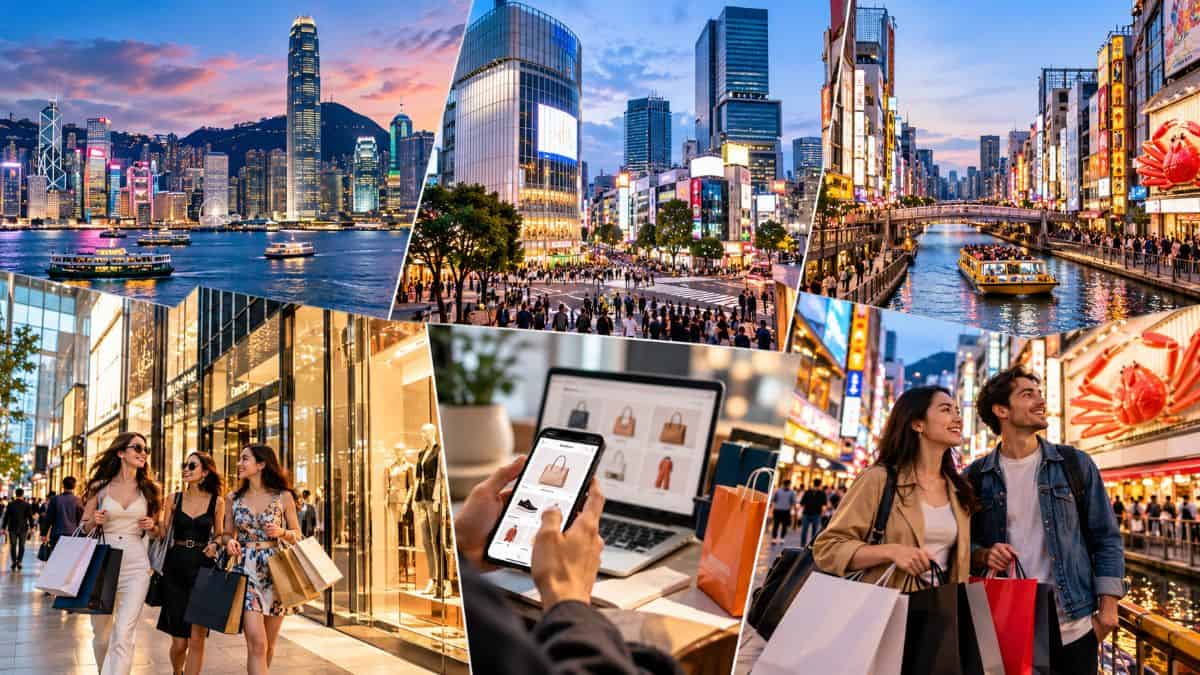
Hong Kong, Tokyo and Osaka are confronting an unusual tourism paradox. Online retail keeps expanding, yet travellers continue to devote valuable holiday time to physical shopping. Tokyo recorded a record 28.65 million foreign visitors in 2025, while foreign tourism spending reached about ¥4.55 trillion. Hong Kong welcomed 49.9 million visitors, despite a retail sector still facing structural pressure. Osaka recorded 14.64 million foreign visitors in 2024, generating ¥1.393 trillion in foreign visitor spending. Japan’s domestic B2C e-commerce market also reached ¥26.1 trillion in 2024, highlighting the scale of the digital challenge. The emerging lesson is significant for travellers and tourism businesses. Shopping is no longer simply about buying products. Increasingly, destinations must make the act of shopping itself worth travelling for.
The Shopping Holiday Is Being Rewritten
The traditional shopping-city proposition depended on convenience, variety and price. A traveller visited a major commercial district because the destination offered products unavailable at home. That proposition has weakened as online marketplaces have widened their selection and simplified international purchasing.
Advertisement
Advertisement
Japan illustrates the shift particularly clearly. Its domestic B2C e-commerce market expanded 5.1% to ¥26.1 trillion in 2024. The merchandise segment alone reached ¥15.22 trillion, with electronics, apparel, household products and food among its largest categories. Electronics recorded an e-commerce ratio of 43.03%, while books, visual and music software reached 56.45%.
That creates a formidable substitute for conventional retail visits. Yet international tourism is simultaneously producing enormous physical spending. Japan recorded 42.68 million international visitors in 2025, while inbound visitor expenditure reached a record ¥9.4559 trillion. The contradiction is therefore not a collapse of shopping, but a transformation in what travellers expect from it.
Advertisement
Advertisement
| Indicator | Latest official figure | Significance |
|---|---|---|
| Japan B2C e-commerce market, 2024 | ¥26.1tn | Digital purchasing continues expanding |
| Japan inbound visitors, 2025 | 42.68m | International travel reached a record |
| Japan inbound spending, 2025 | ¥9.456tn | Tourist expenditure reached a record |
| Tokyo foreign visitors, 2025 | 28.65m | Tokyo reached a record |
| Tokyo foreign tourism consumption, 2025 | ¥4.553tn | Foreign spending reached a record |
| Hong Kong visitors, 2025 | 49.9m | Arrivals rose 12% year on year |
| Osaka foreign visitors, 2024 | 14.639m | Major regional tourism scale |
| Osaka foreign visitor spending, 2024 | ¥1.393tn | Significant regional economic contribution |
Tokyo Turns Retail Into A Travel Experience
Tokyo provides perhaps the clearest evidence that physical shopping can survive by becoming part of the wider destination experience. The city’s 2025 foreign visitor survey found that 64.8% shopped for daily goods, cosmetics, food and confectionery. Another 56.3% shopped for clothing and fashion accessories.
The figures become more revealing when shopping is placed beside other activities. Eating Japanese food attracted 90.3% of foreign visitors. Modern streetscapes, architecture and views attracted 56.8%, while traditional buildings and streetscapes attracted 56.4%. Anime and manga merchandise attracted 35.6%.
Advertisement
Advertisement
This suggests that shopping rarely operates in isolation. A visitor can move from food to fashion, architecture to department stores, or anime culture to specialist retail within the same urban itinerary. The shop becomes one stage of the destination experience rather than the entire destination.
Tokyo’s expenditure figures reinforce the commercial importance of this behaviour. Foreign travellers spent an average ¥204,117 per person in Tokyo during 2025. Shopping accounted for approximately ¥64,032 per foreign traveller, placing it behind accommodation but ahead of several other spending categories.
The city’s visitor mix also indicates growing repeat behaviour. More than half, 54.6%, were repeat visitors in the latest behavioural survey. That matters because repeat travellers generally seek experiences beyond the conventional sightseeing circuit.
Hong Kong Faces A Different Retail Test
Hong Kong presents a more complicated picture. The city welcomed 49.9 million visitors in 2025, an increase of 12% from the previous year. Mainland Chinese visitors represented approximately 37.8 million arrivals, or 76% of the total.
However, visitor volume does not automatically translate into equivalent retail momentum. Hong Kong’s total retail sales reached about HK$380.45 billion in 2025, rising 1.0% in value terms. In volume terms, however, sales declined 0.4%.
That divergence deserves attention. It suggests that higher nominal sales do not necessarily represent stronger underlying retail demand. For travel businesses, the crucial issue is therefore spending quality rather than visitor quantity.
Advertisement
Advertisement
Hong Kong’s 2024 tourism figures already showed the scale of the opportunity. Tourism expenditure associated with inbound tourism was estimated at HK$195 billion, while overnight visitors spent about HK$5,490 per person. Average overnight stays stood at 3.2 nights.
The competitive landscape has also changed. Visitors can increasingly combine Hong Kong with nearby destinations, including Shenzhen, where retail and consumer experiences offer another proposition. This means Hong Kong cannot depend solely on its historical reputation as a shopping capital.
Its strongest defence may instead lie in density. Few destinations allow travellers to combine luxury malls, independent retailers, dining, harbour views, cultural districts and transport connections within such compact urban geography.
Osaka Builds A Value-Led Retail Ecosystem
Osaka offers another model. Rather than relying primarily on luxury positioning, the city blends shopping with food, entertainment, neighbourhood culture and mass tourism.
Official tourism data recorded 14.639 million foreign visitors in 2024. Their estimated expenditure reached ¥1.393 trillion, giving Osaka a substantial role in Japan’s inbound economy.
The 2025 picture also shows a diversified visitor base. Chinese visitors accounted for about 5.22 million arrivals, followed by South Korea with 2.74 million and Taiwan with 1.64 million. The United States contributed approximately 1.45 million visitors.
Advertisement
Advertisement
More recent Osaka research indicates that average spending per visitor increased from ¥130,431 in 2024 to ¥149,298 in 2025. However, the movement differed sharply by market. Average spending by Australian and New Zealand visitors increased strongly, while the Chinese figure declined.
That distinction matters because the future of shopping tourism will depend increasingly on market composition. A city receiving more visitors is not necessarily generating proportionately more retail value. Visitor origin, length of stay, spending preferences and travel purpose all influence the commercial outcome.
Osaka’s advantage lies in its ability to combine spending occasions. A visitor may shop around Shinsaibashi and Namba, eat in Dotonbori, explore Nipponbashi and continue towards Umeda. The itinerary creates multiple opportunities for discretionary spending without making shopping the sole purpose of the journey.
Online Retail Cannot Sell The Whole Experience
The rapid growth of digital commerce does not affect every product category equally. Japan’s e-commerce statistics show particularly high digital penetration for books, electronics and household products.
That creates a useful distinction for destination retailers. The more interchangeable a product is, the easier it becomes to purchase online. Conversely, products tied to discovery, authenticity, scarcity or cultural identity retain stronger physical appeal.
| Retail category | Digital substitution | Travel-related physical appeal |
|---|---|---|
| Everyday household products | Very high | Limited |
| Standard electronics | High | Moderate |
| Books and media | Very high | Moderate for specialist products |
| Fashion | High | Strong where local identity matters |
| Cosmetics | High | Strong for discovery and testing |
| Luxury goods | High | Strong for service and exclusivity |
| Local food products | Moderate | Very strong |
| Character merchandise | Moderate | Very strong |
| Limited editions | Low | Very strong |
| Local crafts | Low to moderate | Very strong |
| Experiential retail | Very low | Extremely strong |
This explains why physical retail can coexist with enormous e-commerce markets. Travellers do not necessarily visit Tokyo or Osaka because they cannot buy products online. They visit because the physical encounter adds something that delivery cannot reproduce.
Advertisement
Advertisement
The New Currency Is Discovery
Discovery is becoming one of the most valuable assets in destination retail. Online platforms are exceptionally efficient when consumers know what they want. Physical shopping remains powerful when consumers want to discover something unexpected.
A traveller entering a Japanese department store can encounter regional food, specialist cosmetics, stationery, craftsmanship and seasonal products. The same traveller can then continue into a neighbourhood with independent retailers and specialist stores.
That journey creates what could be called a physical shopping premium. It is the additional value created when purchasing becomes part of the holiday itself.
For destinations, this changes the investment question. The objective is no longer simply to attract more shops. It is to create retail environments that encourage visitors to explore, linger and spend.
Shopping Districts Must Become Destinations
The strongest districts increasingly behave like tourism precincts. Shibuya, Ginza and the Tokyo Station–Marunouchi–Nihombashi area are not simply retail clusters. They combine transport, dining, architecture, entertainment, hospitality and commercial activity.
Tokyo’s 2025 survey found Shibuya was visited by 60.3% of foreign travellers, followed by Ginza at 54.1% and the Tokyo Station, Marunouchi and Nihombashi area at 51.8%.
Advertisement
Advertisement
That pattern demonstrates the power of mixed-use urban tourism. Visitors are not necessarily making separate “shopping trips”. Instead, shopping is embedded within their movement through the city.
Hong Kong and Osaka operate through similar principles, although their commercial identities differ. Dense transport networks and closely packed districts reduce the friction between sightseeing and shopping.
For travellers, this means a shopping itinerary increasingly works best when integrated with food, culture and neighbourhood exploration.
Spending Quality Matters More Than Footfall
The next stage of competition will revolve around high-value tourism rather than raw arrival numbers. Tokyo’s figures demonstrate why.
Foreign tourism consumption reached about ¥4.553 trillion in 2025, increasing 14.9% year on year. Average expenditure per foreign visitor also rose to approximately ¥199,874 in one Tokyo behavioural measure.
Japan’s national inbound figures show a similar direction. Visitor expenditure reached ¥9.4559 trillion in 2025, up 16.4%. Average spending per visitor was approximately ¥229,000.
Advertisement
Advertisement
The figures show why retail remains strategically important even when online commerce expands. Physical shopping contributes to a broader visitor economy involving hotels, restaurants, transport and entertainment.
For destinations, therefore, the objective is not to defeat e-commerce. It is to capture expenditure that e-commerce cannot capture.
Travellers Should Shop Differently In Each City
The three destinations also offer different practical propositions.
| Destination | Best physical-retail proposition | Traveller strategy |
|---|---|---|
| Tokyo | Culture-led discovery and specialist retail | Combine shopping with neighbourhood exploration |
| Osaka | Value, food, entertainment and dense retail | Build shopping around Namba, Umeda and wider city experiences |
| Hong Kong | Compact luxury, international retail and urban density | Combine malls with harbour, dining and cultural districts |
Tokyo suits travellers seeking specialist products and Japanese cultural retail. Osaka offers a broader value-and-entertainment combination, particularly for travellers already exploring Kansai.
Hong Kong remains particularly efficient for short stays because of its dense commercial geography. A traveller with limited time can combine major retail zones with food and sightseeing without long inter-city transfers.
The most important practical lesson is simple. Travellers should not judge these cities solely by product prices. The real value lies in what cannot be ordered from home.
Advertisement
Advertisement
The Retail Categories With Staying Power
The evidence points towards a new hierarchy of physical retail. Commodity products face the greatest digital substitution because consumers can compare prices and order them without travelling.
By contrast, products with a destination identity have greater resilience. Japanese confectionery, regional food, specialist cosmetics, character merchandise, local crafts and limited-edition products offer stronger reasons for physical discovery.
Luxury also retains an important role, although its future depends on service, authenticity and exclusivity rather than simple availability. A luxury purchase can become part of a holiday memory when the transaction includes hospitality and destination prestige.
That distinction should shape tourism planning. Retail that creates memories has greater tourism value than retail that merely moves merchandise.
The Next Asian Shopping Model
The three cities point towards a broader transformation across Asia. The traditional shopping capital depended on the concentration of stores. The emerging model depends on the concentration of experiences around stores.
That means transport access, walkability, food, culture, entertainment, architecture and hospitality increasingly matter alongside retail space. It also means destination marketers need to understand shopping behaviour as part of the complete visitor journey.
Advertisement
Advertisement
The strongest cities will not necessarily be those with the largest malls. They will be those that make travellers feel they discovered something worth bringing home.
Online retail will continue expanding. Japan’s official data already shows the direction of travel, while household surveys also report record levels of online-shopping participation and expenditure.
Yet the physical retail economy is not disappearing from tourism. Tokyo’s record foreign visitor spending, Hong Kong’s enormous visitor base and Osaka’s rising visitor expenditure demonstrate a more nuanced reality.
The future of Asian shopping cities will therefore depend on a crucial shift. Shopping must stop competing with tourism and become one of tourism’s most memorable experiences.
For travellers, that changes the question from “What can I buy there?” to something more valuable: “What can I experience there that I cannot buy online?”
Advertisement
