

Image generated with Ai
Southwest Airlines Boeing 737-700 passenger flight WN2665 from Albuquerque, New Mexico to Baltimore, Maryland diverted and made an emergency landing at Tulsa International Airport after an unexpected mid-air operational disruption triggered a fresh aviation alert.
Southwest Airlines Boeing 737-700 passenger flight WN2665 from Albuquerque, New Mexico to Baltimore, Maryland has triggered fresh concern after the aircraft diverted and made an emergency landing at Tulsa International Airport, Oklahoma, United States. The unexpected development unfolded after the flight departed Albuquerque International Sunport slightly behind schedule before air traffic monitoring systems suddenly flagged the aircraft as redirected to Tulsa.
Advertisement
According to the latest flight-tracking update, the Boeing 737-700 was originally scheduled to arrive at Baltimore/Washington International Airport later in the evening. However, the live tracker removed the estimated arrival time and replaced it with a diversion notice, immediately raising questions among passengers and aviation observers. Although Southwest Airlines did not publicly confirm the precise nature of the incident in the tracker update, the system referenced possible bad weather conditions affecting the route.
Meanwhile, aviation experts note that emergency diversions are often initiated as precautionary measures to protect passengers, crew members and aircraft operations. In many situations, pilots choose alternate airports because of severe weather, airspace congestion, fuel concerns or technical irregularities. Tulsa International Airport is frequently used as a diversion point because of its strategic central location and operational capacity.
Advertisement
Advertisement
Southwest Airlines Flight WN2665, operating between Albuquerque, New Mexico, and Baltimore, Maryland, was temporarily redirected during its journey on May 11, 2026, according to live flight-tracking information displayed online. The flight status panel indicated that the aircraft had departed on time from Albuquerque International Sunport but was later marked with a prominent “Flight Redirected” advisory.
The tracking display stated that the flight was “currently redirected to TUL,” referring to Tulsa International Airport in Oklahoma. The notice also clarified that such reroutes can occur because of adverse weather conditions and warned that the aircraft could still ultimately continue to its originally scheduled destination.
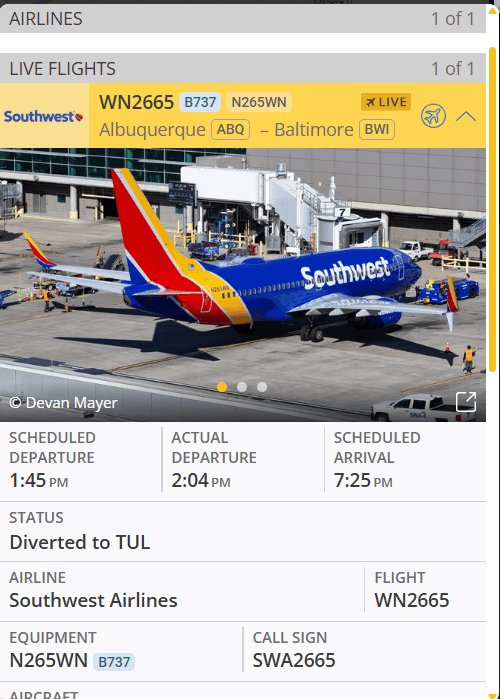
Image generated with Ai
According to the tracking data, Southwest Airlines Flight WN 2665 was scheduled to depart Albuquerque International Sunport at 13:45 MDT on May 11, 2026. The aircraft actually departed at 13:56 MDT, indicating a delay of approximately 11 minutes from the original departure schedule.
The flight was listed as traveling from Albuquerque, New Mexico, to Baltimore/Washington International Airport in Baltimore, Maryland. Despite the later-than-scheduled pushback, the system continued to classify the departure status as “On time.”
Advertisement
Advertisement
No gate or terminal information was available for either the departure or arrival airports at the time the image was captured. The display marked those operational fields as “N/A.”
The most significant update on the flight tracker was the redirection notice appearing across the top of the page. The system specifically stated that the flight had been rerouted to Tulsa, commonly abbreviated in aviation systems as TUL.
Airline diversions are frequently initiated because of severe weather patterns, air traffic congestion, mechanical concerns, or operational restrictions at destination airports. In this case, the tracker explicitly referenced bad weather as a possible reason for the reroute.
However, the advisory also emphasized uncertainty over the aircraft’s final landing point. It noted that the flight “may in fact land at TUL,” suggesting that airline dispatchers and air traffic control authorities were still evaluating whether the aircraft would continue onward to Baltimore after the diversion.
The original scheduled arrival time for Flight 2665 at Baltimore/Washington International Airport was listed as 19:25 EDT. Yet the tracker showed no estimated arrival time, replacing that field with a double dash symbol.
That absence of updated arrival information generally indicates that the airline or tracking platform had not yet confirmed a revised schedule after the diversion decision.
Passengers following the flight online were advised through the notice to contact Southwest Airlines directly for more details regarding the aircraft’s final routing and operational status.
Temporary flight diversions are a routine part of airline operations, especially during periods of unstable weather affecting major air corridors. Flights traveling eastbound across the United States can encounter thunderstorms, turbulence zones, or restricted airspace that force dispatch teams to alter flight paths in real time.
Tulsa International Airport is often used as an alternate airport because of its central geographic position and its capability to handle commercial airline traffic during irregular operations.
Aviation analysts note that diversion decisions are typically made to prioritize passenger safety and fuel management. In many cases, aircraft may land temporarily, refuel, wait for weather systems to clear, and then resume their original route.
No public statement from Southwest Airlines was visible within the tracking image itself. The tracker simply advised travelers to contact the airline for updated information.
At the moment reflected in the image, the aircraft remained categorized as “Departed” with operational uncertainty surrounding the final stage of the journey.
The rerouting of Flight 2665 underscores the continuing impact weather disruptions can have on domestic airline schedules, particularly during peak seasonal travel periods when storms and congestion can quickly alter flight operations across multiple regions.
The diversion of Southwest Airlines Boeing 737-700 passenger flight WN2665 from Albuquerque to Baltimore ultimately appears linked to operational safety concerns, with weather conditions emerging as the most likely trigger behind the emergency landing at Tulsa International Airport. While the aircraft safely reached the alternate airport, the absence of a confirmed arrival estimate for Baltimore highlighted the seriousness of the disruption. Airlines routinely order diversions to prevent greater risks during unstable conditions, and Tulsa’s role as a central emergency alternative airport made it the logical choice. Passengers were advised to seek direct updates from Southwest Airlines as authorities and airline teams assessed the next operational steps.
Advertisement
Tags: delta air lines, Denver International Airport, detroit metropolitan airport, flight diversion, New York LaGuardia Airport
Advertisement
Advertisement













Saturday, September 5, 2026

Friday, September 4, 2026

Saturday, September 5, 2026
Saturday, September 5, 2026

Thursday, September 3, 2026

Wednesday, September 2, 2026

Saturday, September 5, 2026

Saturday, September 5, 2026


