
Auckland and More Reshape Pacific Tourism as Remote Communities Gain New Travel and Economic Opportunities

Updated
Published
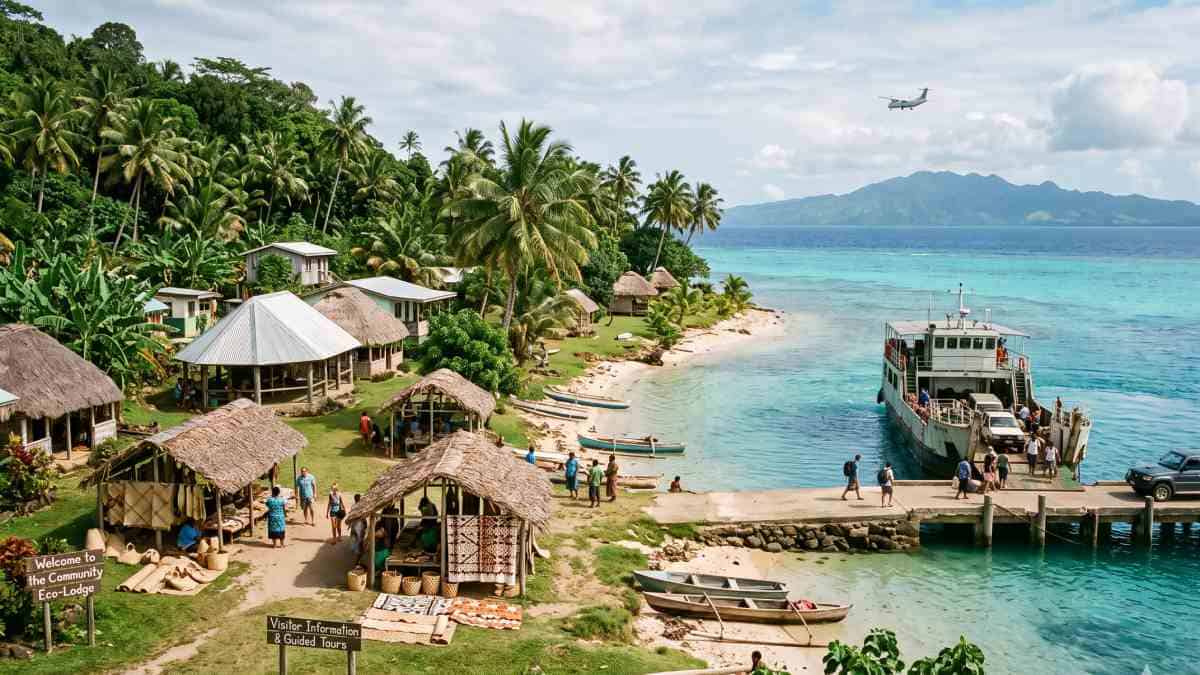
In the Pacific, legacy tourism has traditionally kept the international tourists locked up in their own isolated enclaves, with economic leakage being endemic and outer islanders disenfranchised. But change is being enacted through the creation of interconnected heritage routes by indigenous custodians, regional governments, and local airline companies. Through incorporating ancestral navigation routes, traditional conservation areas, and real weaving traditions into the destination design, the visitor flow has been diffused out of the urban center by the island communities. Sustainable economic wellbeing is being generated in this new orientation towards cultural autonomy and distributed transport systems, and a radical restructuring of Oceania’s regional economies is being accomplished in this process.
Decentralising Oceanian Regional Economies: Beyond the Resort Enclave
Structural Limits of Point-to-Point Resort Tourism
For more than half a century, the political economy of tourism across the Pacific basin was conformed to a rigid enclave model. International transit corridors were operated primarily as direct funnels, with long-haul passenger volumes being transferred into urban gateways and self-contained coastal properties. In destinations such as Viti Levu in Fiji, Tahiti in French Polynesia, and the eastern seaboard of Australia, acute structural distortion was generated by this configuration. The vast majority of visitor spending was captured by multinational hotel conglomerates, offshore cruise operators, and foreign tour wholesalers.
Advertisement
Advertisement
Under this model, substantial public debt was incurred by host governments across Small Island Developing States (SIDS) to finance critical infrastructure, including deep-water berthing docks, international runway expansions, and municipal utility grids, while limited domestic tax yields were captured. Substantial economic leakage across Pacific island destinations was driven by imported culinary supplies, foreign repatriation of corporate dividends, and overseas management contracts. In Fiji, where a considerable share of national production and employment has been sustained by the visitor economy, historic highs in aggregate visitor volumes were recorded in recent periods. Yet expenditure patterns remained clustered within the Nadi, Denarau, and Coral Coast perimeter. Municipal water tables were depleted, severe waste disposal bottlenecks were generated, and increased pressure was placed upon barrier reef environments in gateway zones, while persistent depopulation, a lack of commercial capital, and structural economic decline were suffered by outer islands.
At the same time, deep fatigue with generic, enclosed coastal resorts has been exhibited by core international visitor markets—most notably Australia, New Zealand, North America, and Europe. An accelerating demand for place-based, authentic journeys that offer direct engagement with living indigenous cultures, participatory conservation initiatives, and customary heritage has been indicated by post-pandemic travel metrics. Extended, circuit-based itineraries that span diverse island ecosystems rather than static single-resort stays are increasingly sought by modern travellers. When international travel is restricted to isolated enclaves, the velocity of tourist capital is capped, and regional island economies are deprived of foundational development funding.
Advertisement
Advertisement
The Pacific Sustainable Tourism Policy Framework and SIDS Macroeconomics
To counter this geographic concentration, the Pacific Sustainable Tourism Policy Framework (PSTPF 2030) was mandated by the Pacific Tourism Organisation (SPTO)—the intergovernmental body coordinating tourism development across member states. Directly aligned with the Global Sustainable Tourism Council (GSTC) criteria and regional environmental conventions, four overarching pillars were established for the Blue Pacific continent: prosperous and resilient economies, empowered communities, amplified cultural heritage, and accelerated climate action paired with ecosystem restoration.
Under the PSTPF, tourism is treated not as an isolated commercial sector, but as an operational mechanism for regional economic dispersion. Explicit policy mandates have been established, requiring national destination management offices to break down structural bottlenecks by which visitor expenditure is confined to urban gateways. Under the Pacific Sustainable Tourism Destination Standard, member states are assessed on their capacity to nurture indigenous micro-, small-, and medium-sized enterprises (MSMEs), enforce fair-trade supply contracts, and distribute tourism revenue into rural villages.
Advertisement
Advertisement
A central macroeconomic priority of the PSTPF is the dispersion of visitor spend to stabilise national trade balances. Across Pacific SIDS, critical liquidity is provided by foreign exchange earnings from tourism to offset chronic balance-of-payments deficits, costly fuel imports, and systemic vulnerability to external economic shocks. Expenditure can be spread geographically by regional planners through the establishment of multi-hub circuit networks, whereby volatile national arrival figures are converted into reliable capital flows for remote provincial districts. Commercial incentives are provided to rural communities by this programmatic shift to maintain customary tenure systems, steward fragile biodiversity assets, and protect living craftsmanship.
Indigenous Cultural Threads as Visual and Operational Connectors
Living Art Forms as Multi-Hub Structural Frameworks
Rather than indigenous cultural heritage being treated as passive decorative motifs, living craft traditions are being utilized by Pacific destination planners and First Nations custodian councils as structural, connective infrastructure for multi-destination routes. Across Oceania, cognitive and navigational functions have long been served by traditional visual arts—including barkcloth (masi in Fiji, ngatu in Tonga, siapo in Samoa), architectural carving and rafters (kōwhaiwhai in Aotearoa New Zealand), and songline cartographies across Australia.
Advertisement
Advertisement
Central roles in historical trans-oceanic and trans-continental trading systems were held by these artistic traditions. In Melanesia and Polynesia, genealogical lineages, customary alliances, and maritime sailing routes between neighbouring island clusters were documented through beaten barkcloth motifs. Today, these ancestral motifs are used as cartographic wayfinding tools by regional tourism corridors. By multi-destination routes being curated and signposted through authentic regional motifs, indigenous spatial geographies are reflected in itineraries rather than colonial administrative borders.
In Aotearoa New Zealand, geothermal and textile craft centres, such as Rotorua, are linked with coastal marine sanctuaries, such as Kaikōura, through the embedding of mātauranga Māori (ancestral knowledge) into transit networks. Travellers are guided along designated cultural corridors by the visual iconography of the koru and kōwhaiwhai rafters, where trade interactions connecting inland iwi with coastal fisheries are interpreted by each marae and artisanal precinct. Similarly, across the Top End and Red Centre of Australia, navigational frameworks linking regional hubs like Darwin, Katherine, and Alice Springs directly to remote cultural epicentres like Jabiru in Kakadu and Yulara adjacent to Uluṟu-Kata Tjuṯa are provided by ancestral songlines—interstate trading paths connecting multiple First Nations language groups.
Indigenous Cultural and Intellectual Property and Design Sovereignty
The economic sustainability of using cultural traditions to stimulate Oceanian regional economies is directly dependent upon legal protections for Indigenous Cultural and Intellectual Property (ICIP). In conventional mass tourism, indigenous iconography has frequently been appropriated without customary consultation, commercial consent, or financial compensation. Rural artisans have been deprived of livelihoods and sacred cultural assets have been debased through the uncontrolled retail sale of imported, machine-manufactured souvenirs bearing replicated indigenous motifs.
To counter this commercial exploitation, it was documented by national inquiries—led by the Australian Productivity Commission’s study on Aboriginal and Torres Strait Islander Visual Arts and Crafts—that mass-produced counterfeits lacking authentic indigenous connection accounted for a major share of First Nations-style souvenirs sold across Australia. In response, standalone legislative protections were developed by the Australian Government to safeguard traditional cultural expressions, legally empower traditional custodians to enforce ICIP rights, and penalise misleading commercial appropriation.
Advertisement
Advertisement
In Fiji, the Fijian Made, Fijian Crafted and Fijian Grown certification system is managed by the Ministry of Trade, Co-operatives, Small and Medium Enterprises, and Communications under national statutory decrees. The Fijian Crafted mark is granted exclusively to authentic handicrafts—such as traditional paper-mulberry masi from the islands of Vatuele, Lakeba, and Moce—verifying that products are manufactured entirely by certified indigenous village artisans. A legal trade barrier against imported factory reproductions is provided by this mark, whereby retail prices for authentic village wares are increased and cash incomes across maritime provinces are expanded.
An internationally recognized benchmark is provided by Aotearoa New Zealand with Toi Iho, an authentic trademark administered by the Toi Iho Charitable Trust. Authentic Māori visual, fine, and performing arts are verified by the mark, and traditional kōwhaiwhai, whakairo, and raranga practices are protected against unauthorized commercial exploitation. Regulated under domestic intellectual property frameworks, a clear guarantee of cultural provenance is provided to consumers by Toi Iho certification. Market differentiation is thereby afforded to Māori-owned tourism operators—such as Te Puia in Rotorua and Whale Watch Kaikōura, owned by the Ngāti Kurī hapū of Ngāi Tahu—allowing operational profits to be reinvested into iwi education, marae maintenance, and coastal environmental stewardship.
Transit Logistics, Feeder Airlines, and Multi-Island Infrastructure
Feeder Aviation Dynamics and Route Economics
Substantial transport logistics constraints must be overcome for the construction of integrated island circuits. High operating costs per available seat-distance are generated by the vast maritime expanses between secondary archipelagos. Secondary feeder aviation networks are operated on thin margins, shaped by small fleet sizes, volatile imported aviation fuel costs, runway load limits, and seasonal passenger fluctuations.
Dedicated route structures have been deployed by national carriers and regional airlines, designed so that international travellers may be moved through secondary hubs without frequent, expensive backtracking through primary gateway airports being required. In French Polynesia, arrivals from Tahiti are distributed across the Society, Tuamotu, and Marquesas archipelagos via Air Tahiti’s multi-island airpass system.
This operational model is mirrored in the Cook Islands by Air Rarotonga, linking Rarotonga to Aitutaki with scheduled frequencies using regional turboprop aircraft, while the makatea limestone island of Atiu is served through regular feeder flights. Furthermore, the historical “Coral Route” was re-established through commercial air services directly connecting Rarotonga with Papeete, French Polynesia—operated in partnership with Air Tahiti. Major continental hubs in New Zealand and Australia are bypassed by this link, enabling long-haul travellers to be moved seamlessly across distinct Polynesian cultural jurisdictions on a single, continuous itinerary.
In Fiji, an integrated hub-and-spoke and inter-island matrix is operated by Fiji Airways’ regional domestic subsidiary, Fiji Link, utilizing regional turboprop aircraft and utility twins. The international transit hub at Nadi and the domestic base at Nausori (Suva) are connected with secondary agricultural and eco-tourism nodes, including Matei Airport on Taveuni, Savusavu on Vanua Levu, and the remote Lau archipelago. However, operational data indicates that severe constraints are faced by regional feeder routes. Operations are restricted to smaller utility aircraft by unpaved or short runways on outer islands, whereby seat overheads are driven up and luggage allowances are restricted for long-haul visitors carrying adventure and eco-expedition gear.
Advertisement
Advertisement
Maritime Networks and Mitigating Multi-Modal Transfer Friction
Aviation cannot be relied upon as the sole transit medium due to the geography of Oceania. Viable travel circuits are dependent upon multimodal connections linking regional airfields with inter-island ferries and customary maritime vessels. Where modal friction occurs—such as long transit layovers, uncoordinated timetables, and rough open-water boat transfers across unsheltered wharves—visitor dispersal is sharply reduced, and tourist concentration is driven back toward capital gateways.
In the Independent State of Samoa, a working model of integrated maritime transit is provided by the ferry crossing across the Apolima Strait, linking Mulifanua Wharf on the main island of Upolu with Salelologa Wharf on Savai’i. Supported by state investments in roll-on/roll-off infrastructure and dedicated passenger vessels, independent travellers, rental vehicles, and tour transport are enabled to transition directly from international arrivals at Faleolo International Airport to rural village circuits on Savai’i. High regional dispersal rates are maintained by Samoa through the minimization of friction at the sea-air junction, with multi-night stays on Savai’i being supported in local, village-owned beach fale accommodations.
Conversely, long-haul visitors were historically restricted to single-destination fly-ins in Vanuatu due to maritime transit bottlenecks between Port Vila (Efate) and secondary provincial islands. Regional transport frameworks were developed by the Vanuatu Department of Tourism, in collaboration with the Tafea and Sanma Provincial Tourism Offices, coordinating feeder flight arrivals with local transport associations and village water taxis. Transit risk was reduced through the standardisation of pricing, the upgrading of secondary wharf pontoons, and the formalization of maritime passenger safety standards. Direct transit is thus facilitated between Mt. Yasur’s cultural hiking paths on Tanna and the marine reserves and blue holes of Espiritu Santo.
Unified Entry Passes and Cross-Jurisdictional Mobility Policies
Seamless travel circuits across multiple sovereign jurisdictions require physical transport infrastructure to be matched by cross-border policy coordination. Historically, fragmented border policies were maintained across the Pacific region, with distinct entry fees, immigration systems, and biosecurity screening being enforced by individual island nations. Multi-country routes through Melanesia and Polynesia were discouraged by this institutional friction.
Multilateral border frameworks have been explored by member governments under the SPTO’s regional policy platforms and the Pacific Islands Forum’s 2050 Strategy for the Blue Pacific Continent. Unified multi-destination entry models have been informed by international single-entry structures, with digital travel credentials and shared biosecurity databases being utilized to establish a unified Trans-Pacific Tourism Pass. Concurrently, regional aviation corridors are supported by code-share agreements and coordinated regional travel passes across national carriers. Long-haul international flights and secondary inter-island feeder sectors are permitted to be purchased under a single itinerary, with baggage checked straight through to outer island airstrips, whereby transaction costs are lowered for travellers exploring the connected archipelago.
Community Yield Multipliers and Village Governance Models
Economic Leakage Mitigation and Traditional Governance Dispersion
Local tourism economics are fundamentally transformed by the transition toward sovereignty-led wayfinding corridors. In standard enclave resort models, the primary benefits are captured by foreign institutional shareholders, multinational airline operators, and centralized retail suppliers, while local community economic capture is typically restricted to entry-level service wages, minor land lease rents, and informal artisanal stalls.
Advertisement
Advertisement
In contrast, revenue is re-routed through traditional village administrative bodies by sovereignty-led travel corridors. In Fiji, traditional communal authority is anchored by the Turaga-ni-Koro (the state-recognized village headman) and the hereditary chiefs (Ratu), operating within the institutional framework of the iTaukei Affairs Board and Provincial Councils. When indigenous lands (Vanua) are entered by tourism circuits, customary protocols are adhered to: the formal presentation of sevusevu (kava roots) in the village meeting house (bose vaqali) is performed, followed by the payment of standardized visitor access levies directly to the village treasury.
| Financial Inflow Vector | Enclave Resort Supply Chain Capture | Sovereignty-Led Decentralised Circuit Capture | Primary Local Beneficiary / Governance Entity | Microeconomic Dispersion Mechanism |
| Direct Accommodation Spend | Minority capture through service wages and municipal taxes | Majority capture via direct homestay or community lodge tariffs | Village Chief Council (Turaga-ni-Koro), Family Units | Direct funding of communal water infrastructure, schooling needs, and domestic electrification |
| Craft & Cultural Production | Minimal capture via mass wholesale curio broker margins | Primary capture through direct artisan sales via verified branding | Women’s Artisanal Weaving Cooperatives | Capital accumulation for maternal health, family savings, and small-business equipment |
| Guided Excursions & Guiding | Moderate capture through foreign operator subcontract margins | Near-total capture through registered community eco-guide fees | Local Youth & Ecological Guide Associations | Employment retention in ancestral homelands, mitigating urban outmigration |
| Marine & Land Concession Fees | Minimal capture via general commercial licenses to the central state | Complete capture through customary Tabu / Marine Sanctuary conservation levies | Village Resource Management Committees / Traditional Clans | Direct financing of local patrol boats, boundary buoys, and fisheries replenishment monitoring |
Localized economic multipliers are generated by these direct financial inflows. In Fiji’s Galoa village, a partnership was formed by the Bulikula Women’s Community Group with the SPTO and the United Nations Development Programme (UNDP) under the Pacific Tourism Waste Action Initiative (PTWAI) and the SPTO SME Recovery Toolkit. Ocean plastic waste and local botanical materials are processed into upcycled cultural crafts by the cooperative, capturing income from international travellers while marine debris is removed from adjacent lagoons. By value generation being shifted into female-led collectives, revenue is directed toward household nutrition, healthcare access, and primary education, avoiding the leakage inherent in foreign-owned resorts.
Customary Marine Conservation and Carrying Capacity Regulation
The potential disruption of fragile outer-island ecologies represents a critical risk when tourism is decentralised from central gateways into remote archipelagos. Industrial wastewater facilities, solid-waste recycling plants, and robust freshwater reserves are often lacked by secondary islands, and environmental degradation risks being repeated if visitor growth remains uncontrolled.
To safeguard fragile ecosystems, customary conservation frameworks are deployed by indigenous communities. In Fiji, customary tabu zones across maritime provinces have been unified under the Fiji Locally Managed Marine Area (FLMMA) network. Rooted in customary sea tenure (iQoliqoli), a tabu is an ancestral decree declared by traditional chiefs by which all fishing and extractive activities are prohibited within a specified marine sanctuary.
When coastal villages in Taveuni or the Lau archipelago are visited by tourism corridors, zero-impact marine eco-sanctuaries are established within these tabu areas. Strict visitor limits are mandated by local councils, local certified village guides are required, and non-extractive conservation fees are directed back to the resource management committee. Rapid recovery in reef fish biomass and apex predator counts has been confirmed by scientific monitoring of FLMMA tabu sites, resulting in the creation of world-class ecotourism destinations while subsistence food fisheries are replenished in adjacent harvesting zones. Ecological carrying capacities are shown to be enforced far more effectively through ancestral governance models than through distant, under-resourced national ministries.
Regional Case Studies: Gateway-to-Secondary Destination Circuits
Melanesian Corridors: Fiji and Vanuatu
Within Melanesia, the shift away from enclave resorts has been driven by partnerships between provincial administrative councils and traditional institutions. In Fiji, itineraries were once focused entirely on fly-in arrivals at Nadi International Airport, followed by private coach transfers to gated resorts on Denarau Island or high-speed catamarans to private island concessions across the Mamanuca and Yasawa groups.
Advertisement
Advertisement
Corridors moving international travellers beyond Viti Levu into the northern and eastern archipelagos are now promoted by the Fiji Ministry of Tourism and Civil Aviation and Tourism Fiji. Vanua Balavu and Lakeba are connected to Nadi and Suva along the Taveuni and Lau Corridor via scheduled regional flights, linking to community-owned bilibili bamboo rafting expeditions and coastal village homestays. Direct contributions to village treasuries are made through participation in solevu (traditional ceremonial exchanges) and visits to masi artisans in Moce and Vatulele, with visitors being dispersed across provinces that have historically received minimal shares of national visitor nights.
In neighbouring Vanuatu, tourism delivery was structured by the Vanuatu Department of Tourism (DoT) through its decentralized Provincial Tourism Offices. While the national gateway is provided by Port Vila on Efate, strategic investments have been focused on two provincial corridors: the Tafea Volcano Corridor on Tanna and the Sanma Marine Corridor on Espiritu Santo. Potable water wells, primary school solar arrays, and community disaster-shelter reserves for customary landholding clans are funded by visitor entry fees from the community-owned and operated Mt. Yasur Volcano Cultural Trek under the oversight of the Tafea Provincial Tourism Office. On Espiritu Santo, a strict conservation and licensing regime was implemented around the island’s freshwater blue holes and Champagne Beach by the Sanma Provincial Tourism Office, ensuring management authority is retained by customary landowners while revenue is directed into rural communities.
Polynesian Networks: Samoa, Tonga, and the Cook Islands
In Polynesia, tourism corridors are sustained through ancestral ocean-crossing heritage and the social architecture of Fa’a Samoa (the Samoan way of life) and Anga Faka-Tonga (the Tongan way). In Samoa, visitors are distributed via public transit systems along the Upolu-to-Savai’i corridor. Following arrival at Faleolo International Airport, travellers are transferred to Mulifanua Wharf, boarding the state-operated ferry to Salelologa on Savai’i.
On Savai’i, tourism is governed by the customary Ali’i and Faipule (councils of chiefs and orators) across individual villages rather than by foreign developers. Accommodations are provided primarily through open-air, beachfront fales constructed by local carpenters from native timbers and woven thatch, owned and operated by extended families (aiga). Beachfront access fees, cultural performance tariffs, and guided excursion yields are remitted to the local village council, ensuring capital is directly channelled into public health clinics and communal infrastructure.
In the Cook Islands, strict environmental and capacity zoning protecting the outer southern group is maintained by the Cook Islands Tourism Corporation alongside the traditional House of Ariki (customary high chiefs). On the island of Aitutaki, hotel expansion has been capped by regional bylaws, with large resort developments being restricted to preserve lagoon biodiversity and water quality. Further east, on the raised limestone island of Atiu, small groups are introduced via scheduled regional flights to the tumunu—traditional bush-beer gathering circles governed by local social customs—alongside guided tours of endemic bird sanctuaries within the ancient makatea fossilised coral reefs. By flight frequencies being restricted to match island carrying capacities, the ecological base of the Cook Islands is preserved while micro-economies grounded in organic Arabica coffee harvesting and tīvaevae textile quilting are supported.
Australasian Ancestral Trails: Northern Australia and Aotearoa New Zealand
In Australia and Aotearoa New Zealand, advanced multimodal transport networks are paired with statutory indigenous land governance along regional tourism corridors. In Australia’s Northern Territory, a model of a post-mining, First Nations-led economic transition is provided by the town of Jabiru within Kakadu National Park. Formal land tenure of the Jabiru township was secured by the Mirarr Traditional Owners, represented by the Gundjeihmi Aboriginal Corporation, under statutory land rights frameworks following the closure of the Ranger Uranium Mine.
Advertisement
Advertisement
Backed by national public investment allocations for tourism infrastructure and park road access, the Jabiru Masterplan was implemented alongside regional tourism master planning. The township is being transitioned from an industrial mining base into a cultural and ecotourism hub centered on Bininj/Mungguy heritage. Integrated into the red-centre and Top End songline trail network, Jabiru links visitors travelling along the Arnhem Highway from Darwin to ancient rock escarpment art sites at Burrungkuy (Nourlangie) and Ubirr, with tourism spend being channelled directly into Aboriginal-owned enterprises and indigenous park ranger stations.
In Aotearoa New Zealand, cultural preservation is aligned with regional dispersal through the national tourism strategy, supported by the Ministry of Business, Innovation and Employment (MBIE), Tourism New Zealand (TNZ), and New Zealand Māori Tourism (NZMT). Authentic Māori visitor experiences are invested in by the Crown as a core export capability under national policy frameworks. The primary travel circuit connects Auckland’s international gateway with Rotorua’s geothermal and carving centres, and is extended across Cook Strait to Kaikōura on the South Island’s east coast.
In Kaikōura, Whale Watch Kaikōura was established by the Ngāti Kurī hapū of Ngāi Tahu in the late twentieth century, with family homes being mortgaged to secure their initial vessel. Modern catamarans equipped with specialized propulsion systems designed to minimize acoustic disruption to local sperm whale pods are now operated by the venture, which functions as the principal economic driver of the district. Local schooling scholarships, whānau social housing, and the cultural restoration of ancestral marae are funded by operational profits, demonstrating how an entire municipal economy can be sustained through indigenous-owned ecotourism.
Strategic Roadmap and Macroeconomic Outlook
Strategic Policy Directives for Pacific Tourism Ministries and Airlines
For the institutionalisation of these decentralized circuits to be achieved over the coming decade, coordinated policy reforms must be executed by Pacific transport ministries, regional tourism authorities, and carriers across five key areas:
- Integrated multi-modal ticketing passes combining scheduled air travel, maritime ferries, and local ground transfers under unified digital booking standards should be designed by transport ministries and national airlines.
- Secondary airfield pavement sealing, solar-powered runway night lighting, and sheltered maritime pontoons must be prioritised by international development finance to maintain safe, year-round outer-island connectivity.
- Dedicated intellectual property statutes must be enacted by regional parliaments to eliminate counterfeit souvenir imports and protect indigenous craft trademarks, ensuring artisan revenues remain within rural producing villages.
- Customary land and marine tenure systems must be formally recognized within national tourism master plans, empowering local councils to set mandatory visitor carrying capacities and enforce environmental protection zones.
- Dedicated micro-capital facilities and tax exemptions should be allocated by regional development banks to support indigenous cooperatives, homestay operators, and youth guiding associations, keeping tourism capital within local communities.
Capital Allocation and Infrastructure Investment Horizon
Capital allocation across Oceania’s visitor economy is projected to pivot from standalone coastal hotels to decentralized, community-owned infrastructure. Grants are increasingly being directed by international climate finance facilities toward green infrastructure projects that combine climate adaptation with distributed eco-tourism. Operational footprints will be lowered across secondary corridors as secondary airfield micro-grids are transitioned to solar-diesel hybrid generation and inter-island passenger ferries adopt hybrid-electric propulsion.
Over the coming decade, success in the regional visitor economy will no longer be measured solely by aggregate arrivals at capital airports. Instead, progress will be judged by the spatial distribution of visitor spend, the economic self-determination of indigenous hosts, and the ecological health of customary lands and waters. By ancestral wayfinding being linked with modern sustainable transport networks, a durable, globally relevant model for cultural sovereignty and community-owned tourism is being established across Oceania.
Advertisement
Advertisement
A vital turning point for Pacific development is represented by the systematic shift from isolated resort enclaves to sovereignty-led wayfinding corridors. Rigorous control is exercised over customary intellectual property, marine sanctuaries are protected through traditional tabu regimes, and modern feeder aviation is integrated with maritime links, allowing visitor economies to be reclaimed by indigenous nations. Historic patterns of foreign corporate leakage are dismantled through these coordinated regional initiatives, and vital capital is directed into village councils, women-led weaving guilds, and local ecological guiding enterprises. Self-reliant communities continue to be empowered through this profound structural realignment, and Oceanian regional economies are permanently redefined across the Blue Pacific.
Conclusion
The evolution from the use of resort enclaves into sovereignty corridors is one of the crucial moments of transformation in Pacific development. Indigenous nations will be reclaiming their economies of visitors through controlling intellectual property, safeguarding marine sanctuaries using the tabu regimes, as well as linking feeder air with maritime transportation. The regional initiatives are destroying past trends of foreign corporation leakage to inject money into village councils, weaving guilds run by women, and eco guiding operations within indigenous nations. This structural transformation will enable sustainable heritage tourism to continue empowering the self-reliant communities in Oceanian regional economies.
Advertisement
