
Germany Joins France, United Kingdom and Bahrain as Europe Prepares a Multinational Strait of Hormuz Maritime Security Mission to Protect Commercial Shipping, Energy Corridors and Global Travel Networks—New Report is Here

Published
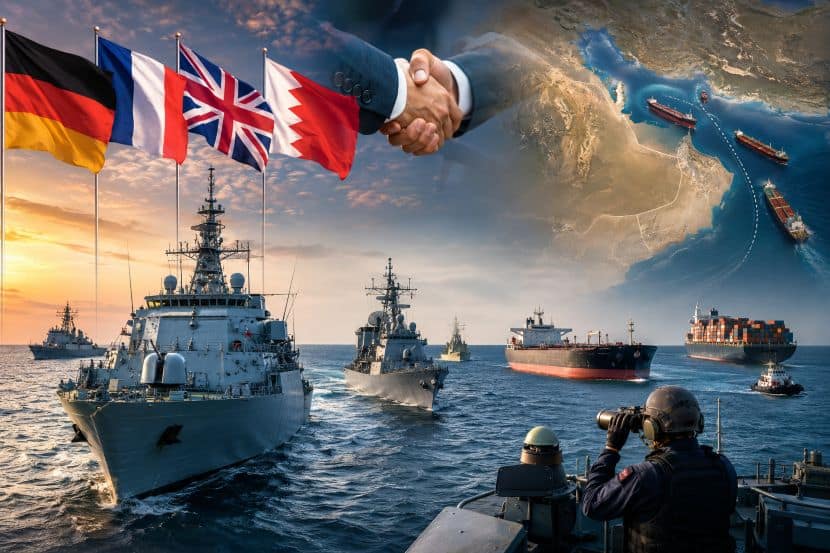
Germany has moved closer to a possible role in protecting one of the world’s most strategically important sea lanes as France, the United Kingdom and Bahrain continue supporting coordinated efforts to strengthen maritime security in the Strait of Hormuz. The latest developments indicate that Europe is preparing a multinational maritime security mission designed to safeguard commercial shipping, preserve energy corridors and reinforce global travel networks against growing regional uncertainty. Although Berlin has not yet taken a final political decision, government ministries have reportedly completed the preliminary legal and operational preparations required for a potential naval deployment, demonstrating Europe’s determination to keep international shipping routes secure.
At the same time, Germany is working alongside France, the United Kingdom and Bahrain within a broader diplomatic and security framework that prioritises freedom of navigation, maritime stability and uninterrupted trade. Consequently, the proposed mission extends well beyond military cooperation because it directly affects airlines, cruise operators, logistics companies, energy markets and international travellers. Since the Strait of Hormuz carries around one-fifth of the world’s oil supplies and a substantial share of global liquefied natural gas exports, protecting this critical maritime passage has become increasingly important for economic resilience. Moreover, secure commercial shipping supports stable energy corridors, which help sustain airline operations and tourism across Europe, the Middle East and Asia. As Europe prepares this coordinated initiative, the new report highlights why governments, businesses and travellers alike are closely monitoring every development and what the proposed mission could ultimately mean for global mobility.
Advertisement
Advertisement
Why Germany Is Preparing for a Hormuz Security Role Instead of Acting Alone
Rather than launching an independent naval deployment, Germany is positioning itself to support a broader multinational effort centred on maintaining freedom of navigation and ensuring that commercial vessels can continue operating safely through one of the world’s busiest shipping corridors.
Reports indicate that Germany’s defence and foreign ministries have prepared a parliamentary mandate that could be activated quickly if political approval is granted. Naval assets already operating in the eastern Mediterranean, including mine-countermeasure capabilities and logistical support vessels, could be reassigned to the Gulf region within days if authorised.
Advertisement
Advertisement
The approach reflects Berlin’s longstanding preference for participating in multinational security frameworks rather than unilateral military operations. German policymakers have also continued examining the legal foundations required under both domestic law and international law before committing forces.
For the travel sector, this cautious strategy offers an important signal. Governments are attempting to reassure international shipping companies, cruise operators, aviation fuel suppliers and travel insurers that contingency measures are being prepared before commercial disruption becomes more severe.
Advertisement
Advertisement
Table 1: Countries Currently Supporting Greater Maritime Security in the Strait of Hormuz
| Country | Current Position | Strategic Objective | Importance for Travel Industry |
|---|---|---|---|
| Germany | Preparing possible participation pending legal approval | Protect commercial shipping and freedom of navigation | Supports stable fuel supplies and international travel markets |
| France | Promoting multinational maritime security cooperation | Secure international sea lanes and mine clearance if required | Protects cruise, cargo and passenger shipping |
| United Kingdom | Working with European partners on maritime protection | Ensure uninterrupted commercial navigation | Supports aviation fuel logistics and British maritime interests |
| Bahrain | Sponsored UN maritime security resolution | Reinforce legal framework protecting shipping | Enhances regional confidence for tourism and commercial investment |
Europe’s Maritime Strategy Is Becoming Increasingly Connected to Tourism
Although naval deployments may appear distant from the travel industry, their economic effects are often immediate. Every increase in maritime risk influences shipping insurance, freight costs and global energy markets. Airlines are particularly sensitive because aviation fuel remains one of their largest operating expenses.
The Gulf region also functions as one of the world’s busiest aviation crossroads. Major international airlines based in the Middle East connect Europe, Asia, Africa and Oceania through hubs that depend upon stable regional logistics and uninterrupted energy supplies.
Similarly, international cruise companies increasingly operate winter itineraries across the Arabian Gulf, while luxury tourism continues expanding in destinations including the United Arab Emirates, Oman, Qatar and Saudi Arabia. Any prolonged maritime instability could influence cruise scheduling, travel insurance policies and regional visitor confidence.
For these reasons, governments increasingly describe maritime security not only as a defence priority but also as an economic necessity supporting tourism, international business travel and global connectivity.
Table 2: Why the Strait of Hormuz Matters Beyond Defence
| Sector | Dependence on the Strait | Potential Effect of Disruption |
| Global Oil Trade | Around one-fifth of global oil consumption transits the strait daily | Higher fuel prices worldwide |
| LNG Exports | Significant volumes from Qatar pass through Hormuz | Increased natural gas prices |
| Aviation | Jet fuel markets linked to global oil prices | Higher airline operating costs and possible fare pressure |
| Cruise Tourism | Growing Gulf cruise itineraries depend on regional stability | Route adjustments and itinerary changes |
| International Trade | Major container and tanker traffic | Longer shipping times and increased freight costs |
France and the United Kingdom Are Driving the European Maritime Conversation
Germany’s preparations have not emerged in isolation. France and the United Kingdom have been among the principal European countries advocating coordinated measures to safeguard maritime traffic through the Strait of Hormuz following heightened regional tensions.
Both countries possess long-established naval capabilities in the Gulf and maintain defence relationships with several Gulf Cooperation Council states. Their objective extends beyond military deterrence. European policymakers increasingly view secure shipping lanes as essential infrastructure supporting global commerce, international tourism and reliable supply chains.
Advertisement
Advertisement
Unlike emergency military responses of the past, the current discussions focus heavily on preventive maritime security, escort capabilities where necessary, mine-countermeasure readiness and preserving confidence among commercial shipping operators. This cooperative approach allows European governments to share operational responsibilities while reinforcing the principle that international waterways should remain open to lawful commercial traffic.
As Germany evaluates its legal options, its potential participation would strengthen a broader European effort designed to reduce uncertainty for shipping companies, airlines, tourism operators and international businesses that rely upon uninterrupted movement through one of the world’s most economically significant maritime corridors.
Bahrain’s Diplomatic Initiative Is Providing the International Legal Foundation
While Germany, France and the United Kingdom have focused on the operational aspects of maritime security, Bahrain has played an equally important diplomatic role by advancing discussions at the United Nations Security Council. Earlier this year, Bahrain introduced a resolution reaffirming the rights of states to protect commercial shipping and uphold freedom of navigation in international waterways. That legal framework has become particularly significant because several European governments continue examining whether an existing UN resolution could provide sufficient international legal authority for future naval participation without waiting for an entirely new mandate.
For Bahrain, the issue extends beyond regional security. The kingdom sits at the heart of the Gulf’s financial and maritime economy and hosts important multinational naval facilities. Maintaining confidence among international investors, airlines, cruise operators and logistics companies is therefore a strategic economic priority. Safe shipping routes underpin Gulf tourism growth, support luxury hospitality developments and facilitate the import of consumer goods that sustain regional visitor economies.
Existing European Naval Missions Already Reveal Germany’s Broader Strategy
Germany’s possible participation in a Hormuz mission would not represent a dramatic shift in foreign policy but rather an extension of existing maritime commitments.
The German Navy is already engaged in several international operations. Through EUNAVFOR Aspides, German personnel contribute to protecting merchant shipping against attacks affecting vessels operating around the Red Sea. Simultaneously, German naval units continue serving under UNIFIL off the Lebanese coast, while NATO deployments require regular patrols across the Baltic Sea and North Atlantic to safeguard critical underwater infrastructure.
Advertisement
Advertisement
This existing operational footprint demonstrates that Berlin increasingly considers maritime security an essential component of European economic resilience. Rather than concentrating solely on territorial defence, modern naval deployments increasingly focus on ensuring uninterrupted international commerce, protecting digital infrastructure and maintaining reliable transport corridors that support both trade and tourism.
Table 3: Germany’s Current Maritime Security Commitments
| Mission | Region | Primary Objective | Relevance to Global Travel |
|---|---|---|---|
| EUNAVFOR Aspides | Red Sea | Protect commercial shipping | Supports shipping reliability between Europe and Asia |
| UNIFIL Maritime Task Force | Eastern Mediterranean | Monitor Lebanese coastal waters | Promotes regional maritime stability |
| NATO Maritime Operations | North Atlantic & Baltic | Protect critical infrastructure and sea lanes | Safeguards European transport networks |
| Possible Strait of Hormuz Mission | Arabian Gulf | Freedom of navigation and mine-countermeasure support | Helps reduce risks to global shipping and tourism |
What It Means for Airlines, Cruise Operators and International Travellers
The travel industry often experiences the economic consequences of geopolitical tensions long before ordinary holidaymakers notice changes on the ground. The Strait of Hormuz may be thousands of kilometres away from Europe’s busiest airports, yet it remains closely connected to international aviation through global fuel markets.
If commercial shipping through the Gulf faces prolonged disruption, higher crude oil prices typically translate into increased aviation fuel costs. Airlines may respond through higher operating expenses, revised route economics or fuel surcharges, particularly on long-haul services linking Europe with Asia, Australia and the Middle East.
Cruise tourism also has a growing stake in regional stability. Gulf cruise itineraries have expanded steadily over the past decade, with ports in Dubai, Abu Dhabi, Doha and Muscat becoming important winter destinations for international cruise lines. A secure maritime environment allows operators to maintain scheduled itineraries while preserving traveller confidence.
For business travellers, reliable shipping routes also influence supply chains, hotel demand and international investment flows. Many multinational corporations operating across Europe and Asia depend upon uninterrupted maritime logistics, making naval security increasingly relevant to corporate travel planning.
Table 4: Potential Implications for the Global Travel Industry
| Travel Segment | Possible Impact if Security Improves | Possible Impact if Disruptions Continue |
| Airlines | Stable fuel markets and predictable operating costs | Increased fuel expenditure and possible fare adjustments |
| Cruise Industry | Greater confidence in Gulf itineraries | Itinerary revisions or operational uncertainty |
| Business Travel | Stable supply chains supporting international commerce | Delayed cargo movement affecting corporate travel demand |
| Tourism Investment | Stronger investor confidence across Gulf destinations | Higher insurance costs and slower investment decisions |
Why the Strait of Hormuz Remains Central to Global Travel and Trade
The importance of the Strait of Hormuz extends far beyond regional geopolitics because it serves as one of the world’s busiest maritime gateways for energy exports and commercial cargo. Every day, millions of barrels of crude oil and petroleum products, along with a significant share of global liquefied natural gas shipments, pass through this narrow waterway connecting the Persian Gulf with the Gulf of Oman. As a result, any disruption can quickly influence aviation fuel prices, international freight costs and cruise operations. For the travel industry, stable maritime security helps airlines maintain predictable operating costs, enables cruise lines to preserve Gulf itineraries and supports tourism-dependent economies across the Middle East. Consequently, the proposed multinational effort involving Germany, France, the United Kingdom and Bahrain is being closely watched not only by defence planners but also by airlines, hotel groups, tour operators, logistics firms and business travellers whose operations depend on resilient global supply chains.
Advertisement
Advertisement
Comparison Table: Why the Strait of Hormuz Is a Critical Global Chokepoint
| Category | Strait of Hormuz | Why It Matters for Travellers and the Travel Industry |
|---|---|---|
| Geographic Importance | Connects the Persian Gulf with the Gulf of Oman and Arabian Sea | Serves as the principal maritime gateway for Gulf economies and international trade |
| Global Oil Transit | Around 20 million barrels of oil pass through daily, roughly 20% of global petroleum consumption | Stable oil flows help moderate aviation fuel costs and airline operating expenses |
| LNG Exports | Approximately 20% of global liquefied natural gas (LNG) trade transits the waterway, largely from Qatar | Supports energy security that influences transport, hospitality and tourism sectors |
| International Shipping | Hundreds of oil tankers, LNG carriers and commercial cargo vessels use the route each month | Reliable shipping strengthens global supply chains and travel-related commerce |
| Tourism Impact | Supports cruise operations and business travel across the Gulf region | Reduces the likelihood of itinerary disruptions, insurance cost increases and travel uncertainty |
| Strategic Focus | Maritime security, freedom of navigation and mine-countermeasure readiness | Helps preserve confidence among travellers, airlines, cruise operators and tourism investors |
Practical Considerations for Travellers Visiting the Gulf
Although governments are strengthening maritime security planning, there is currently no indication that routine tourism across the Gulf region should be suspended. International airports in the United Arab Emirates, Qatar, Bahrain, Oman and Saudi Arabia continue handling millions of passengers while major tourism projects remain operational.
Nevertheless, travellers planning cruises or extended regional itineraries should continue monitoring airline notifications, cruise operator updates and official travel advisories before departure. Comprehensive travel insurance covering itinerary changes, delays and unforeseen disruptions remains advisable, particularly during periods of heightened geopolitical uncertainty.
Business travellers should also remain attentive to possible changes in shipping schedules that could affect trade exhibitions, supply-chain dependent conferences or logistics-intensive events taking place across the Middle East.
Why Germany’s Strait of Hormuz Mission Matters Beyond Naval Operations
The Germany Strait of Hormuz mission has evolved into a wider discussion about protecting the infrastructure that keeps international tourism, aviation, trade and energy markets functioning. Germany’s willingness to prepare for participation alongside France, the United Kingdom and Bahrain illustrates how maritime security is increasingly viewed through an economic as well as strategic lens.
Rather than signalling an escalation, current planning reflects efforts to prevent disruption before commercial shipping faces greater risk. For the travel sector, that distinction is significant. Stable sea lanes help keep fuel prices manageable, preserve airline connectivity, support cruise tourism and reinforce confidence among investors developing hotels, resorts and transport infrastructure throughout the Gulf.
As governments continue evaluating legal mandates and multinational cooperation, the outcome will be closely watched not only by defence planners but also by airlines, tourism boards, cruise companies and millions of international travellers whose journeys increasingly depend upon secure global maritime corridors.
Advertisement
