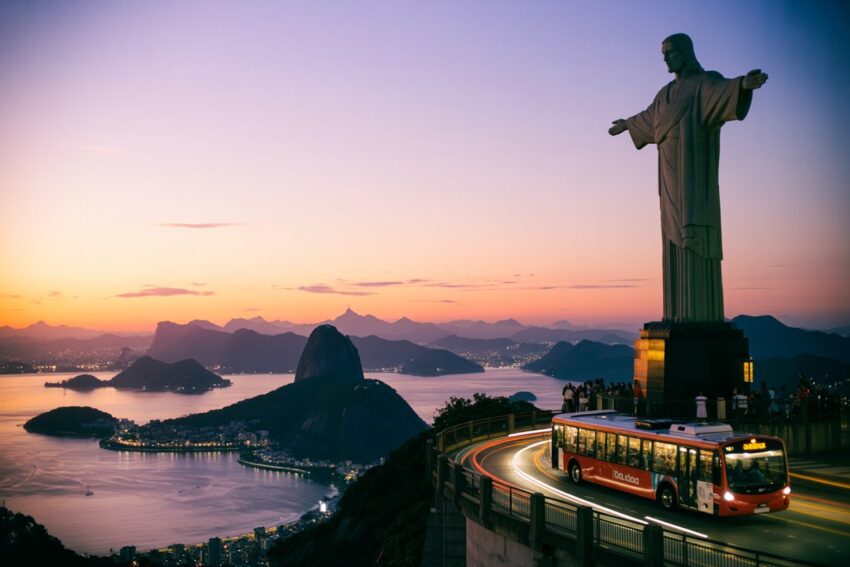
Image generated with Ai
As tourism becomes increasingly digital, Brazil and other countries are going digital to attract international travellers through virtual roadshows, online meetings and destination showcases. Brazil is leading its latest push with the Brasil DNA Virtual Roadshow 2026, scheduled for October 5–8, connecting travel professionals in the United States and Canada with Brazilian destinations, experiences and tourism companies. More than 30 exhibitors and virtual booths will introduce different travel possibilities, while advance access allows professionals to explore suppliers and schedule one-to-one meetings. Meanwhile, countries across the world are using similar digital strategies to attract international travellers, strengthen trade relationships and promote new destinations. Travel And Tour World urges readers to read the entire story to discover how Brazil and these other countries are using virtual roadshows to reshape international tourism promotion.
The Brasil DNA Virtual Roadshow 2026 is opening its platform before the main October programme, giving North American travel professionals an early opportunity to explore Brazil. Organised by Global Vision Access, the virtual event is scheduled for October 5–8, 2026, connecting travel professionals in the United States and Canada with Brazilian destinations, tourism businesses and travel experiences.
Advertisement
Early access allows registered participants to enter the virtual lobby, browse digital booths, review participating destinations and companies, and identify experiences suitable for future travellers. The platform also contains webinars, presentations and professional training material developed through the wider Brasil DNA programme.
More than 30 exhibitors and virtual booths will participate. They represent hotels, attractions, experiences, tour operators and other Brazilian tourism suppliers.
Advertisement
For travellers, this creates an opportunity for advisors to discover alternatives to traditional Brazil itineraries. Instead of concentrating solely on Rio de Janeiro or São Paulo, professionals can explore different regions and tourism styles.
The initiative follows in-person Brasil DNA activities held across North America in June. Those meetings connected Brazilian tourism representatives with travel advisors, tour operators, event organisers, specialist media and content creators.
Brasil DNA’s wider programme focuses on authenticity, culture, gastronomy and natural treasures. These themes reflect Brazil’s broad tourism offer, ranging from cultural heritage and regional cuisine to biodiversity and nature-based journeys.
Recent 2026 activities have highlighted destinations including Bahia, Iguassu Falls, Mato Grosso do Sul and São Paulo. The programme has also presented nature, culture, gastronomy, luxury and MICE travel opportunities to the North American market.
The roadshow arrives while Brazil is strengthening its international tourism presence. Its 2026 strategy specifically targets the United States and Canada, two important markets for Brazilian tourism promotion.
For travellers, the practical impact could be greater destination choice. Better-trained travel professionals can connect visitors with specialised experiences and lesser-known regions.
The October virtual roadshow is therefore more than a business networking event. It is another channel through which Brazil’s diverse destinations can reach international travellers planning their next long-haul adventure.
The Brasil DNA Virtual Roadshow 2026 is part of a broader shift in how national tourism organisations reach overseas travel professionals. Scheduled for October 5–8, 2026, the programme gives registered buyers early access to virtual booths, destination information, tourism suppliers, webinars and one-to-one business opportunities. More than 30 exhibitors are expected to participate, targeting travel professionals in the United States and Canada.
The model is not entirely new. Tourism authorities in several countries have used virtual or hybrid roadshows to overcome geographical barriers, maintain trade relationships and introduce destinations to international buyers.
| Country | Initiative | Scale / participation | Main objective | Reported outcome |
|---|---|---|---|---|
| Brazil | Brasil DNA Virtual Roadshow 2026 | 30+ exhibitors | Connect Brazil with US and Canadian travel trade | Destination and supplier discovery, appointments and professional development |
| United Kingdom | ExploreGB Virtual | 200+ buyers; 320 suppliers | International B2B destination promotion | 10,000+ scheduled meetings in 2023 |
| India | Incredible India Reconnect | Virtual roadshows across 18 source markets in 2022 | Reconnect Indian suppliers with overseas trade | Expanded market coverage across Europe, Asia, North America and Middle East |
| Australia | ATE Online / virtual trade events | Around 130 buyers and 250 sellers in one 2020 marketplace | Maintain international distribution during travel restrictions | Virtual access and B2B appointments |
| South Korea | Korea tourism online B2B meetings | 657 overseas companies and 293 Korean companies | Rebuild international tourism connections | 1,400 planned one-to-one meetings |
| Malaysia | AVIAREPS Southeast Asia Virtual Roadshow | 33 sellers; 500+ outbound agencies | Reconnect ASEAN travel trade | B2B matchmaking and destination promotion |
| Indonesia | WonderVerse Indonesia | National digital tourism platform | Promote destinations through immersive technology | Created an interactive digital tourism channel |
The United Kingdom provides one of the clearest examples of how virtual tourism trade events can operate at scale.
VisitBritain’s ExploreGB Virtual event in 2023 brought together more than 200 international buyers and 320 British tourism suppliers and destinations.
More than 10,000 pre-scheduled one-to-one virtual meetings were planned during the five-day programme. Buyers came from more than 20 countries, including the United States, Australia, China, France, Germany, Italy and Spain.
Earlier virtual ExploreGB activity also recorded more than 11,000 one-to-one appointments involving over 350 buyers and 350 suppliers.
The longer-term evidence is particularly important. VisitBritain reported that its 2024/25 international B2B programme generated 4,456 business leads. The organisation also reported that 64% of new British itineraries or tours resulting from its trade engagement included destinations outside London.
That demonstrates an important benefit for travellers: trade marketing can distribute visitor spending beyond the country’s best-known gateway.
India adopted a particularly broad virtual roadshow strategy.
According to India’s Ministry of Tourism, Incredible India Reconnect virtual roadshows were conducted across numerous international source markets during 2022.
The programme covered the United States, Germany, Australia, Singapore, Thailand, Spain, United Kingdom, France, Oman, Italy, Portugal, Japan, South Korea, Malaysia, Sri Lanka, Netherlands and Canada.
The first round covered nine markets between April and June 2022, followed by additional sessions during July–September.
This approach allowed Indian tourism stakeholders to communicate with overseas markets without requiring every participant to travel internationally.
India’s current tourism data infrastructure also demonstrates the scale of its international market. Government data report 9.15 million foreign tourist arrivals in 2025, alongside 20.22 million international tourist arrivals when broader categories are included.
Australia also moved quickly towards digital tourism trade.
Tourism Australia’s ATE Online was created for international buyers who could not travel because of border restrictions. Buyers from Asia, North America, the United Kingdom, Europe and New Zealand could participate remotely.
Tourism Australia’s 2020 North American virtual business-events showcase produced particularly useful feedback.
The organisation reported 100% buyer satisfaction, while 89% of buyers said they were more likely to send groups to Australia after participating.
Australian sellers also recorded 100% satisfaction, with 89% saying they intended to secure more business following the event.
Australia also previously used a Virtual Travel Fair in India. Tourism Australia said earlier editions generated more than 87,000 bookings for partner airlines, demonstrating how digital tourism promotion can connect destination marketing directly with travel purchases.
South Korea created another strong example.
During its online tourism business programme, 657 overseas companies from 29 countries registered alongside 293 Korean tourism companies and organisations.
The programme planned 1,400 one-to-one meetings over five days.
Participating Korean organisations included travel agencies, hotels, airlines, tourism ventures, local governments and public institutions.
South Korea subsequently expanded its international roadshow strategy. Its Ministry of Culture, Sports and Tourism announced plans for 25 K-Tourism Mega Roadshows, targeting 1 million visitors and more than 12,500 business consultation meetings.
The programme demonstrates how tourism authorities increasingly combine B2B meetings, destination experiences, consumer marketing and cultural promotion rather than treating them as separate activities.
Government statistics show South Korea welcomed 16.37 million inbound tourists in 2024, compared with 11.03 million in 2023.
Malaysia’s Tourism Promotion Board participated in the AVIAREPS Southeast Asia Virtual Roadshow in January 2021.
The event operated in a fully virtual 3D environment.
It included 33 sellers and more than 500 leading outbound agencies from Southeast Asia.
Participants could use B2B matchmaking to connect with preferred buyers and sellers. Tourism Malaysia itself brought 16 participants, including destination-management companies, hotels and theme parks.
Malaysia also joined the virtual PATA Travel Mart 2021, where its participants could use exhibitor spaces, video calls, expert forums and product-promotion tools.
The country continues to use trade roadshows in 2026. Tourism Malaysia reported 1.5 million Indian visitors in 2025, up 14.6% from 1.3 million in 2024. More than 600,000 Indian visitors had already travelled to Malaysia between January and May 2026.
Indonesia went beyond conventional video meetings.
In 2022, its Ministry of Tourism and Creative Economy developed WonderVerse Indonesia, a digital tourism platform using metaverse technology.
The objective was to present Indonesian tourism and creative-economy products through an interactive digital environment.
The initiative demonstrates another direction for destination marketing: instead of simply transferring a physical exhibition online, tourism organisations can create digital experiences designed specifically for remote audiences.
| Benefit | How virtual roadshows can help | Evidence from international examples |
|---|---|---|
| Lower geographic barriers | Buyers can participate without international flights | Australia and Malaysia provided remote participation |
| More B2B meetings | Digital scheduling enables concentrated appointment programmes | UK: 10,000+ scheduled meetings |
| Wider market access | One programme can reach numerous countries | India covered 18 source markets |
| Better destination discovery | Buyers can compare suppliers and regions online | UK reported 64% of new itineraries included destinations outside London |
| Business continuity | Tourism companies can maintain overseas relationships during disruptions | Australia and South Korea used digital programmes during travel restrictions |
| Potentially measurable results | Meetings, leads and buyer feedback can be tracked | Australia recorded 89% buyer intention to send groups |
| Greater regional distribution | Advisors can discover less prominent destinations | UK trade engagement expanded itineraries beyond London |
For Brazil, the Brasil DNA Virtual Roadshow 2026 follows this established international pattern while focusing specifically on the North American travel trade. Its combination of early platform access, virtual booths, content, professional education and business meetings creates a digital pathway between Brazilian tourism suppliers and overseas travel sellers.
For travellers, the most important potential effect is not the virtual event itself. It is what happens after travel advisors discover new destinations, products and suppliers.
A successful B2B roadshow can help turn unfamiliar regions into bookable itineraries. It can also encourage longer trips and distribute visitor spending across more communities.
Brazil is therefore entering October’s event with a strategy that has already been tested in several major tourism markets. The key challenge will be converting digital meetings into actual bookings, new itineraries and measurable international visitor growth.
Brazil and other destinations are increasingly turning to digital tourism promotion to reach international travellers in new ways. Virtual roadshows can connect travel professionals with destinations, hotels, tour operators and experiences without requiring international travel.
The Brasil DNA Virtual Roadshow 2026 adds to this growing movement by bringing Brazilian tourism suppliers closer to North American travel professionals. As similar initiatives continue across global tourism markets, travellers could benefit from broader destination choices and more specialised holiday itineraries.
For Brazil, the opportunity is particularly significant. Its combination of culture, gastronomy, nature, adventure and diverse regional experiences gives international visitors many reasons to explore beyond traditional tourist routes. Digital connections made today could ultimately inspire the real journeys of tomorrow.
Advertisement
Tags: Brazil tourism, brazil travel, Brazil virtual tourism roadshows, digital tourism, global travel
Advertisement
Advertisement












Tuesday, September 1, 2026
Tuesday, September 1, 2026

Wednesday, September 2, 2026

Wednesday, September 2, 2026

Tuesday, September 1, 2026
Tuesday, September 1, 2026

Tuesday, September 1, 2026

Tuesday, September 1, 2026