
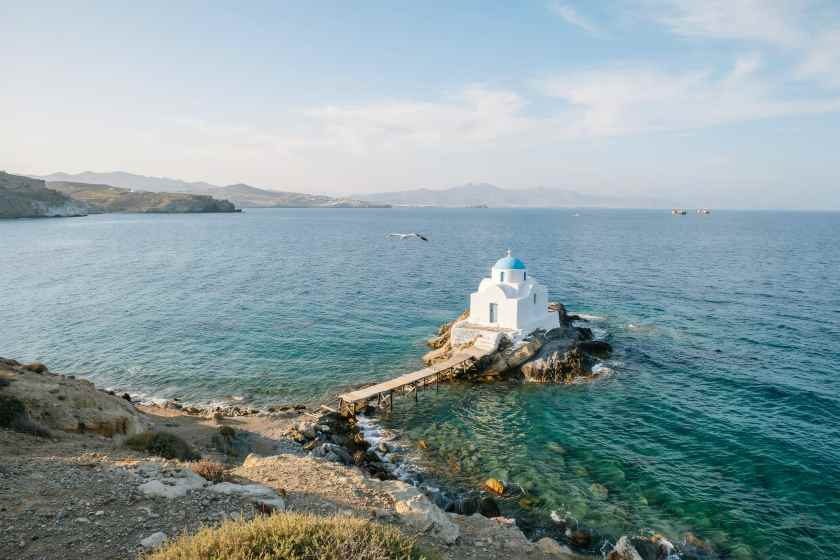
Image generated with Ai
Tripiti, Milos and the wider Cyclades region continue attracting travellers interested in Greece’s rich archaeological heritage as the Ancient Theatre of Milos stands as one of the island’s most remarkable historical landmarks. Perched on a hillside overlooking the Aegean Sea, the marble theatre offers visitors a rare opportunity to experience a site where ancient entertainment, public gatherings and cultural life once flourished against one of the most spectacular natural backdrops in the Mediterranean.
Located below the picturesque village of Tripiti, the theatre remains one of Milos’ most significant archaeological attractions. While the island is internationally recognised for its dramatic coastline, volcanic landscapes and crystal-clear waters, the Ancient Theatre reveals another side of Milos—one deeply connected to the cultural and social traditions of the ancient Greek and Roman worlds.
Today, visitors can walk among the surviving marble tiers and imagine a time when audiences gathered to watch performances, celebrate festivals and participate in communal events overlooking the same sea that stretches before them today.
The origins of the Ancient Theatre of Milos date back to the Hellenistic period during the 3rd century BC.
Advertisement
Advertisement
This era followed the conquests of Alexander the Great and witnessed significant cultural development throughout the Greek world. Public theatres became central features of urban life, serving as venues for dramatic performances, music, public ceremonies and civic gatherings.
The theatre on Milos was established during this period as part of the island’s growing cultural landscape.
Its location was carefully selected to take advantage of the natural slope of the terrain, allowing architects to create an amphitheatre-style structure that maximised both visibility and acoustics.
The design reflected the architectural sophistication of the period while also embracing the island’s stunning natural environment.
The theatre’s history did not end with the Hellenistic era.
Following the destruction of the city by the Athenians, the site underwent substantial redevelopment during Roman rule.
The Romans expanded and renovated the existing structure, transforming it into a larger and more elaborate entertainment complex.
These improvements reflected the continuing importance of public performances and social gatherings within the community.
Roman builders enhanced many Greek theatres throughout the Mediterranean, often increasing seating capacity and improving infrastructure while preserving the original character of the venues.
The Ancient Theatre of Milos became one of the island’s most important public spaces during this period, reinforcing its role as a centre for culture and community life.
One of the theatre’s most distinctive features is its location.
Constructed on a hillside overlooking the Aegean Sea, the site offers panoramic views that continue to captivate visitors.
The combination of ancient marble architecture and coastal scenery creates one of the most memorable archaeological experiences in the Cyclades.
The surrounding landscape provides insight into why ancient builders selected this location.
The natural slope supported the theatre’s design while the open views towards the sea enhanced the visual appeal of the venue.
Even today, visitors often describe the setting as one of the most beautiful theatre locations in Greece.
The site demonstrates how ancient architects integrated their structures into the surrounding environment rather than imposing them upon it.
Like many ancient Greek theatres, the Theatre of Milos was designed with acoustics as a key consideration.
The arrangement of seating tiers and the natural shape of the hillside helped project sound effectively throughout the venue.
This allowed audiences to hear performances clearly even without modern amplification systems.
The surviving remains continue to demonstrate the engineering expertise of ancient builders.
The ability to create venues capable of hosting large audiences while maintaining sound quality remains one of the most impressive achievements of Greek architectural design.
For travellers interested in ancient engineering and performance spaces, the theatre offers valuable insight into how entertainment venues functioned more than two thousand years ago.
The theatre served a much broader purpose than simply hosting performances.
In ancient societies, theatres functioned as important gathering places where residents came together for cultural, social and civic activities.
The Ancient Theatre of Milos likely hosted theatrical productions, musical performances and religious ceremonies.
These events formed an important part of community life, helping strengthen social bonds and cultural identity.
Public gatherings at the theatre would have brought together residents from across the island, making it one of the most active and influential locations within the ancient settlement.
The site therefore provides important evidence of how communities interacted, celebrated and communicated during different periods of Greek and Roman history.
Although time has inevitably altered the structure, significant portions of the theatre remain visible.
Visitors can explore sections of the marble seating tiers, the orchestra area and parts of the stage.
These surviving elements provide a clear impression of the scale and design of the original venue.
The white marble construction remains particularly striking against the backdrop of the sea and surrounding landscape.
Archaeological preservation efforts have helped ensure that travellers can continue experiencing the site while learning about its historical significance.
The theatre also forms part of a wider network of archaeological attractions on Milos, encouraging visitors to explore the island’s rich cultural heritage.
While Milos is often associated with beach tourism and natural attractions, interest in the island’s archaeological sites continues expanding.
Travellers increasingly seek destinations that combine cultural experiences with scenic beauty.
The Ancient Theatre of Milos perfectly reflects this trend by offering history, architecture and breathtaking views within a single attraction.
As cultural tourism grows across Greece, sites such as the theatre are helping diversify visitor experiences and highlight the country’s rich historical legacy.
3rd Century BC
The Ancient Theatre of Milos is constructed during the Hellenistic period.
Following the Athenian Destruction of the City
The theatre underwent major expansion and renovation during Roman rule.
Roman Era
The venue serves as a centre for performances, ceremonies and public gatherings.
Modern Archaeological Preservation
Surviving sections of the theatre are protected and open to visitors.
Present Day
The Ancient Theatre of Milos remains one of the island’s leading cultural tourism attractions.
Tripiti, Milos and the Cyclades preserve one of Greece’s most scenic and historically significant performance venues through the Ancient Theatre of Milos. From its Hellenistic origins and Roman expansion to its commanding views of the Aegean Sea, the theatre offers travellers an extraordinary connection to the cultural life of the ancient Mediterranean. As visitors explore its marble tiers and imagine the performances that once echoed across the hillside, the site continues to demonstrate how history, architecture and natural beauty combine to create one of Greece’s most rewarding cultural tourism experiences.
Advertisement
Tags: Aegean heritage tourism, Aegean Sea, Ancient Greek theatre, Ancient Theatre of Milos, cultural tourism Greece
Advertisement
Advertisement













Friday, September 4, 2026

Friday, September 4, 2026

Friday, September 4, 2026

Friday, September 4, 2026

Thursday, September 3, 2026

Wednesday, September 2, 2026

Friday, September 4, 2026