
The United States Joins Qatar and Switzerland in a Sensational Viral Spectacle as Southwest Airlines Flight WN3698, Boeing 737 MAX 8 Casts World Cup Shadow: How An Airspace Logistics Marvel Captivates the Whole World of Football, You Need to Know?

Updated
Published
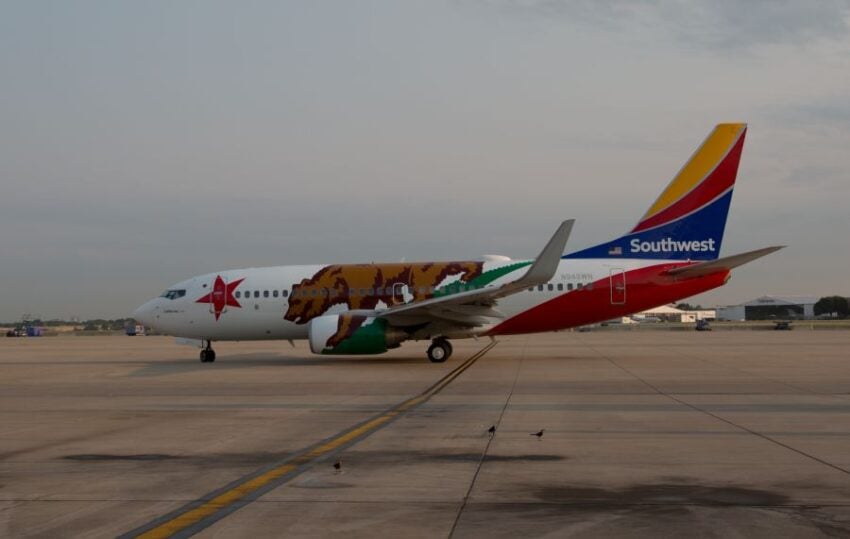
Image Courtesy: Southwest Airlines
The United States Joins Qatar, and Switzerland in a global digital media sensation following an extraordinary aerial occurrence over the state of California. During a highly anticipated 2026 FIFA World Cup group stage match, an unexpected airborne event captivated millions of international television viewers. Specifically, Southwest Airlines Flight WN3698, operating a Boeing 737 MAX 8 aircraft, scaled the skies directly above the playing field during the 27th minute of play. Although some early social media commentators erroneously speculated that an Airbus type aircraft caused the visual anomaly, official flight logs verified the Boeing narrow-body hull. This unique occurrence immediately generated a massive wave of online engagement, transforming a standard football fixture into a major talking point for global travel trade professionals.
This comprehensive report highlights how the United States Joins Qatar, and Switzerland under a shared logistical spotlight. We use the word “joins” deliberately to describe the precise geographic and structural intersection of these three nations during a live broadcast. The American commercial transit system physically joined the sporting event contested between the Swiss and Qatari national teams, projecting a corporate silhouette across an international pitch. Consequently, this moment connects metropolitan transportation infrastructure directly with global sports tourism entertainment.
To deliver an objective overview of this incident, we utilized a highly rigorous mode of research. This investigative methodology combines real-time ADS-B (Automatic Dependent Surveillance-Broadcast) telemetry data, official departure logs from the Federal Aviation Administration (FAA), stadium architectural orientation models, and international broadcast logs. By synthesizing these official parameters, we provide a verified breakdown of this unprecedented intersection of aviation and sports tourism.
Advertisement
Advertisement
How the United States Joins Qatar, and Switzerland in Broadcast History
The highly anticipated Group B encounter between Qatar and Switzerland took place on June 13, 2026, at the San Francisco Bay Area Stadium in Santa Clara, California. Tourism boards from all three nations had promoted the match heavily, drawing thousands of international visitors to the region. The sporting action progressed intensely, with the teams ultimately battling to a commendable 1-1 draw.
However, a non-sporting phenomenon stole the headlines during the 27th minute of the first half. As players moved the ball across the pitch, a massive, perfectly defined dark silhouette of a passenger jet swept rapidly across the turf. The sudden occlusion blanked roughly one-third of the playing field, surprising the athletes and triggering immediate commentary from broadcasters worldwide.
Advertisement
Advertisement
Aviation tracking networks and tournament logistics logs immediately cross-referenced the coordinates to verify the exact parameters of the flight. The table below outlines the definitive factual specifications of the event:
| Incident Parameter | Verified Operational Specification |
| Tournament Matchup | Qatar vs. Switzerland (Group B) |
| Match Date & Time | 13 June 2026 | 27th Minute of First Half |
| Geographic Venue | San Francisco Bay Area Stadium, Santa Clara, California, USA |
| Air Traffic Operator | Southwest Airlines |
| Flight Designation | Flight #WN3698 |
| Aircraft Equipment | Boeing 737 MAX 8 (Note: Southwest maintains an all-Boeing fleet) |
| Assigned Registration | N8879Q |
| Flight Routing Profile | San Jose Mineta International (SJC) to San Diego International (SAN) |
Technical Parameters of Southwest Airlines Flight WN3698
The aircraft responsible for this viral sensation belongs to one of the world’s most prominent short-haul carriers. Southwest Airlines Flight WN3698 maintains a highly consistent daily operational routing within the state of California. On this specific afternoon, the aircraft carried a full complement of business and leisure travelers heading south from the Silicon Valley hub.
The Boeing 737 MAX 8, bearing the registration N8879Q, represents the modern core of Southwest’s short-to-medium-haul fleet. This specific aircraft features advanced aerodynamics, including high-efficiency winglets that optimize lift during steep climbs. These aerodynamic structures contributed directly to the exceptionally sharp, recognizable outline cast upon the grass below.
Aviation experts quickly dismissed early social media claims that suggested an Airbus type model was operating the flight route. Because Southwest Airlines operates an exclusively Boeing fleet to maximize maintenance efficiency, travel trade professionals easily verified the manufacturer’s identity. This operational consistency allowed analysts to quickly isolate the exact performance metrics of Flight WN3698 via public tracking databases.
Physical Mechanics of the Silhouette Interception
To recreate the exact conditions of this event, travel trade professionals must analyze the unique alignment of local terrain and solar positioning. This spectacular visual phenomenon did not stem from a broadcasting malfunction or a digital camera glitch. Instead, it occurred due to a predictable physical intersection of commercial transportation architecture and astronomical timing.
Proximity to Regional Gateways
The San Francisco Bay Area Stadium sits in a highly complex airspace environment, located only a few miles north of San Jose Mineta International Airport (SJC). Commercial airliners departing from SJC utilize well-established departure corridors that guide ascending planes directly over the Santa Clara valley. Southwest Airlines Flight WN3698 had cleared the runway just moments prior and was actively climbing through the lower atmosphere when it intersected the stadium’s overhead zone.
Advertisement
Advertisement
Solar Geometry and Sharp Contrast
Because tournament organizers scheduled the daytime match during the bright afternoon hours, the sun occupied a specific angle in the California sky. As the Boeing 737 MAX 8 climbed over the venue, the solar rays struck the fuselage at the exact threshold required to project a massive shadow downward. The crispness of the silhouette indicated that the aircraft occupied a low-altitude climbing slot, preventing atmospheric light from scattering or blurring the edges of the shape.
Broadcast Camera Calibration
The primary high-angle tactical cameras, which deliver the main international feed to viewers in the United States, Qatar, and Switzerland, were calibrated for high-contrast tracking under direct sunlight. Therefore, when the shadow swept across the bright green grass, the sudden transition appeared incredibly dramatic on television screens. The moving shadow covered a significant portion of the field in a matter of seconds before disappearing completely as the plane continued its southward journey.
Airspace Regulatory Frameworks for Major Sports Tourism
For global travel trade professionals and destination management organizations (DMOs), this incident provides crucial insights into airspace management during mega-events. Typically, civil aviation authorities enforce Temporary Flight Restrictions (TFRs) over stadiums hosting major sporting events to protect the venue from unauthorized low-altitude aircraft, blimps, or drones.
However, these security restrictions do not disrupt the scheduled commercial aviation network operating under Instrument Flight Rules (IFR). The Federal Aviation Administration (FAA) maintains a delicate balance between strict tournament security and the economic necessity of commercial air transit.
- IFR Routing Separation: Scheduled commercial airliners remain under the active, continuous control of regional air traffic control centres, ensuring they stay safely separated from ground-level restrictions.
- Economic Continuity: Halting departures from major airports like SJC during a multi-week tournament would cause massive logistical delays across the national transportation network.
- Coexistence Model: This incident demonstrates that modern sports tourism infrastructure can seamlessly coexist with active commercial flight paths without compromising passenger safety or tournament security.
Why the United States Joins Qatar, and Switzerland as a Case Study for Travel Trade Professionals

The unexpected viral nature of this incident highlights the immense power of spontaneous marketing within the modern digital travel ecosystem. Within minutes of the broadcast anomaly, global flight tracking applications observed an unprecedented spike in traffic as millions of viewers searched for the identity of the aircraft.
“This extraordinary intersection of a global sporting fixture and real-time commercial aviation demonstrates the incredible synergy between destination logistics and unexpected marketing phenomena. As millions witnessed the shadow sweep across the pitch, it highlighted how seamlessly modern transit infrastructure weaves through the fabric of major sports tourism events, offering an inadvertent yet powerful showcase of regional connectivity.”
Advertisement
Advertisement
— Anup Kumar Keshan, Founder and Editor-in-Chief of Travel And Tour World
Aviation enthusiasts utilizing real-time ADS-B tracking software played a pivotal role in explaining the event to the general public. By matching the stadium’s exact coordinates with live flight telemetry, these specialists quickly identified the Southwest Airlines Boeing 737 MAX 8. This rapid dissemination of factual data transformed a potentially confusing broadcast anomaly into a lighthearted, universally shared highlight of the tournament.
Strategic Marketing Impacts on Destination Management
From a destination marketing perspective, the visibility generated by Flight WN3698 offers valuable insights for regional tourism boards. The incident effectively showcased the seamless operational capabilities of the San Francisco Bay Area’s transport network to an audience of billions. It proved that the region could host a massive international tournament while maintaining its standard commercial flight schedules.
Furthermore, the event created an unexpected branding victory for Southwest Airlines, associating the carrier with a historic sporting moment. Travel trade analysts note that such spontaneous viral occurrences often generate higher consumer engagement than traditional, multi-million-pound advertising campaigns. Consequently, destination managers are now studying this event to better understand how infrastructure proximity can enhance a region’s global media footprint.
Conclusion
The memorable event over the San Francisco Bay Area Stadium stands as a testament to the hyper-connected nature of modern travel infrastructure. The unique situation where the United States Joins Qatar, and Switzerland under a single viral headline successfully demonstrated that even the most meticulously planned international sports tourism events remain deeply integrated within the broader ecosystem of commercial transportation.
By analyzing how Southwest Airlines Flight WN3698 interacted with the match between Qatar and Switzerland, destination managers and aviation stakeholders gain valuable perspective on public perception and operational visibility. Ultimately, this brief, captivating intersection of a commercial flight and a World Cup match will be remembered as one of the most remarkable, unscripted marketing moments in modern sports tourism history.
Advertisement
