

Amsterdam Alongside Rotterdam, Utrecht, Hague, Groningen, and Middelburg Declares Visitation War on Costly Travel Become Accessible with a Stunning €49 Unlimited Rail Pass Unveils Its Most Radical Offer Yet as European Travel would Change Forever

Published
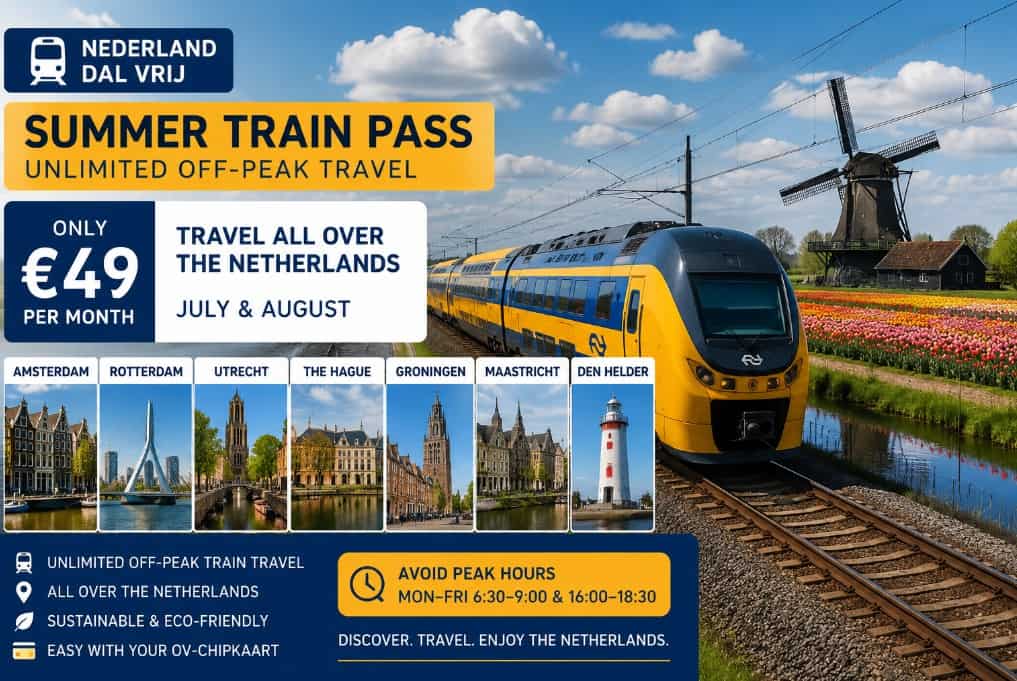
This summer 2026, the Dutch government has officially launched an incredible €49/month summer train pass via the national Nederland Dal Vrij initiative, drastically slashing travel costs to encourage highly sustainable green tourism. Generously backed by a €118 million budget for inflation relief and strict climate goals, this temporary ticket grants completely unlimited off-peak rail travel nationwide throughout July and August. Holidaymakers can seamlessly navigate the bustling Randstad core, visiting Amsterdam, Rotterdam, Utrecht, and The Hague without paying expensive point-to-point fares. For ultimate long-distance exploring, the pass lets you ride easily all the way from Groningen in the far north down to Maastricht in the southern tip. You can also comfortably venture from Den Helder on the northwest coast to the historic peninsulas of Middelburg in the southwest delta. To unlock these spontaneous day trips, passengers simply require a personal OV-chipkaart and must avoid weekday peak hours. Ultimately, this magnificent summer promotion offers an incredibly affordable, eco-friendly, and efficient solution to experience the complete geographical diversity, unique culture, and historical beauty of the beautiful Netherlands now.
 Image generated with Ai
What is the €49 Summer Train Pass?
The €49 monthly ticket is a heavily discounted version of the standard NS Flex Dal Vrij subscription, which normally costs €127.95 per month. The summer pass grants you unlimited second-class travel on all domestic train services in the Netherlands, including those operated by NS, Arriva, Qbuzz, Keolis, Blauwnet, and RRReis.
Advertisement
Advertisement
The primary condition of this pass is that it is strictly for off-peak travel. The schedule is structured as follows:
- Weekdays (Monday to Friday): Travel freely between 9:00 AM and 4:00 PM, and from 6:30 PM to 6:30 AM.
- Weekends: The off-peak window runs continuously from Friday evening at 6:30 PM until Monday morning at 6:30 AM.
This flexibility makes the pass incredibly advantageous for tourists, digital nomads, and locals taking summer staycations. Instead of meticulously calculating point-to-point fares—where a single round-trip ticket between Amsterdam and Maastricht can easily exceed €60—travelers can enjoy spontaneous day trips for a fraction of the traditional cost.
Advertisement
Advertisement

The “Why”: Government Motivations and Climate Goals
You might be wondering why the Dutch government decided to heavily subsidize this program. Reducing a €127.95 subscription to just €49 requires significant financial backing, and the answer lies in a convergence of economic relief efforts and ambitious environmental targets.
The Dutch Ministry of Infrastructure and Water Management has allocated a €118 million budget to fund this specific summer discount. The primary goals of this initiative include:
Advertisement
Advertisement
- Environmental Impact: Encouraging citizens and visitors to leave their cars behind directly lowers carbon emissions. By subsidizing rail travel, the government is leaning into its climate goals, providing a green alternative during the heavy summer travel season.
- Economic Relief: With the cost of living and fuel prices remaining high, this “climate ticket” offers a much-needed financial reprieve. It makes domestic tourism widely accessible to students, families, and budget-conscious travelers.
- Traffic Management: By distributing travel demand exclusively into off-peak hours, railway operators benefit from reduced overcrowding during morning and evening rush hours. The initiative spreads the passenger load more evenly throughout the day, easing congestion on peak services while giving leisure passengers a more comfortable alternative.
The Randstad Core: Amsterdam, Rotterdam, Utrecht, and The Hague
The pass truly shines when exploring the Randstad, the densely populated megalopolis that encompasses the four largest Dutch cities. With intercity trains connecting these hubs in under an hour, you can easily wake up in one city and have dinner in another.
Amsterdam
The capital city remains the cultural and historical heartbeat of the country. With your pass, you can glide into Amsterdam Centraal, stepping out into a labyrinth of iconic canals, historic bridges, and world-class institutions like the Rijksmuseum and the Van Gogh Museum. Because you are traveling during off-peak hours, you can avoid the hectic morning commuter crush and arrive just in time for a mid-morning coffee by the Herengracht.
Rotterdam
If Amsterdam is defined by its Golden Age history, Rotterdam is characterized by its futuristic resilience. Destroyed during World War II, Rotterdam rebuilt itself with striking modern architecture. A quick train ride from Amsterdam brings you to Rotterdam Centraal, an architectural marvel in itself. From there, you can visit the iconic Cube Houses, the massive Markthal, and the Euromast, all while enjoying the city’s vibrant, multicultural culinary scene.
Utrecht
Utrecht is geographically central and serves as the primary hub of the Dutch railway network. The city offers a cozier, more intimate alternative to Amsterdam, famous for the Dom Tower and its unique two-level canals. The Oudegracht features cellars right at the water’s level, many of which have been converted into lively cafes and restaurants. Utrecht’s massive train station makes it the perfect launchpad for any spontaneous journey.
The Hague
Known as the political center of the Netherlands, The Hague (Den Haag) houses the Dutch parliament, the King’s working palace, and the International Court of Justice. Beyond its bureaucratic importance, The Hague is a city of refined art galleries—such as the Mauritshuis, home to Vermeer’s Girl with a Pearl Earring—and beautiful coastlines. A short tram ride from the main station brings you to Scheveningen, the country’s most famous beach resort, perfect for a summer afternoon.
From North to South: Ride from Groningen to Maastricht
One of the most liberating aspects of the €49 summer pass is the ability to traverse the entire vertical length of the country without worrying about the distance-based fares that usually apply.
Advertisement
Advertisement
The Northern Frontier: Groningen
Located in the far north, Groningen is a vibrant university city with a youthful, energetic atmosphere. Often overlooked by tourists who stick to the Randstad, Groningen boasts the stunning Groninger Museum, bustling market squares, and historic buildings like the Martinitoren. The train ride up to Groningen takes you through the serene, flat, and green landscapes of the northern provinces, offering a peaceful contrast to the urban center of the country.
The Southern Tip: Maastricht
At the absolute opposite end of the nation lies Maastricht, situated in the southern tip of the province of Limburg. Traveling from Groningen down to Maastricht is a journey that showcases the geographical diversity of the Netherlands. As you head south, the famously flat Dutch landscape gradually gives way to rolling hills. Maastricht itself feels distinctly un-Dutch, bearing strong Roman influences, historic basilicas, and a Burgundian lifestyle characterized by excellent food and wine. Wandering through the Vrijthof square or exploring the ancient St. Pietersberg caves makes the long, scenic train ride entirely worthwhile.
From East to West: Explore Den Helder to Middelburg
The Netherlands may not be incredibly wide, but the cultural and visual shift from east to west is striking, especially when you factor in the diverse coastal extremities.
The Maritime North-West: Den Helder
Positioned on the northernmost point of the North Holland peninsula, Den Helder is a city steeped in maritime history and serves as the country’s main naval base. With your €49 pass, you can easily travel to this breezy coastal town to visit the Dutch Navy Museum or to catch the short ferry ride over to Texel, the largest of the Wadden Islands. The train journey up to Den Helder cuts through vast fields and polders, offering uninterrupted views of classic Dutch windmills and agricultural expanses.
The South-West Peninsula: Middelburg
Traveling all the way down to the southwest brings you to Middelburg, the capital of the Zeeland province. Zeeland is a delta region composed of islands and peninsulas, famously protected by the Delta Works engineering marvels. Middelburg is a remarkably preserved historical city that once rivaled Amsterdam in importance during the era of the Dutch East India Company. The Gothic town hall and the imposing Lange Jan abbey tower stand as testaments to its wealthy past. Reaching Middelburg by train involves riding over incredible bridges and causeways, with water stretching out on both sides of the tracks—a truly unique rail experience that highlights the Dutch mastery over their aquatic environment.
Vital Information and How to Secure Your Pass
If you are eager to take advantage of this initiative, here is a breakdown of the logistical details, verified from the latest government and NS updates as of early July 2026.
Advertisement
Advertisement
| Feature | Details |
| Cost | €49 per month (temporarily discounted from €127.95) |
| Where to Buy | The official NS website, the NS App, or at major NS ticket machines |
| Requirements | A personal OV-chipkaart is mandatory to load the subscription |
| Validity | Ends August 31, 2026 |
| Included Networks | NS, Arriva, Qbuzz, Keolis, Blauwnet, RRReis (domestic services only) |
Exclusions and Timing Limitations
While the pass covers almost every domestic train, there are notable exceptions. It is not valid on international premium services such as the Eurostar, Nightjet, ICE Frankfurt, or ICE Berlin. Additionally, the time you check in at the station gates dictates your fare. If you check in during peak hours (for example, at 8:45 AM or 4:30 PM on a weekday), you will be charged the full standard fare for that specific journey.
Additional Benefits for Travelers
For families, this pass is an exceptional deal, as children up to 11 years old can travel for free using the companion “Kids Vrij” subscription. Furthermore, travelers who wish to combine rail travel with a car journey can take advantage of the summer offer at one of the NS’s 270 Park & Ride locations. Parking costs are reduced to a maximum of €2 a day when you use your pass to travel.
The introduction of the €49 Nederland Dal Vrij pass for the summer of 2026 represents a brilliant intersection of environmental policy, economic relief, and a celebration of domestic tourism. Whether you are aiming to experience the cosmopolitan rush of Amsterdam and Rotterdam, seeking the historic tranquility of Middelburg, or looking to traverse the country from Groningen to Maastricht, this initiative puts the entirety of the Netherlands at your fingertips. By honoring the off-peak travel windows, you can enjoy absolute freedom to discover the hidden gems and major landmarks of this beautiful country seamlessly. Ensure you have your personal OV-chipkaart ready, mind the rush-hour clock, and enjoy exploring the Dutch railways this summer!
Advertisement
