
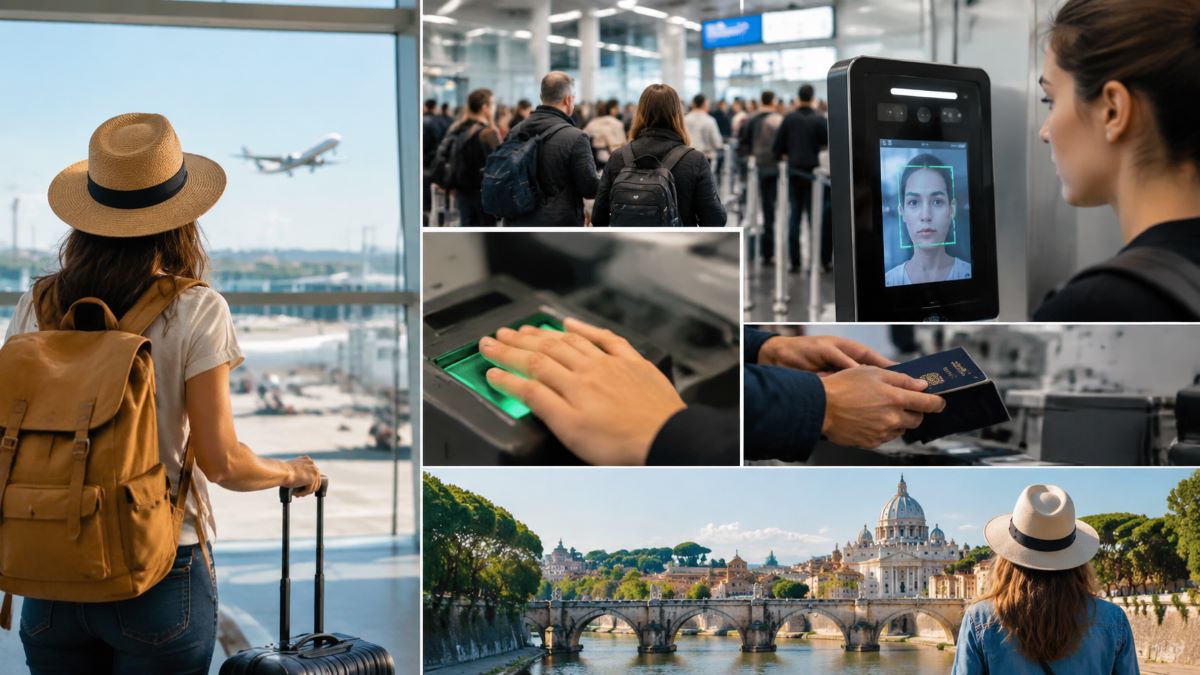
Image generated with Ai
UK Along With US and More Tourists Face New Europe Entry Rules as EES Digital Border System Changes The European Union has pulled back on flexibilities for its digital border system. A side effect of that decision will be complications for tourists in the UK, Canada, Australia, and the United States. Those tourists will have new requirements for facial recognition and fingerprinting. This will occur when those travelers make trips to Europe. The EES, or Europe EES Biometric Border Checks, is intended to create a modern system of border management that is both secure and digital.
Europe’s Entry/Exit System (EES) is transforming how millions of international visitors enter and leave the Schengen Area. From 6 September 2026, temporary flexibility measures that allowed border authorities to ease biometric registration during periods of extreme congestion will end. The digital border system replaces traditional passport stamping with electronic recording of traveller details, including facial images, fingerprints, passport information and entry-exit movements. The system applies to non-EU nationals visiting Schengen countries for short stays of up to 90 days within a 180-day period.
The change is particularly important for travellers from the UK, United States, Canada and Australia, as citizens from these markets are among the largest long-haul visitor groups travelling to Europe.
| EES Feature | Details |
|---|---|
| System name | European Entry/Exit System |
| Main purpose | Digital border management and security |
| Applies to | Non-EU short-stay travellers |
| Biometric data collected | Facial image and fingerprints |
| Operational date | Fully operational from 10 April 2026 |
UK travellers are among the most affected groups because British citizens are now treated as non-EU nationals when entering the Schengen Area. The EES requires British visitors to complete digital registration when crossing external Schengen borders. The new process is designed to improve border monitoring, record travel movements accurately and help authorities identify overstays. The UK Government has advised travellers that EES is part of wider European border modernisation and that visitors should prepare for possible changes in processing times.
Advertisement
Advertisement
The UK remains one of Europe’s most important tourism markets. Millions of British travellers visit Spain, France, Italy, Greece and other Schengen destinations every year, meaning airports and ports with high UK traffic will need to manage large volumes of biometric registrations.
| UK Traveller Impact | Details |
|---|---|
| Travel status | Non-EU visitor |
| Affected trips | Short Schengen stays |
| Main destinations | Spain, France, Italy, Greece |
| Required checks | Passport, facial image, fingerprints |
| Preparation advice | Allow extra border processing time |
American travellers visiting Europe will experience a significant change in border procedures as the EES becomes fully established. The United States is one of Europe’s strongest overseas tourism markets, with millions of visitors travelling annually for holidays, business trips and cultural experiences. Under EES, US citizens travelling to Schengen countries for short stays must complete biometric registration when required.
The system creates a central digital record of entry and exit movements. The European Union states that EES will strengthen border security, improve monitoring of permitted stays and create a more modern travel process.
| US Traveller Impact | Details |
|---|---|
| Region affected | Schengen Area |
| Travel purpose | Tourism and business |
| Registration requirement | Facial image and fingerprints |
| Stay limit | 90 days within 180 days |
| Main concern | Border processing time |
Canadian visitors travelling to Europe will also experience the new biometric border environment. Canada is among the major international tourism markets for Europe, with strong visitor flows to countries including France, Italy, Spain, Germany and Portugal.
The EES introduces a more technology-focused border process where traveller identity information is digitally recorded. Canadian citizens travelling for short stays in the Schengen Area will need to complete the required checks when crossing external borders. The system aims to create a consistent approach across participating countries while improving border security management.
| Canada Traveller Impact | Details |
|---|---|
| Traveller category | Non-EU visitor |
| Main affected travel | Short European stays |
| Border requirement | Digital registration |
| Biometric information | Facial image and fingerprints |
| Travel advice | Allow additional border time |
Australian travellers visiting Europe will also move through the new EES framework. Australia is a major long-haul tourism market for Europe, particularly for destinations offering heritage, culture, food, luxury travel and seasonal experiences.
The EES changes the arrival experience by replacing manual passport stamping with automated digital records. Travellers from Australia visiting participating Schengen countries will need to complete biometric checks as part of the new border process.
The European Union designed the system to create a stronger and more efficient external border network while maintaining accurate monitoring of visitor movements.
| Australia Traveller Impact | Details |
|---|---|
| Travel market | Long-haul visitor source |
| Destination region | Schengen Europe |
| Entry process | Digital biometric checks |
| Previous system | Passport stamping |
| New system | Electronic border records |
European airports and border crossings are adapting to one of the biggest changes in international travel management. The EES introduces new technology, equipment requirements and passenger processing procedures across 29 participating countries.
During the transition period, authorities had limited flexibility to manage congestion by temporarily adjusting biometric collection requirements at certain locations. With these measures ending, airports must rely more heavily on available infrastructure, staffing and digital systems during busy travel periods.
The impact is expected to be most visible at major international hubs handling large numbers of non-European visitors.
| Airport Impact Area | Expected Change |
|---|---|
| Immigration control | More biometric processing |
| Passenger flow | Additional verification steps |
| Peak periods | Higher congestion risk |
| Technology | Greater dependence on kiosks |
| Long-term goal | Faster digital border management |
The introduction of EES represents a major change in how Europe manages international tourism flows. The system is part of a wider European strategy to modernise border controls through digital technology, improve security and create better oversight of short-stay travel.
For travellers from the UK, US, Canada and Australia, the most important change is preparation. Visitors should understand that border procedures will no longer rely only on passport checks. Instead, biometric identity verification will become a standard part of entering and leaving the Schengen Area.
As international travel continues growing, Europe’s digital border transformation will shape the future visitor experience.
| Future Europe Travel Change | Impact |
|---|---|
| Digital borders | Increased automation |
| Biometrics | Stronger identity verification |
| Tourism flows | More structured management |
| Traveller behaviour | More preparation required |
| Future systems | ETIAS integration expected |
The end of EES flexibility marks a major change for international travel to Europe, with UK Along With US Travellers Warned as Europe EES Biometric Border Checks End Flexibility from 6 September. Because of the new phase, travelers will be expected to comply with more stringent biometric border control systems as Europe gets closer to having a fully digital border control system. The EES is designed to make Schengen border control systems more secure and more convenient, but travelers from the UK, US, Australia, Canada, and other nations will experience additional border control systems as a result of the system. The new digital border control systems will have consequences on international traveling and tourism to Europe in the future.
Advertisement
Tags: digital border system, Europe EES biometric border checks, Schengen travel rules 2026, UK travellers Europe, US travel to Europe
Advertisement
Advertisement













Saturday, September 5, 2026

Saturday, September 5, 2026

Saturday, September 5, 2026

Saturday, September 5, 2026

Saturday, September 5, 2026

Thursday, September 3, 2026

Saturday, September 5, 2026

Saturday, September 5, 2026



