
Mtskheta Unites Sacred Orthodox Liturgy and Autumn Heritage as Svetitskhovloba 2026 Accelerates Georgian Cultural Tourism

Published
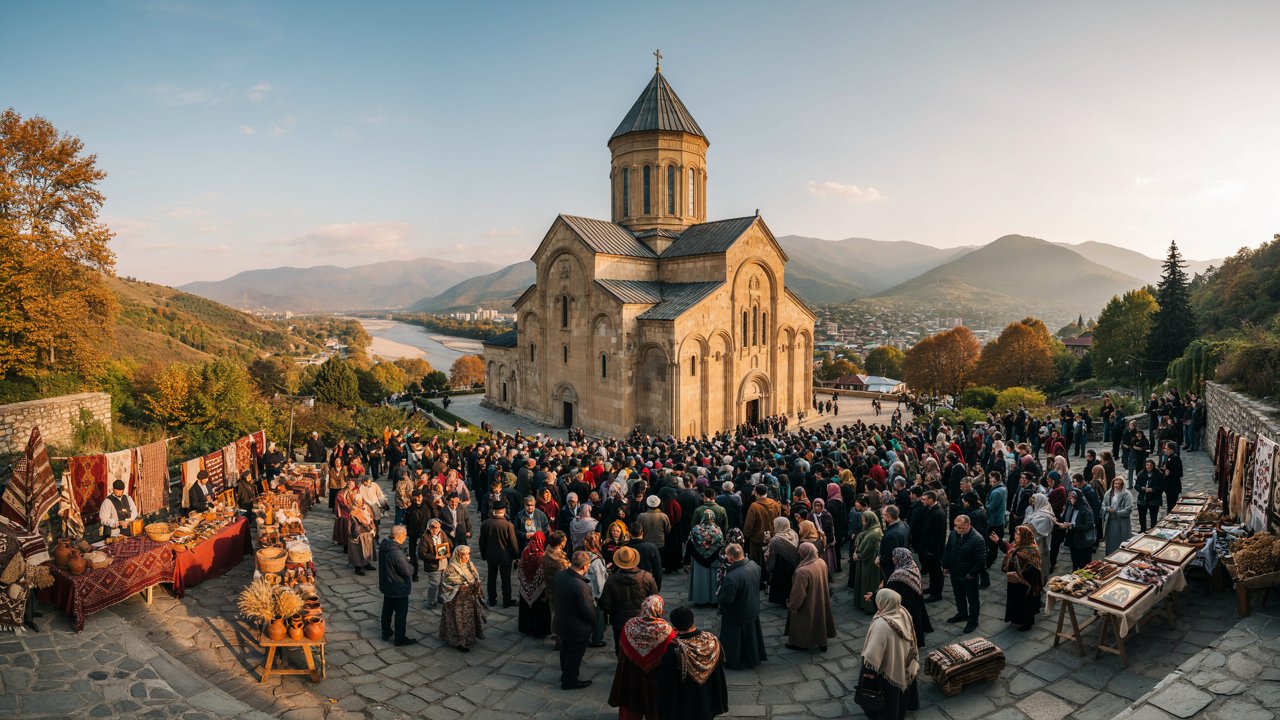
Mtskheta Unites Sacred Orthodox Liturgy and Autumn Heritage as Svetitskhovloba 2026 Accelerates Georgian Cultural Tourism.Bells chimed across the confluence of the Mtkvari and Aragvi rivers this morning as tens of thousands of Orthodox pilgrims, diaspora families, and international heritage travelers converged upon the ancient royal capital of Mtskheta. Staged annually on 14 October, the celebration of Svetitskhovloba (also known as Mtskhetoba or the Feast of the Life-Giving Pillar) stands as one of Georgia’s preeminent public holidays and intangible spiritual landmarks.
Where Does This Event Happen and Who Is Participating?
Rather than operating inside an isolated conference center, Svetitskhovloba permeates the entire ancient municipal core and surrounding foothill terrain of Georgia’s historical seat of power:
- Svetitskhoveli Cathedral Compound: The monumental 11th-century cathedral complex serves as the epicenter of spiritual observance. The Patriarchal Divine Liturgy is concelebrated inside the nave by the Holy Synod of the Georgian Orthodox Church, attended by the Prime Minister of Georgia, members of Parliament, municipal mayors, and visiting Orthodox bishops from foreign sister churches.
- The Mtkvari River Confluence & Samtavro Convent: Downhill along the riverbanks, clergy lead mass ceremonial baptisms (Katlisi), welcoming hundreds of catechumens, infants, and youth into the Church, while nearby Samtavro Monastery hosts veneration lines at the shrines of St. Nino and St. Gabriel Urgebadze.
- Aragvi Embankment & Old Town Thoroughfares: The pedestrian avenues of Arsukidze Street and surrounding civic squares host open-air harvest fairs (Tbilisoba–Mtskhetoba harvest stages). Here, rural agricultural cooperatives, polyphonic choral ensembles, traditional dancers in chokha attire, and master artisans participate in public masterclasses, showcasing Georgian enamel jewelry (minankari), ceramic wineware, and regional viticulture.
How Has Attendance Tracked Over the Past Five Years?
Audited visitor telemetry compiled from regional road checkpoint telemetry, Georgian Railway excursion logs, and municipal destination registries monitored under the National Statistics Office of Georgia (Geostat) demonstrates sustained post-pandemic expansion across Mtskheta’s autumn festival day:
| Year | Edition / Operational Slate | Core Venues & Precincts | Aggregate Day Turnout | Regional Lodging Uptake | Audited Dynamics & Policy Catalysts |
| 2021 | 2021 Staging (Phased Public Return) | Svetitskhoveli Grounds & Perimeter | ~38,500 | 68.0% | Reopening under sanitization protocols; limited outdoor cohort spacing. |
| 2022 | Full Civic Resumption | Municipal Mtskheta & Riverbank | ~52,000 | 78.5% | Reinstatement of unrestricted mass river baptisms; inbound regional recovery. |
| 2023 | Regional Heritage Integration | Old Town Corridors & Confluence | ~64,500 | 84.0% | Significant surge in short-haul European travelers and Middle Eastern leisure stays. |
| 2024 | Integrated Transit Slate | Expanded Heritage Footprint | ~73,000 | 89.2% | Coordinated suburban rail shuttles from Tbilisi Central; record artisan stalls. |
| 2025 | Pre-Jubilee Benchmark | Multi-Venue Municipal Grid | ~81,500 | 92.5% | Record day-trip excursion traffic along the E60 corridor; high church attendance. |
| 2026 | 2026 Active Staging Showcase | Full Confluence & Cathedral Grid | ~86,000–90,000 (Projected) | 95.0%+ (High booking velocity) | Full multi-tiered choral staging, open crafts avenues, and diplomatic presence. |
Which Other Countries Have This Same Event?
While the precise dedication to the “Life-Giving Pillar” (Svetitskhoveli) is unique to Georgia’s sovereign identity, sovereign Christian destinations worldwide stage structurally parallel national Patronal feast days and patron-saint celebrations that integrate statehood, liturgy, and municipal street culture:
Advertisement
Advertisement
- Spain (Fiesta Nacional de España & Fiestas del Pilar, Zaragoza): Staged annually on 12 October under royal patronage, honoring Our Lady of the Pillar with mass floral offerings, regional folk attire, and sovereign military pageantry.
- Greece (Feast of Saint Demetrios / Dimitria, Thessaloniki): Celebrated across late October, uniting cathedral pontifical liturgies with municipal street carnivals, folk dance, and civic remembrance of the city’s liberation.
- Armenia (Feast of the Holy Cross of Varak & Holy Etchmiadzin Pilgrimages, Vagharshapat): Anchored at the spiritual mother see of the Armenian Apostolic Church, linking ecclesiastical relic venerations with public harvest feasts.
- Cyprus & Mount Athos (Panagitsa & Patronal Orthodox Feasts): Island-wide and monastic community feasts that deploy sacred all-night vigils alongside vibrant open-air village agoras and food fairs.
- Ukraine & Romania (Pokrova / Protection of the Mother of God, 1–14 October): An identical autumn liturgical and state holiday celebrating national defender heritage, pairing church services with harvest craft markets.
Which Region of Travellers Comes to This Event Most?
Mobility analytics and international border checkpoint datasets maintained in coordination with the Georgian National Tourism Administration identify three dominant travel feeder corridors:
- Tbilisi Metropolitan & Domestic Commuter Basin (Over 64% of Turnout): Commuters arrive along the E60 highway and direct suburban minibuses (marshrutkas) departing Didube station. Situated only 20 kilometers north of the capital, Mtskheta functions as a high-density holiday day-trip for families, church congregations, and academic youth.
- Transcaucasian & Neighboring Regional Feeder Corridors (Armenia, Azerbaijan, Turkey): Accounting for roughly 18% of visiting travelers, this contingent includes regional road travelers, diaspora returnees, and cross-border heritage travelers arriving via overland corridors and Tbilisi International Airport (TBS).
- European & Middle Eastern Heritage Travelers (EU, Gulf States, Israel): Comprising approximately 18% of audiences, this cohort consists of high-spending cultural and architectural tourists from Germany, Poland, the United Kingdom, France, and the UAE who integrate the festival into broader autumn wine-harvest (Rtveli) itineraries across Kakheti and Kartli.
Which Country Benefits Most and How Are Tourism and the Economy Impacted?
Georgia—and explicitly the Mtskheta-Mtianeti Region and the Municipality of Mtskheta—stands as the direct macroeconomic and commercial beneficiary:
Advertisement
Advertisement
┌────────────────────────────────────────────────────────────────────────┐
│                   MUNICIPAL ECONOMIC & TOURISM FOOTPRINT               │
├───────────────────────────────────┬────────────────────────────────────┤
│       DIRECT HOSPITALITY          │       AGRICOLE & REGIONAL TRADE    │
├───────────────────────────────────┼────────────────────────────────────┤
│ • ₾9.5M–₾12.2M ($3.5M–$4.5M USD)  │ • Direct monetization for rural    │
│   estimated direct municipal      │   cooperatives: honey, churchkhela,│
│   and regional visitor spend.     │   cheese, and clay qvevri wine.    │
│                                   │                                    │
│ • Regional lodging compression:   │ • Cultural asset preservation:     │
│   90%–96% occupancy across        │   supports conservation funds for  │
│   Mtskheta and Aragvi valley inns.│   UNESCO-listed monuments.         │
└───────────────────────────────────┴────────────────────────────────────┘
Preservation of Inscribed Cultural Capital: High-profile international visibility reinforces statutory monitoring commitments under UNESCO, incentivizing national conservation investments that safeguard Mtskheta’s ancient stonework against environmental weathering without incurring municipal debt.
Counter-Cyclical Economic Spending: According to tourism impact datasets from the Georgian National Tourism Administration and Geostat, cultural and religious tourists spend 28% to 35% more per day than routine volume sightseers. The single-day holiday window injects between ₾9.5 million and ₾12.2 million GEL into local trade through family-run taverns (salobio), traditional guest houses, private taxi outfitters, and souvenir markets.
Advertisement
Advertisement
Hospitality Occupancy and ADR Compression: Boutique guest houses and riverside hotels across Mtskheta, Saguramo, and Natakhtari record occupancy levels between 90% and 96%, driving Average Daily Rates (ADR) during a mid-October period that bridges the gap between summer hiking in the Caucasus and the winter ski season.
Grassroots Agritourism and Artisan Value Retention: Because municipal squares are open directly to farmers and craftspeople without corporate middleman fees, 100% of retail transactions for churchkhela, raw artisanal cheeses, Svanetian salt, and natural Qvevri wines remain directly with agrarian households.
Advertisement
