

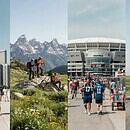
Image generated with Ai
Arizona teams up with Utah and more US states in facing a decline in national park tourist arrivals in 2026 as several iconic destinations, including Grand Canyon and Bryce Canyon, record lower visitation after the introduction of the new $100 fee surcharge for non-US residents. The decline comes amid a broader drop in visitor numbers, although factors beyond the surcharge, including weather, travel trends and access conditions, are also influencing demand.
Several of America’s internationally famous national parks are recording fewer visitors in 2026, months after the United States introduced a new $100 per-person surcharge for non-US residents at 11 major National Park Service sites.
The decline is particularly visible at Grand Canyon National Park, where recreation visits through July were roughly 9% below 2025. Bryce Canyon was running about 5.5% lower, while Yellowstone was down around 1% through July. Acadia and Everglades had also reported year-to-date declines in their latest available first-half data.
But there is an essential qualification: the National Park Service has not established that the new international visitor fee caused these declines. Weather, access conditions, domestic demand, wildfire and road disruptions, economic conditions and international travel trends can all affect park visitation.
Advertisement
Advertisement
The timing nevertheless makes the trend significant. The new fee regime began on 1 January 2026, fundamentally increasing the cost of visiting some of America’s most recognisable parks for foreign travellers.
The Department of the Interior introduced differential pricing for non-US residents at 11 national parks from 1 January 2026. Nonresidents aged 16 and older must pay the normal entrance charge plus an additional $100 per person at affected parks unless covered by the new nonresident annual pass.
That pass costs $250, compared with $80 for US residents. A nonresident annual pass can cover its holder and up to three additional nonresident adults for the surcharge where fees are assessed per person.
The policy applies to Acadia, Bryce Canyon, Everglades, Glacier, Grand Canyon, Grand Teton, Rocky Mountain, Sequoia & Kings Canyon, Yellowstone, Yosemite and Zion.
The Congressional Research Service says the policy followed a July 2025 executive order directing higher fees for nonresidents, with the stated objective of raising revenue and improving national park experiences.
Grand Canyon National Park currently presents the strongest evidence of declining visitation among the major surcharge parks. NPS data show 2,396,551 recreation visits through July 2026, compared with about 2.633 million during January-July 2025. That means the park was running approximately 236,600 visits lower, a decline of about 9%. June was particularly weak, with 392,770 recreation visits, down 13.72% from 455,209 in June 2025.
The reasons cannot be reduced to the surcharge alone. Grand Canyon demand is affected by seasonality, weather, access conditions and wider US travel trends. But international travellers now face a substantially higher park-entry cost. If July’s year-to-date pace continued through August, an indicative projection would put January-August 2026 visitation near 2.78 million, compared with 3.057 million during the same eight months of 2025 — an estimated shortfall of about 275,000 visits.
Bryce Canyon National Park is showing another clear decline. Official NPS data put recreation visitation at about 1.056 million through July 2026, compared with roughly 1.118 million through July 2025. That leaves the Utah park approximately 61,400 visits behind, or about 5.5% lower. July itself was much weaker: 196,101 recreation visits, down 16.34% from 234,414 in July 2025.
The July fall is notable because summer is a critical period for Bryce Canyon. International travellers visiting Utah often combine Bryce with Zion, Grand Canyon and other western parks, making cumulative entrance costs relevant to multi-park itineraries. If the current 5.5% year-to-date gap broadly persisted through August, Bryce would reach approximately 1.274 million recreation visits through August, versus 1.348 million in January-August 2025 — roughly 74,000 fewer visits.
Yellowstone National Park is experiencing a smaller but still important decline. The park recorded 958,706 recreation visits in July 2026, down 2% from 975,109 in July 2025. Through July, visitation reached 2,635,384, compared with 2,666,031 in 2025 — a shortfall of 30,647 visits, or about 1%.
Yellowstone is especially important to the surcharge debate because the park has unusually useful historical international-visitor research. Congressional Research Service data show overseas visitors represented around 15% of Yellowstone’s summer visitors in 2024, compared with 30% in 2018 and 17% in 2016. If Yellowstone’s current roughly 1.1% deficit continued through August, projected eight-month visitation would be about 3.508 million, compared with 3,547,967 in 2025 — around 40,000 fewer visits. That remains an estimate, not an NPS forecast.
Acadia National Park was also running below its previous-year level in the latest comparable first-half NPS report. Total visitation through June stood at approximately 1.091 million, about 2.3% below the comparable 2025 level of roughly 1.117 million. June alone recorded 617,820 total visits, down 3.29% from 638,833 a year earlier.
Acadia is especially exposed to seasonal travel patterns because a large share of demand is concentrated in the warmer months. It is also one of the 11 parks where international adults now face the additional $100 fee. However, because complete July data comparable with Grand Canyon, Bryce and Yellowstone were not available in the official material used here, an August projection would be less robust. The first-half trajectory nevertheless points to a moderate decline rather than a collapse.
Everglades National Park also showed weaker visitation during the first half of 2026. The latest comparable NPS data available for this analysis put first-half recreation visits at roughly 456,000, against about 482,000 over the comparable 2025 period — a decrease of approximately 26,000 visits, or around 5%.
Unlike Yellowstone, Bryce or Grand Canyon, the Everglades has a very different seasonal pattern. South Florida’s heat, humidity, rainfall and mosquito conditions can significantly affect summer demand, meaning an August projection based simply on first-half performance would be particularly uncertain.
The park’s inclusion is nevertheless significant because international travellers aged 16 and above are subject to the same additional $100 nonresident charge imposed at the other surcharge parks. The observed decline happened after that policy took effect, but available NPS data do not identify how much of the decline came specifically from international visitors.
The available NPS figures do not support a claim that all 11 surcharge parks are losing visitors. Several are growing. The table below therefore deliberately includes only parks for which the latest usable data show a decline.
Park State Latest Confirmed 2026 Trend Current Decline Jan-Aug 2026 Indicative Projection Estimated Jan-Aug Shortfall Grand Canyon Arizona ~2.397m through Jul ~−9.0% ~2.782m ~275,000 fewer Bryce Canyon Utah ~1.056m through Jul ~−5.5% ~1.274m ~74,000 fewer Yellowstone Wyoming/Montana/Idaho 2.635m through Jul ~−1% ~3.508m ~40,000 fewer Everglades Florida ~456,000 through Jun ~−5% Not reliably projected First-half shortfall ~26,000 Acadia Maine ~1.091m total visits through Jun −2.3% Not reliably projected First-half shortfall ~26,000
Projection methodology: Grand Canyon, Bryce Canyon and Yellowstone estimates assume their current 2026 year-to-date percentage difference from 2025 broadly continues through August and apply that trend to the corresponding 2025 August volume. These are analytical estimates, not NPS forecasts. Current-year NPS statistics are preliminary and can be revised.
The headline figure is $100, but its effect can become much larger depending on how people travel.
The surcharge is assessed per nonresident aged 16 or older, on top of the park’s normal entrance charge. That means an overseas family containing four chargeable adults could theoretically face $400 in nonresident surcharges at one affected park if they do not hold the qualifying nonresident annual pass.
Commercial tour passengers are also covered. NPS states that non-US residents entering as part of commercial tours, commercial-use-authorisation groups or concessioner tours must pay the surcharge unless appropriately covered by the $250 Non-Resident Annual Pass.
For international travellers planning several famous western parks, the $250 pass can therefore become economically preferable to paying repeated individual surcharges.
The surcharge matters because America’s national parks form a substantial part of the country’s international tourism product.
Congressional Research Service analysis cites International Trade Administration research showing that the US received 48.3 million international air travellers in 2024, with 33% of surveyed travellers saying they visited national parks and monuments. The National Park System itself recorded approximately 331.9 million recreation visits in 2024.
However, there is a major statistical gap.
NPS historically did not systematically count international visitors separately across the entire park system. That means researchers cannot yet look at Grand Canyon’s decline and determine precisely how many missing visitors were Americans and how many were overseas travellers.
This is why attributing the entire 2026 decline to the surcharge would go beyond the evidence.
Fewer visitors do not necessarily mean less park revenue.
The 2026 policy was explicitly designed to generate additional income. All entrance-fee revenue remains within the National Park Service, and at least 80% generally stays at the park where it was collected.
This creates an unusual possibility: a park could experience fewer total visits while collecting more entrance-fee revenue because some international visitors are paying an additional $100 each.
Congressional Research Service analysis notes that one study of Yellowstone projected that a $100 international surcharge could generate additional revenue despite a small reduction in international visitation.
There is not yet enough official 2026 park-by-park surcharge-revenue data to determine whether that prediction is being realised.
The individual declines are occurring against a softer national backdrop.
A current NPS national summary showed approximately 188.1 million recreation visits through July 2026, compared with about 191.3 million during the corresponding 2025 period. That represents a system-wide decline of roughly 3.2 million visits, or around 1.7%.
This is crucial context.
It suggests that declining attendance at Grand Canyon, Bryce Canyon and Yellowstone cannot automatically be treated as a surcharge-only phenomenon. Broader factors are affecting National Park Service visitation in 2026.
At the same time, the much steeper 9% decline at Grand Canyon and roughly 5.5% drop at Bryce Canyon make those parks particularly important to watch.
The 2026 changes go beyond the $100 surcharge.
NPS has designated several entrance-fee-free dates in 2026, including Presidents Day, Memorial Day, Flag Day, the Independence Day weekend, the National Park Service’s 25 August birthday, Constitution Day, Theodore Roosevelt’s birthday and Veterans Day.
But beginning in 2026, these free-entrance benefits apply to US citizens and residents. Nonresidents must continue paying the normal entrance fee and any applicable nonresident surcharge.
That further increases the pricing difference between domestic and international visitors at affected parks.
August will provide a much stronger test.
Grand Canyon, Bryce Canyon and Yellowstone are already deep into their critical summer seasons. If their year-to-date deficits remain after July and August — particularly at Grand Canyon — the evidence of a sustained 2026 visitor slowdown will become stronger.
The indicative projections currently suggest Grand Canyon could finish August roughly 275,000 visits behind its 2025 January-August level, Bryce Canyon around 74,000 behind, and Yellowstone around 40,000 behind, assuming their current relative trends persist.
But these projections should not be presented as official forecasts.
NPS explicitly states that current-year visitation figures are preliminary and are finalised later.
The clearest conclusion from the available official data is narrower — but more defensible — than saying the surcharge has caused a nationwide national-park tourism collapse.
Grand Canyon, Bryce Canyon and Yellowstone are currently recording confirmed year-to-date visitation declines in 2026. Acadia and Everglades were also below 2025 in their latest comparable first-half figures.
The timing follows the 1 January introduction of the $100 nonresident surcharge, making the fee an important new variable in international park travel. But the National Park Service does not yet provide enough international-versus-domestic visitor data to establish direct causation.
That distinction matters.
The emerging 2026 story is therefore not that America’s national parks have universally lost tourists because of higher fees. It is that several of the country’s best-known surcharge parks are seeing measurable visitor declines at the same time that international travellers face substantially higher entry costs.
Grand Canyon is currently the strongest warning sign. Bryce Canyon’s summer decline has accelerated. Yellowstone remains slightly behind 2025. Acadia and Everglades have also shown weakness.
The next major evidence will come from complete August visitation data and, eventually, park-level surcharge revenue figures. Those numbers will help answer the central question left unresolved in 2026: whether charging international visitors substantially more is generating enough additional revenue to outweigh any tourism demand that America may be losing.
Arizona teams up with Utah and more US states in facing a decline in national park tourist arrivals in 2026 as Grand Canyon and Bryce Canyon record lower visits after the $100 fee surcharge for non-US residents, alongside wider travel factors.
In conclusion, Arizona teams up with Utah and more US states in facing a decline in national park tourist arrivals in 2026 as major destinations experience weaker visitation following the introduction of the $100 fee surcharge for non-US residents. While the surcharge has become a significant new factor affecting international travel costs, weather, access conditions, economic trends and broader visitor patterns are also shaping demand. The declines at Grand Canyon, Bryce Canyon and other iconic parks highlight the need to balance additional revenue goals with maintaining America’s appeal among global travellers.
Advertisement
Advertisement
Advertisement













Friday, September 4, 2026

Friday, September 4, 2026

Friday, September 4, 2026
Friday, September 4, 2026

Thursday, September 3, 2026

Wednesday, September 2, 2026

Friday, September 4, 2026