Manosree Majumder Manosree Majumder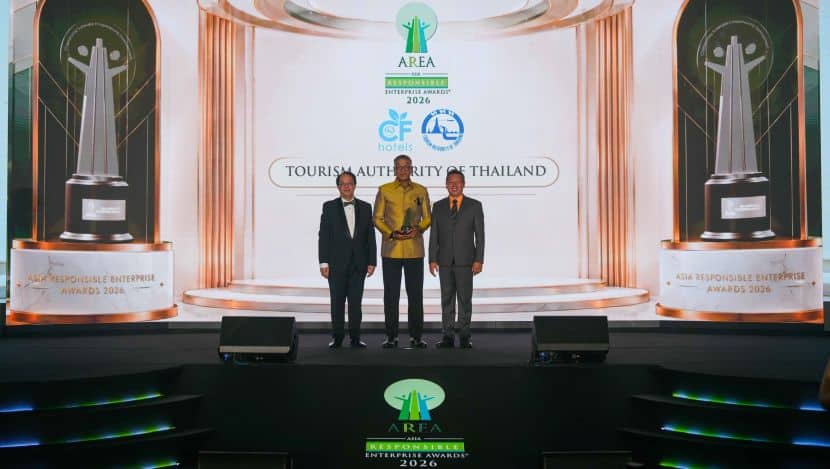
Thailand has pushed its sustainable travel story onto the Asian stage after the Tourism Authority of Thailand’s Carbon Footprint Hotels platform, known as CF-Hotels, won the Green Leadership category at the Asia Responsible Enterprise Awards 2026 in Malaysia. Announced in Bangkok on 2 July 2026, the win gives Thailand a timely tourism message. Its hotels are being positioned not only for beaches, service and value, but also as measurable players in the low-carbon travel economy.
The award matters because it rewards action, not decoration. CF-Hotels gives hotels and accommodation operators across Thailand a structured digital route to measure, manage and reduce greenhouse gas emissions. The system helps operators put environmental data into a usable format. It also links carbon performance with business opportunity, green finance and future market access.
Advertisement
TAT has presented the platform as a practical bridge between policy and the front desk. This is important for Thailand’s tourism industry, where hotels shape the traveller experience from Bangkok to Phuket, Chiang Mai, Pattaya and Koh Samui. When hotel operators can track carbon output, they can plan energy savings, improve waste management and show responsible performance to travel buyers.
The Asia Responsible Enterprise Awards 2026 were organised by Enterprise Asia. The ceremony took place on 26 June 2026 in Malaysia and brought together regional organisations linked to sustainability and corporate responsibility. TAT’s Green Leadership recognition places CF-Hotels inside a wider Asian conversation on responsible enterprise.
Advertisement
The recognition also strengthens Thailand’s quality tourism narrative. TAT’s digitalisation, research and development leadership described CF-Hotels as a platform that connects data, carbon control, market incentives and green finance. The message was clear. Sustainable tourism must now work inside business systems, not remain a slogan for brochures.
A major feature of CF-Hotels is accessibility. TAT says the platform gives accommodation businesses, especially small and medium-sized operators, free access to tools for greenhouse gas data collection and assessment. This matters because sustainability compliance can be expensive and complex for smaller hotels.
Tourism Thailand’s official platform explains that CF-Hotels was created to help hotel and lodging operators build an environmental inventory covering energy, water, waste and greenhouse gases. It also helps calculate the carbon footprint of hotel and lodging activities. The platform was developed through TAT’s cooperation with the Research Unit for Energy Management and Ecology at Chiang Mai University.
That technical foundation gives the programme a stronger travel-industry purpose. It allows hotel owners to see where emissions come from. It also helps them identify ways to cut greenhouse gases, reduce energy expenses and make better business decisions.
CF-Hotels became publicly active in 2024. Since then, it has grown from 21 pilot hotels to more than 900 registered hotel accounts across Thailand. That expansion shows strong uptake by the accommodation sector within a short period.
The measured impact is also significant. Participating properties have recorded greenhouse gas reductions of 16,838.79 tonnes of carbon dioxide equivalent. TAT compared that impact with the environmental value of planting more than 1,202,770 mature trees. These figures give the platform a visible metric for travellers, regulators and business partners who increasingly demand proof behind sustainability claims.
CF-Hotels does more than collect information. It connects environmental data with finance. TAT says the platform works with the Bank of Thailand and nine commercial banks under the Financing the Transition initiative. This creates a route for hotels to turn sustainability data into access to green finance.
The ThaiCI Fund also supports this low-carbon shift. TAT reports that CF-Hotels has mobilised more than 29.3 million Baht through the ThaiCI Fund. Thai-German Cooperation separately states that ThaiCI’s hotel-SME support can provide financial assistance of up to 50%, capped at 1 million Baht per hotel, for eligible green measures.
That support matters for hotels planning real upgrades. Thai-German Cooperation lists eligible areas such as solar panels, solar water heating, refrigerator or minibar replacement, recycling-focused waste separation and composting from organic waste. These are operational improvements that travellers may not see in detail but can feel through cleaner, smarter and more responsible hospitality.
CF-Hotels also supports hotels moving towards international sustainability standards, including ISO 14064-1 and GSTC-related frameworks. This gives Thai accommodation providers a clearer pathway towards recognised sustainability language used by travel sellers, corporate buyers and responsible tourism markets.
For travellers, the award adds a new layer to Thailand’s destination image. A stay in Thailand can still mean island escapes, wellness retreats, city breaks and cultural journeys. But the hotel behind that stay is being pushed towards measurable climate responsibility.
For the Thai tourism economy, this is a strategic moment. Hotels that understand their carbon footprint can compete better as global travel demand becomes more climate-aware. Thailand has used CF-Hotels to show that sustainable travel can move from promise to practice, and from policy tables to check-in counters. For visitors choosing where to sleep, spend and return, that change may become part of the destination’s lasting appeal.
IMAGE AND INFORMATION SOURCE: TAT
Advertisement
Advertisement
Advertisement













Saturday, September 5, 2026

Friday, September 4, 2026

Saturday, September 5, 2026

Saturday, September 5, 2026

Thursday, September 3, 2026

Wednesday, September 2, 2026

Saturday, September 5, 2026