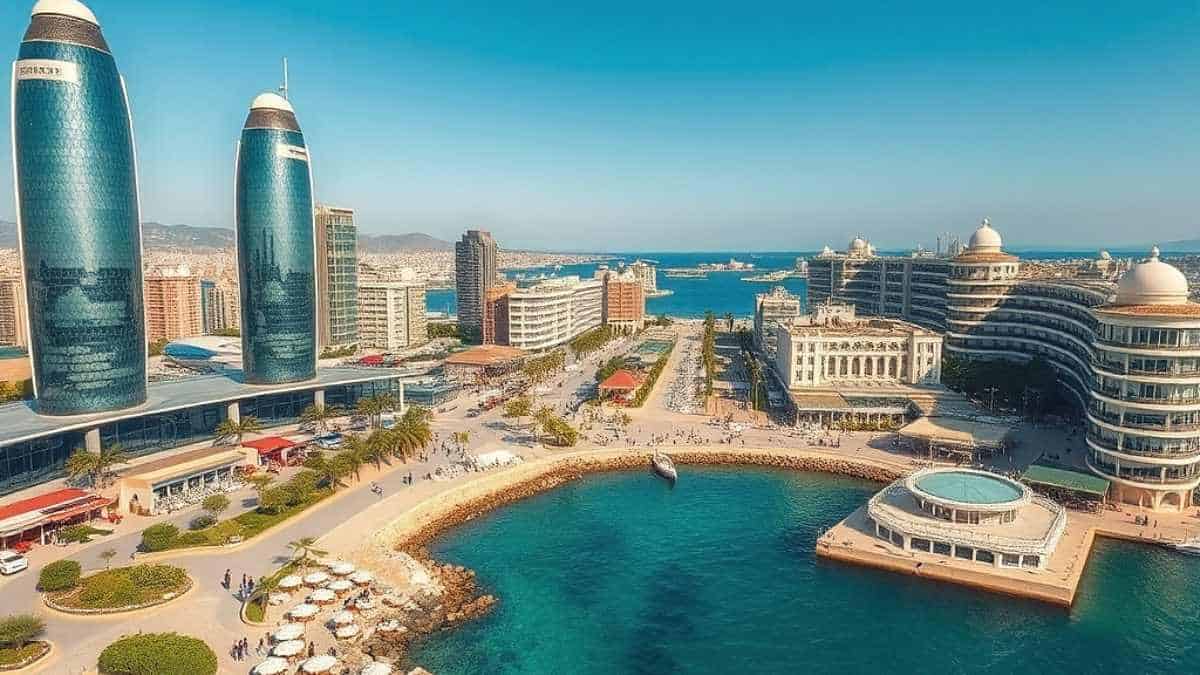
Image generated with Ai
Eurobank Cyprus’s €231 Million Profit Surge has placed Limassol, Paphos, Larnaca and Nicosia Tourism Growth Under the Spotlight as the banking sector responds to evolving SME Credit Challenges. The latest financial results show that Eurobank Cyprus is in a place and this can help tourism businesses in Cyprus that are looking for people to invest in them. The big profit of 231 million euros has made people notice how important it is for a place to have money to develop and attract tourists. Cities like Limassol, Paphos, Larnaca and Nicosia are still very important for tourism and the people who own hotels, restaurants and travel companies in these cities need to be able to get loans that they can pay back. So now people are trying to make it easier for medium sized businesses to get credit, which will help the tourism industry in these cities grow. Everyone is watching to see how Eurobank Cyprus can use its financial position to help the whole economy in Cyprus and make it easier for tourism businesses to expand. As the tourism industry in Cyprus changes cities like Limassol, Paphos, Larnaca and Nicosia will still be at the center of talks about how to make it easier for businesses to get the money they need to grow and develop. Eurobank Cyprus will be a part of these talks because of its strong financial position and its ability to support tourism businesses, in Cyprus.
Eurobank’s financial strength in Cyprus has been reinforced by €231 million in adjusted net profit generated during the first half of 2026. The result has underlined the importance of the Cypriot market to Eurobank Group, with approximately 30 per cent of total adjusted net profit being contributed by operations on the island.
A substantial domestic balance sheet has also been maintained. Gross loans of €9.2 billion have been managed alongside €24.1 billion in client deposits, leaving the bank with a net loan-to-deposit ratio of well below 40 per cent in Cyprus.
Yet, the strength of Eurobank’s liquidity position has not been matched by an equally broad expansion of credit across the private economy. A 7.7 per cent year-on-year decline in adjusted profit has been recorded, while new lending growth has been moderated across Cyprus.
Advertisement
Advertisement
For the tourism and hospitality sector, a central question has therefore been raised. Considerable banking liquidity has been accumulated, but access to that capital has remained uneven for independent hotels, destination management companies, restaurants, transport providers, event suppliers, rural guesthouses and travel-technology businesses.
Eurobank’s €231 million adjusted net profit from Cyprus has demonstrated the continuing profitability of its operations. However, the result has also reflected a more normalised banking environment.
The year-on-year reduction has been shaped by the transmission of European Central Bank monetary policy. As interest rates have been reduced across the euro area, returns from interest-bearing assets have been lowered and net interest margins have been compressed.
Greater importance has consequently been placed on loan-volume growth, fee-based income and efficient use of risk-weighted assets. At the same time, strict risk-management standards have continued to be applied.
Eurobank’s position in Cyprus has been strengthened through the consolidation and majority ownership of Hellenic Bank. Through this expanded presence, a deep pool of deposits has been secured. Total deposits of €24.1 billion have been held against gross loans of €9.2 billion, reflecting a significant level of unused lending capacity.
The liquidity overhang has also been observed across the wider Cypriot banking system. Strong capital adequacy and low non-performing exposure ratios have been maintained, but lending to non-financial businesses has continued to be constrained by collateral requirements, supervisory limits and elevated operating risks.
According to data published by the Central Bank of Cyprus, pure new lending to the non-financial private sector reached €1.1 billion during the first quarter of 2026. In the same period of 2025, €1.2 billion had been recorded.
Positive growth in corporate lending has still been maintained. However, a clear moderation has been detected. Annual loan growth for non-financial corporations stood at 6.3 per cent in March 2026 after a peak of 8.2 per cent had been reached in February.
This slowdown has been linked to higher business costs, regional geopolitical uncertainty and tighter lending conditions. Corporate borrowers have been required to demonstrate stronger repayment capacity, while additional attention has been placed on industry exposure and business resilience.
A tightening of terms and conditions for enterprise loans was reported in the Central Bank of Cyprus April 2026 Bank Lending Survey. Heightened risk perceptions connected to the economic outlook were cited by participating institutions, and further tightening was projected for the second quarter.
As a result, larger companies with established assets and predictable income have generally been provided with more competitive borrowing terms. Smaller businesses have been subjected to higher collateral requirements, conservative debt-service coverage ratios and more detailed credit assessments.
Tourism has continued to be treated as an important contributor to growth in Cyprus. Economic activity has been supported by accommodation, food services, transportation and trade.
A total of 4.04 million tourist arrivals was recorded in 2024. Growth of 10 per cent was then reported through August 2025, with the United Kingdom accounting for 33.2 per cent of arrivals, Israel contributing 12.9 per cent and Poland representing 8 per cent.
Despite this demand, pressure has been placed on the operating margins of tourism businesses. Average Harmonised Index of Consumer Prices inflation had fallen to 0.8 per cent during 2025, but headline HICP inflation reached 3.0 per cent in April 2026 as international energy costs increased.
Higher expenses have subsequently been carried through transport, food services and hotel operations. Energy-intensive hospitality properties have been particularly exposed because cooling, heating, lighting, kitchens, pools and guest facilities must be operated continuously during busy periods.
Business cash reserves have also been placed under pressure. Growth in private corporate deposits slowed from 17.5 per cent in December 2025 to 12.8 per cent in March 2026, indicating that reserves were being used to absorb rising expenditure.
For city-based restaurants, hotels, attractions and event businesses, greater working capital has been required to manage payroll, utilities, supplier payments and seasonal fluctuations. For rural operators, renovation and infrastructure costs have been made harder to absorb because smaller businesses usually hold fewer liquid assets.

Image generated with Ai
Independent hotels have continued to require substantial capital for property renovation, building modernisation and energy-efficiency upgrades. Compared with many other tourism businesses, hotel owners have been placed in a stronger borrowing position because loans can be secured against real estate.
Moderate to high credit accessibility has therefore been maintained within this segment. Nevertheless, stricter underwriting conditions have been imposed.
Conservative loan-to-value ratios have been required, while debt-service coverage has been assessed against seasonal income patterns and changing energy costs. Additional personal assets may also be requested from independent owners when sufficient unencumbered collateral cannot be provided by the hotel business.
Large resort groups have generally been able to use broader corporate balance sheets to obtain more favourable terms. Smaller properties have been placed at a disadvantage because cash flows are more concentrated and refinancing options are more limited.
Green lending could be used to address part of this imbalance. Targeted facilities for energy retrofits could be paired with government efficiency grants, reducing the total debt required for upgrades and protecting long-term operating margins.
Destination management companies have been placed among the most credit-constrained tourism businesses. These companies are responsible for tour assembly, local logistics, supplier coordination and ground handling, but few fixed assets are typically owned.
Working capital is needed to cover the gap between advance payments to suppliers and later settlements from clients. However, standard lending models continue to be based heavily on physical collateral.
Long-term loans are therefore difficult to obtain. Short-term overdrafts are often used instead, leaving destination management companies exposed to variable interest rates and sudden changes in travel demand.
Similar challenges have been faced by conference and event suppliers. Capital is required for audio-visual equipment, staging systems and temporary event infrastructure, but revenue can be affected quickly by changes in corporate travel budgets or regional geopolitical conditions.
Credit lines may be provided to established event suppliers during stable periods. During weaker demand cycles, those facilities can be restricted, making long-term investment in equipment more difficult.
Pre-approved revolving credit facilities could provide greater protection. When arranged during periods of expansion, flexible funding could be accessed quickly during sudden demand disruptions without requiring a complete credit review.
Restaurants, leisure venues and visitor attractions have been affected by the combined impact of food, labour and energy costs. Hotel and restaurant prices increased by 5.4 per cent in 2025, but higher consumer prices have not automatically been converted into stronger profit margins.
Food-service businesses are often assessed as higher-risk borrowers because asset-recovery values are limited and business failure rates can be elevated. Equipment, interiors and kitchen installations may lose value quickly once a business has stopped trading.
Access to financing is consequently restricted in many cases to short-term equipment leasing. Personal guarantees may also be required from business owners.
Urban tourism businesses can be particularly exposed to rent, utility and wage costs. When demand is concentrated around holiday seasons, conferences or events, cash-flow gaps can be created between high-expense and high-revenue periods.
The availability of flexible working capital could allow these companies to retain employees, maintain service standards and invest in visitor experiences during slower months.
Coach and transfer operators have been provided with comparatively stronger access to commercial borrowing because vehicles can be used as collateral.
Fleet replacement, maintenance and the transition towards zero-emission transport have created substantial capital requirements. Commercial lenders have been more willing to provide equipment financing because buses and coaches retain a secondary-market value.
However, higher purchase prices for electric vehicles and increased import costs have placed additional pressure on repayment capacity. Smaller transport providers can therefore remain vulnerable even when asset-backed facilities are available.
A combination of equipment finance and public green-energy support could be used to reduce the debt burden. Lower initial borrowing requirements would allow fleet upgrades to be completed without placing excessive pressure on seasonal cash flows.
Travel-technology companies have faced some of the most significant structural barriers in the commercial lending market. Their value is often held in software, booking platforms, data systems, property-management tools and intellectual property rather than property or machinery.
These intangible assets are difficult to value under conventional banking models. As a result, low commercial debt accessibility has been experienced by travel-technology startups and growing digital businesses.
Greater reliance has been placed on venture capital, private equity and public funding. Under the Horizon Europe framework, Cypriot companies can access the European Innovation Council Accelerator 2026 call.
Grant funding of up to €2.5 million can be provided, with up to 70 per cent of eligible technology demonstration and commercialisation costs being covered. Optional equity investment can also be accessed.
Through this structure, software research and product development can be funded without excessive debt being added at an early stage. A stronger financial profile can then be presented when supplementary bank finance is required for expansion.

Image generated with Ai
Traditional guesthouses, craft businesses and agritourism operators have been used to diversify the visitor economy beyond established urban and coastal areas. However, these enterprises have frequently been excluded from standard bank finance.
Many rural loan requests are valued at less than €150,000. For large commercial institutions, fixed legal, valuation and administrative costs can make smaller applications less attractive.
Rural businesses may also hold heritage properties that are difficult to value, while seasonal income can limit their ability to meet conventional repayment thresholds.
Greater dependence has therefore been placed on government subsidies, European structural funding and targeted tourism grants. Schemes managed by the Deputy Ministry of Tourism have been designed to support the upgrading of tourist accommodation and the creation of authentic visitor experiences in rural and remote areas.
Capital support can be provided directly to guesthouse operators and traditional businesses that would struggle to obtain normal bank facilities.
A practical route between Eurobank’s liquidity and the capital needs of tourism SMEs can be created through public-private risk sharing.
The Research and Innovation Foundation manages competitive funding schemes covering up to 85 per cent of eligible project costs. The Fast Track Innovation Programme has been allocated €2 million to support established enterprises adopting new technologies and operational processes.
Support has also been provided through programmes managed by the Ministry of Energy, Commerce and Industry. SME competitiveness, youth and female entrepreneurship, and green-energy upgrades have been targeted.
When non-repayable grants cover between 50 and 85 per cent of a project’s initial cost, the amount that must be borrowed is substantially reduced. Lower loan-to-value ratios can then be achieved, while debt-service obligations are made more manageable.
Approved grants could also be recognised as qualified equity within commercial underwriting processes. By being integrated into risk assessments, public funding could be used to improve creditworthiness and shorten loan approval periods.
Eurobank’s €231 million adjusted net profit shows that financial strength is still present in the banking sector. Its €24.1 billion deposit base and €9.2 billion gross loan portfolio also show that there is still a lot of liquidity
It is not enough to rely on liquidity to ensure growth in the tourism sector. Credit needs to be designed in a way that matches the operating models that exist in accommodation, transport, technology, food services, events and rural tourism.
Property-backed hotels and vehicle operators are expected to have access to finance. Asset-light destination management companies, travel-technology developers, event suppliers and small businesses will still have difficulties unless guarantees and public grants are included in the lending decisions.
If Eurobank works with national support programs its balance sheet strength could be used for more useful tourism investments. Energy improvements could be funded rural accommodation could be updated digital services could be. Businesses in cities that serve tourists could get more flexible working capital.
The banking system in Cyprus has arrived at a point where stability’s already in place. The next step will depend on whether that stability can be turned into access to finance, for the businesses that help the island’s tourism economy.
Advertisement
Tags: credit access for hospitality SMEs, Cyprus banking, cyprus tourism, Cyprus tourism business loans, Eurobank
Advertisement
Advertisement













Saturday, September 5, 2026

Friday, September 4, 2026

Saturday, September 5, 2026

Saturday, September 5, 2026

Thursday, September 3, 2026

Wednesday, September 2, 2026

Saturday, September 5, 2026