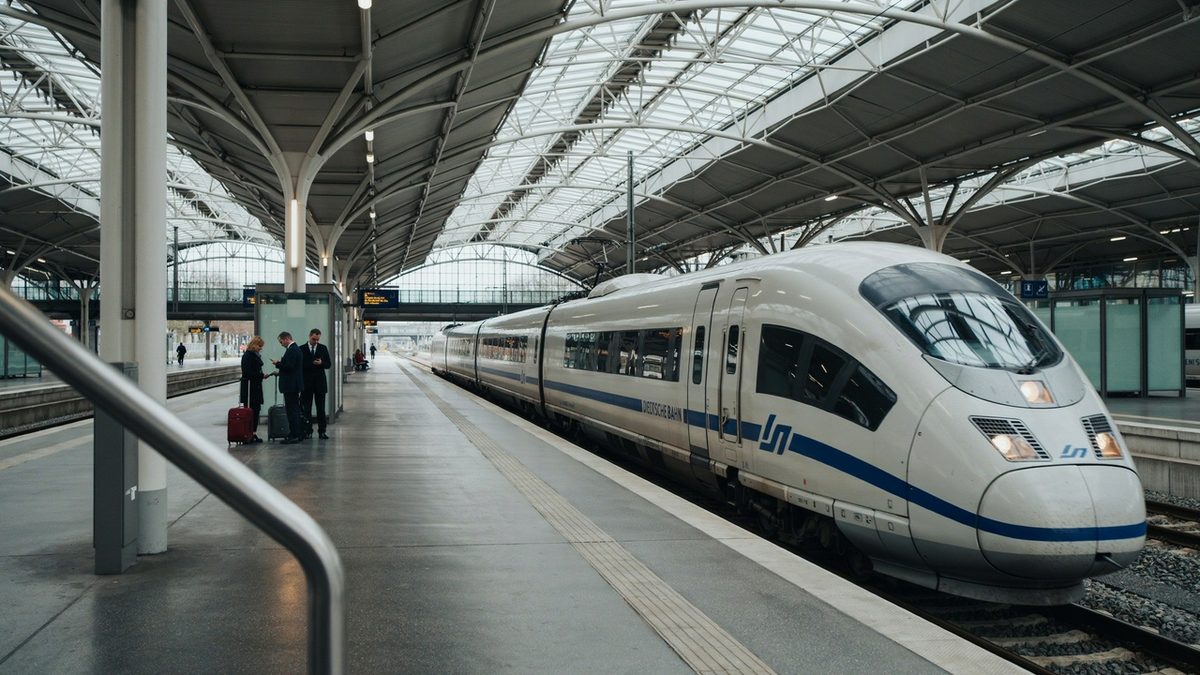
Image generated with Ai
Germany Belgium direct ICE travel will grow a lot from 7 September 2026. A new Deutsche Bahn train will run from Cologne to Antwerp stopping at Aachen, Liège, Leuven and Brussels Airport. Two trains will run each day. This gives choices for people who travel for work, holidays or to catch a flight. Brussels Airport will get its direct ICE link and Leuven will link straight to Germany. Using ICE 3neo trains the journey is part of a big plan to make rail travel across borders stronger to help people combine train and other travel and to make trips, in Europe easier.
Cross-border rail travel between Germany and Belgium is set to gain an important new link in September 2026. Deutsche Bahn has scheduled a new direct ICE service between Cologne and Antwerp, extending international high-speed connectivity beyond the established German connections with Brussels.
Advertisement
The planned service is due to begin on 7 September 2026. According to Deutsche Bahn’s published timetable information available before 4 August, trains will operate from Köln Hauptbahnhof through Aachen, Liège, Leuven and Brussels Airport before reaching Antwerp. Two daily train pairs are planned, meaning two services in each direction.
That routing is particularly significant because it is not simply another service between two established international rail terminals. It creates direct ICE access for several strategically important points along the German-Belgian corridor.
Advertisement
For Antwerp, the connection provides a direct ICE link towards Cologne. For Leuven, it creates direct long-distance connectivity with Germany. Most notably, Brussels Airport is scheduled to become directly connected to Deutsche Bahn’s ICE network.
The development therefore combines three different travel markets within one service: conventional international city-to-city rail journeys, regional cross-border movements and air-rail connections.
This broader function gives the Germany Belgium direct ICE service significance beyond its two terminal cities. Instead of requiring every international passenger to travel through central Brussels, the new routing creates additional opportunities for travellers whose final destination is elsewhere in Belgium or whose journey continues by air.
The new service is designed around a relatively straightforward international corridor:
Advertisement
Advertisement
Cologne → Aachen → Liège → Leuven → Brussels Airport → Antwerp
Each stop gives the route a distinct travel function.
Cologne will serve as the German terminus of the new connection. Its position within Germany’s long-distance railway system means passengers will be able to use the city as a gateway between Belgium and other parts of the German network.
Cologne already occupies an important position in European rail connectivity. European Commission information on Germany’s rail corridors identifies the Cologne area as part of major European transport infrastructure, with international routes extending towards Germany’s western borders and other European markets.
For international travellers, this matters because a Cologne-Antwerp train does not function only as transport between those two cities. Connections available through the wider German railway network can extend the practical reach of the service.
The route also strengthens the existing rail relationship between Germany and Belgium rather than creating cross-border rail travel from scratch. Deutsche Bahn already operates ICE services between Germany and Brussels, and during summer 2026 it introduced additional Belgian services, including an ICE reaching the Belgian North Sea coast on selected weekends.
The Antwerp connection represents another expansion of that cross-border network.
After Cologne, trains are scheduled to call at Aachen, one of Germany’s most important rail gateways towards Belgium.
Aachen’s geographical position close to the Belgian and Dutch borders gives it particular importance for international passenger transport. Under the planned service, travellers boarding in Aachen will gain direct access not only to Belgian destinations but also to Brussels Airport.
This matters for passengers who might otherwise need to change trains during an airport journey.
The route therefore strengthens Aachen’s role as more than an intermediate station. It becomes part of an integrated rail-air corridor connecting western Germany with Belgium’s principal international airport.
The service will then continue to Liège, preserving the importance of the eastern Belgian city within cross-border rail travel.
Liège already sits on the established international railway axis between Germany and Brussels. Including it on the new Cologne-Antwerp service means passengers in the city will gain another direct travel option towards Germany while also receiving direct access towards Leuven, Brussels Airport and Antwerp on these trains.
That creates a useful east-west link across Belgium without forcing passengers to route every journey through Brussels’ principal city-centre stations.
For tourism and business travel, such direct connections can simplify itineraries because they reduce the number of required transfers. However, the actual effect on passenger demand will only become measurable after operations begin, so no future ridership increase should be assumed before official data become available.
One of the more notable elements of the new timetable is the inclusion of Leuven.
The Belgian city is scheduled to receive direct ICE connectivity with Germany through the new service. Deutsche Bahn‘s published information specifically identifies Leuven as one of the stations on the route between Liège and Brussels Airport.
This expands the geographical reach of international high-speed rail within Belgium.
Leuven’s inclusion also illustrates an important feature of the new service: the train is designed to serve destinations beyond the traditional Brussels-centred international travel pattern.
International travellers heading to Leuven will be able to remain on the same ICE from Cologne or Aachen rather than relying on a transfer elsewhere in Belgium. Likewise, passengers starting in Leuven will have direct access towards western Germany on the scheduled trains.
For visitors, direct rail access can make trip planning simpler. It reduces interchange requirements, limits the need to navigate unfamiliar stations and can make luggage-heavy journeys easier.
Those practical advantages are especially relevant in international travel, where passengers may already be combining several transport stages.
The most distinctive feature of the planned Germany Belgium direct ICE connection is its call at Brussels Airport.
Deutsche Bahn’s pre-launch announcement stated that the airport would receive its first direct connection to the ICE network when the service begins. The route is scheduled to provide two daily train pairs between Cologne and Antwerp via the airport.
That changes the journey proposition for travellers from western Germany.
Instead of treating rail and aviation as completely separate modes of transport, the new connection is designed to support an integrated journey in which the train can function as the surface transport stage of an international flight itinerary.
This is where the service extends beyond conventional railway expansion.
A traveller from Cologne or Aachen flying through Brussels Airport may be able to use the international train instead of driving to the airport or constructing a rail journey involving additional changes. The direct ICE stop consequently strengthens the airport’s accessibility from the German market.
It also fits a broader European policy direction favouring better integration between transport modes and easier international journeys.
The new route was announced alongside cooperation between Deutsche Bahn and Brussels Airlines designed around combined rail-and-flight travel.
Official pre-launch material described a codeshare arrangement covering Cologne, Aachen, Liège and Brussels Airport, intended to make the train-to-flight connection more attractive.
The concept is important because airports do not depend solely on local passengers. Major aviation hubs draw travellers from wider catchment areas, and rail can expand that accessible market without requiring every passenger to reach the terminal by road or short connecting flight.
For travellers, integrated transport can also reduce the friction associated with organising separate parts of a journey.
The European Commission has identified precisely this type of fragmentation as a broader problem in European passenger transport. In May 2026, it proposed a Passenger Package intended to make regional, long-distance and cross-border journeys easier to plan and book, particularly where multiple operators or transport services are involved.
The Commission’s proposals seek to improve the ability of passengers to compare and purchase journeys while strengthening protection where different rail operators are involved.
The Cologne-Brussels Airport connection is not itself the result of those proposed rules, but its multimodal structure demonstrates why integrated booking and cross-border passenger rights have become increasingly important policy issues.
The rolling stock is another important component of the project.
Deutsche Bahn has indicated that the ICE 3neo will operate on the cross-border route. The trains were already being used on Germany-Belgium services before the Antwerp launch, including ICE connections between Frankfurt, Cologne and Brussels.
The use of modern rolling stock is relevant because international services have demanding operational requirements. Trains must function across different national railway systems while providing the reliability and passenger facilities expected on long-distance routes.
For travellers, the significance is straightforward: the Antwerp service is being incorporated into Deutsche Bahn’s principal ICE product rather than being presented as a separate regional cross-border operation.
The ICE 3neo deployment also supports continuity across the wider Germany-Belgium timetable. Passengers familiar with existing ICE services towards Brussels will encounter the same modern train generation on the new route.
The September launch should be viewed within the broader expansion of Germany-Belgium rail links during 2026.
Deutsche Bahn scheduled additional services towards Belgium during the summer, including an ICE connection from Cologne and Aachen to the Belgian coast on selected weekends. The train served Ghent, Bruges and Ostend, providing direct German ICE access to important Belgian visitor destinations.
Deutsche Bahn described the summer Ostend service as the ninth daily train pair between Germany and Belgium during its operating periods. Tickets for the forthcoming Antwerp service were also already available through DB sales channels before its September start.
This sequence shows that the Antwerp route is part of a broader pattern of expanding direct international passenger options.
The Belgian coast service addresses leisure demand. Existing Brussels trains serve established capital-to-capital and business travel patterns. The new Antwerp route adds another major Belgian city while introducing direct airport access.
Together, these developments broaden the range of journeys that can be completed directly by ICE between Germany and Belgium.
For Antwerp, the new connection carries particular importance because the city becomes the Belgian terminus of the service.
Passengers will be able to travel directly towards Cologne through Brussels Airport, Leuven, Liège and Aachen without changing trains.
From a tourism perspective, this creates a simpler arrival option for German visitors travelling to Antwerp by rail. From a business perspective, it provides another direct international link between one of Belgium’s principal economic centres and western Germany.
Antwerp is also positioned within a much larger European transport geography. Belgium and Germany form part of major EU transport corridors designed to strengthen connectivity between ports, urban centres, industrial regions and neighbouring states.
The European Commission’s transport framework identifies Belgium and Germany within the North Sea-Baltic transport corridor, which connects western European transport nodes with markets further east and north.
The passenger ICE service should not be confused with the entire TEN-T infrastructure programme, but its cross-border character is consistent with the EU’s wider objective of improving international railway connectivity.
The timing of the new route is especially notable because 2026 has also brought important changes to European railway policy.
In June 2026, the European Union adopted new rules governing the use of railway infrastructure capacity. The framework aims to improve coordination across national borders, make better use of congested infrastructure and create a more harmonised approach to capacity planning.
According to the European Commission, fragmented national capacity-management procedures have historically created difficulties for international rail operations. The new system is intended to support smoother cross-border services, improve reliability and enable infrastructure to be used more efficiently.
The first optimised timetable under the new framework is expected to take effect in December 2030, meaning the regulation should not be portrayed as the immediate cause of the September 2026 Cologne-Antwerp service.
Nevertheless, the policy direction is clear.
Europe is seeking more international rail services, better coordination between infrastructure managers and simpler passenger journeys across borders.
The Germany Belgium direct ICE expansion therefore arrives at a time when cross-border rail is becoming an increasingly prominent component of European transport policy.
The route also fits into a longer-term European ambition to strengthen high-speed passenger rail.
The European Commission’s high-speed rail action plan, published in November 2025, set out measures intended to reduce journey times, address barriers to international services and improve the competitiveness of rail. The plan is built around the trans-European transport network and includes measures concerning cross-border ticketing, infrastructure capacity, interoperability and rolling stock.
In 2026, the Commission also moved forward with proposals designed to make cross-border travel easier to purchase.
This matters because infrastructure alone does not determine whether international rail works effectively for passengers.
A railway may physically cross a border, but travellers also need understandable timetables, accessible booking systems, coordinated connections and clear passenger protections. The Commission’s policy work increasingly addresses those less visible barriers.
Against that backdrop, the new Cologne-Antwerp service provides a practical example of how international rail networks are extending beyond traditional capital-city connections.
Its scheduled stops at Aachen, Liège, Leuven and Brussels Airport create multiple journey combinations within a single direct service.
For travellers, that may prove to be the route’s most meaningful characteristic: it is not merely connecting Germany with Belgium. It is connecting a chain of cities, an international airport and two national rail networks through one scheduled ICE journey.
For passengers, the most immediate value of the Germany Belgium direct ICE lies in removing transfers from journeys that previously required greater coordination.
Deutsche Bahn’s published 2026 timetable set out two daily ICE pairs between Cologne and Antwerp from 7 September 2026. Departures from Cologne were scheduled for 06:03 and 14:26, while trains from Antwerp were planned for 11:01 and 19:01. The services were scheduled to travel through Aachen, Liège, Leuven and Brussels Airport.
Those timings create options for several distinct passenger groups.
Holidaymakers can use the service for direct travel between western Germany and Belgium. Business travellers gain another international rail option. Residents along the route receive new direct links. Air passengers can reach Brussels Airport without changing trains.
The timetable was also designed to make Antwerp accessible for day travel from Cologne. Deutsche Bahn stated when unveiling its 2026 Nordrhein-Westfalen timetable that the schedule could permit roughly a 10-hour stay in Antwerp before the return journey.
That is particularly relevant for short-break and day-trip travel, although actual demand after September will need to be assessed using passenger data rather than predicted in advance.
| Travel Detail | Officially Announced Information |
|---|---|
| Start date | 7 September 2026 |
| Route | Cologne–Aachen–Liège–Leuven–Brussels Airport–Antwerp |
| Frequency | Two daily return train pairs |
| Cologne departures | 06:03 and 14:26 |
| Antwerp departures | 11:01 and 19:01 |
| Train category | ICE |
| Key new connection | Direct ICE access to Brussels Airport |
| Major tourism market served | Germany–Belgium |
| Air-rail cooperation | Deutsche Bahn and Brussels Airlines codeshare |
| Booking status before launch | Tickets released in advance |
The frequency remains modest compared with high-frequency domestic corridors, so the new service should be viewed as an expansion of international choice rather than a replacement for the wider Germany-Belgium timetable.
Deutsche Bahn had already planned eight year-round ICE train pairs between Brussels, Aachen, Cologne and Frankfurt in its 2026 schedule. The two Antwerp pairs therefore extend an established cross-border network into additional Belgian destinations.
The new rail connection is entering a travel market where substantial cross-border demand already exists.
Belgium recorded 46,136,112 overnight stays in tourist accommodation during 2025, according to the final annual figures published by Statbel in June 2026. That represented growth of 2.9 per cent from 2024. Hotels accounted for 46 per cent of overnight stays, while international demand increased faster than the overall market.
Germany was particularly important.
Statbel recorded 3,483,633 German overnight stays in Belgium in 2025, making Germany one of the country’s largest foreign source markets. Only the Netherlands generated more nights among the individual foreign markets listed by Statbel.
The regional figures strengthen that picture.
Of those German overnight stays, approximately 2.34 million were recorded in Flanders, the region containing Antwerp. Another 576,029 were registered in Wallonia and 570,134 in the Brussels-Capital Region.
Official preliminary figures from Tourism Flanders also estimated that Flanders received about 15.4 million visitors in 2025, including 8.3 million international visitors. Germany was its second-largest international source market, with approximately 1.1 million arrivals, behind the Netherlands.
These figures provide important context.
They do not prove that the new Cologne Antwerp ICE will automatically produce additional tourism. Such a conclusion would require post-launch passenger and accommodation statistics.
They do demonstrate, however, that the railway is being introduced between markets where a large volume of travel already exists.
Antwerp’s inclusion therefore has clear strategic relevance for tourism access.
The city sits within Flanders, where Germany is already one of the most important inbound visitor markets. The direct ICE removes the need for passengers on the new trains to change in Brussels or another Belgian station before reaching Antwerp.
For destination planners, direct transport connectivity matters because accessibility forms part of the practical tourism proposition. Travellers considering a city break evaluate not only attractions and accommodation but also journey complexity, departure times and the number of connections required.
The new service addresses that accessibility dimension.
It does not change Antwerp’s tourism product itself. Instead, it changes how some travellers from western Germany can reach the city.
That distinction is important when assessing the likely tourism impact. Rail connectivity can facilitate travel, but official visitor numbers after the launch will be required before any claim can be made that it has increased arrivals, overnight stays or visitor expenditure.
Belgium entered 2026 from a strong tourism base. Statbel’s 2025 figures showed foreign overnight stays rising by 4 per cent, faster than total accommodation nights. Germany, France and the Netherlands remained particularly important neighbouring markets.
Short-term figures were less uniform. Eurostat reported that overnight stays by foreign visitors in Belgium declined by 4 per cent in the first quarter of 2026 compared with the same period of 2025.
That makes it especially important to avoid presenting the September railway launch as evidence of a tourism boom before corresponding statistical results exist.
The airport stop gives the route a second function beyond tourism between Germany and Belgium.
Deutsche Bahn confirmed that its cooperation with Brussels Airlines would allow travellers to purchase a combined train-and-flight journey in a single booking process. The announced codeshare covers the railway journey towards Brussels Airport, creating a formal connection between international rail and aviation.
DB also stated that the ICE services would be entered into common airline reservation systems, making the trains available as feeder connections and allowing tickets to be sold through airline and travel-agency distribution channels.
This represents a different model from purchasing an unrelated rail ticket and airline ticket separately.
The railway becomes part of the airport-access system.
For travellers starting in Cologne or Aachen, that means Brussels Airport becomes reachable directly by ICE on the two scheduled daily services. For travellers from Liège and Leuven, the same trains offer another direct airport option.
Brussels Airport itself handled 24.4 million passengers in 2025, according to its official annual traffic results, an increase of 3.3 per cent from 2024. Germany was among the airport’s ten largest passenger country markets.
That existing German aviation market helps explain the commercial logic behind improving surface access from western Germany.
A central feature of the planned codeshare is the attempt to treat the railway and flight as components of one journey.
Deutsche Bahn’s official announcement emphasised a combined train-to-flight product rather than simply promoting a train that happens to stop at an airport.
That matters because multimodal journeys can become complicated when passengers are required to manage separate operators, tickets, connections and conditions of carriage.
European policymakers have identified exactly this issue.
In May 2026, the European Commission proposed its Passenger Package, designed to simplify planning and booking for regional, long-distance and cross-border journeys, particularly where different operators are involved. The proposal includes measures aimed at enabling passengers to purchase journeys involving several rail companies as a single ticket and strengthening protection throughout the trip.
The Cologne-Brussels Airport codeshare should not be described as being created by that proposal. The DB partnership was announced separately.
Instead, it illustrates the same broader challenge: travellers increasingly combine different modes, while ticketing and passenger protection systems must keep pace.
Travellers using the new ICE will also operate within the wider framework of EU rail passenger rights.
Regulation (EU) 2021/782 has applied since 7 June 2023 and covers passenger protection across much of the European rail system.
Under EU guidance, passengers must receive information concerning timetables, fares, disruptions, accessibility and relevant passenger rights.
Where a train is expected to reach its destination at least 60 minutes late, passengers can have rights involving reimbursement, continuation or rerouting depending on the circumstances. Compensation can generally amount to 25 per cent of the ticket price for delays between one and two hours and 50 per cent for delays exceeding two hours, subject to the applicable conditions and exceptions.
Passengers combining air and rail should nevertheless check the precise conditions applying to their booking because protection can depend on how the journey has been contracted and ticketed.
The code share’s value therefore extends beyond convenience. Integration of transport products can affect how passengers manage disruptions and connections.
The Cologne-Antwerp expansion is also arriving during a period of strong European rail usage.
Eurostat reported that passengers made approximately 8.7 billion rail journeys across the EU in 2024, covering 444.5 billion passenger-kilometres. Germany and France recorded the largest passenger-kilometre totals among the countries reported.
A separate Eurostat assessment found that approximately 150 million passengers made international rail journeys in 2024, travelling about 23 billion passenger-kilometres on the national-network portions captured by the data.
These statistics show that cross-border rail remains smaller than domestic rail in absolute terms but already represents a substantial European mobility market.
Deutsche Bahn has also been expanding its own international timetable.
Its 2026 programme involved around 40 new or extended cross-border journeys per day across connections involving countries including Belgium, Poland, Denmark, Switzerland and the Czech Republic. The Cologne-Antwerp service forms one part of that broader strategy.
Environmental policy provides another layer of context.
The European Commission’s rail-market monitoring work reported that rail accounted for approximately 0.3 per cent of EU transport-related greenhouse gas emissions in 2022, despite carrying 8.1 per cent of passengers and 16.6 per cent of freight.
More recent European Environment Agency analysis similarly identified rail as the lowest absolute contributor of transport greenhouse gas emissions, accounting for around 0.3 per cent of direct EU transport emissions in 2023.
Those figures do not mean every individual train journey has the same environmental footprint, nor should they be used to calculate an unsupported emissions saving for the Cologne-Antwerp route.
They do explain why the EU continues to prioritise rail within its transport decarbonisation strategy.
The revised Trans-European Transport Network framework also gives particular attention to airport connectivity. European Commission guidance states that major airports handling more than 12 million passengers annually are expected to be connected to long-distance rail under TEN-T requirements.
Brussels Airport’s new ICE stop is therefore aligned with a broader European policy objective of improving connections between major airports and long-distance rail networks.
The European Commission’s high-speed rail plan, published in November 2025, set out an ambition to make international train journeys faster and easier while improving European competitiveness and supporting climate objectives.
The plan focuses on infrastructure, cross-border services, regulatory conditions and stronger coordination.
Separately, revised rules for rail infrastructure capacity seek to improve coordination between national networks.
These measures are particularly relevant to international trains because a cross-border service must operate across infrastructure managed under different national systems.
The Cologne-Antwerp ICE is a comparatively short international route, but it reflects the wider European objective: fewer borders should function as practical barriers to passenger rail.
For travellers, those policy discussions ultimately matter only when they produce usable services.
The September route is one such tangible change.
Passengers planning to use the service after its scheduled launch should verify their journey shortly before departure.
International rail timetables can be affected by infrastructure works, operational changes or other disruption. Deutsche Bahn and SNCB provide official journey-planning information, while EU passenger-rights rules require operators to provide relevant disruption information.
Travellers combining the ICE with a flight should pay particular attention to whether they are purchasing the codeshare product or separate tickets.
That distinction can affect booking conditions and connection arrangements.
Passengers should also confirm:
The officially announced timetable should not replace a live journey check on the day of travel.
The significance of the service is ultimately found in its structure.
It links two German and four Belgian travel points through a single international ICE operation. It connects a German metropolitan rail hub with Aachen’s border region, Liège, university-centred Leuven, a major international airport and Antwerp.
That produces several overlapping travel markets rather than one simple end-to-end flow.
A Cologne resident can travel to Antwerp.
An Aachen passenger can reach Brussels Airport.
A Leuven traveller gains a direct ICE towards Germany.
An Antwerp passenger can travel towards Liège and western Germany without changing trains.
An airline passenger can combine rail with an international flight.
This network effect helps explain why the service is more strategically interesting than its frequency of two daily pairs might initially suggest.
The future of Germany-Belgium high-speed rail should nevertheless be assessed cautiously.
Deutsche Bahn has identified strong demand for international services and has expanded cross-border capacity during 2026. Belgium also receives substantial tourism demand from Germany, while European institutions continue to promote stronger rail connectivity.
Those conditions establish a supportive background.
They do not establish the commercial performance of a service that, as of the 4 August 2026 verification cut-off, had not yet begun operating.
Important post-launch indicators will eventually include passenger numbers, load factors where published, punctuality, airport-connection usage and any future timetable changes. Tourism statistics may also show changes in German arrivals or overnight stays, but even then direct causality should not be assumed without supporting evidence.
For now, the confirmed development is straightforward: two daily ICE train pairs are scheduled to open a new direct Cologne-Antwerp corridor through Brussels Airport from 7 September 2026.
The Germany Belgium direct ICE service will begin on 7 September 2026.
The Germany Belgium direct ICE service creates a timetable that covers city travel, airport access and international rail.
Germany is a visitor market for Belgium and EU policy backs interoperable rail so the Germany Belgium direct ICE service is very important.
Still we must measure how the Germany Belgium direct ICE service will affect business and tourism after launch.
For travellers the Germany Belgium direct ICE service brings changes: two daily train pairs, fewer transfers and a new direct ICE gateway to Brussels Airport.
[Source:- Railway PRO]
Advertisement
Advertisement
Advertisement












Wednesday, September 9, 2026

Wednesday, September 9, 2026

Wednesday, September 9, 2026

Wednesday, September 9, 2026

Wednesday, September 9, 2026

Tuesday, September 8, 2026

Wednesday, September 9, 2026

Wednesday, September 9, 2026