
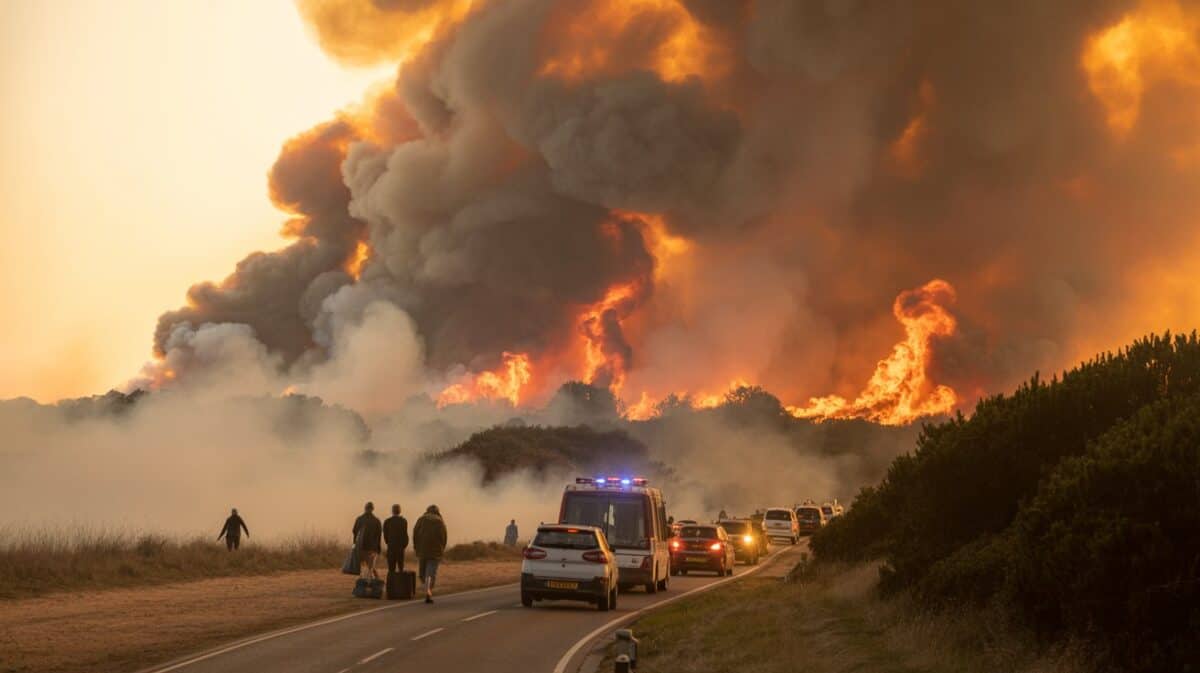
Image generated with Ai
A fast-moving Suffolk Wildfire has thrown UK travel into chaos along the popular coast, forcing holidaymakers and residents to flee accommodation around Dunwich Heath overnight. The rapidly spreading fire sparked a major emergency because of its size, speed and operational complexity. Cliff House Holiday Park, Coastguard Cottages, Mount Pleasant Farm and nearby coastal areas have experienced the most direct disruption.
Although the emergency has severely affected local tourism, its impact remains geographically limited. Visitors face accommodation uncertainty, attraction closures, smoke and possible access restrictions. However, the fire has caused no changes to UK visa, passport or border rules. Authorities have also confirmed no related nationwide flight or international rail disruption.
Advertisement
The official county incident record lists the outbreak at 5pm on 29 July 2026. Other contemporary accounts placed the first emergency call shortly after 5.30pm. The small difference likely reflects separate incident recording and reporting times. The fire spread rapidly through forest and heathland towards St James’ Church, near Westleton Road. Strong winds pushed the flames across dry vegetation and made the direction difficult to control. Emergency teams consequently upgraded the event to a major incident. This status reflected the fire’s size and complexity rather than any national security concern.
Fourteen fire appliances attended the scene during the initial operation. Approximately 70 firefighters remained there by 10.30pm. Later operational information indicated that the deployment had risen to around 90 firefighters. These figures represent changing staffing levels during the response. They do not provide a fixed total for the entire incident. Relief crews arrived after midnight and divided the fireground into operational sectors. This structure allowed teams to protect properties, examine fire behaviour and continue work through darkness. The operation remained active into the morning of 30 July.
Advertisement
Advertisement
Emergency teams concentrated on Coastguard Cottages, Mount Pleasant Farm and Cliff House Holiday Park. These locations faced the most immediate threat from the spreading fire and smoke. Officials prepared for the possible evacuation of around 200 caravans at the holiday park. The wording of that update requires careful interpretation. It described preparations for a potential evacuation involving approximately 200 caravans. It did not initially confirm that exactly 200 caravans had already been cleared. Later reports sometimes presented the planning figure as a final evacuation total.
An official update at 6am confirmed that every person requiring evacuation had left safely. However, the update did not publish a verified number of people or caravans evacuated. Displaced holidaymakers and residents received instructions to attend Westleton Village Hall from 8am. The hall provided a central location for information and temporary assistance. Some visitors therefore faced an unexpected night away from their booked accommodation. Others needed confirmation before returning to cottages, caravans or nearby properties. The emergency interrupted holidays during a busy summer travel period along the Suffolk coast.
The available official information shows a large but local emergency. It confirms extensive firefighting activity, successful evacuations and direct disruption around Dunwich Heath. It does not establish widespread disruption across Suffolk or the wider United Kingdom. The following table separates confirmed information from its relevance to travellers.Category Verified development Importance for travel and tourism Incident date The fire began on 29 July 2026 Visitors should check updates carrying clear dates and times Recorded time The official incident log lists 5pm Reports citing 5.30pm may reflect the emergency call time Emergency response Fourteen fire appliances attended Emergency vehicles require clear local roads Firefighting personnel Updates recorded approximately 70 to 90 firefighters The scale indicates a substantial and continuing operation Specialist resources Teams used drones, Unimogs and four-wheel-drive quad bikes The terrain required equipment suited to heathland and forest Protected properties Three nearby accommodation locations received direct protection Guests may face evacuation, delayed access or cancelled stays Caravan preparations Plans covered the potential evacuation of around 200 caravans This was a planning estimate, not a confirmed final count Evacuation result All affected individuals were evacuated safely No official total of evacuees was published Visitor assistance Displaced people were directed to Westleton Village Hall The hall provided updates and temporary support Nuclear facility Officials reported no current risk to Sizewell B The emergency did not become a nuclear safety incident Border arrangements No visa, passport or border changes were announced International visitors retain their normal travel conditions
The table demonstrates that local access and accommodation remain the central travel issues. It also clarifies the reported ratio between firefighting resources and operational demand. Fourteen appliances supported a workforce ranging from approximately 70 to 90 firefighters. That equals roughly five to six firefighters for each appliance. However, this ratio only provides operational context. It does not describe how teams were assigned across vehicles, sectors or specialist equipment.
Dunwich Heath forms an important part of Suffolk’s nature-based visitor economy. The area supports walking, birdwatching, coastal recreation and family activities. Its heathland contains rare vegetation and several sensitive wildlife habitats. Visitors normally explore marked trails through heath, grassland and woodland. The main routes range from approximately one mile to three miles. Late July also begins the main heather-flowering period, which usually continues into September. The emergency therefore arrived during an important seasonal period for nature visits.
The official visitor information page confirmed that Dunwich Heath closed while emergency work continued. This closure interrupted access to trails, visitor facilities, coastal viewpoints and scheduled summer activities. A reopening time had not been confirmed within the verified emergency updates. Nearby RSPB Minsmere contains reedbeds, coastal lagoons, wet grassland, heathland and vegetated shingle. However, the reviewed emergency notice did not confirm an evacuation or closure there. Visitors should therefore check each attraction independently. Proximity to the fire does not automatically prove that every nearby reserve or coastal site has closed.
Travellers with bookings around Dunwich, Westleton or the immediate coastal area should confirm arrangements before departure. Mapping applications and older tourism listings may not show live emergency restrictions. Visitors should prioritise direct accommodation updates and current public safety notices. They should not travel towards the fire simply to check conditions personally.
These precautions support both visitor safety and emergency access. They also reduce the risk of travellers arriving at closed accommodation or attractions. Holidaymakers staying farther along the Suffolk coast should not assume that their plans face automatic cancellation. The verified disruption concerns the emergency area around Dunwich Heath and nearby properties.
Sizewell B lies only a few miles from the affected area. Its proximity attracted considerable attention during the emergency. At 7.30am on 30 July, officials reported no current risk to the facility. They based that assessment on the distance and the fire’s easterly movement. However, they also described the situation as live and dynamic. That qualification means later updates remain important whenever wind direction or fire behaviour changes.
No authority announced an evacuation, shutdown or safety event at Sizewell B. Travellers should therefore avoid describing the wildfire as a nuclear emergency. The incident also has no established connection with immigration policy. No new UK visa restrictions have followed the fire. No passport validity rules have changed. Authorities have announced no related border closures or additional health documents. International visitors already staying in Suffolk remain subject to their usual entry conditions. The wildfire only affects local safety, accommodation, roads and attraction access.
Emergency teams will continue assessing fire behaviour, affected ground and nearby properties. Their immediate priorities include controlling the fire, preventing renewed spread and protecting access routes. Drones can help identify hotspots and examine areas that remain difficult to reach. Ground crews may continue working after visible flames decline. Heathland fires can retain heat below vegetation and within dry organic material. Therefore, the absence of large flames does not automatically make the landscape safe for visitors.
Travellers should watch for three confirmed types of update. The first concerns the operational status of the fire. The second concerns access to evacuated accommodation. The third concerns the reopening of Dunwich Heath and its visitor facilities. Any environmental assessment will require inspection after emergency teams secure the area. No official damage total or reopening timetable was available within the checked data. Until authorities publish further information, visitors should avoid the affected zone and maintain direct contact with accommodation providers.
Advertisement
Tags: chaos, Dunwich Heath, emergency, holidaymakers, UK Travel
Advertisement
Advertisement













Saturday, September 5, 2026

Friday, September 4, 2026

Saturday, September 5, 2026

Thursday, September 3, 2026

Wednesday, September 2, 2026

Saturday, September 5, 2026

Saturday, September 5, 2026