

Image generated with Ai
Delta Air Lines Flight DL5287 From Jackson to Atlanta Diverts to Birmingham, United States: What Travel Updates You Need to Know on 27 July 2026! Unexpected airborne delays forced a sudden regional jet reroute. Here is what happened in mid-air!
Why did Delta Air Lines Flight DL5287 From Jackson to Atlanta Diverts to Birmingham, United States? What Travel Updates You Need to Know on 27 July 2026 starts with sudden operational disruption over busy Southern airspace. Air traffic controllers unexpectedly routed the regional jet away from its destination hub following localized airspace congestion. The crew acted swiftly, executing standard safety protocols by altering their primary navigation track. Passengers on board experienced an immediate course change as pilots safely directed the aircraft toward Alabama. Official aviation updates subsequently confirmed the unscheduled arrival, prompting ground personnel to coordinate immediate passenger assistance and onward routing.
Advertisement
Delta Air Lines flight DL5287, operated by regional carrier Endeavor Air from Jackson–Medgar Wiley Evers International Airport (JAN) to Hartsfield-Jackson Atlanta International Airport (ATL), was diverted to Birmingham–Shuttlesworth International Airport (BHM) in Alabama. The Bombardier CRJ-900 jet, carrying registration N906XJ, altered its flight path after air traffic congestion and holding patterns over Atlanta made an immediate landing unsafe within standard fuel reserve margins.
Flight diversions occur when unexpected environmental or technical circumstances prevent an aircraft from completing its journey to the scheduled destination airport safely. For flight DL5287, heavily congested air corridors and severe convective summer storms over the Atlanta metropolitan area triggered airborne holding patterns that significantly delayed incoming regional traffic.
Advertisement
Advertisement
Because commercial airliners operate under strict Federal Aviation Authority and international regulations governing mandatory fuel buffers, pilots must maintain enough fuel to reach an alternative airfield plus an additional emergency reserve margin. When air traffic control informed the flight crew that holding times over Hartsfield-Jackson would exceed their remaining usable fuel capacity, the captain elected to divert to nearby Birmingham to ensure complete operational safety.
The flight was operated using a Bombardier/Mitsubishi CRJ-900LR twin-engine regional jet carrying the aircraft registration tail number N906XJ. Operated by Endeavor Air on behalf of Delta Connection, this 76-seat jet plays a vital role in connecting smaller regional hubs like Jackson, Mississippi to primary global airports like Atlanta.
While smaller than mainline narrow-body airliners like the Airbus A320 family, regional jets are built with modern navigational systems and safety equipment that handle weather diversions seamlessly. However, because regional aircraft carry smaller overall fuel capacities than large international jetliners, flight crews must strictly monitor fuel burn rates and execute diversion procedures earlier during prolonged holding delays.
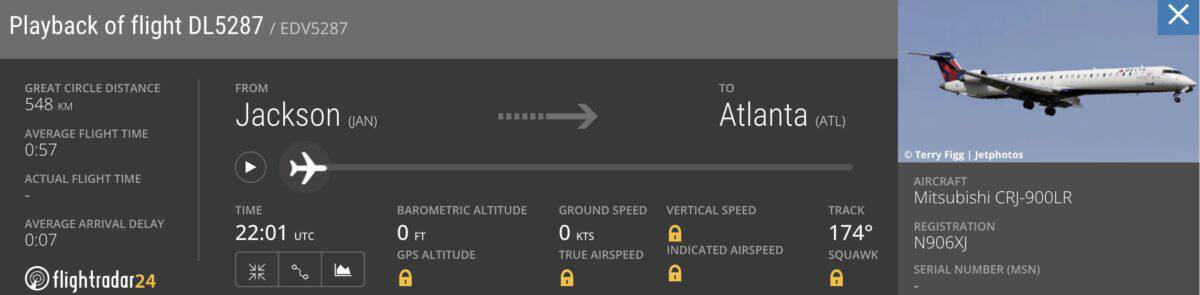
Image generated with Ai
Birmingham–Shuttlesworth International Airport serves as one of the major designated alternate airports for commercial flights heading toward Hartsfield-Jackson Atlanta International Airport. Located approximately 135 nautical miles west of Atlanta, Birmingham offers an expansive runway infrastructure capable of accommodating regional jets alongside larger commercial aircraft without bottlenecking local airspace.
Advertisement
Advertisement
During severe weather events over Georgia, air traffic controllers routinely route incoming regional traffic toward Birmingham because of its extensive ground services, emergency response readiness, and quick turnaround capabilities. This strategic proximity allows airlines to land safely, refuel their aircraft efficiently, and await a cleared departure window once conditions over the primary hub begin to improve.
When an airliner lands at an alternate destination, ground support teams and flight crews immediately coordinate to minimise disruption and maintain passenger comfort. Ground crews in Birmingham assess whether the aircraft can undergo a rapid refuelling process while passengers remain on board or if a complete disembarkation into the terminal building is necessary based on expected ground delay times.
Airlines prioritise re-establishing a clear flight plan to the original destination as soon as weather conditions clear and air traffic restrictions lift over the hub. Throughout the diversion process, passenger care protocols ensure that travellers receive updated flight status communications, refreshed cabin amenities, and revised connecting flight arrangements once their journey onward to Atlanta resumes.
Severe atmospheric conditions and air traffic congestion around Atlanta created extensive holding queues, forcing flight crews to reassess remaining fuel endurance. Commercial aviation rules mandate strict minimum reserve fuel levels, meaning pilots cannot remain indefinitely in holding patterns without an immediate landing option. Because the regional jet faced extended delays, the captain activated standard diversion procedures to maintain complete operational safety. Birmingham provided an ideal alternate airfield owing to its proximity, long runways, and rapid refueling support. Consequently, crew decisions directly prioritised passenger security, landing smoothly in Alabama while awaiting updated flight clearance to resume their journey toward Georgia.
Understanding why Delta Air Lines Flight DL5287 From Jackson to Atlanta Diverts to Birmingham, United States: What Travel Updates You Need to Know on 27 July 2026 highlights the vital role safety protocols play in modern aviation. Unscheduled landings remain standard preventative measures whenever destination weather or congestion threatens normal schedules. By diverting promptly to Birmingham, crew members eliminated fuel concerns and protected everyone on board. Ground support teams managed necessary refueling and logistics efficiently, minimizing further traveler inconvenience. Ultimately, the incident demonstrates how robust alternate planning ensures continuous, reliable air travel safety throughout regional hub networks.
Advertisement
Advertisement
Advertisement













Saturday, September 5, 2026

Friday, September 4, 2026

Saturday, September 5, 2026
Saturday, September 5, 2026

Thursday, September 3, 2026

Wednesday, September 2, 2026

Saturday, September 5, 2026

Saturday, September 5, 2026


