
Northern Ireland Keeps Pace With New Zealand and South Korea as Film and Social Media Tourism Fuels Global Destination Demand

Published
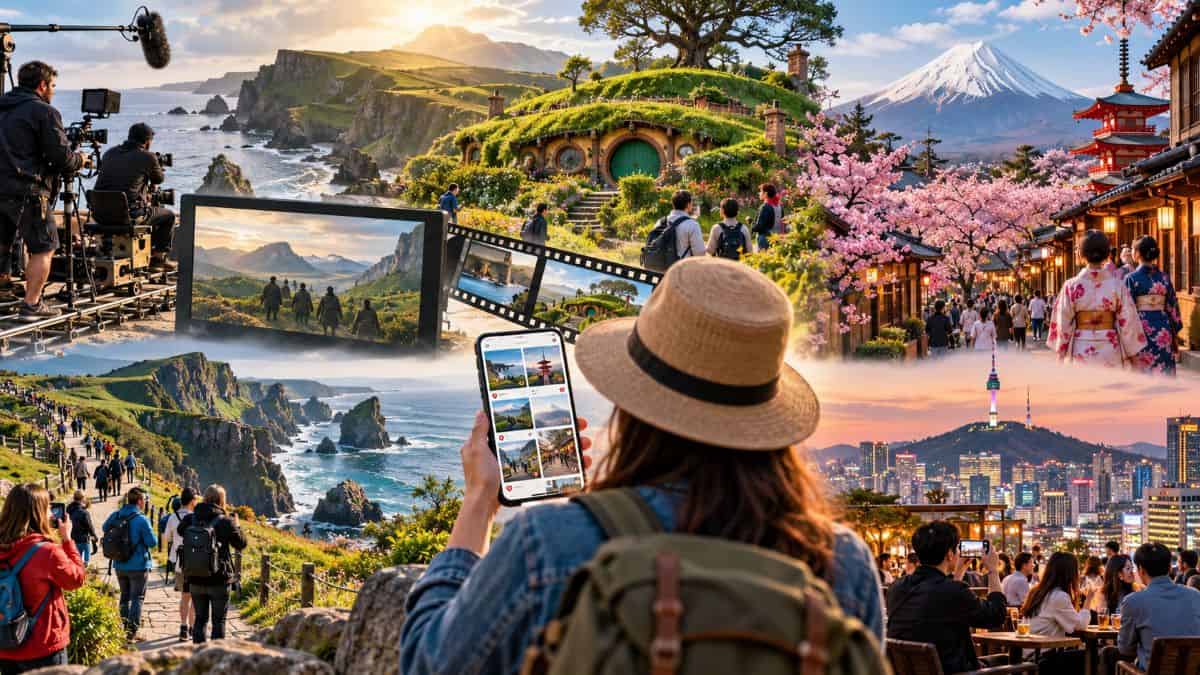
Image generated with Ai
Film and social media tourism are changing how travellers discover places, choose itineraries and decide where to spend money. From Northern Ireland’s Game of Thrones effect to New Zealand’s Lord of the Rings legacy, screen exposure can convert landscapes into recognisable travel products. Japan has taken the phenomenon further through anime and film-location tourism, while South Korea increasingly packages K-drama locations into visitor itineraries. At the same time, social platforms turn individual locations into visual trends through short videos, reviews and user-generated photographs. The result is a powerful discovery cycle. Screen exposure creates recognition, social media supplies validation, and physical travel completes the loop. For travellers, this means destinations can now emerge from entertainment as much as traditional tourism marketing.
When A Screen Becomes A Travel Invitation
The relationship between entertainment and tourism is not new. Academic research on movie-induced tourism has documented increased visitation after successful productions for decades, including evidence from 12 US locations. One influential study found that visitor increases continued for at least four years after certain films were released.
What has changed is the speed and scale of the process. A film once created awareness through cinemas, television and newspapers. Today, streaming services can expose a location to international audiences almost simultaneously. Travellers can then search the location, compare photographs, save itineraries and watch other visitors recreate the scene.
Recent research published in the Journal of Hospitality and Tourism Insights examined 404 Vietnamese film viewers. It found that film involvement influenced destination image and emotional responses, while user-generated content strengthened both cognitive and emotional destination perceptions. The research also identified a circular relationship between screen engagement, travel, emotional attachment and later content creation.
Advertisement
Advertisement
| Stage | What Happens | Traveller Effect |
|---|---|---|
| Screen Exposure | Film or series shows a location | Destination becomes recognisable |
| Emotional Connection | Viewers associate place with characters | Desire to experience it grows |
| Digital Search | Traveller searches locations online | Practical information becomes available |
| Social Validation | Visitors post photographs and videos | Destination appears accessible |
| Trip Planning | Maps, tours and accommodation are compared | Intent becomes a bookable journey |
| Physical Visit | Traveller reaches the location | Screen fantasy becomes experience |
| User Content | Traveller posts the experience | Destination receives another exposure cycle |
This creates a self-reinforcing destination loop that tourism boards increasingly seek to understand. The place does not simply receive publicity from entertainment. Visitors themselves become part of its continuing promotional machinery.
Northern Ireland Shows The Economic Multiplier
Northern Ireland offers one of the clearest documented examples of screen exposure becoming a tourism asset. Tourism Northern Ireland estimates that Game of Thrones helped attract about 350,000 out-of-state visitors in 2018. Those visitors generated more than £50 million in local spending.
Advertisement
Advertisement
The figures are particularly striking because the show did more than advertise scenery. Northern Ireland built a broader visitor ecosystem around filming locations, fan trails, exhibitions and themed experiences. Tourism NI says the production generated £251 million for the local economy across its ten-year filming period.
The destination also used audience behaviour to shape tourism promotion. Its Glass of Thrones campaign reached 87 million people and generated 8 million video views. Tourism NI estimated the campaign’s earned advertising value at £31.7 million.
Advertisement
Advertisement
The lesson for destinations is significant. A successful production creates the initial cultural recognition, but destination management determines whether that recognition becomes tourism revenue.
The Game of Thrones touring exhibition provides another useful indicator. More than 12,000 advance tickets sold within 24 hours for the 2013 exhibition. The 2014 edition generated about £735,000 in direct spending and an estimated £2.9 million in public-relations value.
| Northern Ireland Screen-Tourism Indicator | Documented Figure |
|---|---|
| Visitors linked to Game of Thrones in 2018 | 350,000 |
| Share of out-of-state leisure visitors | 1 in 6 |
| Visitor spending in 2018 | £50m+ |
| Wider production economic impact | £251m |
| Glass of Thrones campaign reach | 87m |
| Glass of Thrones video views | 8m |
| Earned advertising value | £31.7m |
| 2013 exhibition advance tickets sold | 12,000+ |
For travellers, this means a filming location can become more than a photo stop. It can develop into a structured tourism circuit with exhibitions, trails, guides and interpretation.
New Zealand Proves The Long Tail Matters
New Zealand demonstrates another dimension of screen tourism: longevity. The country has continued to benefit from the international recognition generated by The Lord of the Rings and The Hobbit films.
Advertisement
Advertisement
New Zealand’s Ministry of Business, Innovation and Employment reported that Tourism New Zealand estimated 16% of international visitors in 2015, or more than 500,000 people, initially considered a trip after exposure to The Hobbit Trilogy. Their estimated expenditure approached NZ$2 billion.
The same government assessment notes that Hobbiton became a stand-alone visitor enterprise. Before the pandemic, it attracted well over half a million visitors annually and supported around 250 jobs.
Yet the evidence also contains an important qualification. An earlier New Zealand government economic study found that the direct increase in total overseas visitor numbers attributable to The Lord of the Rings was less than 1%. This demonstrates why film-tourism claims need careful interpretation.
A film can strongly influence a particular group without being responsible for an entire country’s tourism growth. Correlation, motivation and total destination growth are not interchangeable measures.
That distinction matters for tourism professionals and readers alike. A successful screen franchise may influence travel decisions while operating alongside air connectivity, exchange rates, destination marketing, infrastructure and broader tourism trends.
Japan Turns Fandom Into Regional Discovery
Japan illustrates how entertainment-led travel can move beyond conventional film locations. Anime, manga and games have helped create what is often described as content tourism, including the practice known as seichi junrei, or pilgrimage to places associated with fictional works.
Advertisement
Advertisement
Japan’s tourism data provides a useful measure of this behaviour. The 2024 inbound visitor survey recorded 8.1% of visitors as having visited places connected with films or anime. A separate question found 11.8% said they wanted to undertake this activity on a future visit.
The distinction is important. The 11.8% figure does not mean that anime or film was the primary reason for every traveller’s trip. Instead, it identifies a sizeable pool of visitors expressing future interest in screen-related locations.
The progression is also notable. The share reporting visits to film- or anime-related places was around 4.6% in 2019, rising to 7.5% in 2023 and 8.1% in 2024.
That creates a strong regional-tourism opportunity. A fictional connection can give travellers a reason to visit a railway crossing, shopping street, coastal town or rural community that might otherwise remain outside an international itinerary.
For Japan, the value therefore extends beyond fandom. Content can function as a geographical distribution mechanism, encouraging travellers to move beyond the country’s most established urban gateways.
South Korea Packages The K-Drama Effect
South Korea offers another sophisticated model. The Korea Tourism Organization now curates dedicated itineraries around K-drama, film, K-pop and wider Hallyu content.
Advertisement
Advertisement
Official tourism material describes filming locations as increasingly popular tourist attractions. It promotes places connected with productions ranging from historical dramas to contemporary series, while combining filming locations with food, accommodation, cultural attractions and local experiences.
That packaging is important because a location alone does not necessarily create a sustainable visitor product. A successful itinerary needs transport information, opening hours, nearby attractions and reasons to stay longer.
Korea has also extended the idea beyond scripted drama. Official tourism content now highlights locations featured in dating reality programmes and entertainment shows. This indicates that screen tourism is expanding from cinema into an entire entertainment ecosystem.
A beach made famous through a music video, a restaurant appearing in a drama and a park shown in a reality programme can all become components of the same travel journey.
The strategy also helps distribute tourism geographically. Official K-content itineraries highlight destinations outside Seoul, including locations in Gyeongsangbuk-do, Jeollanam-do, Chungcheongnam-do and Gangwon-do.
Social Media Adds The Algorithmic Push
Film creates recognition, but social media increasingly determines what travellers notice next. A traveller may first see a location in a series, then encounter dozens of TikTok videos, Instagram photographs or YouTube guides before making a booking.
Advertisement
Advertisement
Platform research illustrates the scale of this influence. TikTok’s tourism playbook cites an Ipsos study of 3,000 users in Saudi Arabia from 2021. It reported that 64% of surveyed users had booked a trip after receiving inspiration from TikTok travel content.
The figure should be treated as platform-commissioned research, rather than a universal global benchmark. Nevertheless, it illustrates how inspiration can move rapidly from entertainment into travel consideration.
Academic research offers a broader explanation. A 2024 Tourism Management study examining social-media effects on rural destination image found that social-media affordances influenced both cognitive and emotional destination perceptions. Those perceptions subsequently contributed to travel-intention formation.
This is why user-generated content has become so valuable. Official tourism imagery tells travellers what a destination wants them to see. Traveller imagery shows what the destination looks like when someone actually experiences it.
Micro-Destinations Are The New Winners
One of the most consequential changes is the rise of the micro-destination. A tourism campaign may promote an entire city, but an algorithm can elevate one staircase, café, beach, bridge or railway crossing.
That can produce extraordinary visibility for small places. It can also create sudden visitor concentration in locations that were never designed for mass tourism.
Advertisement
Advertisement
Research into user-generated photographs shows why visual content matters. A systematic review of 106 academic studies found that traveller photographs influence destination-image perception, while researchers increasingly use large volumes of visual data to study visitor behaviour.
The traveller’s camera therefore becomes part of destination formation.
A visitor recreates a cinematic frame. Another traveller sees that recreation. The second visitor makes another version. Soon, the location has its own visual language.
The destination becomes recognisable because people repeatedly reproduce the same image.
The New Tourism Funnel Is Highly Visual
Traditional destination marketing often followed a relatively linear path. Authorities created campaigns, travellers discovered destinations, and travel companies converted interest into bookings.
The new model is more circular.
Advertisement
Advertisement
| Traditional Discovery | Emerging Discovery |
|---|---|
| Tourism advertisement | Film or streaming scene |
| Destination brochure | Short-form video |
| Professional photograph | Traveller-generated imagery |
| Tourism website | Search and social platforms |
| Planned campaign | Algorithmic amplification |
| Visitor feedback | Continuous public content |
| Destination promotion | Traveller-led co-creation |
This does not make tourism authorities irrelevant. Instead, it changes their role.
Destinations increasingly need to manage the ecosystem around attention. That includes location protection, transport, interpretation, visitor flows, local businesses, resident engagement and digital information.
Japan’s government research on content tourism has similarly emphasised resource creation, resident understanding, promotion, rights coordination and sustainable usage. The principle is straightforward: a media association becomes a tourism asset only when communities can manage it.
Travellers Need To Look Beyond The Viral Frame
For travellers, screen-led discovery can produce unusually focused itineraries. However, visitors should distinguish the famous frame from the complete destination.
A cinematic viewpoint may represent only a few seconds of a much larger place. Transport access, private-property rules, opening times, crowd conditions and photography restrictions can differ from what appears online.
Travellers should also verify whether a location is genuinely accessible. Some filming sites sit on private land, inside working businesses or beside operational transport infrastructure.
Advertisement
Advertisement
The best approach is to combine the screen reference with official tourism information. Check transport, opening hours and local rules before visiting, then explore nearby attractions rather than reproducing only one social-media image.
This can also spread spending more widely. A traveller who follows a filming location with a museum, local restaurant, neighbourhood walk or regional attraction contributes more to the destination economy than someone making a single photograph and leaving.
Why Some Screen Locations Fade Away
Not every successful film creates a tourism phenomenon. The strongest results usually depend on several conditions working together.
| Factor | Why It Matters |
|---|---|
| Global audience | Creates initial awareness |
| Emotional attachment | Gives travellers a reason to visit |
| Distinctive scenery | Makes the location memorable |
| Accessibility | Converts interest into actual visits |
| Tourism infrastructure | Supports longer stays |
| Social-media shareability | Extends visibility |
| Local businesses | Converts visits into economic value |
| Destination management | Controls crowding and protects assets |
| Community support | Improves long-term sustainability |
This helps explain why a spectacular location can remain relatively obscure while an ordinary street becomes internationally famous.
Visibility creates opportunity, not guaranteed tourism.
The latest research also warns against treating every film-related visitor as a direct economic gain. Some travellers would have visited the destination anyway. Others may visit briefly, spend little locally or concentrate within a single site.
Advertisement
Advertisement
For industry professionals, the real task is therefore measuring incremental impact rather than simply counting visitors.
The Traveller Is Now Part Of Marketing
The most important shift is perhaps the simplest. Travellers no longer consume destination imagery passively.
They reproduce it.
A visitor takes the photograph, posts the video, leaves the review and answers questions from future travellers. That content can remain searchable for years.
This transforms tourism into a form of participatory destination building. Film studios create the narrative trigger. Tourism authorities create infrastructure and interpretation. Platforms distribute the imagery. Travellers then create the next layer of visibility.
The process explains why screen tourism can remain relevant long after a production finishes filming. Northern Ireland continues to market its Game of Thrones legacy, while New Zealand retains a strong screen association decades after the original trilogy.
Advertisement
Advertisement
The emerging destination is therefore not simply a geographical place. It is a media-shaped mental image that travellers can physically enter.
The Screen-To-Trip Cycle Keeps Expanding
Film, streaming, social media and tourism are increasingly operating as one connected attention economy. A fictional scene can create recognition, social platforms can reinforce that recognition, and a tourism authority can turn the resulting interest into an itinerary.
The strongest destinations will not simply chase viral exposure. They will convert attention into meaningful visitor experiences, distribute spending, protect local communities and measure genuine economic impact.
For travellers, the change offers a richer way to plan. A favourite film can become the starting point, rather than the entire itinerary. The next tourism hotspot may not be discovered on a map first. It may appear on a screen, gather momentum online and only then become a place people feel compelled to see.
Advertisement
