
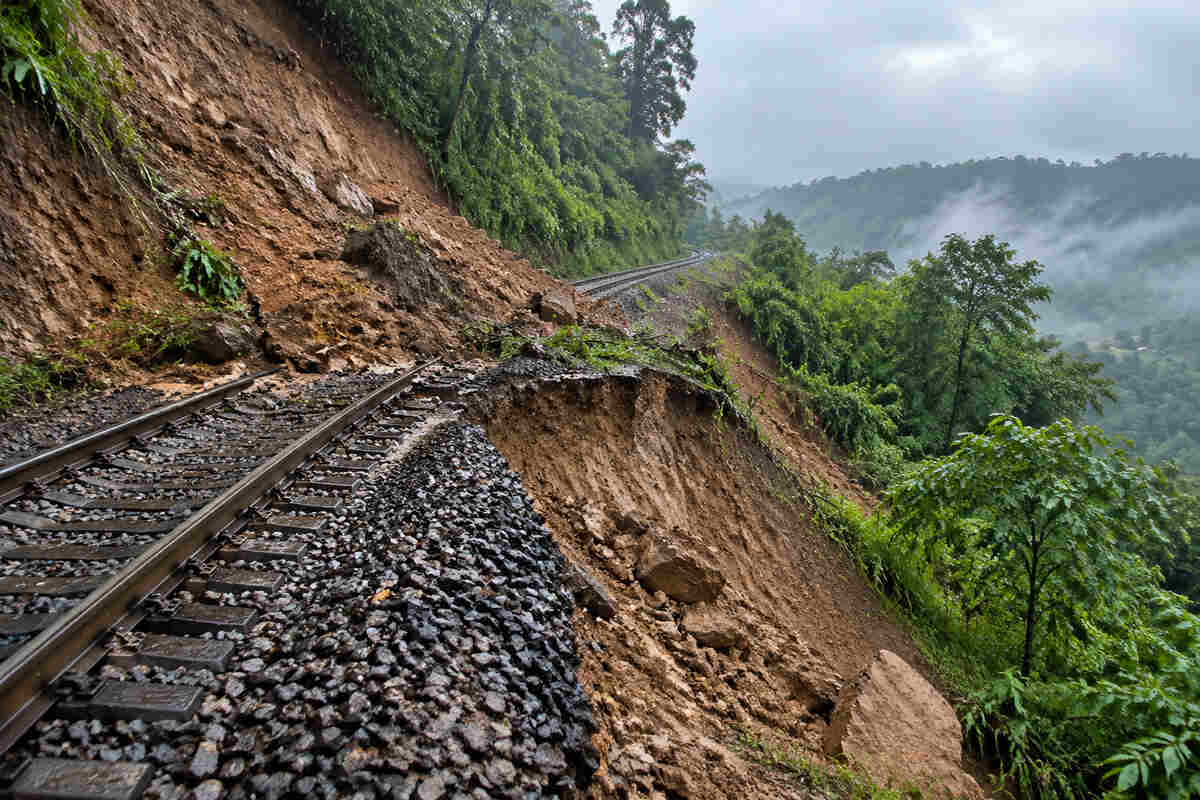
Image generated with Ai
Assam’s rail line has been severely impacted due to heavy rains and subsequent landslides in Hailakandi district that have damaged a major rail line to Mizoram. It also damaged about 50 meters of track between Jamira and Bairabi near the Assam-Mizoram border. It has enabled the authorities to stop movement of trains on safety grounds, and has also affected many passenger services between Assam and Mizoram, including canceling and relocating trains. Railway teams are working on the restoration. Meanwhile, the affected passengers are being taken care of. Normal scheduling of trains is expected to resume shortly.
The disruption followed persistent rainfall that caused severe soil erosion along the railway line between Jamira and Bairabi, close to the Assam-Mizoram border. Around 50 metres of the track section was affected, creating unsafe operating conditions for trains using the route.
Advertisement
Railway authorities suspended train movement through the damaged section as a safety precaution. Repair teams, engineering equipment and construction materials were immediately sent to the location as efforts began to stabilise the affected area and restore the railway line.
The Jamira-Bairabi section forms part of an important railway connection serving passengers travelling between southern Assam and Mizoram. The damage has therefore affected several services connecting Silchar, Bairabi, Sairang, Guwahati and Kolkata.
Advertisement
Continuous rainfall weakened the soil supporting the railway infrastructure, resulting in erosion across a stretch of approximately 50 metres.
Operating trains over an unstable track can pose serious safety risks. Railway authorities therefore stopped services through the affected section while engineers assess the damage and carry out restoration work.
Workers are continuing repairs with the aim of reopening the railway line once it is considered safe for passenger operations.
Passengers travelling on the Silchar-Bairabi passenger service were among the first to experience changes.
Advertisement
Advertisement
The train that operated before the disruption was terminated at Jamira instead of continuing towards Bairabi. The same train was scheduled to begin its return journey from Jamira rather than Bairabi.
Passengers whose journeys extended towards Bairabi were provided with alternative road transport arrangements.
The measure is intended to maintain some connectivity while direct rail operations remain unavailable across the damaged section.
Travellers using this corridor should therefore expect changes to normal boarding and arrival points until repair work is completed.
The disruption has also affected the Guwahati-Sairang service.
Instead of completing its scheduled journey towards Sairang, the train was terminated at Hailakandi. Operations between Hailakandi and Sairang were cancelled because trains could not safely pass through the damaged railway section.
This creates additional inconvenience for passengers travelling between Assam and Mizoram, particularly those relying on rail connections for long-distance journeys.
Passengers with onward travel arrangements may need to use road transport or modify their travel plans depending on railway service availability.
The landslide has resulted in multiple train cancellations across the affected network.
Services involving Bairabi-Silchar, Sairang-Kolkata and Silchar-Sairang have been cancelled because of the temporary closure of the Jamira-Bairabi section.
The cancellations demonstrate the wider impact of the track damage, as the affected route supports both regional passenger movements and longer-distance connectivity.
Passengers planning journeys through southern Assam and Mizoram are advised to verify their train status before travelling to stations.
Train schedules could continue to change depending on weather conditions and the progress of repair work.
Railway authorities have introduced several measures to support passengers affected by the disruption.
Drinking water and light refreshments have been arranged at Jamira, Bairabi and Sairang stations for travellers facing extended waiting periods or interrupted journeys.
Passenger assistance centres have also been established at several railway stations, including Guwahati, Lumding, Naharlagun, Badarpur and Sairang.
These centres are providing information about cancelled and modified train services. They are also assisting passengers with ticket-related enquiries and other travel requirements resulting from the disruption.
The support measures are especially important for passengers who may need to reorganise connecting journeys after trains have been terminated before their scheduled destinations.
Restoration work is continuing at the damaged Jamira-Bairabi section.
Railway engineering teams are working to repair the eroded portion of the track and strengthen the surrounding railway formation before normal train operations can resume.
Repairing a rain-damaged railway section requires careful inspection because the ground beneath and around the track must be stable enough to support trains safely.
Equipment and construction material have already reached the site, allowing restoration teams to continue work without interruption.
However, the reopening of the railway line will depend on the condition of the damaged section and whether further rainfall affects the repair process.
Passengers planning journeys involving Silchar, Bairabi, Sairang, Hailakandi or other stations connected with the affected route should check the latest train status before beginning their journey.
Travellers should also allow additional time if they need to transfer between rail and road transport.
Those holding tickets for cancelled services may need assistance with alternative travel arrangements or ticket procedures. Railway assistance centres operating at major stations can provide information while disruption continues.
Passengers travelling with children, elderly family members or significant luggage should be particularly prepared for possible route changes.
Heavy rainfall can make railway restoration more difficult because saturated soil may continue shifting even after the visible damage has been repaired.
Engineering teams must therefore ensure that the track foundation is stable before passenger trains are permitted to return.
Safety inspections are expected to remain a central part of the restoration process.
Until authorities determine that the Jamira-Bairabi railway section is safe for operations, passengers should expect temporary cancellations, shortened services and possible replacement road transport.
The railway network remains under close observation as repair work progresses.
For travellers between Assam and Mizoram, the disruption means additional journey planning will be necessary in the short term. Normal rail operations are expected to resume only after the damaged track has been repaired and cleared for safe train movement.
Advertisement
Advertisement
Advertisement













Saturday, September 5, 2026

Friday, September 4, 2026

Saturday, September 5, 2026

Saturday, September 5, 2026

Thursday, September 3, 2026

Wednesday, September 2, 2026

Saturday, September 5, 2026



